Batman by Doug Moench and Kelley Jones Volume 1

Batman by Doug Moench and Kelley Jones Volume 1

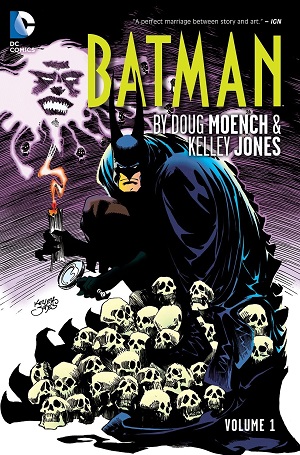
The title as I read it is just Batman. But this book is usually said to be Batman by Doug Moench and Kelley Jones Volume 1 because how many thousands of Batman books are there now?

The extended title does signal the importance of the writer (Moench) and artist (Jones) for this particular run of Batman. These are two big names who were at this time (1995-96) at the top of their game. Of the two though I would rate Jones as the more important. He has a remarkable ability to indulge cartoonish caricature and wildly exaggerated forms (Batman’s cape here is a giant life form all its own, while the “ears” on his hood must jut out a couple of feet over his head) without being ridiculous. Some of the faces of secondary characters look like they belong in MAD Magazine, and the Batmobile is sometimes a silly bubble car that I couldn’t even imagine Batman getting into, but none of this is laughable. It’s all part of an insane, dark, and grotesque world.

Collected here are Batman issues #515-535 (excepting #520, 526, and 533-34). Coming right after the epic Knightfall story arc there was a switch to what are mainly double-issue stories, and I think this probably struck most readers as a bit of a relief. The central stories deal with Batman facing off against the usual suspects. Killer Croc escapes from New Arkham so he can retire to the bayou with Swamp Thing. Scarecrow escapes from New Arkham and goes after the jocks who tormented him in highschool. Mr. Freeze is actually released from New Arkham following a “positive psychological review” (ha-ha!). Two-Face escapes from New Arkham and goes on a justice tour. Batman springs Poison Ivy from New Arkham so she can help fight a killer plague.

Don’t know about you, but I’m starting to think New Arkham isn’t any more secure a facility than Old Arkham.

None of these stories struck me as all that impressive. Instead, the two I liked the best were an early one featuring a new villainess named the Sleeper who was the subject of a military intelligence sleep-deprivation experiment and the final story which introduces us to the Ogre and his brother Ape, subjects of a military intelligence bioengineering experiment. Both the Sleeper and the Ogre are on missions of revenge, killing the doctors who tormented them. That these stories stood out as the best may say something about how played-out the veteran supervillains are, or just be an example of Moench enjoying a free hand. But then the long story involving Batman and Deadman heading off to Peru to fight a gang of neo-Conquistadores alongside a mummy cult didn’t work for me at all. Oh well, You have to expect a lot of ups and downs in a series like this.

As a footnote, there’s a reference in the Ogre issue to Poe’s “The Murders in the Rue Morgue,” which is said to be “the story of a man who increased the intelligence of an ape . . . and who used that ape to commit murder.” Maybe this is how Moench remembers it, or maybe he’d only heard of the story, but this is so far from what happens in “The Murders in the Rue Morgue” that it took me by surprise. There are editors too who proofread comics and it’s hard to believe nobody caught such a mistake. Or is it that so few people still know these things?

Graphicalex

Marvel Zombies: Dawn of Decay

Marvel Zombies: Dawn of Decay

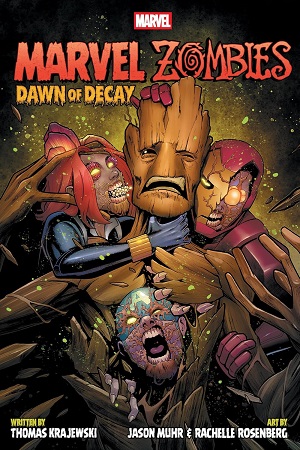
For starters, it’s a lousy title. This four-part series isn’t part of the Marvel Zombies universe but instead deals with a bio-plague that turns people into homicidal plant creatures. Pansies and rosettes for eyes, bark and fungal growth breaking out over their skin, that sort of thing. Plus they go around biting people, which is the way thing the virus spreads. Though I don’t think anyone gets eaten.

Second, it isn’t clear that this is “decay.” The infected haven’t died and in fact they can even be cured and turned back to normal at the end.

So not zombies. Just zombie-adjacent. Sort of like the Contagion storyline in that respect.

Groot and Rocket of the Guardians of the Galaxy are in superhero prison before being let out by the Avengers. It seems Rocket was up to his usual Rocket stuff but everything is OK aside from the fact that Groot now has a case of the sniffles. On the jet back home though Groot sneezes on Captain America, which instantly has the effect of turning him into one of the aforementioned plant zombies. And Cap then infects Black Widow, Ant-Man, Thor, and Iron Man before Groot bails from the jet with Bruce Banner. Practically by the time they hit the ground all of NYC has been turned into plant zombies and Banner figures the only way to stop the plague is to get to the Avengers HQ where he can find a cure in the lab. The only problem is that in order to cross the city and get there he will have to turn into the Hulk (who, along with Groot, is immune to the virus). And the Hulk doesn’t want to find a cure, he just wants to smash.

That’s all there is to it, and even though there’s a lot of fighting between Groot and the Hulk on one side and the zombified Avengers on the other, the real conflict is between Groot and the Hulk. As noted, the Hulk doesn’t care about the mission and he gets really sick of listening to the stick man keep saying “I am Groot.” Something I can certainly relate to.

If you like the primitive comic banter that goes on between two characters so limited in their speech then you might have a good time. But even at only four issues I wouldn’t have wanted any more of it. And I say that despite how rushed the ending felt to me. There’s a twist I won’t get into, but the main thing is that they need to find a cure and then they just get one by accident. I actually had to go back and read it again to understand what happened.

I would say this might pass muster for zombie fans, but actually they may be the least impressed by it. There’s less gore and horror, for one thing, because they were targeting a younger audience. But more than that, I found the story too simple and the characters too flat and uninteresting to care very much about it.

Graphicalex

Archer: The Galton Case

Ten years or so ago I did a review of a book called What We See When We Read by Peter Mendelsund, which is all about what the title indicates. Mendelsund makes the case that reading only provides fragments that our imaginations have to fill in. If I recall correctly one example he uses is what Anna Karenina looks like. You might say Greta Garbo, Vivien Leigh, or Keira Knightley, but that’s allowing for the influence of a more visual medium. When reading any text our response as readers is to create a “readerly vision” more grounded in personal associations and what we find significant. It’s a bit like reading a sentence with all the vowels left out and still having no trouble reconstructing what all the words say because our brains just automatically fill in the blanks. We don’t see what’s missing.

I think this is a profound idea. All reading involves a kind of skimming, and if we can’t say after we’re finished reading the book anything about Anna Karenina’s appearance, that’s because our brains have inserted a filler into that place in the text, or else we skip over it as not being that important.

What made me think of this while re-reading The Galton Case after many years was that there were a number of places in the opening pages where I caught myself doing this same skimming. Detective Lew Archer enters a lawyer’s office where a secretary sits behind a desk that has “a bowl full of floating begonias” on it. Normally I’d just pass over this bit of detail but for some reason I stopped and asked myself if knew what a begonia actually looks like. I realized I did not. So I went online and found out that there are many different kinds of begonias, varying widely in their appearance. This is not a flower I would have any confidence I’d be able to identify.

Later in the same paragraph Archer takes a seat in a “Harvard chair.” Again I paused. Was this a particular kind of chair? Apparently it is, being a style of armchair with a deep seat and railed back and arms. An official Harvard chair would also have the university’s seal. They were used in Harvard’s dining hall back in the day.

A couple of pages later we find Archer proceeding along a “black-and-white terrazzo corridor.” I just assumed a black-and-white pattern of tiling, but then stopped myself as I had with the begonias. What does terrazzo look like? So I looked this up as well and it wasn’t what I had thought at all. Terrazzo is a kind of flooring with chips of marble, quartz, granite or glass floating in a polished cement, polymer, or concrete binding.

Now I’m sure many readers, and indeed many people reading this, will know all of these, or at least two out of the three. But if I’d just been in my normal reading mode I would have only registered that Archer saw a flower on a desk, sat in a chair, and then walked down a corridor with some kind of black-and-white pattern in the flooring. I would have been skimming. And if you’d asked me what I saw when I was reading, the answer would have been far less than the information given.

On to the book. By which I mean not these details, but the story. Which itself displays a bias toward plot and against décor.

Macdonald himself considered The Galton Case to be his first complete Archer novel, figuring it had taken him a dozen years to get to this point. Which sounds about right, but also says something, and by that I mean nothing good, about how today we expect artists’ careers to be front-loaded. If you don’t have a hit with your first or second album, novel, or movie then it’s pretty much not going to happen for you. This is not the way it works, at least in most cases. It takes a while for someone to hit their stride. Faulkner, for example, didn’t give up after Soldier’s Pay and Mosquitos. I don’t think our current acceleration of the process does anyone any favours, but there you have it.

Anyway, Macdonald may have been more comfortable but he also wasn’t breaking much new ground here. Once again we start with Archer making a visit to some stately Californian mansion where the Grande Dame hires him to find a missing person. Money is no object, as “the Galton household had hot and cold running money piped in from an inexhaustible reservoir.” Meaning oil money, I believe. His investigation involves Archer wading through some tortured family history (“Nothing is lost in the universe”), fighting in a mostly friendly way with the law, and getting the crap beaten out of him by some bad guys who aren’t that important to what’s really going on. All of which was par for the course in an Archer novel by this point.

Stylistically there are the usual purple flourishes that rarely feel out of place. OK, the tires of a car that “shuddered and screeched like lost souls under punishment” is too much, but that’s an example of one that stood out. Better is the desk clerk at a seedy hotel who “had large sorrowful eyes and a very flexible manner, as if he had been run through all the wringers of circumstance.” I miss those desk clerks. But then, I’m not often in those sorts of hotels anymore.

I’m not sure I buy all the coincidences in the plot that leave young John Galton right where he’s supposed to be in the end. More than that though, I didn’t care for the moral lens that Archer brings to the case. In the first place we get the harsh treatment of Gordon Sable. “You surprise me, Lew,” Sable tells him at the end. “I didn’t expect you to bear down so hard. You have a reputation for tempering the wind to the shorn lamb.” Now to be sure Sable is no angel. He’s one of those compromised older men with a young wife/lover, like Graves in The Moving Target. But in his defence, the guy has been through a lot, and the people he was dealing with were worse.

I just wrote “defence,” which is the Canadian spelling. This makes for the big giveaway clue here, as Galton Junior is revealed to be Canadian by his spelling of “labour.” I got a smile out of that. Macdonald himself was born in the U.S. but raised in Canada and his wife was Canadian. This is one reason people have seen a connection between Macdonald and Galton, and in fact he did admit to some autobiographical elements being present. Which leads me to the second part of the moral judging I mentioned. If Archer bears down hard on Sable he seems to let Galton off the hook a little too easily for my liking. Whatever the facts of the case at the end, Galton is a nasty little schemer, a violent drunk and guilty of at least manslaughter (and probably worse). But he ends up winning the lottery, getting both the money and the girl. Will he “take good care of her,” as Archer wishes? I don’t see any reason to be hopeful. This is a young man on the make. If there’s any justice it’s in the hints dropped earlier about how “money was never free” and the walls of a big estate can be like a prison. I don’t think that bothers John at all though.

Archer index
To infinity, and beyond

Reading A Dark Knight in Aurora I came across this description of the “Ultraception symbol” that mass murderer James Holmes invented. The Ultraception takes the form of “a circle enclosing an infinity symbol (called a lemniscate) that touches both sides, with a seriffed numeral ‘1’ through the middle.”

The word lemniscate (which, I note in passing, WordPress spellcheck does not recognize) comes from the Latin for a ribbon, or decorated with ribbons, and it derives from a Greek word meaning the same. Now if you’re a mathematician, which I am not, you’ll know that lemniscate has a more technical meaning, referring to a figure-eight shaped curve whose equation in polar coordinates is ρ2=a2 cos 2θ or ρ2=a2 sin 2θ. I gather from the Internet that there are different kinds of lemniscates named after different mathematicians. But I don’t know anything about that. I just thought it interesting that there’s a word for the infinity symbol, which is basically a figure eight turned on its side. That’s something I didn’t know.

Words, words, words

American Vampire Book One

American Vampire Book One

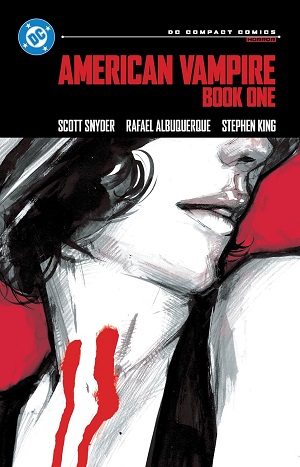
This is a comic that really impressed me. Writer Scott Snyder (with some help from Stephen King) and artist Rafael Albuquerque actually took the tired vampire trope and made something that felt fresh and interesting out of it. This is a challenge that comic writers and artists are always being tasked with – how can you tell a “new” Batman or Spider-Man story? – and it’s something they probably don’t get enough credit for.

So the idea here is that vampires are a species of predator that has arrived in the New World (that would be America), not just to feed on people (“Americans are only food, like the great slabs of cow they shovel down their throats!”) but to get rich. These vampires are nasty, rich, decadent types hailing from Britain, France, Russia, and other parts of the continent. Because they live forever they can invest for the long term and basically they form a cabal of hypercapitalists in the late nineteenth and early twentieth century.

A run in with a deadly gunslinger named Skinner Sweet sends the vampire bloodline off on a tangent though. Sweet is infected by one of the European vampires just as he’s being killed, which means he comes back from the dead as a vampire himself. But not just any vampire but a new-and-improved American vampire. Which means, among other things, that he has a greater tolerance for sunlight. Then Sweet brings Pearl Jones, a young woman hoping to make her way in Hollywood, back as a vampire after she’s killed by the same crew of Eurotrash in the 1920s. After she “rises” Sweet explains what’s happened to her as a kind of evolution: European vampires are, “in automotive terms . . . like old, broken-down European clunkers” while Skinner and Pearl are “like shiny new 1926 Fords. Top of the line, just rolled out onto the showroom floor. See sometimes, when the blood hits someone new, from somewhere new . . . it makes something new. With a whole new bag of tricks.”

These bloodlines keep branching off (it’s surprisingly easy to get infected by vampire blood and so turn into one), but Skinner Sweet, Pearl Jones, and Jones’s (former) BFF Hattie Hargrove are the main recurring American vampires. Only they don’t work together unless they’re forced to since they all hate each other. And there are other people/vampires involved as well, and they in turn have descendants as the story proceeds to work its way through several decades of American history.

To be honest, at times I did feel a little lost keeping up with who was who and when we were. Part of the problem might have been that I was reading a collection of issues #1-11 in one of DC’s “compact comics” editions. These are at least more reasonably priced (comics and graphic novels have become very expensive) but you do lose something in the smaller format. But I also think the story jerked around a bit too much and was hard to follow in places. Not enough to stop me having a great time with it though.

Graphicalex

Wimsey: The Fantastic Horror of the Cat in the Bag

Feline lovers relax, there is no cat in a bag. It’s just a woman’s head.

This was a very silly story, full of coincidences and not much actual detective work. It even kicks off with a motorcycle race, and Lord Peter in his roadster is bringing up the rear. The first man in the motorcycle is looking to get away from the bag with a head in it. The second motorcyclist is trying to return the bag with the head in it. And Lord Peter thinks the bag contains some of his mother’s stolen jewels and not a head.

I assume Sayers meant it all as a joke, and taken in that spirit it works pretty well. Plus it made me look up what a charabanc is, as I’d forgotten. I swear I once knew, but that was a while ago and the word isn’t used much anymore. Apparently it’s pronounced “sharra-bang” in England and called a “charra” in Wales.

Wimsey index

Running with the Hound

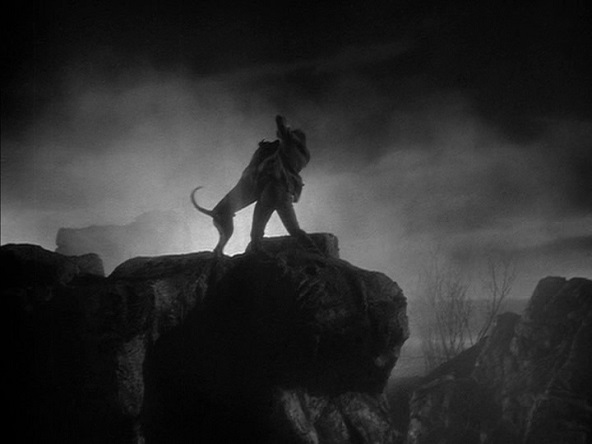
Over at Alex on Film I’ve just posted my notes on another adaptation of the Sherlock Holmes story The Hound of the Baskervilles. There have been many versions of The Hound over the years so I thought I’d provide this page as an index to some of them.

First off, here’s a link to my thoughts on Conan Doyle’s book.

Then here’s a link to a graphic novel adaptation, and here’s one to a pop-up version.

Now on to the movies:

Der Hund von Baskerville (1914)
Der Hund von Baskerville (1929)
Der Hund von Baskerville (1937)
The Hound of the Baskervilles (1939)
The Hound of the Baskervilles (1959)
The Hound of the Baskervilles (1978)
The Hound of the Baskervilles (1983)
The Hound of the Baskervilles (2000)

As always, you can find my index to reviews of the Holmes canon here, and Holmes on film here.

Drew: The Hidden Staircase

The second Nancy Drew mystery, and one that was again extensively revised from its 1930 version for republication in 1959. And I do mean extensively. If you read a comparison of the two books you’ll see how not just the characters’ names but most of the plot has been changed. Mildred Benson, writing under the pseudonym Carolyn Keene, considered this to be a personal favourite books but I don’t think I can make any comment on that since the book she wrote wasn’t the one I was reading.

As things kick off it seems as though there are two mysteries in play: a couple of old ladies (Helen Corning’s great-grandmother and great-aunt) are living in a mansion that seems to be haunted while Nancy’s lawyer father is involved in a real estate deal that is coming undone in ways that are too complicated to explain (and that I’m not sure make any sense). Is there a connection? Of course there’s a connection. But it will take a while before things can be sorted out.

Nancy herself is feisty, fearless, and formidable. You don’t mess with this girl. If she sees a suspicious man (a man with an “athletic build” and cauliflower ear) checking out where she’s parked her car in an isolated field she takes off chasing him! Her friend Helen may be nervous about ghosts, or about ancient passageways crumbling down upon them, but Nancy just charges and barges ahead. And all this unarmed! In the 1930 version she’s packing a revolver, but here she only has a flashlight. When the police tell her she’ll never break the witnesses they have in custody she wins them over in mere seconds. There’s really no stopping her. And when it comes to noticing things she’s more machine than detective. I had to wonder, reading this passage, if she was perhaps being ironic. But I don’t think so.

“What did he look like?” Nancy asked.

The officer described the man as being in his early fifties, short, and rather heavy-set. He had shifty pale-blue eyes.

“Well,” Nancy replied, “I can think of several men who would fit that description. Did he have any outstanding characteristics?”

“Harry didn’t notice anything, except that the fellow’s hands didn’t look like as if he did any kind of physical work. The taximan said they were kind of soft and pudgy.”

“Well, that eliminates all the man I know who are short, heavy-set and have pale-blue eyes. None of them has hands like that.”

“It’ll be a good identifying feature,” the police officer remarked.

Maybe people noticed soft hands more 80 years ago. It’s certainly the case that today you wouldn’t feel a radio “to see if it were even slightly warm to prove it had been in use.” (“The music wasn’t being played on this,” she determines, “finding the radio cool.”) And how many teenagers today would be able to use a buttonhook even for its intended use, much less to open a secret wooden panel in the ceiling? I had to look up what a buttonhook was.

I shouldn’t be too hard on the Nancy Drew novels. After all, they’re YA fiction, directed primarily at girls, and written very much on an assembly line. Just as the end of almost chapter gives us a cliffhanger, so the end of each book hooks you into the next in the series, the title of which is already helpfully provided.

That said, aside from the historical interest I have to register that I don’t care for them very much. The plot in this one anyway I found hard to follow, with far too many secondary characters and the legal stuff, as in The Secret of the Old Clock, just a lot of fudge. More than that though, the writing struck me as lazy. To take just one example, on page 101 Nancy is referred to as “the young sleuth.” She’s called this again on page 103. On page 109 she’s “the young detective” and on 112 she’s the young sleuth again. And she’s the young sleuth again on pages 117 and 119. This list isn’t meant to be exhaustive, even for these twenty pages, as I know I’m missing some. But you get the point.

So these books are interesting as cultural touchstones. And I also found something compelling in the family dynamics at play. The housekeeper Hannah Gruen is usually presented as a kind of surrogate mother figure, but most of the time Nancy herself seems to be her father’s partner. It has a bit of the air of Haworth Parsonage about it. But even that doesn’t make me eager to read a lot more.

Drew index

Something is Killing the Children Volume One

Something is Killing the Children Volume One

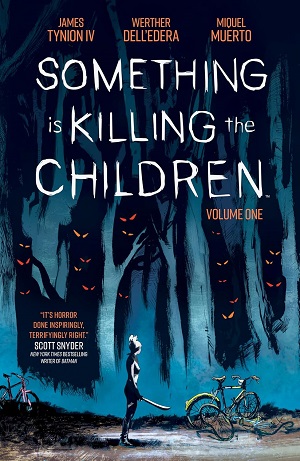
An adult fairy tale? In the town of Archer’s Peak children are disappearing or being murdered in horrible ways. As the coroner puts it, “there’s some scary shit at work.” It seems the woods are full of monsters. These monsters are only visible to kids though, who are also the monsters’ only target or food of choice.

A kid named James survives one monster attack, though he’s traumatized after seeing three of his friends being sliced and diced. Help, however, is on the way in the form of Erica Slaughter, a monster-hunting ninja chick with a stylish ‘do and a backpack full of weapons. Erica is sent by a mystical council (the dragon-slaying Order of St. George) to Archer’s Peak so that she can put an end to this latest monster outbreak. To do so she’ll need some help from James and the strange spirit/familiar in her stuffed octopus.

As I say, it plays out much like a fairy tale. The monsters might as well be hiding under the bed as being in the woods. And I suppose it’s all an allegory about growing up, feeling vulnerable and not being taken seriously. It got a good reception, perhaps because of the gay angle thrown in. James is gay so he’s even more vulnerable and isolated. I didn’t see this as being enough to keep things fresh though. A punk riot grrrl heroine teaming up with a gay boy didn’t strike me as anything new, or interesting, especially in 2019 (when the series started). That writer James Tynion IV was drawing on personal experience didn’t add anything either. Everything about the story seemed stale. I’ll probably stick with it for a while though in the hope that things turn around.

Graphicalex

Holmes: The Late Sherlock Holmes

A fun squib by Peter Pan author J. M. Barrie. Barrie was a friend of Conan Doyle and, as with the other Holmes parodies he penned, “The Late Sherlock Holmes” has the flavour of a shared joke.

The story takes the form of a breathless newspaper report on the death of the great detective, with Dr. Watson being arrested for murder after the events at Reichenbach Falls described (from Watson’s own point of view, of course) in “The Final Problem.” Drawing on the evidence presented in that story, which is heightened for humorous effect, the report makes the case for why Watson may have wanted to do away with his famous former companion. “Latterly,” we’re told, the two men “have not been on friendly terms, Holmes having complained frequently that whatever he did the other took credit for.”

On the other hand, the suspected accomplice [Watson] has been heard to say “that Holmes has been getting too uppish for anything,” that he “could do very well without Holmes now,” that he “has had quite enough of Holmes,” that he is “sick of the braggart’s name,” and even that “if the public kept shouting for more Holmes he would kill him in self-defence.”

Then the screw gets turned a little further as Barrie plays on Doyle’s own desire to do away with Holmes, introducing the author himself into the story as a “dark horse” candidate for Watson’s accomplice. And if you’re a real Holmes aficionado you’ll like the reference to the Ardlamont murder case, the trial for which took place the same year, 1893, that this story was first (anonymously) published. One of the expert witnesses at the Ardlamont trial was Dr. Joseph Bell, the man who inspired the character of Sherlock Holmes.

Holmes index