The Avengers: Earth’s Mightiest Heroes
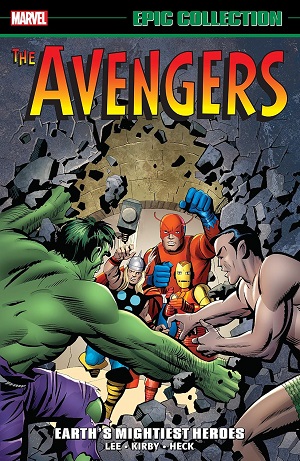 This first Avengers Epic Collection volume reproduces Avengers #1-20, published from 1963 to 1965. So let’s return to the heady days when Iron Man had all-yellow armour that rusted in the rain, Thor turned back into Doctor Don Blake if he lost contact with his magic Uru hammer for more than 60 seconds, the Wasp was swooning like a lovesick schoolgirl over every hunky hero she met (even Kang the Conqueror turns her head: “I’ll be he’s not bad-looking under that silly headgear he’s wearing!”), and the Hulk actually had hair on his chest. (You win a special trivia prize is you named Hulk as one of the original Avengers, because he didn’t stay on the roster for long). We’ll also return to the days of Rick Jones and the Teen Brigade, a bunch of Marvel superfans who don’t really do much of anything but sometimes get in trouble and need rescuing. And since this was the Cold War, we’ll return to the repressive communist Asian state of Sin-Cong and its brutal warlord leader the Commissar. This particular issue came out in 1965, naturally, and Quicksilver’s questioning of American involvement is prescient: “I thought our purpose was to battle crime! Why need we concern ourselves with international affairs?” Captain America, however, overrules him: “We’re supposed to avenge injustice, right? Well, when liberty’s threatened, justice goes down the drain! That’s it in a nutshell!” And so what would have been a timely debate on American foreign policy is nipped in the bud.
All the comics here were written by Stan Lee and illustrated first by Jack Kirby and then by Don Heck. Lee was in full carnival barker mode. Here’s some bumf from the covers and title pages: “This is the issue you’ve been waiting for!! One of the greatest battles of all time!!” (#3), “A tale destined to become a magnificent milestone in the Marvel Age of comics! Bringing you the great superhero which your wonderful avalanche of fan mail demanded!” (#4), “Caution!! Don’t tear this magazine or wrinkle the pages or get food stains on it! We have a hunch you’ll want to save it as a collector’s item for a long, long time!” (#6), “The Mighty Avengers Meet Spider-Man! And the only blurb we can write is ‘Wowee!’” (#11), “A Marvel tale of most compelling excellence!” (#12), “You’ll gasp in amazement at the most unexpected final panel you’ve ever seen!” (#13), “Possibly the most memorable illustrated story you will read all year!” (#16).
Did the comics deliver? I think so. Once the barker had drawn you in he did a good job presenting a three-ring circus of action. The plots here are madcap. I’ll just break down one issue (#14) as an example. Are you buckled in? Here goes:
This issue begins with the Avengers racing to get the Wasp to a hospital because she’d been struck by a bullet at the end of the previous comic (in case you were wondering, that was “the most unexpected final panel you’ve ever seen!”). At the hospital they’re told that her lungs will collapse in 48 hours unless she’s operated on by a Norwegian lung-restoration specialist named Doctor Svenson. Since Thor is the only one who “can span the ocean in minutes” he flies off to Norway, tears the doctor, protesting, out of his lab, and flies him back the U.S. At the hospital, however, it’s discovered that the doctor is actually an alien, and when his mask is pulled off he dies because he can’t breathe Earth’s oxygen.
Consternation! The Avengers now have to search the entire planet for the aliens who abducted Doctor Svenson and replaced him. They figure this will take them eight hours. After this time has expired they haven’t found anything, but absence of evidence is not evidence of absence. Obviously the aliens must be hiding out in one of the uninhabited parts of the globe, which they quickly reason must mean either the North or South Pole. Thor sticks his hammer out the window of the Avengers’ jet and it points to the North Pole, so that’s where they head next.
Landing at the North Pole they start digging through the ice and end up falling into a giant subterranean alien city (the North Pole apparently being solid land underneath the ice). The aliens capture them by hitting them with a paralyzing ray. This forces them to stand immobile while Kallu, the leader of the Kallusians, explains how they came to Earth fleeing a more warlike group of aliens. Because the Kallusians can’t breathe Earth’s atmosphere they kidnapped Dr. Svenson, who designed masks that allowed them to deal with our air. Thor then jumps on Kallu (he’d only been feigning being paralyzed since the ray doesn’t work on immortals, you see) and the Avengers break free and there is a big fight (“And so, the inevitable battle begins . . .”). The action is interrupted though when Dr. Svenson shows up and agrees to help the Avengers, while at the same time the bad aliens, with their “robot detectors,” discover where the Kallusians have been hiding (it’s hard not to think that The Empire Strikes Back stole something from this part), forcing the Kallusians to scramble their battle fleet and head into space. Dr. Svenson successfully operates on Jan (the Wasp), and the Watcher makes an appearance to say that he’s been observing all of this and won’t make any comment other than to say that “the power of prayer is still the greatest ever known in this endless, eternal universe!”
That’s a lot of plot in only19 pages of comic, especially with all the time spent running around and fighting.
There are things here that would continue to be of importance with the Avengers, no matter what form their changing line-up took. In particular the way that in-fighting and personal squabbles would be as greater or even a greater threat than any supervillain. It’s also refreshing to see heroes who aren’t quite so powerful. Iron Man being hit with an “emery dust pellet,” for example, causes his joints to stiffen. And Captain America is frequently disparaged as someone with no super powers at all. He’s basically just an athletic gymnast who knows how to fight. And when the Swordsman shows up in the final two issues he’s no different except that he has a sword instead of a shield. And still it takes the Avengers two comics to defeat him, and even then he mostly gives up because he doesn’t want to fight alongside the Mandarin.
Some examples of understatement are surprising sixty years later. Baron Zemo is built up as Captain America’s arch-nemesis, with Cap chasing after him to avenge the death of Bucky Barnes. But when he finally manages to kill him (by tricking Zemo into causing an avalanche that buries him, so Cap hasn’t killed him directly) it’s presented in a couple of tiny panels and almost seems like an afterthought. Today a moment like that would be given epic treatment.
The one thing I’m really glad they got rid of was the character of Rick Jones. He’s a completely useless tag-along who starts out riding on the Hulk and later is adopted by Captain America. And he even gets snippy about it. When Cap comes back from South America with Rick in tow, he (Captain America) is greeted by the other Avengers as a returning hero while Rick sulks in the background, muttering “And what am I – a fever blister?” I doubt he’d even rate that high. But somehow he thinks he’s going to be a real Avenger someday. When Hawkeye, Scarlet Witch, and Quicksilver join the team he’s still sulking in the background, thinking to himself “It isn’t fair! Those three Johnny-come-latelies are now official members and Cap still won’t let me be a full-fledged uniformed Avenger!” No mention of what Rick can do, but he wants a uniform and a membership card anyway. Maybe kids reading the comic were meant to identify with him, but I don’t think that’s likely. He’s just too big a wimp. Marvel would later give in and award him a power-up, but here in the early days he’s hard to take.
Graphicalex
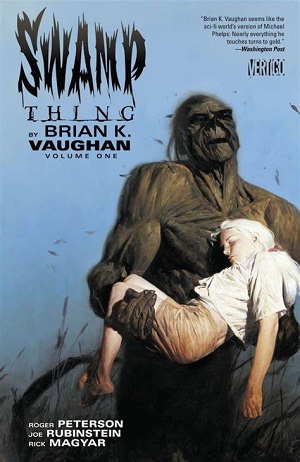 It’s called Swamp Thing but that character (the transformed Alec Holland) only briefly appears a couple of times, once in a flashback. Instead this is the Daughter of Swamp Thing, a teenage girl named Tefé, who has come about through – here I take a deep breath – Swampy temporarily possessing the body of John Constantine and having sex with his (Swampy’s) wife Abby and impregnating her with an elemental spirit known as the Sprout. After she’s born, Tefé inhabits the body of a girl named Mary Conway, who was terminally ill. Tefé loses her memory of being the Sprout when she becomes Mary, but it all comes back to her when she gets angry, leading to her shedding the body of Mary and being reborn as the platinum-haired Tefé Holland. With her hair she’s supposed to look like her mom Abby but I kept being reminded of Sabrina the Teenage Witch. She even operates a bit like a witch, as her super powers involve casting what amount to plant-based spells that kill or incapacitate people. In any event, now conscious of her powers she starts crisscrossing the U.S. having various adventures while different people (federal agents, a samurai-style killer from the Green) try to hunt her down.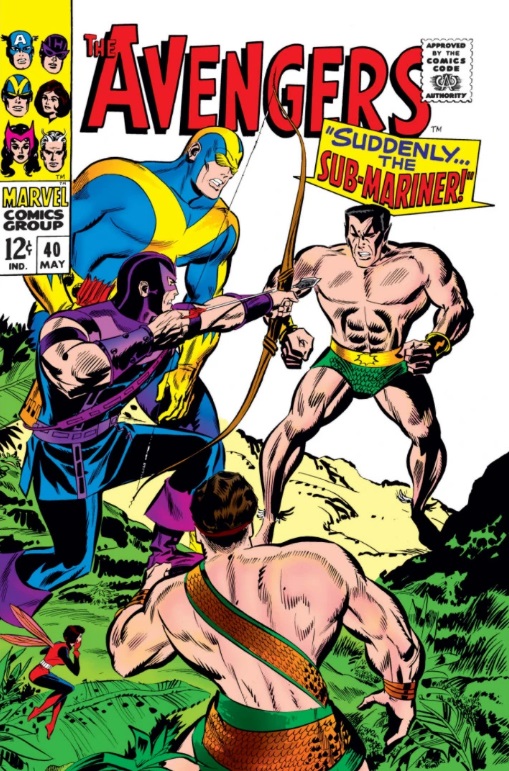

 Alex Good