
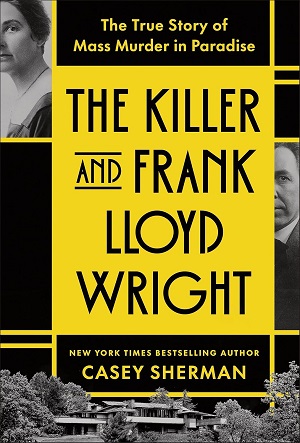
The Killer and Frank Lloyd Wright: The True Story of Mass Murder in Paradise
By Casey Sherman
The crime:
Around noon on August 15, 1914 Julian Carlton, a cook and caretaker at the architect Frank Lloyd Wright’s newly-built mansion, named Taliesin, went on a rampage, killing Wright’s then domestic partner Mamah Borthwick and her two children (from a previous marriage) with a hatchet. He then proceeded to set fire to Taliesin and killed several workman as they fled the burning building. After he was finished Carlton attempted suicide by swallowing hydrochloric acid but wasn’t immediately successful. He died from his injuries while in custody however, and there was no trial.
 The book:
I think there’s some false advertising in the title. “The killer” gets top billing, with the “mass murder” at Taliesin being in the descriptive subtitle. But that event is dealt with in just five or six pages and Julian Carlton isn’t give much attention in the book. In part this is because any account of the actual massacre has to be somewhat speculative, as there were only a couple of survivors, neither of whom knew everything about what was going on. Also, as there was no trial there wasn’t a lot of evidence to pore over. Not much is known about Carlton even today, and a criminal profile can’t be taken much further than the conclusion reached by Wright and Edwin Cheney, Mamah’s ex and the father of the two murdered children: that Carlton was suffering from some kind of mental illness that culminated in a psychopathic break. “He must have lost his mind,” Wright would say after the fact. Hectored by the press about what might have been behind Carlton’s rampage Cheney responded “I am sure that he was insane and there was no other reason.”
In his Author’s Note, Casey Sherman says that he “had planned to focus solely on the murders at Taliesin” but had been sidetracked into writing about the relationship between Wright and Mamah. I think it more likely that he realized the murder story just didn’t have enough juice. In any event, calling this book true crime, while not untrue, is still a stretch.
Instead, what you’re mainly getting here is an account of Wright’s early life, focusing on his marital and extra-marital relationships. While living with Borthwick, Wright was still married to his first wife, who refused to divorce him. The tabloids at the time had a lot of fun with the scandalous side of this, and even took to calling Taliesin a love nest and “bungalow of love.” As one critical minister put it, “Monogamy is society’s domestic ideal.” Wright, for his part, would deride this morality as “the gospel of mediocrity,” preached from the pulpit of the press to the man on the street. His was the master morality of the Nietzschean superman, which he described to a reporter in the following terms:
I want to say this: laws and rules are made for the average . . . The ordinary man cannot live without rules to guide his conduct. It is infinitely more difficult to live without rules, but that is what the really honest, sincere, thinking man is compelled to do. And I think when a man has displayed some spiritual power, has given concrete evidence of his ability to see and to feel the higher and better things of life, we ought to go slow in deciding he is acting badly.
You can get away with this, at least some of the time, if you’re a genius. And I think Wright was. But it sure is annoying.
I’ve discussed a couple of Sherman’s books before on this site. Hell Town I couldn’t finish. A Murder in Hollywood I thought just a rehash of an old story. That latter judgment I would repeat here. There have been a couple of books recently that dig deeper into what happened at Taliesin, and I was left again wondering how much trust I could put into Sherman’s account. For example, he quotes something “reportedly” said by one of Borthwick’s children to her just before Carlton killed her. The source given for this is a contemporary newspaper story. I couldn’t figure out where they got it from though, as all the participants were dead except for Carlton, and he was an unreliable witness who was not doing a lot of talking.
Noted in passing:
Carlton came to Taliesin as the result of a recommendation from a man Wright knew in Chicago. For her part, Borthwick thought Carlton and his wife (the two both worked at Taliesin as a package deal) “simply too good to be true.” Wright called them “the best servants I have ever seen . . . Julian especially seemed to have an intelligence above the average and a good education for one of his class.” Only a few days earlier “he seemed perfectly normal.”
This despite the fact that Carlton was apparently behaving in an increasingly paranoid and disturbed manner and just before the massacre had been given his notice due to issues he’d had with workers at Taliesin. This made me wonder to what extent Carlton, a Black man and a servant, was an “invisible man,” in Ralph Ellison’s phrase. The ideal servant, after all, or at least the “perfectly normal” servant, is one you don’t notice. That’s a big part of the job.
Takeaways:
As noted, Carlton came recommended to Wright. I’ve had glowing recommendation letters written about me. And some that were slanderous. Both were filled with lies. Recommendations are worthless.


Wright should have read and taken note of “Crime and Punishment”. The Law is for all and when it’s not, we get the chaos and disruption we see today 😦
LikeLike
The other view is that laws are for little people, and the only thing that saves us from chaos is the will of the superman. I don’t agree with that, or what Wright said, but I give him credit for at least coming out and saying it directly. And as it turns out he ended up inviting a lot more chaos into his life by living by his own personal code.
LikeLiked by 1 person
new post just went up. I had forgotten to schedule it so it was sitting there in my drafts folder 😀
LikeLike
Thanks for the heads up!
LikeLiked by 1 person
I know you don’t use the wp reader, so you won’t automatically see new posts. I should check in with Fraggle and see how she gets new posts.
LikeLike
Well Wright sounds like a right knob, pity he wasn’t home that day instead of his lady.
LikeLiked by 1 person
Basically just a fluke he was in Chicago working on another project that day. I think he was supposed to be around.
Like a lot of artistic geniuses he was quite full of himself, yeah.
LikeLiked by 2 people
Calling it true crime is a stretch? Sounds like Silly Putty to me. Man, I would not have been happy to have picked this up as a true crime book and gotten a story about Wright’s affairs. Surely you’re going to write this author off in the future…?
LikeLike
I think I have another of his sitting around so maybe one more.
Yeah, I mean it’s a readable book but the way it’s presented is all wrong as the murder spree at Taliesin just isn’t that big a part of it.
LikeLike