Binstagrammed Volume VI: Bins Alive

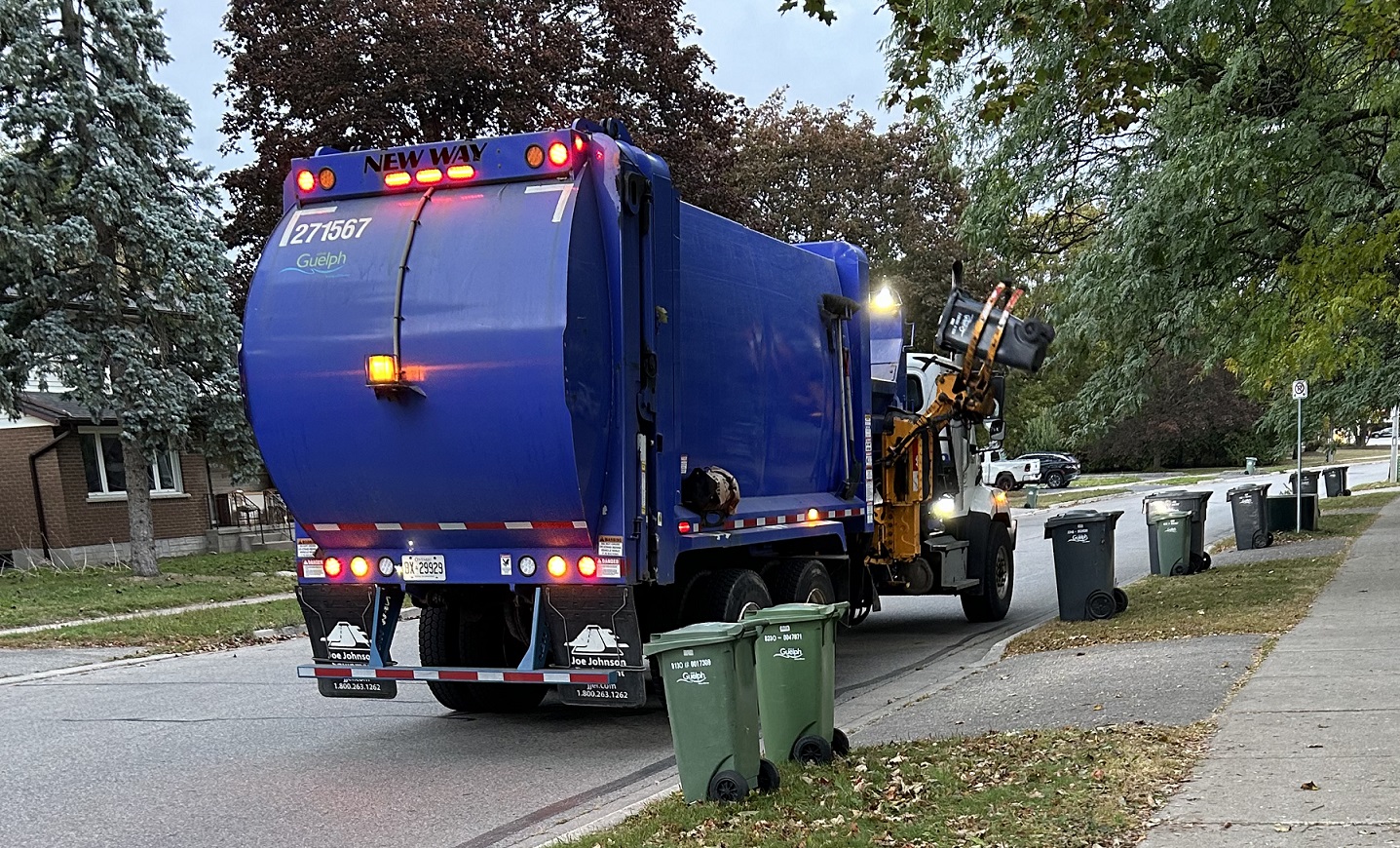
It’s been a while since I’ve had a Binstagrammed post. Almost two years. But I was walking through the blissfully deserted university campus last week and saw all these troopers lined up behind the University Centre building and couldn’t resist taking their picture.

Then, right after I put my phone away, I was walking past and I heard thumping noises coming from inside a couple of them. It actually scared the heck out of me. It sounded like somebody was locked in there! Then squirrels came popping out. It’s not that the lids weren’t fastened, but several of the bins had holes chewed right through them. It’s amazing what animals will do to get to the good stuff. And green bins, for organic waste, definitely have the good stuff.

Wolverine: In the Bones

Wolverine: In the Bones

So our hero Wolverine is off taking another one of his breaks from the X-Men, pondering what he’s done and what he’s going to do with his life in that usual “superhero having a reflective personal crisis” sort of way. He’s even running with a pack of wolves somewhere in Canada’s Northwest Territories. But then trouble, as it always does, comes knocking, in the form of his old enemy Cyber. And here’s where things start to get interesting. After Wolverine kicks Cyber’s ass (when they butt heads it makes a great CLONG sound) Cyber skulks away and gets possessed by a recently awakened primordial force called the Adamantine. Now you’ll probably know that Cyber’s skin and Wolverine’s skeleton and claws are made of (or, to be precise in the latter case, bonded with) adamantium, which is a virtually indestructible man-made alloy. Adamantine, by way of contrast, is a naturally occurring metal that is more the stuff of legend. Both are fictional substances, by the way.

The Adamantine doesn’t like adamantium, seeing it as a kind of blasphemy, so it has a mission to destroy it wherever it finds it. To do so it takes over Cyber and then goes around hunting other supervillains with adamantium in their body and possessing them. Names like Lady Deathstrike, Constrictor, and Romulus. Of course it also wants to possess and destroy Wolverine. To stop them, Wolverine has to team up with his daughter (X-23), Nightcrawler, and a teenage Wendigo that he is helping fight the cannibal curse.

I thought it was a good storyline from Saladin Ahmed, though in the end it falls back on the cliché about our hero just being made of stronger stuff and having personal reserves too great for the evil force to overcome. I get tired of that, and was actually hoping the Wendigo, as the anti-adamantium force in play, might have had a larger role. But I was still hooked enough to want to see what would happen next.

Graphicalex

Another foxy lady

Saw this vixen walking about pretty boldly in the early morning last week. She obviously got a scent of something because she crossed the street with her nose in the air, then sniffed around and crossed back. Probably a rabbit. She didn’t seem too concerned about me.

Macbeth (illustrated by K. Briggs)

Macbeth (illustrated by K. Briggs)

In my notes on the Macbeth graphic novel illustrated by Gareth Hinds I mentioned some of the ways he’d cut and adapted the language of the play, concluding that it wasn’t a full-text Macbeth, nor should it have been.

This Macbeth, illustrated by K. Briggs, is a full-text version of the play, and while I want to give credit to Briggs for her ambition I came away thinking that this sort of thing isn’t well advised. I gave up on the graphic adaptation of Philip K. Dick’s Do Androids Dream of Electric Sheep? for much the same reason. The text gets to be too much, and if you know the novel or the play that’s being adapted well enough you tend to skim it anyway and just look at the pictures.

I also want to credit Briggs for her striking visuals. She’s got quite an original sense of style, playing a lot with the format of the pages and mixing in various novel bits of imagery, like tarot cards, into a collage. She’ll also flip images upside-down, or present scraps of text or medieval-themed design elements as background. You can spend quite a bit of time on nearly every page, pulling it apart. And there are other creative flourishes I enjoyed too. Macbeth is so often presented, at least today, as a heroic young man that I liked seeing him as a bald, professorial type. At least he looks a lot like professors I had. You could roll your eyes at Malcolm appearing as a Black woman, but given the spirit of the proceedings this barely stood out.

But then there is all the text, which Briggs does try to jazz up as much as she can but which still just feels like it’s getting in the way. To be honest, and not only because I do know the play pretty well and was skimming, I started wondering at one point if the book might have worked better as a strictly graphic presentation, with no text at all. I mean, they made a whole lot of silent films out of Shakespeare’s plays, so, as crazy as it may at first seem, the words really aren’t indispensable.

Graphicalex

Bookmarked! #153: Paper Cuts

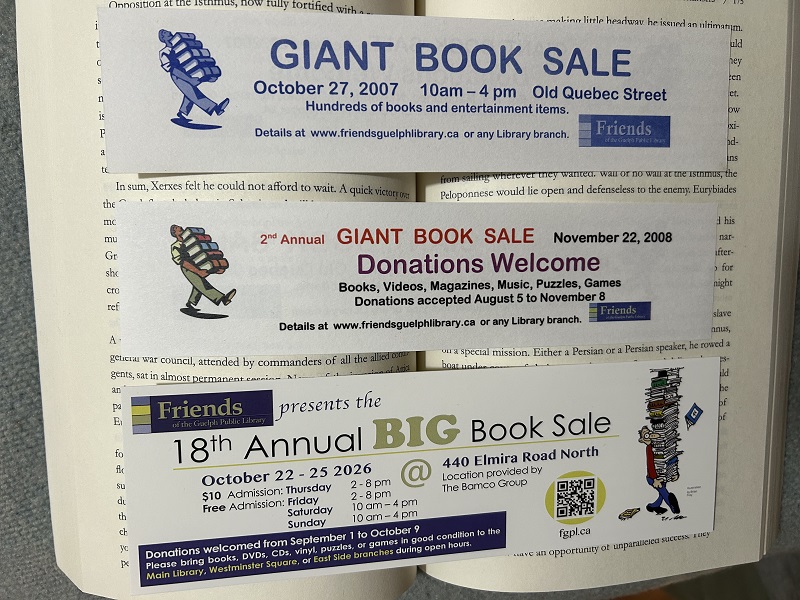
I’ve talked before about how you can have special bookmarks made out of rare types of wood or silver, or ones that are creative novelty items. But you can also just pick up free paper bookmarks, which are usually ads for something, at bookstores and libraries. At least you used to always be able to do that. More recently I haven’t seen as many.

On my last trip to the library I did see a pile of these bookmarks though, which really mark the bottom of the bookmark hierarchy. Looks like they just photocopied sheets of the same image and then chopped them up with a paper cutter. But since my aim is to include every sort of bookmark, from high to low, I thought I should give them a post anyway.

Book: The Bungalow Mystery by Carolyn Keene

Bookmarked Bookmarks

Montalbano: The Terra-Cotta Dog

The second Inspector Montalbano novel clocks in at more than twice the length of The Shape of Water, which suggests to me that Camilleri was entering a comfort zone. The physical and social environment were set, from the town of Vigàta and its environs to Montalbano’s regular squad of lieutenants: Augello, the second in command he doesn’t trust; Fazio, who he does trust; Gallo, who drives too fast, Galluzzo, who has the brother who’s a reporter ; Tortorella, who was shot in the gut; and Catarella, who talks funny and isn’t that bright. For a self-described “solitary hunter,” Montalbano has a lot of help to call on. And there are also other secondary characters who recur, like Montalbano’s mistress Livia, Jacomuzzi at the crime lab, the lefty journalist Nicolò Zito, the antiquarian Judge Lo Bianco, and Dr. Pasquano at the morgue. I was surprised that Ingrid, the Swedish babe from The Shape of Water, was back, and that Gegè, the childhood friend turned pimp, wasn’t long for this world, but otherwise the cast of characters already felt quite familiar.

Montalbano himself is also coming into better focus. A gourmand, though he doesn’t cook much himself, he’s also quite a cultured man. By himself he whistles Schubert’s Eighth, and “it came out splendidly, he didn’t miss a note.” When trying to figure out where Ingrid’s housekeeper has come from he tries giving her the name of Gaugin’s Manau tupapau, which she doesn’t recognize and thus eliminates Polynesia. When an old man comes to visit the well-read inspector identifies him as being “a perfect double” of “a jacket-flap photo of Jorge Luis Borges.” Discussing the case with the commissioner they liken the proceedings to something from Pirandello, then Sciascia. In his downtime Montalbano rereads Faulkner’s Pylon . . . for the fifth time! I don’t think there are more than a hundred people alive in the world today who have read Pylon five times. It comes in handy, however, as it gives him an idea on how to draw someone out of hiding.

Montalbano’s not all high-brow though. He likes detective fiction, and at one point decides “that in matters of taste he was closer to Maigret than to Pepe Carvalho.” Carvalho being the name of a detective appearing in novels written by Manuel Vázquez Montalbán, a writer from Barcelona who Montalbano feels a connection with due to their having the same surname. Montalbano’s name was, in fact, an homage to Montalbán, so we’re getting pretty meta.

The main case itself here is a historical one, as a pair of bodies are discovered in a cave where they’ve been sealed away for the last fifty years. But as the commissioner recognizes, this is just the kind of case that Montalbano enjoys: “because even if you were to find the solution, it would prove utterly useless. Just the sort of uselessness that you would find amusing and – excuse me for saying so – almost congenial.” The only problem with it, from my point of view, is that it’s not the kind of case that you can play along with. Montalbano only figures out what’s going on because he’s able to talk to a bunch of old people with very good memories, gets lucky by hearing a story relating to the crime scene while out for a walk, and has the fellow who put the bodies in the cave show up on his doorstep and explain everything at the end.

I call the cave business the main case because there’s a bunch of other stuff going on about mafia turf wars and local murders and heists, but this remains on the level of background noise. As I noted in my review of The Shape of Water, Montalbano’s Vigàta is a fantastically violent place. I don’t know how realistic that is, though. Perhaps no more so than Montalbano reading obscure Faulkner novels. I’m sure you wouldn’t find many inspectors as well read as Montalbano today anywhere in the world, and probably not even in the 1990s, which really was a different world when it came to the place books had in people’s lives. Then again, Italy might also just be very different in that respect. Meanwhile, that the high culture rubs shoulders with such violence and ubiquitous crude insults feels like more than just local colour. If Sicily really is like that then I don’t think I’d feel very at home.

Montalbano index

Postcards from a bygone era

So I was looking to buy a postcard recently. My first stop was the Dollar Store, where you can usually pick up a lot of cheap cards. Alas, there was no rack for postcards. So I asked the woman working there, who I would have put in her early 30s, if they had any postcards. She looked at me blankly. I asked again and she shook her head, not saying anything, apparently in some confusion. Then she said that they sold envelopes for cards. I told her that postcards don’t go in envelopes. This seemed to confuse her even more and I don’t think she knew what I was talking about. But I chatted with her for a while anyway and left without thinking any more of it.

My next stop was a drug store that also has a post office desk in it. I asked the woman running the place (another thirty-something) if they had any postcards. She didn’t understand me so I repeated “Postcards?” I got another blank look. I honestly thought I wasn’t speaking clearly enough, as I do tend to mumble a bit. So I leaned in closer and said “Post. Cards.” She leaned back away from me (I can be a bit intimidating) with a look of nervous confusion on her face. “I don’t know what you mean,” she said. I said “Postcards. They’re like pictures . . . that you mail.” She still looked at me with a total lack of understanding. She honestly had no idea what I was talking about.

I realize people don’t mail postcards that much anymore, but still this was a bit surprising. Two youngish people who didn’t have a clue what a postcard was? The times they are a-changing.

Macbeth (illustrated by Gareth Hinds)

Macbeth (illustrated by Gareth Hinds)

Even though Macbeth is one of Shakespeare’s shortest plays (I think only The Comedy of Errors has fewer lines), most productions still make a fair number of cuts, and we shouldn’t be surprised that a graphic novel adaptation, coming in at 134 pages, would be any different. Gareth Hinds doesn’t go wrong in getting rid of Hecate’s appearance before the witches in Act III Scene v (which Shakespeare might not have written), as well as the long and (in my opinion, tedious) exchange between Malcolm and Macduff in Act IV Scene iii. This isn’t a full-text Macbeth, nor should it be.

Purists may take fairer exception to places where the language has been simplified or expurgated. Among the foul ingredients going into the witches’ cauldron, for example, there’s a “Finger of birth-strangled babe / Ditch-delivered by a drab.” That second line, identifying the strangled babe as having been birthed by a prostitute in a ditch, is omitted by Hinds. And at another point a notorious crux is done away with in Macbeth’s concern over washing the blood from his hands:

Will all great Neptune’s ocean wash this blood
Clean from my hand? No, this my hand will rather
The multitudinous seas incarnadine,
Making the green one red.

Should that final line read “Making the green one, red”? As in making the green ocean red? Or should it be read as saying “Making the green, one red”? Meaning making the entire ocean turn red? Hinds avoids the problem by changing the line to “No, this my hand will rather stain the great seas crimson.” Which is at least clearer, if you’re no fan of ambiguity.

As far as Hinds’s visual representation of the play goes, I think there’s good and bad. The good takes the form of a lot of interesting concepts like the witches first appearing as birds perched in a tree, Macbeth’s elongated shadow taking the form of a dagger as he sets off to kill Duncan, Macbeth and Lady Macbeth literally wading in blood after the scene with Banquo’s ghost (where Banquo’s ghost takes several different, monstrous forms), and Lady Macbeth’s obsessive hand-washing represented by multiplying sets of scrubbing hands. The not-so-good is mainly down to Hinds’s figures, which all look stiff and artificial to me. Adding to this effect is the lettering, which is just a regular font that doesn’t go well with the action and adds a layer to the generic feel. I wonder if comic lettering is a dying art now though. Too bad if it is. It’s something we often overlook, but it can make a difference.

Graphicalex

Little fellow

I’ve been trying to get a decent picture of a chipmunk for a while, but it’s not easy. They’re quite camera shy and they zip around very quickly. This guy posed on a porch for just long enough though.

Meanwhile, back at the drive-in

Just a note to let you know that I’m back updating at Alex on Film, for how long and how often I’m not sure. I just don’t watch as many movies as I used to. And you do get to a point where you start repeating yourself, a rut which is made easier to fall into by how repetitive and formulaic the movies are. But I’ll keep posting notes for a little while longer anyway.

I also noticed that my traffic to Alex on Film is now experiencing another surge, akin to what I got from the Chinese bots a year or so ago. I think I had over 6,000 visits yesterday alone, which is quite high. I don’t really care because none of it is real, but it does have the unfortunate effect of making the traffic reports that WordPress gives me meaningless. I don’t think there’s any way of stopping it though, even if I cared enough to try.