Batman: One Bad Day: Clayface
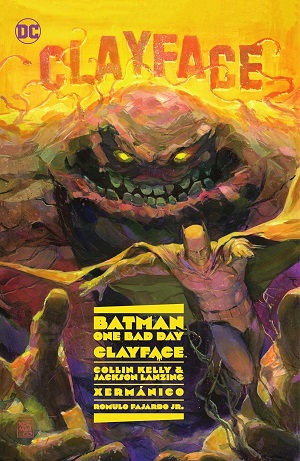 This is one of eight single-issue comics in the Batman: One Bad Day series, each by different writers and artists and each focusing on the tortured psyche of a famous Batman villain. Now in the case of One Bad Day: Clayface what we get isn’t an origin story so much as a reboot, since there have been a whole lot of Clayfaces over the years, which is what you might expect from such a Protean figure. What’s happened in this one is that Clayface, an actor named Basil Karlo, has left Gotham and is now working as a waiter in Hollywood, where he’s trying to break into the movie business. Things don’t go well, however, and soon “Clay” (his adopted name) is demonstrating that even if he’s not quite willing to die for his art he’s absolutely on board with killing for it. Which means literally working his way up the Hollywood food chain from fellow struggling actors to agents to directors to producers. They all get the mud bath treatment when they don’t share Clay’s creative vision.
I loved pretty much all of this. The story by Collin Kelly and Jackson Lanzing (the Hivemind) is solidly constructed, even though initially a bit disorienting as we get introduced to all of Clay’s co-workers. Things keep escalating as Clayface works his way through the usual gang of movie-business jerks. And the punchline ending is both grim and funny. I don’t know if I’m a big fan of the art of Xermánico normally, but he really does a great job with Clayface here, giving pathos to his sad, pupil-less eyes. And finally I’ll call out the lettering by Tom Napolitano. Usually I rail against the speech of characters being presented in stylized ways where it’s distracting and not required. But here I thought it very effective. I liked how when Clay reverts to his Clayface form the speech bubbles become swirling, puddly forms and the lettering liquefies. I also thought the business of providing emphasis through the use of what looks like yellow highlighter was a gamble that paid off. It works with the way they present the text for the scene settings in screenplay format throughout (“Int./Ext. Sunset Chateau. Day.”)
Batman does show up at the end to put an end to Clayface’s theater of blood, or mud, which is done in a perfunctory way with a Ghostbusters-style trap and a quick moral lesson about truth and lies in the dream factory. But Clayface not only gets the last word, he’s also a far more complicated and compelling character. Sure he’s deluded about Hollywood, but he has the conviction of the true psycho, while also being sympathetic. I mean, who hasn’t wanted to throw mud at movie stars at some point? It’s just that Clayface is mud with teeth.


Will you be doing the others?
LikeLiked by 1 person
The only one I have is the Penguin one and the library only had this one (all the other were reported stolen!). So just the Penguin I guess. Too expensive to buy.
LikeLiked by 2 people
Keep an eye on ebay, they may turn up cheap.
LikeLiked by 1 person
Yep, that’s how I got the Penguin one.
LikeLiked by 2 people
More mud and teeth, less movie stars please! 😀
too bad there isn’t a Predator movie where it reaps Hollywood. That would be awesome.
LikeLike
Somebody’s probably working on it. The Predator is showing up all kinds of places lately.
Predator 2 was set in L.A. but not really Hollywood.
LikeLiked by 1 person
Yeah, P2 was more about gangs and druggies than the Stars.
It’s probably because all of the stars aren’t worthy prey 😀
LikeLike
Movie stars would be pretty easy pickings for the Pred.
LikeLiked by 1 person
Exactly. So they’d have to have some insane predator who chose weak prey. And given the nature of Predators, how would we even know it WAS insane?
LikeLike
Maybe not insane. Maybe just baby predators learning the ropes by preying on celebrities. If they can have Baby Yoda they can do a cute Baby Predator too.
LikeLiked by 1 person
They did the young predator (but not a baby) thing in Batman vs Predator II where it goes up against Robin. Or maybe that was BvsP III.
LikeLike
Man, I thought you were joking. Looked it up on a whim. It was BvP III.
LikeLiked by 1 person
BvsP was a good miniseries. The other 2 stunk pretty bad…
LikeLike
Sounds interesting, but not in at the library and I’m not sure it’s even still in print. Maybe they’ll do a cheap compact classics reprint at some point.
LikeLiked by 1 person
I doubt it. I picked them up back in the day when they were still cover price for the omnibus.
I can’t remember, do you do ecomics on your computer?
LikeLike
They’re probably worth something today!
I don’t read e-comics, no. Just hard copies.
LikeLiked by 1 person
I’ll have to go look. I’ve got a lot of comic graphic novels from that time period.
LikeLike
$20 on ebay for the first graphic novel.
LikeLike
Too much!
LikeLiked by 1 person
Baby Yoda just needs to die…
LikeLike