DNF files: Goliath’s Curse

Goliath’s Curse: The History and Future of Societal Collapse

By Luke Kemp

Page I bailed on: 60

Verdict: This made me think a bit of my response to Peter Turchin’s End Times, being a work of Big History that tries to come up with a master thesis of how and why things fall apart, with the help of “some new terminology and lots of numbers.” But I think Turchin was probably on to something more. I just couldn’t get on board with what Kemp was saying here, beginning with his choice to label all the societies he was discussing as “Goliaths.” A glossary at the back defines a Goliath as “a collection of interconnected hierarchies in which some individuals dominate others to control energy and labour.” A Goliath is not just a state or a civilization, but a mosaic of dominance hierarchies “organized primarily through authority and violence.” So Goliath = Leviathan? Given that the first chapter tears down “Hobbes’s delusion” (that the state of nature is nasty, brutish, and short) I don’t know if Kemp would go that far. But I couldn’t be sure. Goliath just seems like a really poor attempt at branding to me, and it continues with such concepts as Goliath evolution, Goliath fuel, and Goliath traps.

Language aside, I had a sense that Kemp maybe had a decent, if overly broad, argument to put forward that might have worked for a magazine article or podcast but that I just didn’t feel up to spending 500 pages with.

The DNF files

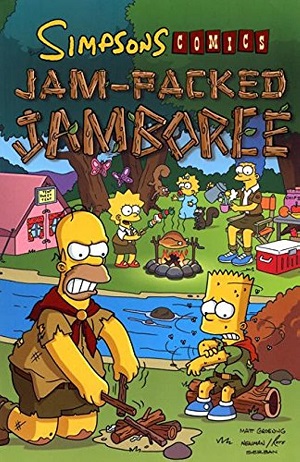
Simpsons Comics Jam-Packed Jamboree

Simpsons Comics Jam-Packed Jamboree

The Simpsons have been with us for so long that a list of minor recurring characters from the show would likely be as long as the tax rolls in some small towns. And yet, even though it’s been years if not decades since I watched the show, I can identify all of them, or nearly all of them, as soon as they’re introduced. Examples showing up several times in this collection include Dr. Nick (catchphrase: “Hi everybody!”), Gil the worn-down salesman, and Cletus the Slack-Jawed Yokel. Hell, I even remember the Cletus song.

But I said I recognized nearly all of these guys because I had no recollection of Dr. Colossus. This sent me to the Internet to see if maybe he was introduced sometime after I stopped watching, but actually he’s been around since 1994.

I didn’t even notice Dr. C the first time he shows up in this collection, when he briefly appears with his mother before Judge Marge. But then it’s easy to miss things in these comics as they often have so many gags appearing even within a single cell that you have to squint and read the fine print to catch them. As usual, the stories are pure zaniness, giving you no idea where they’re heading aside from the fact that at the end normalcy (or what passes for normalcy in Springfield) will be re-established, with the Simpson family as indestructible as ever. Which makes you wonder at their evolution from what were, at the time, subversive roots, into something so conservative you could even think of them as an institution. Though after nearly fifty years that may be a natural progression.

Graphicalex

Holmes: The Memoirs of Silver Blaze

A Holmes story by Michael Sims that takes a novel angle. So novel that the penny never dropped for me even with the title. Surely this was the story of the racehorse Silver Blaze, not strictly a memoir.

But no, it’s a memoir, or at least a part of one, relating the events of the story “Silver Blaze” as told by Silver Blaze himself.

Like I said, a novel angle.

I can’t say it adds much to the story, basically just reinforcing how noble a fellow Holmes is and how nasty Straker and Brown are, but I enjoyed it thoroughly. These kinds of stories are typical of children’s literature and I felt something like nostalgia reading it, taking me a back to a world where I imagined animals as basically having fully human personalities and intelligence but no ability to talk.

Holmes index

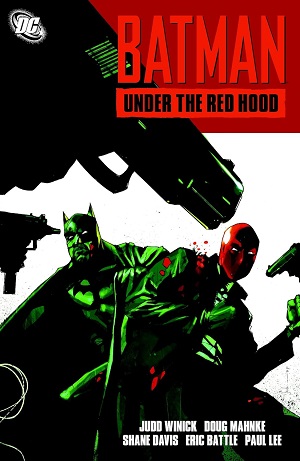
Batman: Under the Red Hood

Batman: Under the Red Hood

Batman has always had a Robin problem. He’s never been that popular a character, doesn’t fit well with the Dark Knight’s grim persona, and the relationship between Bruce Wayne and his young ward probably seemed creepy at the time and ever since has become the stuff of comedy sketches. Even Robin’s costume looks campy and ridiculous, with elven slippers and shiny green speedo briefs under a shirt that might be a minidress. Fans even voted to have the Joker kill him off in the 1988 storyline “A Death in the Family.”

That particular iteration of Robin was Jason Todd, who was the second lad to step into the role after the departure of Dick Grayson (who went on to become Nightwing). In this story, however, Jason is back as a new crime-fighting crusader who goes by the name of Red Hood. Even though it’s more of a helmet than a hood. But whatever.

How Jason was resurrected is a tale too complicated for me to relate or, if I’m being honest, understand. Suffice to say that Jason as Red Hood is now taking out Gotham’s crime syndicates, which are being run by Black Mask. This should mean he’s one of the good guys, but his methods are quite brutal, which doesn’t sit well with Batman. It seems that when Jason came back from the dead he brought with him a taste for vengeance and rough justice, whether because of how he died or due to some infection from taking a dip in R’as al Ghul’s Lazarus Pool isn’t clear. So there’s a lot of blood in these comics, and bodies are soon piling up all over the place.

I thought it was a strong story, with good character development and conflict between the two leads. Jason/Red Hood has a grudge to settle with Batman, not for letting the Joker kill him but for not killing the Joker in revenge. And he has a case.

Bruce, I forgive you for not saving me. But why . . . why on God’s earth – ??! Is he still alive!!?? . . . Ignoring what he’s done in the past. Blindly, stupidly, disregarding the entire graveyards he’s filled. The thousands who have suffered . . . the friends he’s crippled . . . I thought . . . I thought killing me – that I’d be the last person you’d ever let him hurt. If it had been you that he beat to a bloody mass. If it had been you that he left in agony. If he had taken you from this world . . . I would have done nothing but search the planet for this pathetic pile of evil, death-worshipping garbage . . . and sent him off to hell.

I think this is a question that a lot of Batman readers have probably asked over the years. But we just have to accept that the man has a code and that’s all there is to it.

The conflict between Bruce and Jason is the main one being explored throughout the series, and it culminates with lots of bone-crunching fisticuffs and blood splatter. There’s also some dark comedy, especially coming from Black Mask and his exasperation with his incompetent underlings. And I got a chuckle out of things like how the Batman symbol is printed on the soles of the Dark Knight’s combat boots.

Most of all, however, I think they finally made something out of Robin. I count myself as a die-hard Robin hater, and I’m not a fan of Nightwing either. Red Hood as the back-from-the-dead vigilante, however, is a character with some edge. There were a lot of improbabilities along the way and parts that I felt didn’t add up, but this was a solid comic all around.

Graphicalex

Holmes: The Curious Affair of the Italian Art Dealer

A curious affair indeed, as this is a story that goes in a couple of directions I didn’t anticipate. We begin traditionally enough, with Watson describing Holmes in one of his drug-soaked longueurs between cases. But then one of Watson’s calls – to attend upon a visiting American who has been beaten up during the theft of a painting, presumed a Titian, he had brought to London for verification – turns into one of Holmes’s clients. And from there we take several twists and turns before a revelation at the end not of who was behind the theft of the painting (though that’s included) but of the dual investigation that was going on all this time.

You see, this isn’t primarily a Sherlock Holmes mystery but one starring the American detective Miss Butterworth, the creation of Anna Katherine Green. Something very alert readers (not me!) will have twigged to in the name of the hotel manager being Gryce, since Ebenezer Gryce was the main detective created by Green. (Inspector Whicher gets name-dropped too, but that’s just a throwaway.) Anyway, it’s Miss Butterworth who really solves the case and then has to explain it all to Holmes. This puts him out to the point where he is said to be furious at her condescension, but she tells him he shouldn’t sulk because nobody’s perfect. I have to say though in Holmes’s defence that he has no reason to feel one-upped because Miss Butterworth had been investigating the case for months before he got involved, and she had far more personal information about what was going on.

Sara Paretsky, the creator of V. I. Warshawski, is obviously making a feminist point here, but it’s not one that I found took anything away from the story, which was enjoyable all the way through and stands well enough on its own.

Holmes index

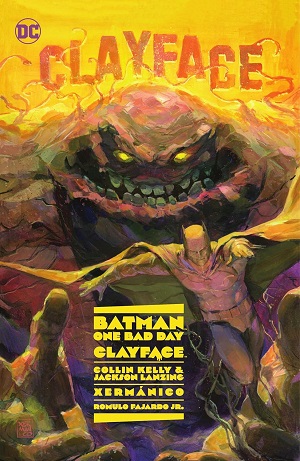
Batman: One Bad Day: Clayface

Batman: One Bad Day: Clayface

This is one of eight single-issue comics in the Batman: One Bad Day series, each by different writers and artists and each focusing on the tortured psyche of a famous Batman villain. Now in the case of One Bad Day: Clayface what we get isn’t an origin story so much as a reboot, since there have been a whole lot of Clayfaces over the years, which is what you might expect from such a Protean figure. What’s happened in this one is that Clayface, an actor named Basil Karlo, has left Gotham and is now working as a waiter in Hollywood, where he’s trying to break into the movie business. Things don’t go well, however, and soon “Clay” (his adopted name) is demonstrating that even if he’s not quite willing to die for his art he’s absolutely on board with killing for it. Which means literally working his way up the Hollywood food chain from fellow struggling actors to agents to directors to producers. They all get the mud bath treatment when they don’t share Clay’s creative vision.

I loved pretty much all of this. The story by Collin Kelly and Jackson Lanzing (the Hivemind) is solidly constructed, even though initially a bit disorienting as we get introduced to all of Clay’s co-workers. Things keep escalating as Clayface works his way through the usual gang of movie-business jerks. And the punchline ending is both grim and funny. I don’t know if I’m a big fan of the art of Xermánico normally, but he really does a great job with Clayface here, giving pathos to his sad, pupil-less eyes. And finally I’ll call out the lettering by Tom Napolitano. Usually I rail against the speech of characters being presented in stylized ways where it’s distracting and not required. But here I thought it very effective. I liked how when Clay reverts to his Clayface form the speech bubbles become swirling, puddly forms and the lettering liquefies. I also thought the business of providing emphasis through the use of what looks like yellow highlighter was a gamble that paid off. It works with the way they present the text for the scene settings in screenplay format throughout (“Int./Ext. Sunset Chateau. Day.”)

Batman does show up at the end to put an end to Clayface’s theater of blood, or mud, which is done in a perfunctory way with a Ghostbusters-style trap and a quick moral lesson about truth and lies in the dream factory. But Clayface not only gets the last word, he’s also a far more complicated and compelling character. Sure he’s deluded about Hollywood, but he has the conviction of the true psycho, while also being sympathetic. I mean, who hasn’t wanted to throw mud at movie stars at some point? It’s just that Clayface is mud with teeth.

Graphicalex

Wimsey: The Unprincipled Affair of the Practical Joker

It’s curious the way the Lord Peter Wimsey stories by Dorothy Sayers are so different in tone from the novels. To be sure the novels have a comic spirit to them, but the stories, at least in the early going, dial this way up. You can tell as much just from the titles, which seem intent on wearing their silliness as a badge. They can also be clever too though, as in this story and “The Entertaining Episode of the Article in Question,” where there’s a pun that you’re not expecting.

This is also not a true mystery story. A society woman approaches Lord Peter and asks him if he can retrieve some stolen jewelry. But she knows who stole it, and Lord P doesn’t doubt her, so all that happens is that Lord P has to figure out a way to trick the thief into giving the jewels back. You may think of stories like “The Purloined Letter” or “A Scandal in Bohemia,” but in those cases Dupin and Holmes respectively have to find out where the item in question is. That takes some detection skills. Here Lord Peter just has to find a way to blackmail the blackmailer, and that turns more on sleight of hand than ratiocination.

Another thing that got me wondering here is the way Sayers presents Lord Peter as not just a toff and a dandy but effeminate. This despite the fact that he served with distinction on the Western front in the Great War, has a love of motor cars, and can manage himself in a fist fight with local roughs. But his first appearance in this story is that of “a young man, attired in a mauve dressing-gown of great splendour, from beneath the hem of which peeped coyly a pair of primrose silk pyjamas.” I think the pyjamas go with his “sleek, straw-coloured hair.” In any event, if an author described a character in this manner today you would immediately catch the implication that he was gay, and that might have been true in the 1920s as well. But Lord Peter isn’t gay, he’s just eccentric. I’m not sure what Sayers was about in drawing him this way. Perhaps it was to show why people so often underestimate him, which is something he frequently turns to his advantage. But then are the silk pyjamas only meant to be a disguise?

Wimsey index

Feeling hungry?

While reading Richard Seymour’s Disaster Nationalism I came across an account of contemporary conspiracy thinking, and how such ideas as that of George Soros as evil puppet-master “could never have taken root if multiple economic and social crises, not to mention the unpunished ruling class crime wave preceding the financial crash, hadn’t established the orectic conditions for their uptake.” In other words, people had to be first primed to believe things that there was little evidence for. They had to want to believe, which is what “orectic” refers to.  The dictionary definition is “relating to appetite or desire.” It’s not a word I’d encountered before, but comes from the Latin for stimulating appetite and the Greek for desire.

I didn’t know “orectic,” but it made me think of an obscure word that I do use occasionally for desire: esurient. This comes from the Latin esurire (to be hungry) and has the meaning of hungry or, more often, greedy. I remember first coming across it when reading Will Durant’s History of Civilization, in a description of greedy heirs waiting for the deaths of their parents as “esurient ghouls.” That’s always stuck in my head. But orectic, which has a similar meaning, was new to me. I don’t think either word is used much now, though spellcheck recognizes esurient while orectic is flagged.

Words, words, words

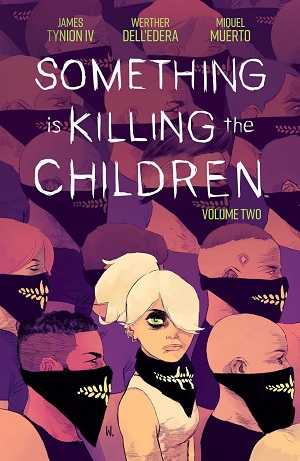
Something is Killing the Children Volume Two

Something is Killing the Children Volume Two

Volume Two of this series, collecting issues #6-10, and . . . things aren’t getting better. In terms of the story that means that all the little baby demons of the mother demon that Erica killed at the end of Volume One are now getting hungry and killing more of the children of Archer’s Peak. But what I really mean is that I’m not liking this comic any better as it goes along.

James, the kid who survived an attack by the mother demon, is laid up in the hospital most of the time here. So instead it’s Erica teaming up (sort of) with another demon hunter named Aaron sent out from the Order of St. George with instructions to clean up Erica’s mess. And that means more than just killing the demons. But Aaron turns out to be pretty useless. As do the police. And Tom Mahoney, the only other adult gifted with the ability to see the demons, isn’t much help either.

So actually very little happens. There are more references to obscure monster lore like the fact that the baby demons are “oscuratypes” who only exist in a shadow form until they start eating. Which is just a bit of mumbo-jumbo that’s introduced to keep the plot moving along (in order to kill them, Erica will need some live bait, you see). Erica and the demon hunters know all this stuff, and they’re impatient with all the normies they have to deal with who just don’t understand. This makes Erica irritating, but she’s not the least likeable character. To be honest, I don’t think I cared for any of these people.

Nor am I a big fan of Werther Dell’Edera’s art (though I love that name). Erica’s cyclopean look is certainly striking, but I found her oversized green eye to be distracting and even repellent. Meanwhile, some of the secondary characters are hard to distinguish, at least to my eye.

Well, maybe I’ll give the series a bit more rope. But so far things aren’t looking good. I’ll be surprised if I make it to the end, if there even is an end yet.

Graphicalex

Holmes: The Adventure of the Empty House

In The Hound of the Baskervilles Sir Arthur Conan Doyle hadn’t really brought Sherlock Holmes “back” after killing him off in the story “The Final Problem” since The Hound had been set sometime before  Holmes and Moriarty took their plunge from the Reichenbach Falls. With this story, however, Doyle finally had some explaining to do.

I think he does so with real skill. Holmes’s survival is accounted for with a wave of the hand. When Moriarty grappled with him at the edge of the cliff above the Falls, Holmes used a baritsu maneuver to flip his enemy and save himself. Apparently baritsu (“the Japanese system of wrestling”) might have been based on the then new British mixed martial art of Bartitsu (a combination of “ju-jitsu” with the name of the guy who developed it, Barton-Wright). Contemporary readers may have been intrigued, but despite attempts at its revival I think Bartitsu is only a historical footnote today.

The mechanics of Holmes’s survival aside, what I found most impressive about what Doyle does here is the way he threads the plot of “The Final Problem” (which had been published ten years earlier) with what’s going on here. After his presumed death, Holmes had stayed in hiding in order to hunt down the rest of Moriarty’s gang, making this story a pretty direct sequel. His fear of an assassin with an air gun is even worked back into the plot as an essential point. Sure you can pick holes in various places as you go along, and various editors have, but they’re points that I had no problem ignoring. Meanwhile, the shift from the main mystery, a locked-room murder, to the capture of Moriarty’s Number Two (“the second most dangerous man in London”) is nicely done.

Though he doesn’t have much to say for himself, Colonel Moran’s face tells a story. Watson reads his physiognomy like a medical text:

It was a tremendously virile and yet sinister face which was turned towards us. With the brow of a philosopher above and the jaw of a sensualist below, the man must have started with great capacities for good or for evil. But one could not look upon his cruel blue eyes, with their drooping, cynical lids, or upon the fierce, aggressive nose and the threatening, deep-lined brow without reading Nature’s plainest danger-signals.

Physiognomy is now seen as a pseudo-science, but in 1903 the idea was still current. Holmes, however, is prepared to take these matters a speculative step further:

There are some trees, Watson, which grow to a certain height, and then suddenly develop some unsightly eccentricity. You will see it often in humans. I have a theory that the individual represents in his development the whole procession of his ancestors, and that such a sudden turn to good or evil stands for some strong influence which came into the line of his pedigree. The person becomes, as it were, the epitome of his own family.

Watson immediately responds that this is “surely rather fanciful.”

“Well,” Holmes admits, “I don’t insist upon it.”

It is indeed a fanciful theory, and one that expands quite a bit on the notion that comes up in The Hound of the Baskervilles where Holmes sees something in the portrait of Hugo Baskerville that reminds him of the face of Stapleton, calling it “an interesting instance of a throwback, which appears to be both physical and spiritual.” What he’s arguing here though is less like a regressive gene resurfacing than an instance of the theory of embryo recapitulation, where “ontogeny recapitulates phylogeny,” only occurring on the family level rather than that of the species. I’m sure this is an idea that doesn’t bear much looking into, but I love the way Holmes himself dismisses it as unimportant anyway. What is important is that the great detective is back: “once again Mr. Sherlock Holmes is free to devote his life to examining those interesting little problems which the complex life of London so plentifully presents.”

Who says that? Watson? No, it’s Holmes, referring to himself in the third person! He really was setting the pattern for a modern celebrity.

Holmes index