Reports on business

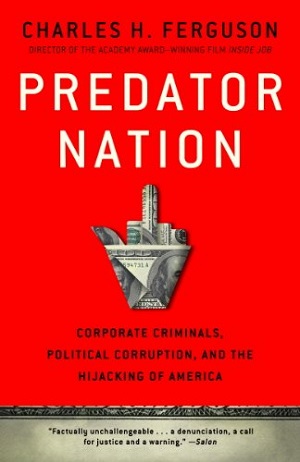
Over the past week I’ve been revisiting the 2007-08 subprime mortgage crisis, on page and on screen. A good place to start is Charles Ferguson’s documentary Inside Job, with more detail available in his companion volume Predator Nation. Also good as backgrounders are John Lanchester’s I.O.U. and (more journalistic) All the Devils are Here by Bethany McLean and Joe Nocera.

Hollywood has had several kicks at the can. The best, in my opinion, is Margin Call (2011), a taut drama focusing on character and condensing the crisis into the events of a single day. Oliver Stone’s Wall Street: Money Never Sleeps (2010) had a lot of potential, all of it unrealized. It’s a pointless sequel to an ’80s classic. Finally there is The Big Short (2015), a film based on Michael Lewis’s book of the same name. For some reason this film got rave reviews. I found it to be silly.

Ruination

A nice view from up there, but it's a bitch to get down.

A nice view from up there, but it’s a bitch to get down.

Over at Alex on Film I’ve added my notes on The Ruins (2008), a film based on a novel by Scott Smith that I reviewed when it came out. It’s one of the more original but also more ridiculous concepts for an American horror film from the past decade. That may not be a coincidence. Perhaps an original idea has to be kind of ridiculous, because otherwise someone would have already thought of it. Like a cursed videotape. Though I don’t want to give the book or the movie too much credit for breaking new ground. Man-eating plants are nothing new, and basically this is another variation on the tourists-in-trouble theme, and a cautionary tale for what might happen to you if you take the road less travelled.

The myth of the Marquis

I’m not a big fan of the writings of the Marquis de Sade. He seems long-winded, obsessive, and simple-minded to me. I’m also not a fan of the man himself, for what I think should be obvious reasons. He has, however, become a mythological figure, and not just in popular culture. In films like Peter Brook’s Marat/Sade (1967) and the more recent Quills (2000), we see him as a sexy rebel figure, representative of the counterculture’s struggle against authority. But even today’s biographers find him sympathetic. Francine Du Plessix Gray’s At Home With the Marquis de Sade and David Carter’s brief Marquis de Sade both seem to me to be overly apologetic. I don’t think we have to burn de Sade, but at the same time I don’t think we should romanticize him. That we continue to do so says a lot about our us and our need for a certain kind of hero. Who knew we were still so repressed?

Re-reading Shakespeare: Macbeth

(1) Shakespeare is credited with a huge vocabulary, and his plays also include the first appearances of many words. Scholars have a lot of fun tracking these down, and then speculating on possible meanings. Definitions are of course difficult when you’re dealing with a first usage. Take a line like this delivered by the sailor’s wife: “‘Aroynt thee, witch,’ the rump-fed ronyon cries.”

Nobody knows where “aroynt” (or “aroint”) came from. From the context here (and its use in King Lear) it’s assumed to be a curt form of dismissal. It could be a curse too. I wonder if Shakespeare just made it up because it sounds good. I wouldn’t put that past him.

Then there’s the “ronyon.” Is that, or was that, a word? Did anybody use it before Shakespeare? It’s usually given as derived from the French rogne for mange.

Finally, there’s the “rump-fed” part. In the edition I’m looking at a note says this has been “variously explained,” and gives four different readings. The editor is inclined to the fourth, which is “fed on the best joints, pampered.” I would have never guessed this. I think it’s closer to the second explanation provided: “fat-bottomed, fed or fattened in the rump.” The sailor’s wife is a fat-ass just sitting there mounching and mounching on bon-bons. I don’t think this makes literal sense of “rump-fed,” but I don’t think that’s important. The meaning seems clear.

(2) This is the tragedy of the bad man and his wife. As such it’s unique among the tragedies (I’m not including Richard III). Shakespeare’s other tragic heroes certainly have their flaws, but the Macbeths are villains and they know it. What’s more, they think that conscience is a sign of weakness and that things will start to get better once they wade a little further out in blood. They are but young in deed. “Things bad begun make strong themselves by will.”

Like a lot of bad people, they are paranoid. They are afraid that other people are just like them. Which is to say, as wicked as they are. It is the tyrant’s point of view. Once having overthrown authority and seized power, what’s to stop anyone else from doing the same to them? This is the source of their obsession over safety and security. To be thus is nothing, they need to be safely thus. Lady Macbeth fantasizes of being in a position where “none can call our power to accompt.” It seems to me that they worry about this more than they do about their souls. When they startle at various night sounds they probably hear the footstep of an assassin, not the devil.

(3) There’s a history of people wondering just how much Banquo knows about what’s going on. He tells us that Macbeth has “play’dst most foully for” the crown and I don’t think he’s giving private voice to mere suspicions here. As A. C. Bradley remarked:

He [Banquo] alone of the lords knew of the prophecies, but he has said nothing of them. He has acquiesced in Macbeth’s accession, and in the official theory that Duncan’s sons had suborned the chamberlains to murder him.

So call Banquo tinged with guilt. But what makes the play so much fun, at least for me, is the fact that everyone knows what’s going on. Immediately after Duncan’s murder Donalbain and Malcolm shift away, not dainty of their leave-taking. They know they’re next. The same can be said for Ross and Macduff, as is clearly implied in their brief conversation. Roman Polanski’s film version captured this well, with all sorts of knowing looks being exchanged between the various lords. It was no big secret. When Lady Macbeth starts walking and talking in her sleep, the doctor and her waiting-gentlewoman are less surprised (or embarassed) by what she’s saying than the fact that she’s saying it. They know right away who the old man is that had so much blood in him. And of course the witches not only know everything that’s going on, they know it all in advance. The evil spirits don’t have to hear Macbeth’s questions, they already know what he’s come to ask of them.

Macbeth is like any public figure today (politician or other form of celebrity) whose legitimacy is a fraud but who never gets called out for it because it’s in no one’s interest to do so. Until, of course, a tipping point is reached and they are exposed, leaving everyone who once enabled them (the time-servers like Ross) flying for plausible deniability and rushing to switch sides. This isn’t just the fate of tyrants, but that of all players. Not that they care much, in the end.

Warts and all

While I’ve long been a fan of the work of Philip K. Dick I have to confess I never knew more than the basics about his life. Which is to say, I knew he took a lot of drugs. This made Lawrence Sutin’s standard (and sympathetic!) biography, Divine Invasions, a depressing revelation. Dick appears to have been a truly awful person: “a dangerous, demanding, self-pitying, and manipulative man-baby.” Gak.

Dumbing down to Dumbledore

I don’t think of myself as being that much of an elitist culture snob, but I do have standards. I never gave in to Harry Potter-mania, for one thing. I did read part of the first book and thought it seemed like the kind of thing I might have enjoyed when I was eight years old. Good for the kids. Why any teenager, much less any adult, would want to read them was a mystery to me. I think I remarked at the time that I’d rather look at porn because at least its fantasies were post-pubescent.

Nevertheless, after about the third book in the series Pottermania officially became an adult phenemenon. Whether this was kidult or hipster culture coming to its full fruition, I don’t know. But it’s depressing. The current fad for adult colouring books is less worrisome, as at least that has an arts-and-crafts or therapy angle to it. Why grown-ups would want to bury their heads for hours in brick-like children’s fantasies is something else. Escapism yes, but escape from what? An adult world?

Leaving that question aside, I come to Stacy Schiff’s recent book on the Salem witch hysteria The Witches: Salem, 1692. What does this have to do with Harry Potter? Very little, or more likely nothing at all, I would have thought. But as an author of popular history Schiff knows her audience and so introduces the boy wizard into a chapter titled “The Wizard.” At the beginning of this chapter we are told of an investigator into the accusations of witchcraft in Salem who saw the whole affair as typical of the devil’s business, something which was “managed in imagination yet may not be called imaginary.”

This seemed like a fairly innocuous observation in itself, though one pregnant with danger.  A footnote, nevertheless, is provided by Schiff to help the reader with a modern paraphrase:

Or as Dumbledore assures Harry Potter: “Of course it is happening inside your head, Harry, but why on earth should that mean that it is not real?”

No reference is given for the Harry Potter quote, perhaps assuming that we all know which book (or film) it comes from. Neverthless, I found it to be remarkable. In the first place because I wouldn’t have thought any gloss on the text necessary, especially one that jumps forward over three hundred years to snatch a platitude from pop culture. But more than that I was amazed that in a semi-scholarly work such as Schiff’s Harry Potter would be brought in not just as a cultural/intellectual touchstone, but as an example of universal wisdom.

In an earlier post I talked a bit about how every culture has its sacred texts, works that are part of the collective consciousness. One suggestion I quoted in the post was that The Wizard of Oz (the movie, not the book) was one of ours. Perhaps Harry is next.

Murder and the single man

Added my review of Steve Lillebuen’s The Devil’s Cinema over at Good Reports. It’s a well-written true crime story about the “Dexter killer” Mark Twitchell, and one that I think has some interesting things to say about the directions psychopathy might take in the twenty-first century as well as how victims are targeted and identified. Who are among the most vulnerable members of society? Perhaps surprisingly, single men are one of the groups most at risk.

Intimations of the Internet

From Walden (1854) by Henry David Thoreau:

Our inventions are wont to be pretty toys, which distract our attention from serious things. They are but improved means to an unimproved end, an end which it was already but too easy to arrive at; as railroads lead to Boston or New York. We are in great haste to construct a magnetic telegraph from Maine to Texas; but Maine and Texas, it may be, have nothing important to communicate. Either is in such a predicament as the man who was earnest to be introduced to a distinguished deaf woman, but when he was presented, and one end of her ear trumpet was put into his hand, had nothing to say. As if the main object were to talk fast and not to talk sensibly. We are eager to tunnel under the Atlantic and bring the Old World some weeks nearer to the New; but perchance the first news that will leak through into the broad, flapping American ear will be that the Princess Adelaide has the whooping cough. After all, the man whose horse trots a mile in a minute does not carry the most important messages; he is not an evangelist, nor does he come round eating locusts and wild honey. I doubt if Flying Childers ever carried a peck of corn to mill.

From Myth and Meaning (1978) By Claude Lévi-Strauss:

What threatens us right now is probably what we may call over-communication –that is, the tendency to know exactly in one point of the world what is going on in all other parts of the world. In order for a culture to be really itself and to produce something, the culture and its members must be convinced of their originality and even, to some extent, of their superiority  over the others; it is only under conditions of under-communication that it can produce anything. We are now threatened with the prospect of our being only consumers, able to consume anything from any point in the world and from every culture, but of losing all originality.

Off to see the Wizard

in-the-basement-of-the-ivory-towerJust posted some of my thoughts on In the Basement of the Ivory Tower over at Good Reports. Throughout most of recorded history, individual cultures have had special, if not always sacred, texts. The Greeks had Homer. Chinese civilization had the Five Classics. Christianity had the Bible. English literature had Shakespeare. What unites us today? Professor X was curious to find out:

One of the things I try to do in English 102 is relate the literary techniques we will study to novels the students have already read. I try to find books familiar to everyone. This has thus far proven impossible to do. Many of my students don’t read much, and though I tend to think of them monolithically, they don’t really share a culture. To Kill a Mockingbird? Nope. (And I thought everyone had read that!) Animal Farm? No. If they have read it, they don’t remember it. The Outsiders? The Chocolate War? No and no. Charlotte’s Web? You’d think so, but no. So then I expand the exercise to general works of narrative art, meaning movies, but that doesn’t work much better. That really surprised me — that there are no movies they have all seen, except one: they’ve all seen The Wizard of Oz. Some have seen it multiple times. So, when the time comes to talk about quest narratives, we’re in business. The farmhands’ early conversation illustrates foreshadowing. The witch melts at the climax. Theme? Hands fly up. (The students can rattle off that one without thinking. Dorothy learns that she can do anything she puts her mind to and that all the tools she needs to succeed are already within her.) Protagonist and antagonist? Whose point of view is the movie told from? Can anyone tell me the cowardly lion’s epiphany? Are the ruby slippers a mere deus ex machina? What would you say is the symbolic purpose of the winged monkeys?

The movie comes in handy. Discussions are pretty lively.

In the long run, we’re all dead

elnarcoFrom El Narco (2012) by Ioan Grillo:

“When I did my first hit, I got a little too close and shot too many bullets into the body. Then the blood and guts exploded out all over me and I had to throw away my clothes and wash hard to get it off. That night I had bad dreams. I kept remembering shooting the person and the blood spurting out.”

Gustavo did more hits and the bad dreams stopped. Every few  weeks he would be given a new target. Mostly he killed in Medellín but he was also sent to take out victims in other cities across Colombia such as Bogotá and Cali. Soon he had killed ten, then fifteen, then twenty people. Then he lost count.

I ask him if he thinks about the victims. He shakes his head.

“I keep focused and do my work. Before I go out, I pray to Jesus and clear my mind. I never take drugs or drink before a job as I need my five senses. When I come back I will relax and smoke a spliff and listen to music.”

Does he feel remorse about the people he has murdered? I ask. How can he square what he does with his Catholicism? “I know it is bad,” he says. “But I do it out of need. I do it to support my family.

He also knows that his work may well lead to his own murder. But he tries to keep any fear tucked deep inside.

“I need to keep strong and focused. I can’t spend all my time worrying if they are going to kill me or not. Everyone dies in the end.”