No books for old men

From “Closing the Books” by Arthur Krystal, Harper’s Magazine (March 1996):

At fifteen or twenty, the books we read — or rather the minds behind them — are far more interesting than our own. But as we experience for ourselves the rites of passage that were previously only read about, and as we mature and reflect on what those experiences mean, novelists and poets begin to lose an important advantage — at some point we’ve all been down that road. And what may happen is this: we begin to find that most writers are less interesting than we think ourselves to be.

From Bookslut interview with David Markson (July 2005):

Where did I read that you no longer pay attention to more recent fiction?

It’s true. Any fiction, really. I hate to admit it, and I don’t really understand it, but it’s some years now — it just seems to have gone dead for me. Not just recent stuff, but even novels that I’ve deeply cared about — I try to reread and there’s none of the reaction I used to get, none of the aesthetic excitement or whatever one wants to call it, all a blank. With one exception of course — I can always reread Ulysses. In fact I went through it twice, consecutively, just a few years ago. But hell, that’s not like reading a novel, it’s more like reading the King James Bible. Or Shakespeare. You’re at it for the language. But even The Recognitions, which I think is categorically the best American novel of the twentieth century, just doesn’t do anything similar for me. It did, the first four times I read it — and four is not an exaggeration, by the way, in spite of its length — but the last time out it just went flat. It’s not the books, I’m sure, it’s me — I’m just not bringing the same receptiveness to them that I used to.

No other exceptions?

Oh, well, there are books by friends, that you do give yourself to. You approach them with a different psychological stance, somehow, wanting to enjoy. And doing so. As with the most recent Gil Sorrentino, for instance. Or Ann Beattie’s new collection of stories. But there’s simply no impulse toward anything else, and certainly not toward the latest generation. They all seem like they shouldn’t have driver’s licenses, even. You do become aware of the names, of course. Who are they, Lethem, Foer, Eggers? Are they mostly named Jonathan?

You know of them, but you’re not interested in reading them?

Seriously — to paraphrase Ezra Pound, there’s no record of a critic ever saying anything significant about a writer who came later than he did. You grow up getting interested in books, and the writers of your own generation or the generation or two before your own are the ones you pay most attention to. But listen, I’m scarcely as bad as some of the people I know. But good lord, some of the people I went to college or even graduate school with pretty much quit about nine days after they got their diplomas. And haven’t read a poet since Auden, or a novelist since Hemingway. There was one fat novel I did read. In 1996, in fact. I remember the date because my novel Reader’s Block had also just been published: Infinite Jest. Before I’d heard of David Foster Wallace, way back in 1990, he’d written a very perceptive long essay on Wittgenstein’s Mistress for a periodical. Even though I was never able to solve the structure of his novel, to understand why it ended where it did, I admired the hell out of it. Eight or nine years ago even, I wasn’t reading with the equipment I possessed when I was younger. But pat me on the head, I did manage to get through one novel that long in the past decade.

Re-reading Shakespeare: A Midsummer Night’s Dream

(1) Why does Helena rat Hermia out? Her competition for Demetrius is leaving Athens to get married! Let her go! But no:

I will go tell him of fair Hermia’s flight:
Then to the wood will he, tomorrow night,
Pursue her; and for this intelligence
If I have thanks, it is a dear expense.
But herein mean I to enrich my pain,
To have his sight thither and back again.

The “dear expense” is an ironic compensation. She’s betraying her friend to him for nothing but the bit of grudging attention she will receive. But it puts her in an even worse position than before.

I guess she’s one of those women, happy to be Demetrius’s dog.

I am your spaniel; and, Demetrius,
The more you beat me, I will fawn on you.
Use me but as your spaniel, spurn me, strike me,
Neglect me, lose me; only give me leave,
Unworthy as I am, to follow you.
What worser place can I beg in your love —
And yet a place of high respect with me —
Than to be used as you use your dog?

Argh! They’ve always been with us.

(2) It’s often been remarked how the diminishment of one sense enhances another. Hermia expands on this when she follows the sound of Lysander’s voice in the dark:

Dark night, that from the eye his function takes,
The more quick of apprehension makes;
Wherein it doth impair the seeing sense,
It pays the hearing double recompense.

But is this true? Do we hear better at night? I think the science is still shaky, but it’s interesting that as folk wisdom the idea has such a long history.

(3) Near the end of Theseus’s “The lunatic, the lover, and the poet” speech he offers this up:

Such tricks hath strong imagination,
That if it would but apprehend some joy,
It comprehends some bringer of that joy

This strikes me as one of those profound human truths Shakespeare is always tossing out, but I wonder why it’s expressed in such clunky lines. They’re hard enough to read much less speak aloud. Was that intentional?

The end of the word as we know it

Last year I had the odd experience of reading (and reviewing) two new books that came out at almost exactly the same time and that were, despite being speculative fantasies, remarkably similar: Peter Norman’s Emberton and Alena Graedon’s The Word Exchange. Both books have heroes who work for dictionary publishers, which means they’re manning the bastions against the coming digital apocalypse of cyber-barbarism. The citadel, however, is crumbling both from without and within. Literature and culture are disintegrating, along with language itself. The  heroine in The Word Exchange is sure of the crisis we face:

As more and more of our actions are mediated by machines . . . there’s no telling what will happen, not only to language but in some sense to civilization. The end of words would mean the end of memory and thought. In other words, our past and future.

Re-reading Shakespeare: Romeo and Juliet

(1) When Romeo is looking to buy some poison in Mantua, he knows just where to go. Earlier he had seen a very desperate looking apothecary in a “needy shop,” presumably in a low-rent neighbourhood.

Noting this penury, to myself I said
‘An if a man did need a poison now,
Whose sale is present death in Mantua,
Here lives a caitiff wretch would sell it him.’

He knocks on the wretch’s door and is told that selling drugs is a dangerous business. The apothecary is aware that it’s a capital offence (and indeed in Shakespeare’s source for the story he is later executed for selling Romeo the drug). But Romeo is able to reason with him:

Art thou so bare and full of wretchedness,
And fear’st to die? famine is in thy cheeks,
Need and oppression starveth in thine eyes,
Contempt and beggary hangs upon thy back.
The world is not thy friend nor the world’s law;
The world affords no law to make thee rich;
Then be not poor, but break it, and take this.

So much for the war on drugs. “The world affords no law to make thee rich.” That is: You have no legitimate way to make a living. But this nice rich kid from Verona will help you out.

(2) Gazing on Juliet’s comatose body, Romeo thinks he sees signs of life and attributes this to a bit of folk wisdom:

How oft when men are at the point of death
Have they been merry! Which their keepers call
A lightning before death.

Apparently this was proverbial, but why? Does it have any basis in reality? You’d think it must have been a widely observed phenomenon to have got a name attached to it, but I wonder. Or perhaps we just die differently today.

(3) What are we to think of poor Paris? When Shakespeare wants us to hate a character he can do it in a line. But Paris here seems a fairly sympathetic guy, if a bit eager to start dynasty building (“Younger than she are happy mothers made”). Structurally, he’s Juliet’s Rosaline, a potential lover to be tossed aside at the first sign of something better. But Rosaline is still out there at the end, presumably oblivious to her silent role in this tale of woe. Meanwhile, Paris is a neglected corpse. Nobody’s going to build any monuments to him! This is the real cruelty of love.

Yann Martel and the Alpha Male

Added my brief review of Lisa Pulitzer and Cole Thompson’s Portrait of a Monster over at Good Reports. It’s the story of Joran van der Sloot, widely regarded as the murderer of Natalee Holloway and now serving a 28-year prison sentence in Peru for the murder of Stephany Flores. Van der Sloot liked to think of himself as an “alpha male” and I go off a bit on the mis-use and misunderstanding of this label.

There’s also an interesting CanLit connection to the story. According to interviews done at the time, Van der Sloot was working on an essay on Yann Martel’s Life of Pi the night of Natalee Holloway’s disappearance. In his own words, “Pi is a boy lost at sea on a boat with a lion, monkey, and a zebra.”

I don’t know if investigators ever followed up on this. Anyone who has read the book will recall that Pi is lost at sea on a boat with a Bengal tiger, an orangutan, a zebra, and a hyena. Given that a picture of a tiger appears on the cover of most editions of the book that I’ve seen, I wonder if Van der Sloot had even bothered to look at it, much less read it. But then alpha males don’t have a reputation for reading a lot, do they?

The blinding backlash

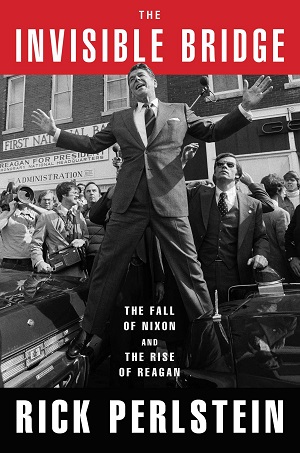
theinvisiblebridgeAdded my review of Rick Perlstein’s The Invisible Bridge over at Good Reports. This is a must-read for political junkies, offering a thorough and insightful interpretation of the ’70s. (For another book on the same subject written by a kindred spirit I recommend Dominic Sandbrook’s Mad as Hell. For a more academic analysis, James T. Patterson’s Restless Giant. Or, if your tastes are more right-wing, David Frum’s How We Got Here.) Perlstein’s book is quite long and detailed, but manages to forcefully argue a single thesis: that in these years Reagan turned America away from self-criticism toward simple optimism and feel-good nationalism. It describes, in other words, yet another example of the deep and abiding anti-rationality that seems to be inherent in most societies. We should stop being surprised by this. As Perlstein remarks at one point near the end of his survey:

Liberals tend to get into the biggest political trouble when they presume that a reform is an inevitable concomitant of progress. This is when they are most unprepared for the blinding backlash that invariably ensues.

Blinding and blind. “Progress” is neither natural nor ineluctable. We can, and do, go into reverse.


How secretive is the bourgeoisie!

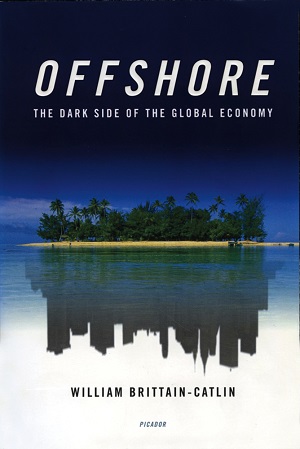
offshoreFrom William Brittain-Catlin’s Offshore:

Yet no one was more adept at preserving himself in modernity than the bourgeois. Like the criminal, he would go undercover, but his cover was the interior of his home. He would escape into his private dwelling, where secrecy would become a fetish against the outside world. The bourgeois would cover up his traces in the interior as he would no doubt cover up the traces of his expropriation scams during the Hausmannization of Paris, with the proceeds and evidence of his criminality kept out of sight of the authorities. “To live in these interiors was to have woven a dense fabric about oneself,” wrote Benjamin: as the crowd was a veil for the criminal, so the interior became a veil for the bourgeois.

The criminal and the bourgeois both hid undercover from modernity, obliterating their traces and protecting their freedom. The criminal hid his traces from the police — undercover, underground. In the bourgeois interior, objects and ornaments were covered in plush and velvet, sealing away what was under them. The bourgeois preserved his freedom with covers and boxes; his home became a shell, his possessions and wealth “removed from the profane eyes of non-owners.” The bourgeois would seek refuge in his library, his art, in his assets, which were the sacred objects of his ideal, free identity.

That the bourgeois continues to preserve his traces in a shell is evident to this day in the private banking and asset management schemes that run through the global offshore financial system, where wealth is protected against its uncovering through mechanisms that completely remove the identity or trace of ownership. The offshore system, built for the bourgeois by a network of other bourgeois — lawyers and accountants — also provides cover for the proceeds of organized crime and white-collar financial crime, money launderers, and corrupt presidents who have stripped their countries bare of assets, proving Benjamin’s point that “a career criminal is a career like any other.” The offshore system today it to corporate, private, and criminal wealth what the nineteenth-century interior was to the bourgeois and what the crowd was to the criminal: a cover behind which to hide their traces from modernity, where the criminal is masked as a bourgeois and the bourgeois unmasked as a criminal.

Or, as the great chronicler of the bourgeoisie had it: The secret of great fortunes without apparent cause is a crime forgotten, because it was properly done.

Devil in the details

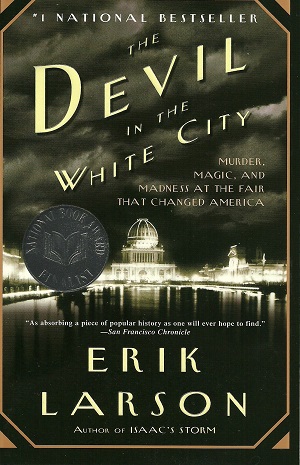
devil-in-the-white-cityAdded my review of Erik Larson’s The Devil in the White City (2003) over at Good Reports. In general I was unimpressed by this one, given how big a fan I am of true crime writing and how successful it was (a “major motion picture” is even reported to be in the works). Larson has been praised for his novelistic style, but I’m afraid this undercut some of my pleasure in the book. In brief, I thought he took liberties with the facts. He insists in his prefatory note that “However strange or macabre some of the following incidents may seem, this is not a work of fiction.” And at the end he mentions his agonizing over how to re-create some of serial killer H. H. Holmes’s murders when there were no witnesses to them. Buttressed by a reading of Capote’s In Cold Blood (perhaps not the ideal text in such a situation) he went on to build his murder scenes by using “threads of known detail to weave a plausible account, as would a prosecutor in his closing remarks to a jury.”

This sounds fair enough, but the fact is that Holmes had a rather bizarre and involved method of doing away with his victims and I think it would have been better if Larson had just admitted our inability to say for sure what happened. Far more troubling, however, was this account Larson gives of Holmes taking a pair of prospective victims on a tour of Chicago:

Holmes took the sisters to the Union Stock Yards, where a tour guide led them into the heart of the slaughter. The guide cautioned that they should watch their feet lest they slip in blood. They watched as hog after hog was upended and whisked screaming down the cable into the butchering chambers below, where men with blood-caked knives expertly cut their throats. The hogs, some still alive, were dipped next into a vat of boiling water, then scraped clean of bristle — the bristle saved in bins below the scraping tables. Each screaming hog then passed from station to station, where knifemen drenched in blood made the same few incisions times after time until, as the hog advanced, slabs of meat began thudding wetly onto the tables. Holmes was unmoved; Minnie and Anna were horrified but also strangely thrilled by the efficiency of the carnage. The yards embodied everything Anna had heard about Chicago and its irresistible, even savage drive toward wealth and power.

I was so struck by this passage that it was one of only two in the entire book that I made a note of. Did Chicagoans in the late nineteenth century really take young ladies out to the slaughterhouse on a date? As anyone who has been inside such a place will testify, they are truly horrifying. And yet Minnie was Holmes’s “wife” and Anna a newly-met sister-in-law.

Alas, this is what we are told in the notes by way of explanation:

Despite the stench and pools of blood, the Union Stock Yards were Chicago’s single most compelling attraction for visitors, and tour guides did indeed lead men and women into the heart of the operation. It seems likely that Holmes would have brought Minnie and Nannie there, partly because of the yards’ status,  partly because he would have derived a certain satisfaction from subjecting the women to its horrors.

“It seems likely . . .”? This will not do. Larson’s passage describing the visit is entirely made up, based on pure speculation. We don’t even know if Holmes ever visited the Union Stock Yards, much less what his reason would have been for bringing these two women on such a tour, or what their response would have been (“horrified but also strangely thrilled”?). Yes, it makes for a colorful passage with heavy thematic overtones (Holmes would run his own slaughterhouse in Chicago, where little would go to waste), but it’s a bit of writing that has no place in such a book.

Waiting for the Great Transformation

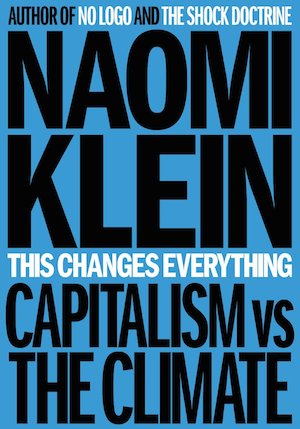
thischangeseverythingAdded my review of Naomi Klein’s This Changes Everything over at Good Reports. I believe the environment is the most pressing issue of our time, and that we are facing great challenges ahead. I don’t see how we’ll be able to hit any of the targets, no matter how modest and insufficient, that have been projected as necessary for keeping global climate change catastrophe at bay. As I say in my review of Klein’s book:

The phrase “Great Transformation” [used by environmentalists] recalls Karl Polanyi’s classic work on the birth of the market economy and the capitalist system, a development contemporary with the Industrial Revolution. That was one of the most profound shifts in all of human history, matched only by the beginnings of agriculture some 12,000 years earlier. And as Polanyi noted, the (first) Great Transformation marked a change not only in human society but in human nature.

The work of the next Great Transformation will be to effectively undo all of this, creating a new economy, or human ecology, and a new human nature, all within the next decade or so. A tall order, for which there is no historical precedent, despite Klein’s best efforts at finding one.

This is a subject I’ve returned to many, many times over the years, often repeating myself. Here, for example, is what I had to say in a review of Annie Leonard’s The Story of Stuff:

With all due respect to Annie Leonard, and I am deeply sympathetic to her concerns, her sharing, caring community in downtown Berkeley is not a viable model for a new economic order. It is an enclave, existing within and supported by industrial civilization. As Leonard correctly points out, it was the Industrial Revolution that changed the world and turned our economy into one based on mass production and mass consumption. To change things – either “back” or forward, if there is a difference – means to some extent undoing the Industrial Revolution. Unfortunately, that revolution has turned into what Ronald Wright, in A Short History of Progress, describes as a “progress trap.” There simply is no way out of it because of the sacrifice involved in tearing ourselves free.

It’s rare, and usually not a very good idea, for a reviewer to inject personal, biographical information into a review, but in this case I feel it’s warranted. I grew up, and spent a great deal of my life living on a farm. Briefly the house had no plumbing. We used an outhouse. We churned our own butter for years. We baled hay in the summer using small bales that had to be loaded and unloaded by hand. We cleaned out cattle stalls all winter – every day, seven days a week – by pitchfork. Today, I know of very few farmers – aside from the local Mennonites – who live like this. Hay is baled in massive round bales, stalls are cleaned out by automated systems or small tractors. Butter is so cheap there’s no point making your own. Or even, for that matter, growing your own vegetables (as we always did).

Most of the people I know would, I think, rather die than live the idyllic life I did growing up. And yet this is what a truly post-industrial, environmentally sustainable civilization would look like. Except it would be worse. We would not live in urban communes like Berkeley, but have to work as peasants. To pretend otherwise, to say (as many do) that we can live environmentally and still enjoy something approximating our current standard of living is the noble lie at the heart of a lot of environmental talk. Our world would be changed utterly. Even those of us lucky enough to reside in towns would find work far more labour-intensive and uncomfortable, with far less leisure time. Would we be healthier? Almost certainly. Would it be better for the planet? Absolutely. But it would not be anything like what we see described in this passage from Alan Durning that Leonard endorses:

“Accepting and living by sufficiency rather than excess offers a return to what is, culturally speaking, the human home: to the ancient order of family, community, good work, and good life; to a reverence for skill, creativity, and creation; to a daily cadence slow enough to let us watch the sunset and stroll by the water’s edge; to communities worth spending a lifetime in; and to local places pregnant with the memories of generations.”

In other words, a return to a News from Nowhere sort of medievalism. It sounds like the vision of Princess Nekayah [in Samuel Johnsons’s novel Rasselas], and is just as likely to be realized. When Pol Pot wanted to send Cambodians back to the land he had to do it at the point of a bayonet, and even so he ended up killing millions.

As I said at the end of my review of Rubin’s book [Jeff Rubin’s Why Your World Is About to Get a Whole Lot Smaller], three things will be needed to respond to the challenge of finding an environmental balance for modern civilization, each of which is a total non-starter politically: real sacrifice, meaning accepting at least some diminishment, and probably quite a lot, in our quality of life; a spirit of radical egalitarianism, meaning we all sacrifice equally; and a global consensus on action, since the problems we face have global ramifications. To say that Leonard is right in pointing out the dangers of not doing anything, of just continuing to live the way we live now, is almost beside the point. We know smoking is bad for you – a major cause of cancer and heart disease – but people still smoke. We know fast food will kill you, but that hasn’t stopped billions of people from eating it.

And these are examples where the ill effects of our behaviour are personally and (relatively speaking) immediately felt! The fact of the matter is that we are not a rational species, and we’re even worse when it comes to planning for the future.

I hate to seem this cynical, but I honestly can’t see any way out. Elizabeth Kolbert was of a similar point of view in her review of Klein in the New York Review of Books:

To draw on Klein paraphrasing Al Gore, here’s my inconvenient truth: when you tell people what it would actually take to radically reduce carbon emissions, they turn away. They don’t want to give up air travel or air conditioning or HDTV or trips to the mall or the family car or the myriad other things that go along with consuming 5,000 or 8,000 or 12,000 watts. All the major environmental groups know this, which is why they maintain, contrary to the requirements of a 2,000-watt society, that climate change can be tackled with minimal disruption to “the American way of life.” And Klein, you have to assume, knows it too. The irony of her book is that she ends up exactly where the “warmists” do, telling a fable she hopes will do some good.

In her response to Kolbert, Klein emphasized that her “book is about the huge public policy shifts needed to make . . . low-carbon choices far easier and accessible to all. It is, therefore, a book first and foremost about ideology, and the need for a dramatic move away from the dominant free-market logic that has made so many of these necessary policies seem politically impossible.”

This is fine as far as it goes, and I am in broad agreement with Klein that what is necessary is a transformation of our entire world view if we want to create a sustainable society. But Kolbert’s rejoinder is also correct:

I wrote that I found much of her book compelling, but indicated that, on several crucial issues, I found it vague. In particular, I wrote that the book glossed over the really significant—and politically unpopular—changes in American life that meaningful climate action requires.

Klein’s letter only confirms this assessment. She reiterates a claim she makes in her book that as far as cutting consumption goes, “we would need to return to a lifestyle similar to the one we had in the 1970s, before consumption levels went crazy in the 1980s.” This claim is either purely impressionistic or just plain wrong. If you look at the figures, which, once again, are readily available online, you’ll see that since the 1970s, per capita energy consumption in the US has actually declined, as have per capita emissions. How far back would we have to go to make the kind of difference that’s needed?

How far back? To a time before the first Great Transformation, before the Industrial Revolution and all it brought with it. To be fair, there are those who believe that with new technologies we can continue to maintain today’s high standards of living with a “steady state” or “zero growth” economy. In my Story of Stuff review I called this the “noble lie” of environmentalism, but it’s one that many people believe in. Marq De Villiers made the argument in Our Way Out:

De Villiers says we can still enjoy the fruits of advanced technology and live “as well as, or perhaps better than, the well-off do now” in a green society.

I find this very hard to believe.

There is another s-word that cannot be dis-attached from the idea of sustainability: sacrifice. Yes, we could all do more with less energy and shrink our carbon footprints to a fraction of their present size. The economy as currently structured is incredibly wasteful. What’s more, living locally and consuming less may very well make us healthier and happier, both as individuals and as a society.

But so what? De Villiers’s principles may be perfectly rational, but reason has nothing to do with the way we live our lives. What we want is comfort and convenience, status and respect. To take an obvious example: we know that cigarettes and fast food are expensive luxuries that are bad for us, but they are still industries worth billions of dollars. And these are products that impact our personal health directly! We haven’t been able to give up cigs and greasy burgers even to save our own lives. Our concern for the future of the planet is probably less of a priority.

It is hard to imagine our being able to enjoy lifestyles even in the relatively near future that are anything close to those in the West now. But, as George W. Bush so eloquently and correctly put it, the American way of life is non-negotiable. Some people dream of living a life off the grid, growing their own veggies, darning their own socks, using public transit, turning vacations into stay-cations, and all the rest of it. But most of us would draw a line in the sand long before giving up air conditioning, air travel, and an expensive home entertainment system.

I want to be optimistic, but as you can tell from these review excerpts, I’ve been saying the same thing for years now and haven’t read any evidence to change my mind. We may be on the cusp of a Great Transformation, but it won’t come through planning, or willingly.
Kitten Coupland

Added my review of Douglas Coupland’s Kitten Clone over at Good Reports. I’ve been pretty harsh on Coupland over the years, so I’m happy to say that Kitten Clone, which is about the corporation Alcatel-Lucent and the digital revolution generally, is one of the best books I read in 2014. It’s a dispiriting story (the employees of Alcatel seem a rather sad and pessimistic bunch, at least to me), but Coupland’s report is lively, mature, and full of insight. I hope we’ll get more like this from him.