Jesus pics

Over at Good Reports I’ve posted a quick review of Stephen Prothero’s American Jesus. It’s a fascinating exploration of the way representations of Jesus have changed over time, evolving to meet the demands of a changing audience. The only bad thing about the book was that the reproductions of the artwork in the paperback were pretty crude and hard to make out. So I went online to find some of them, and expanded my search outside of Prothero’s range, both forward and back.

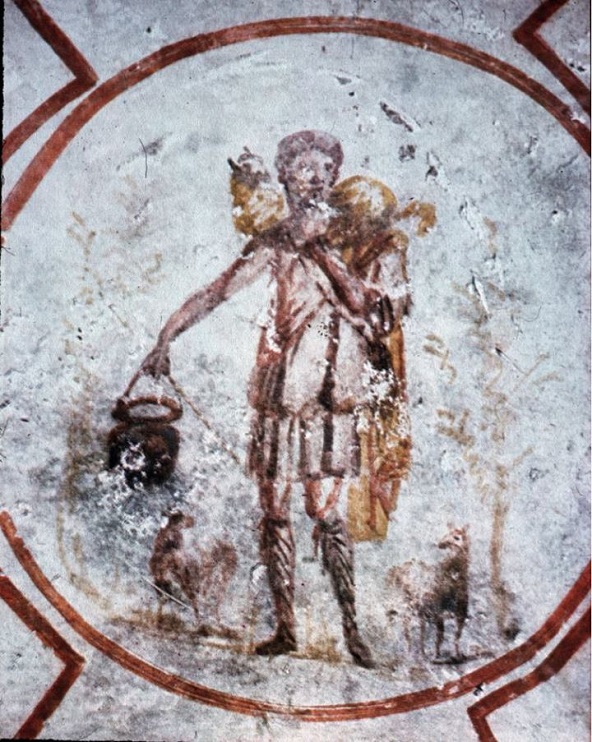
Fresco from the Catacomb of Callixtus, 3rd century. The first depictions of Jesus were as the good shepherd, a beardless youth. Jesus wouldn’t be depicted with a beard until the late 3rd or early 4th century.

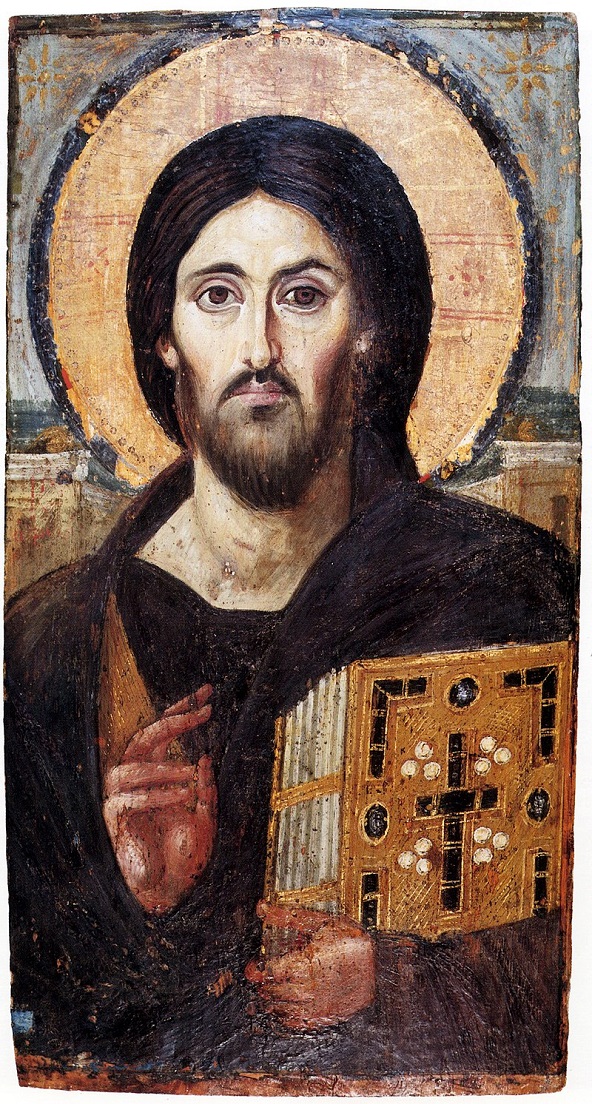
Christ Pantocrator, 6th century panel icon.

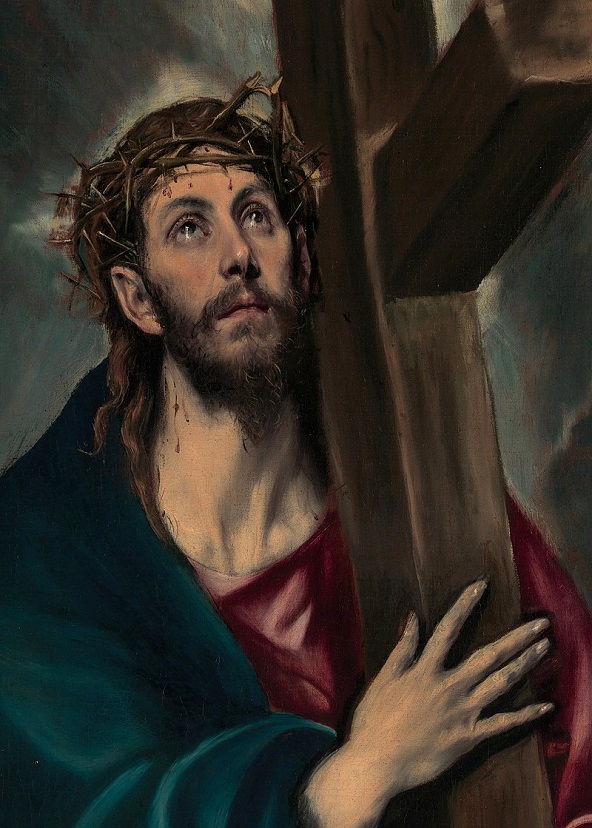
El Greco, “Christ Carrying the Cross” (1580).

Heinrich Hoffman, “Christ’s Image” (1894). Prothero: “During the first decades of the twentieth century, reproductions of Hoffman’s works appeared in hundreds of books and churches across the United States. They also provided Americans with their most vivid and enduring images of Jesus.”

Warner Sallman, “Head of Christ” (1940). Prothero: “As of the turn of the twenty-first century, over 500 million copies had been produced, making ‘Head of Christ’ the most common religious image in the world.”

Willis Wheatley, “Christ, Liberator,” better known as “Laughing Jesus” (1973).

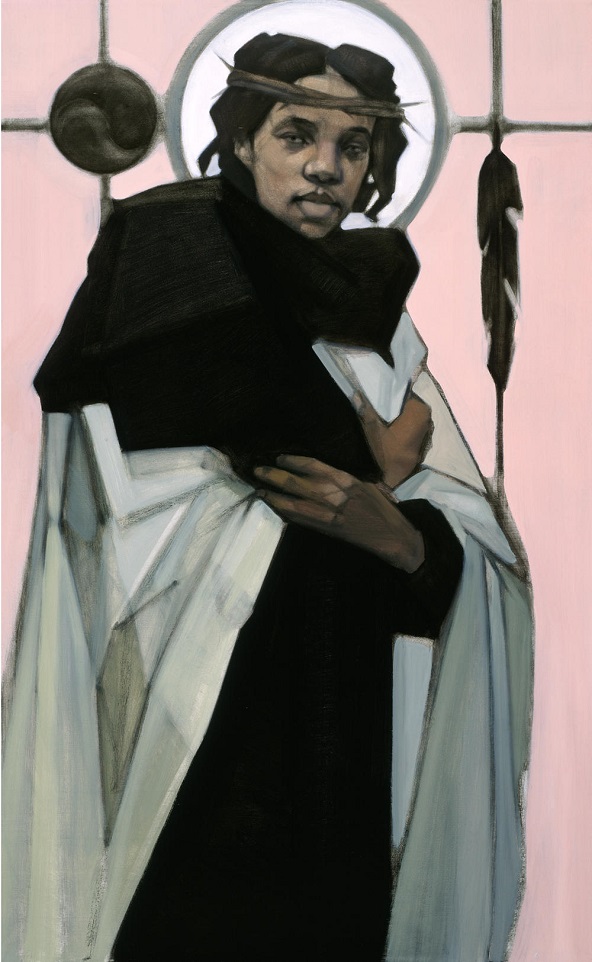
Janet McKenzie, “Jesus of the People” (2000). McKenzie won the National Catholic Reporter’s worldwide art competition “Jesus 2000″ with this painting.

Bas Uterwijk, “Jesus” (2020). The Irish Catholic: “Speaking about the techniques Mr Uterwijk used in the development of the image, Dr Caffrey said it ‘builds on the traditional iconography of Jesus Christ. He has specialised in making portraits of historical figures using Artbreeder which uses GAN (generative confrontation network) to create a new image that looks realistic and gives life and personality to representations of famous people which are derived from paintings or sculpture.'”

DNF files: A Fatal Thing Happened on the Way to the Forum

A Fatal Thing Happened on the Way to the Forum: Murder in Ancient Rome

By Emma Southon

Page I bailed on: 140

Verdict: I felt somewhat the same way to this one as I did to Murder Book. Just not my thing. I love reading ancient history, and this seemed like a good fit with my true-crime site, but it’s written in the same jokey, irreverent style that I can only take so much of.

On Southon’s website no less an authority than the Wall Street Journal declares that “At a moment when the study of classics struggles to escape its starchy, imperialist legacy, Southon’s cheeky enthusiasm feels like the path of salvation.” So that’s the pitch: making classical literature and history more accessible to people who wouldn’t normally read a book on this subject. However, I would normally read a book on this subject, so the path of salvation just felt to me like dumbing things down. There are a lot of books on ancient Rome written for a non-academic audience that don’t sound at all like this, and I think they’re not only more enjoyable but more accurate as well. Being a slave in the Roman Empire was no picnic, for example, but I don’t think it’s true that all slaves were “subject to the most extraordinary violence every day.”

I’m not saying Southon doesn’t know her stuff. I’m sure she does. But the writing here is all “yeah,” “yada yada yada,” “wow,” “really really,” and “sorry not sorry.” We’re even told that killing Caesar was “a pretty big fucking deal.” Which it was. Sure. And then there all of the pop culture references that made me feel like I was doing an Internet quiz. I know who Marty McFly and Patrick Bateman are, but mistakenly thought Shaggy was a reference to the character from Scooby-Doo and pulled a blank on Grand Designs. Is this a home reno program? I wasn’t interested enough to find out.

According to the Booklist review, writing like this “provides not only humor but a sense of relevance to today’s world.” I don’t know what “relevance” means when it’s used this way. Southon is apparently involved in some kind of history podcast, and the prose here has that sort of random, conversational style. Maybe it works better as an audiobook. But then Mike Duncan’s book on ancient Rome, The Storm Before the Storm, which was very popular with a mass audience, also grew out of a podcast and it wasn’t written like this so I’m still wondering who this book was directed at.

It’s likely you’ll learn something, but Southon just tends to go from story to story,  a number of which she confesses are totally irrelevant, without much of a larger point to make. I stopped where I did because it was the middle of a chapter on slavery and murder and even though I’d been dimly aware of the politically correct movement to replace the word “slave” with “enslaved person” I hadn’t actually confronted it before. I’m sure it’s well meant and can be justified, but to call it awkward isn’t the half of it. I just couldn’t take it anymore.

The DNF files

TCF: The House of Gucci

The House of Gucci: A Sensational Story of Murder, Madness, Glamour, and Greed
By Sara Gay Forden

The crime:

Maurizio Gucci, former head of the luxury fashion and accessories company that his grandfather founded, was killed on the morning of March 27, 1995. His ex-wife, Patrizia Reggiani, had put the hit out on him, a crime for which she spent 18 years in prison.

The book:

This was a widely celebrated book even before Ridley Scott’s (overrated) 2021 movie, which had Lady Gaga playing Patrizia and Adam Driver as Maurizio. But while I thought it was readable, mainly due to its inherently interesting subject matter, I didn’t much care for it.

More than a true crime book, it’s mainly a history of the Gucci company, though that’s a history that involved a fair bit of shady dealings, mostly involving tax evasion schemes. (In a charming aside, Forden talks about how some of the financial maneuverings that were illegal at the time would be permissible today because of the “liberalization” of Italy’s laws. I’m not sure, but I think she registers this as some kind of progress.) I admit I have little interest in the world of fashion, but as a business story it works. Plus the family in-fighting is fabulously Italian, in a tradition running from the Borgias to the Corleones.

I had a couple of difficulties with Forden’s writing though.

In the first place, she has an annoying habit of skipping around instead of sticking to a strict through chronology. I got confused at figures like Paolo Gucci dying and then coming back to life, or Silvio Berlusconi being described as a “former Italian prime minister” in what I think is 1993 (Berlusconi first came to power in 1994, and would serve as prime minister off-and-on up until 2011). I assume this was a typo, of the same sort that has Paolo referred to as Aldo Gucci’s “youngest son,” but that were a lot of moments like this that had me mentally scrambling trying to get dates in order. Yes there are different threads being followed, but anyone who writes narrative history has to try to keep them straight. For example, it’s painful to read an account of the landmark YSL fashion show in March 2001 and then be jerked back with what had been happening a week earlier on the legal front. As a reader you start to get whiplash.

The other problem I had was with Forden’s attempt to make the events seem more dramatic by presenting them novelistically. Again, this is something every historian has to deal with in some way: how do you describe a particular historical actor’s thoughts and feelings at a certain time? In her section of Bibliographical Notes Forden explains her approach:

References to what a person was thinking are based on extensive research into the situation and the person’s frame of mind at the time according to people close to him or her or other reliable accounts. In dramatizing contemporary conversations, I have based dialogue on conversations with one or more of the participants.

That sounds fair, but vague, with a lot of wiggle room. What it results in though is passages like this, describing Maurizio at his uncle Aldo’s funeral service:

As Maurizio stood by himself in the chilly church, he looked down at his clasped hands in front of him and let the rise and fall of the priest’s voice float through his mind. He pictured Aldo scaling the stairs of his Via Condotti office two at a time, barking orders to his salesclerks right and left, or holding court in the New York store, signing Christmas packages. His mind’s ear heard Aldo’s voice repeating his old adage about the dynamics of the family – “My family is the train, I am the engine. Without the train, the engine is nothing. Without the engine, well, the train doesn’t move.” Maurizio smiled. As the mourners around him shifted their feet and dabbed their eyes with soggy tissues, Maurizio unclasped his hands, then clenched and unclenched his fists as though for warmth.

Reading stuff like this in a work of non-fiction gets my back up. How do we know what was floating through Maurizio’s mind at this exact moment, or what he was hearing in his “mind’s ear”? Perhaps there’s a source, but I doubt it’s this specific. And there’s quite a bit of this sort of thing here. At one point we even follow Maurizio into the confessional. I remember commenting on an even more egregious moment like this in Erik Larson’s The Devil in the White City years ago. If you don’t know how something happened, or even if it happened, then you shouldn’t pretend as though you do.

Noted in passing:

In explaining his reasons for giving Patrizia a twenty-nine year sentence instead of life (which is what the trigger man got), the judge at her trial gave her diagnosis of having narcissistic personality disorder (NPD) as a mitigating factor. This really turned my head around. While not a legal defence, the fact that one is a pathologically entitled asshole can actually reduce one’s sentence? This would mean that narcissists are actually victims of their “condition.” What sense does that make?

The edition I read was published as a tie-in to the movie, with the familiar banner on the cover about how it was “soon to be a major motion picture.” This made me wonder when a “motion picture” has ever not been “major.” I don’t think I’ve ever seen a book with a blurb like this on a cover say it’s soon to be or now is just “a movie.” It’s always a motion picture. And a major motion picture at that. It’s almost like those exact words are some kind of legal requirement.

Takeaways:

Family businesses rarely work out in the long run because money is more important than blood. That may seem unnatural, but we live in an unnatural world. Meanwhile, not being a publicly-traded company means that a family business is, at least to some extent, free to operate above or beyond the law. Hence the timelessness of these bloody dynastic struggles.

True Crime Files

NSFW: Archeology edition

Sex doll. The early days.

When I was in first year of university I took a course that I don’t remember very much from except something about “cultural universals.” This refers to things that people do in every human society, at all stages in their development. Apparently there aren’t many of these. I think one was the avoidance of human waste (feces).

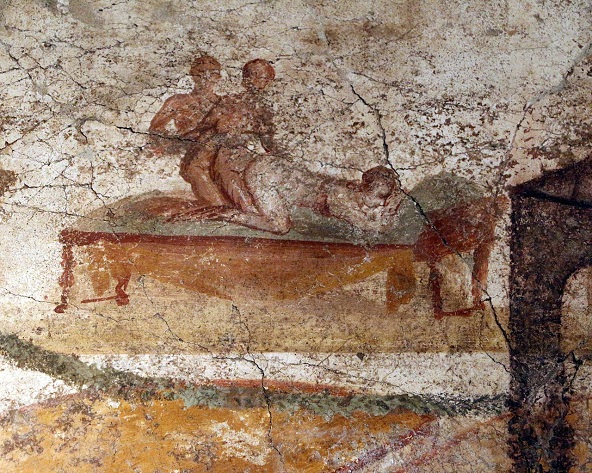
Pulling a train in old Pompeii.

I’ve always thought pornography might be another. Porn gets a lot of attention in the media because it’s a (politically) sexy topic that people can’t seem to get enough of reading about. Does it corrupt youth? Does it program men and women with unrealistic fantasies about what people should look like and behave? Is it addictive? Does it lead to sexual violence, or does it sedate a population of incels who might otherwise act out violent fantasies? Is it inherently misogynist, or empowering for women? Should we even call it porn or, if we feel it’s distinguished enough, do we have to refer to it as “erotic art”?

Laying pipe.

These points have all been argued endlessly, and the debate will likely continue. What strikes me though is the point that porn in some form has always been with us. The Venus of Willendorf, for example, may be a fertility idol, but it’s also porn. What’s more, while it hasn’t always indulged the variety of today’s smorgasbord of fetish, even in ancient times porn was plenty explicit and stepped well outside the boundaries of sexual activity solely directed toward procreation. Our distant ancestors might not have had alien tentacle sex, but they did have Pan copulating with a goat. What’s more, this historical ubiquity held true from the suburbs of Pompeii (buried in 79 CE) to the valleys of the Moche (a South American civilization that flourished ca. 100-800 CE). It’s even popped into religious sites, from the mithuna figures in ancient Hindu temples to the sheela na gigs in twelfth-century Britain. Porn is a cultural universal.

The gang’s all here.

You’re welcome.

More than a cuppa.

I’m not saying this makes porn, or any particular variety of porn, good or bad. I’m just saying it’s always been, and something like it will always be, with us.

Dirty old goat.

DNF files: The Cult of Trump

The Cult of Trump: A Leading Cult Expert Explains How the President Uses Mind Control

By Steven Hassan

Page I bailed on: 129

Verdict: It’s not bad for what it is. The author is a former Moonie who was deprogrammed and he draws on that experience as well as his subsequent work in the field to look at Trump as a cult phenomenon. He makes a number of valid points, though I think there are limits to how useful such a lens is. Basic propaganda paradigms probably work better. In any event, I had to quit because it was getting repetitive. Plus, this is the sort of book I pick up to learn something from and I didn’t feel that was happening.

The DNF files

TCF: The Great Pearl Heist

The Great Pearl Heist: London’s Greatest Thief and Scotland Yard’s Hunt for the World’s Most Valuable Necklace
By Molly Caldwell Crosby

The crime:

On July 16, 1913 the most expensive necklace in the world was stolen out of the mail. Converting figures into today’s dollars is not an exact science, but by Molly Caldwell Crosby’s calculations the necklace, which was a string of sixty-one pearls, may have been worth anywhere from $18 million to $120 million. She also pegs its value as twice that of the Hope Diamond.

Only a few months later, four members of a gang of London jewel thieves were tried at the Old Bailey and convicted of the theft. All but one of the pearls was finally accounted for.

The book:

I thought this was a great read, telling the story of a fascinating historical crime that I knew nothing about. I’m not sure why the case was subsequently, in Crosby’s words, “all but lost to history,” as at the time it was huge, with the trial built up by the press as yet another “trial of the century.” (As an aside: how many trials of the century were there in the twentieth century? The Lindbergh kidnapping trial and the O.J. Simpson trial have both received that billing, and I think arguments could be made for either.)

Crosby suggests that the outbreak of the First World War pushed a lot of the big news items of the pre-War years, or Belle Époque, not just off the headlines but out of public memory. I think this is probably right, as I was often thinking while reading this book of the theft of the Mona Lisa in 1911, which was also a big story at the time but which has mostly been forgotten about today (though there were a couple of books that came out about it in 2009: The Crimes of Paris by Dorothy and Thomas Hoobler and Vanished Smile by R. A. Scotti). The two cases had a similar cachet, which was recognized by contemporary observers, as the New York Times called the necklace “the Mona Lisa of pearls.” And by coincidence the trial of the pearl thieves ended the same week as the Mona Lisa case was resolved.

But as much as I liked it, I have tocall The Great Pearl Heist out on a few counts.

In the first place, it gets failing grades on the visual materials. The photo section has a bunch of pictures, but some of them are of no relevance to anything in the book. The Ten Bells Pub is shown because it “was a favorite haunt for Ripper victims.” What has that to do with anything? Meanwhile, the only picture of any of the thieves is a small, poorly-reproduced shot taken from a newspaper story where they are all shown in profile standing in the dock. The only picture of the lead detective is an even smaller picture, also cropped from a newspaper page and also a group photo, where you can barely make him out. A picture section like this is arguably no better than no picture section at all, which is something I could also say for the single map provided. A good map of the Hatton Garden area showing the location of the different shops would have been nice. But the only map is a crowded one showing a good chunk of London. What’s worse is it looks like a contemporary map, which means it’s almost impossible to read. I didn’t bother referring to it once, recognizing right away that it would be useless.

A second point has to do with the way Crosby fashions the story into a contest between “London’s greatest thief,” the gang leader Joseph Grizzard, and Scotland Yard’s top detective at the time, Alfred Ward. This is the usual formula of cops and robbers, but it doesn’t fit the facts of this case that well. The theft was unraveled only because a pair of continental jewel traders sold the gang out in hopes of getting the reward being offered for the necklace’s return. Ward then had to properly land Grizzard and his accomplices in a sting operation, which was well done but isn’t great detective stuff.

Finally, Crosby says there was a “lengthy legal battle” to determine who got the reward in the end, but doesn’t say how it worked out.

Noted in passing:

When looking at Grizzard’s motives for adopting a life of crime, Crosby quotes a snippet from a letter written by the poet William Blake:

Want of money and the distress of a thief can never be alleged as the cause of his thieving, for many honest people endure greater hardships with fortitude. We must therefore seek the cause elsewhere than in want of money, for that is the miser’s passion, not the thief’s.

This is an interesting take on criminal psychology. After the theft, the New York Times would suggest something a little grander than money as a motivating force: “the theft was committed just for the ‘glory’ of the thing and . . . the purloiner ranked among the great criminal artists.”

Personally, I’ve thought most thieves, at least of the common break-and-entry variety, not so much greedy or artistic as lazy. They think having a real job is too much work and would rather just grab money when they need it in the quickest way possible. Though for someone like Grizzard, and a few other frauds and swindlers that I’ve known, stealing isn’t always easy. Indeed, I’ve often wondered about burglars who put as much effort, and run far greater risks, to steal money that they could have made more of in a much easier, and legal, way.

Grizzard would fall back into his criminal ways after his release from prison, perhaps because it was the only thing he knew how to do. Or perhaps there’s something to the realization Walter White comes to at the end of Breaking Bad: that some people just take to a life of crime when they find out they’re good at it.

I’d also like to note all the wonderful names in this story. Grizzard is a great name for a master of crime, and it’s fitting that he should have been undone by a seedy underling named Lesir Gutwirth. Meanwhile, the jewel agents fishing for the reward were Samuel Brandstatter and Myer Quadratstein. I stumbled over the latter every time I read it. But the winner in the great-name lottery is Nicholas If-Jesus-Christ-Had-Not-Died-For-Thee-Thou-Hadst-Been-Damned Barbon. I think Crosby just wanted to drop his name into the mix for the sound of it, since he was a seventeenth-century economist who doesn’t have any connection to the rest of the story.

Takeaways:

Any criminal conspiracy is only as strong as its weakest link. This one was undone by the aforementioned Lesir Gutwirth. Just because.

True Crime Files

Maigret: Maigret’s Informer

In my review of Maigret’s Madwoman I mentioned Simenon’s habit of introducing little “fillips for fans”: recollections of earlier books in the series that are then slightly adjusted. Typically a name is changed. Maigret’s Informer might be another example of this, as the informer in the title is a little guy known as the Flea and I had to wonder if he was the same character as appeared in Maigret at Picratt’s as the Grasshopper. I think he is. The same, but different.

The Maigret novels where the detective chief inspector takes on gangsters are, I think, the worst in the series. Because Simenon doesn’t write action scenes well and because gangsters aren’t very interesting psychological cases to begin with. Why do they kill people? Because they’re in the way or it’s just business.

Maigret’s Informer is a gangster novel with a very dull murder at its heart. The old boss has a young wife who is screwing around on him, and she and her younger lover (a new boss) conspire to kill him. They actually stand a good chance of getting away with it too, but the informer trips them up and after being arrested they abruptly fall out in an ending that plays like a weak rehash of the end of Maigret and the Saturday Caller.

I didn’t find this one worth bothering with at all. The funereal Inspector Louis was a bit interesting, but that was it. Otherwise it was just the usual dull round of Maigret going about interviewing those indispensable Paris concierges before heading to the bar, or going home so that Madame Maigret can take care of him. She even packs his luggage for him when he has to head down south. Ah, they don’t make helpmeets like that anymore.

Maigret index

Man and Trump and God

Holding a book he’d never read, standing before a building he’d never been in.

Over at Good Reports I’ve added an omnibus review of a bunch of a books on evangelical support for Donald Trump. Much of the Trump phenomenon is meant to generate outrage, but the support of the religious Right or Christian nationalist movement is probably the most outrageous thing about it of all.

It’s hard to imagine Trump coming back, but as of this writing he’s still the frontrunner to be the Republican standard bearer in 2024. The rot in the American body politic goes deep. What’s worse is that it’s hard to see how the conditions that gave rise to Trump are going to improve anytime soon. I may be reviewing more books like this again in another couple of years.

TCF: Kiss of Death

Kiss of Death: True Cases of Fatal Attraction
By Jean Ritchie

The crimes:

“The Giggling Blonde”: after being arrested for trying to kill her third husband with a baseball bat and a carving knife, Dena Thompson is convicted of killing her second by poisoning.

“Smiley Kylie”: Kylie Labouchardiere is murdered by Paul Wilkinson.

“One Go Was Not Enough”: Jill Cahill barely survives a first attempt on her life by her husband Jeff, who then sneaks into the hospital she is recovering in and finishes the job with cyanide.

“Lover in the Wardrobe”: Martha Freeman has a man living in her wardrobe for a month before her husband finds out (he hears him snoring). The two lovers then strangle the husband.

“All for a Life in the Sun”: Tina Strauss can’t handle moving from a Jamaican estate to the north of England and so threatens to leave the man she dumped her wealthy husband for. He kills her and buries her in the backyard.

“The Royal Aide Who Couldn’t Take Rejection”: Jane Andrews worked as a personal assistant to Sarah, Duchess of York. She didn’t like it when men rejected her, and kills Tom Cresswell (with a cricket bat and a knife) when he wouldn’t marry her.

“Left in a Car Boot to Die”: Joe Korp talks his mistress into killing his wife. She does a horrible job of it, with Maria Korp’s case becoming a controversial one in Australia when she was taken off life support in hospital.

“Not One Dead Wife, but Two”: Drew Peterson kills his third wife and disappears his fourth.

“If I Can’t Have You”: Bombay-born doctor “Buck Ruxton” kills his wife and housemaid and cuts their bodies into little pieces.

“Did She or Didn’t She?”: Carolyn Warmus falls for a married man and is convicted of killing his wife. She continues to maintain her innocence.

“A Fit of Conscience”: Lovers Colin Howell and Hazel Stewart conspire to kill their spouses and stage it as a double suicide. Their plan works, but twenty years later Colin confesses and they both go to prison.

“Body in the Fridge”: Laren Sims and gal pal Sarah Dutra kill Laren’s husband, storing his body in a fridge for a while before burying it in a California vineyard.

“Kinky Cottage”: Max Garvie lived a swinging lifestyle in the northeast of Scotland, but is killed by his wife and his wife’s lover.

“Killed by a ‘Bag for Life’”: apparently a “bag for life” is made of particularly strong plastic. Pharmacist Mitesh Patel uses one to suffocate/strangle his wife.

“The Go-Go Dancer and the Cat”: John Perry travels to the Philippines for some sex tourism and picks up a wife. He expects a submissive helpmeet, so when she starts showing signs of independence, including having an affair with a neighbour, Perry kills her. He has trouble getting rid of her body though.

“Desperate Measures”: Mary Pearcey kills her lover’s wife in Victorian London.

“The Exotic Dancer with Two Boyfriends”: Catherine Woods goes to NYC in the hopes of becoming a dancer. She’s killed by a jealous boyfriend.

“The Parachute ‘Accidents’”: two otherwise unrelated cases involving a woman sabotaging a rival’s parachute to get rid of her and a man doing the same to his wife. The wife actually survives.

“Killed by the Dog She Loved”: Dolly Kaplan is killed by a pet pit bull terrier that her boyfriend turned on her.

“The Army Wife”: Christina Dryland runs over her husband’s mistress in her Saab.

“Kinky Sex and a Brutal Murder”: a lesbian couple who are also professional dominatrices have a falling out and the one arranges the other’s murder.

“So Much for Rehabilitation”: John Tanner kills his girlfriend, an Oxford student, and is sent to prison, which does not lead to his reform.

“A Vengeful Suicide”: Paul Dunn is charged with killing his wife with a shotgun, but at trial he is acquitted because it may have been suicide.

The book:

A good selection of cases that stick close to the theme of fatal attractions. In fact, at least one of them, the Warmus case, was dubbed by the press “the Fatal Attraction killing.” Each crime is described in 10-15 pages, so the writing is pretty basic sketchwork. At the same time, since they tell such a familiar, and in many instances repetitive, story there’s little need to go into detail.

Most of the cases aren’t that well known. I suppose everyone will have heard of Drew Peterson, but aside from him the others are pretty obscure. Some were notorious at the time but have since faded from public memory, while some played more in local media. Still others, though tragic, don’t stand out as noteworthy at all.

As noted by Ritchie in her Introduction, you’re more likely to be killed by someone you know intimately than by a stranger. And the domestic killers we meet here fall into easily identifiable gender stereotypes. The men tend to be violent and controlling. They are looking for partners who are submissive and loyal, with John Perry being only the most blatant example: “What John wanted from a woman was the house kept clean, meals on the table and unquestioning obedience. He wanted to be lord of his own home, and he had been unable to find a woman who would treat him with the deference he felt he deserved.” There’s a lot of that here. Meanwhile, many of the women are chasing status and lifestyle, or are threatened by the loss of the same when their husbands go wandering.

Nobody gets what they want, so they take their frustrations out in violent ways.

Sticking with the book’s theme, I found myself wondering to what extent these could truly be called crimes of passion. A lot of the killers here, male and female, had hyperactive sex drives, but they were indiscriminate as well as insatiable and they didn’t kill for kicks. Another point is that the killings were frequently just a way of getting rid of a spouse or lover who had become a drag. It’s rarely the case that each man kills the thing he loves. People are more likely to kill someone they’ve stopped caring about at all.

Noted in passing:

Several firsts are included in the line-up. The body parts discovered in the Buck Ruxton, or “Jigsaw Killer,” case had maggots growing in them, which allowed an entomologist to date when they’d been tossed away. Apparently those maggots “are now preserved in the insect archives of the Natural History Museum because this was the first time insects had been used in forensic investigation.” Then the pit bull killing Dolly Kaplan is said by one of the investigating detectives to be “the first case in the history of the world where somebody was charged with using an animal as a murder weapon and successfully prosecuted.”

The “first” I found most interesting though was more recent. This was the use of the iPhone health app to track Mitesh Patel’s suspicious movements within his house on the day he murdered his wife. This could be done on a granular level because motion processors not only monitored the number of steps he was taking but the difference in going up stairs. I know tracking locations by way of phones had been used before in cases, but I didn’t know it could be used this precisely (yet). Patel’s trial was in 2018 and apparently it was the first time such evidence had appeared in a UK case.

Takeaways:

When considering so many case studies of relationships gone bad it’s natural to look for any warning signs – the proverbial red flags – that were missed. I think there are clear patterns that stand out.

Some of these are so obvious they seem barely worth drawing attention to. Men who seem overly controlling or who show any proclivity at all toward violence should be avoided at all costs. If you find out people regularly lie or cheat (to the point of even adopting various aliases) you should also take that as a danger sign.

Perhaps less obvious, especially in an age where serial monogamy is now an established norm, is that someone (man or woman) who has been married and divorced two or three times before they’re forty, and has kids from at least a couple of those marriages, is probably a bad bet. Anyone can be given a mulligan for having one committed relationship going down the tubes, but if there’s a pattern you should take it as fair warning and pay heed to Samuel Johnson’s adage about second marriages being the triumph of hope over experience.

True Crime Files
Playing pocomon

Trolling too hard to be a true poco.

I recently re-read Ford Madox Ford’s great novel The Good Soldier (the saddest story, but pure joy!) and came across this sentence near the end describing the casual lifestyles of the local gentry: “It is queer the fantastic things that quite good people will do in order to keep up their appearance of calm pococurantism.”

I’m sure I knew what pococurantism meant at some point — I last read The Good Soldier thirty or so years ago — but I pulled a blank here and had to pull out the dictionary. As a noun, pococurante is defined as a careless or indifferent person, someone who displays a lack of concern. As an adjective, someone who is careless, nonchalant or apathetic. It comes from the Italian poco (“little”) and curante (present participle of “to care,” or “caring”).

In fact, it’s a word with a solid literary pedigree. In Voltaire’s Candide there’s a Senator Pococurante and Laurence Sterne uses it Tristram Shandy. As near as I can tell, it’s traditionally been used to carry a negative connotation. A pococurante is an idle person who’s not doing anyone any good. Perhaps someone shirking their duties and responsibilities. When the Ashburnhams in Ford’s novel affect the appearance of “calm pococurantism” it’s a bit like conspicuous comfort and being above it all. Or, as a former first lady’s coat once put it, “I really don’t care. Do U?”

But I like to see pococurantes in a more positive light. Isn’t pococurantism a little like the classical Greek notion of ataraxia? Or the modern cool? Still, there are moments where one should be cool and care, as Thomas Pynchon once put it. In such cases the word, which sounds silly enough, still makes a handy pejorative.

Words, words, words