
“Glass of Water and Coffee Pot” by Jean-Baptiste-Siméon Chardin (1760).
“The Red Wheelbarrow” by William Carlos Williams (1923):
so much depends
upon
a red wheel
barrow
glazed with rain
water
beside the white
chickens
“Glass of Water and Coffee Pot” by Jean-Baptiste-Siméon Chardin (1760).
“The Red Wheelbarrow” by William Carlos Williams (1923):
so much depends
upon
a red wheel
barrow
glazed with rain
water
beside the white
chickens
Earlier this month it was announced that the Griffin Poetry Prize, which for its twenty-year history has been a double-barreled affair with a $65,000 award for the best Canadian book of poetry and another award for the same amount in an international (English-language) category, would be rolling the two prizes together into one open category worth $130,000 for the winner.
This was big news in Canadian poetry circles, but I can say with some confidence that nobody outside of those small circles cared. Indeed, I’m sure nobody outside of those same small circles has ever heard of the Griffin Prize. And that’s the problem, or at least a big part of it.
Put simply: people don’t care very much about any awards in the arts. It used to be presumed that a prestigious award would lead to some sort of bounce in sales, but I don’t think that’s true anymore. From what I’ve heard, even winning top literary prizes won’t move many, or in some cases any, more units. And this isn’t just the case for books. How many people saw CODA, last year’s Best Picture winner at the Academy Awards? How many people could see it? Will Smith slapping Chris Rock received more coverage.
The reason this is important is because arts awards are meant to be advertising. That’s really all they’re meant to be. But how do arts awards advertise themselves? Throwing a huge party with lots of celebrities is one way, but basically unless you’re the Oscars all that can be done to grab eyeballs is to bump up the prize money. So the Griffin Poetry Prize is now (the press releases tell us) the richest for a single book of poetry written in or translated into English in the world. Headlines!
Unfortunately for the Griffin, the headlines weren’t all good. The prize’s founder, Scott Griffin, justified the move by explaining why Canadian poets no longer needed a prize of their own. In short, it’s because the prize’s work is done: “now that a lot of Canadians have been recognized in the poetry world, we felt it was time they had to compete on the international stage with everybody else.”
Now? Why only now has the time come? From what I’ve read, which admittedly isn’t as much as I’d like, I think Canadian poetry has been very good for at least the last couple of decades, but I don’t see it as being any stronger today, or more visible internationally, than it was at the beginning of that period. So what has changed?
Nothing Griffin had to say about the move made sense to me. “Wouldn’t it be fantastic if somebody like Anne Carson wins that top prize?” he said. Such a comment was revealing, to say the least, about what its founder sees the purpose of the award as being. Carson has won the Canadian prize twice already and is one of the most celebrated and recognized poets in the world. The list of rich and prestigious international prizes she’s won is as long as my arm. Why does Griffin feel it’s such an imperative that she (now!) “get a lot of coverage worldwide”? How many poets get more coverage worldwide? It must be a short list.
This all smacks of the Matthew effect. As I said of the Nobel Prize a year ago: “Such awards are in no way, and never have been, meant to provide any kind of objective or even rational assessment of achievement. They continue only as a way of credentialing celebrity or the professionally well-connected and as an exercise in branding.” You can call this a cynical take, but is it any wonder nobody pays attention to prizes anymore?
I don’t like the change to the Griffin’s prize structure. The rationale makes no sense to me even on the face of it. It leads one to question why there should be national arts prizes at all. I’m no cultural nationalist myself, but I can see the point of having awards for Canadian writing. I don’t have any problem with the Women’s Prize for Fiction (formerly the Orange Prize) either, even though you could make at least as strong an argument about women writers being able to compete with everybody else. What the Griffin looks like now is just a big pot of money without any identity. I guess what they were trying to do is spark some interest in a prize that had fallen off the media radar but I’m not sure they’ll get more than a blip. Eventually another prize will offer more money, turning the whole thing into a game of paying for clicks in the attention economy.
Observers of the literary scene have often suggested better uses for the cash doled out on literary awards. In the 1990s Philip Marchand asked “Are Literary Prizes Necessary?” and thought the prize money might be more profitably be directed at literacy programs. In response to the Griffin Prize announcement, poet and critic Jason Guriel tweeted: “Prizes are nice, but if I had $ to burn, I wouldn’t bankroll a book prize, I’d bankroll a book review section in a major newspaper.” Another good idea.
It’s great when arts awards sometimes direct attention to work that’s otherwise likely to be overlooked, or feed a bit of money to filmmakers, novelists, and poets who might be sleeping in their cars. There’s also a dinner for guests. Unfortunately, in their bid to appear relevant in some way awards increasingly feel bound to play to a global media market that’s not very interested in the product that they’re selling. Put another way, if you’re talking about money, you’re losing. And money is all we’re talking about.
I really should have enjoyed this one, and the fact that I didn’t was a clear indication to me that the series is played out.
The reason I thought I should have liked it is that it has such a narrow focus. Maigret is woken from a dream (he has an active dream life) by a phone call from his friend Dr. Pardon, who has had to do some emergency surgery on a mysterious couple who then disappear as soon as he sews the patient up. It turns out she had been shot. The next day her husband is found to have been shot as well, only fatally.
So the question is Who killed Félix Nahour? The wife? The wife’s lover? The maid? The seedy secretary? It’s a neat little mystery involving conflicting passions and loyalties, with all of the suspects lying to Maigret about pretty much everything.
Unfortunately, it’s a neat little mystery without a neat little solution. This is another one of those Maigret stories where the detective chief inspector just gets a feel for what’s going on and nails it. But how are we supposed to play along? What clues were tipping Maigret off? Especially since the double shooting was such a bizarre event in the first place. I also didn’t understand the motivation of the killer. They should have resolved their personal issues with Nahour long before things came to the point they did.

Who has more bins than Alex?
Just a follow-up public service post about the importance of recycling from one of the Internet’s leading binfluencers.

Right place, right time? (CP – Sean Kilpatrick)
After a couple of elections tacking (somewhat) to the left, the Conservative Party of Canada has chosen Pierre Poilievre, in a landslide, to be their new leader. Poilievre is widely seen as a pugnacious type who likes to hit on various, not always consistent, right-wing/neo-populist talking points, like the presumed influence of the World Economic Forum on Canadian politics. I think Poilievre’s policies, at least the ones I’m aware of, are mostly bad — making Canada the crypto capital of the world, doing more to promote the fossil fuel industry, appointing “free speech guardians” to oversee campus free-speech issues — but he does seem to be a politician in the modern mold, meaning that he does Twitter well. He is also likely to benefit from a growing sense of anger at the inevitability of Justin Trudeau, a prime minister who has lost the last two elections to the Conservatives in terms of the popular vote. There’s a wave of backlash coming, and Poilievre wants to be the guy to ride it. With the NDP under Jagmeet Singh having thrown in with the Liberals after the last election, for which I think there will also be a reckoning, Poilievre has to like his chances.
This same weekend, Lorraine Rekmans, the president of the Green Party, resigned in the midst of the process of selecting a new federal Green leader after Annamie Paul stepped down following the disastrous 2021 election (Paul placed fourth in her own riding). The Greens in 2021 blew up in part due to in-fighting around Paul: a lot of squabbling which is too complicated and in some cases too petty to bother with sorting out, but revolved around a raft of identity issues. Paul (a Black, Jewish woman) found herself at the center of charges and counter-charges of racism, sexism, and anti-Semitism.
Well, in 2022 racism, sexism, and anti-Semitism have become old hat, and the latest controversy, the one that led to Rekmans’ resignation, had to do with a letter signed by several party big-wigs complaining of the misgendering of interim Green leader Amita Kuttner, who is transgender and nonbinary, in a Zoom event. This is a bit confusing since: (1) the misgendering seems to have been an accident; and (2) Kuttner had previously responded to an interview question as to what her preferred pronouns were as follows: “They/them. But when I write my pronouns, I sometimes write all of them: they/them, she/her, he/him, because I don’t care. There will be days where I’m not always even aware of what my gender is.” Apparently this was not one of those days, as Kuttner later described the misgendering as revealing a “system of oppression” that led to feelings of hurt and isolation.
In her letter of resignation Rekmans wrote that “there is no vision [in the party] for a better future, but only an effort to look back and settle old scores, while the planet burns.” I share her concern. As I said in my thoughts on the 2021 election, “The environment as an issue simply isn’t a priority for any appreciable part of the electorate.” I get that. What’s depressing is that what is a priority is this gender labeling.
In her resignation letter Rekamans writes that her “optimism has died.” Right-wingers are gleeful at the woke revolution eating its own children, and for good reason. For the left this is a disaster. In fact, I think it’s a disaster for all of us.
There’s an expression you often here among “Never Trump” Republicans that they didn’t leave the party, the party left them. It’s a line that actually predates Trump, with another version of the same phenomenon being “I didn’t change, the party changed.” But this is something you hear just as often on the left as on the right.
I’ve always voted for leftist parties, but I grew up at a time when the NDP still had its roots in the Co-operate Commonwealth Federation (a Western, agrarian party) and the Canadian Labour Federation. Whatever the NDP is today, its base isn’t farmers and blue-collar workers. I’ve also voted Green (at least on the provincial level), but what is the Green Party today? Is it honestly more worried about pronouns than about pollution and climate change? My priorities haven’t changed, but it seems that in both cases the party’s priorities have.
I can understand having to change with the times. There aren’t as many farmers or union workers today. But these gender issues aren’t big vote getters, and indeed are probably counterproductive in that they turn people away. Given the current status of the Green Party, its latest round of virtue signaling may be just another twitch of the death nerve, as I’ve suggested has been happening in universities. If so, that’s depressing. Meanwhile, I know many old-school Tories who are disgusted by Poilievre and almost everything he stands for. Unfortunately for them, “firing up the base” is seen as the party’s only way forward. So far, the Liberals have been winning by just standing in place without actually standing for much of anything, but that’s not going to last.
I’ve never felt so personally alienated from politics. I know that I’m not alone, but, like Rekmans, my optimism has died.
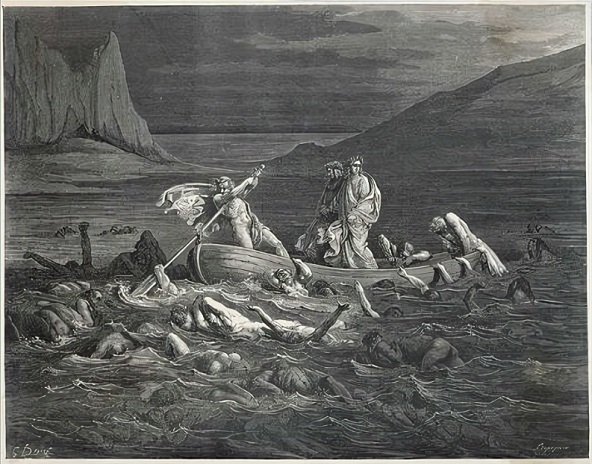
Filippo Argenti is down there somewhere.
In an earlier post I commended the analogy made by a First World War airman between the appearance of a battlefield and the geography of Dante’s Inferno. What I particularly liked was its literary precision. It didn’t just use “Dante’s hell” as shorthand for something very bad, but specifically drew a comparison between the tortured landscape he was flying above and the place where punishment was meted out to heretics.
I was thinking of that correct use of Dante recently while reading Sara Gay Forden’s The House of Gucci. In the first of two references to Dante in the book Forden pulls a line from Inferno to shine some light on the “bizarre Florentine or Tuscan spirit,” which is a very literal translation of some words (fiorentino spirito bizarro) used in Canto VIII that are used to describe Filippo Argenti.
That’s all Forden says, and it surprised me a bit because all I could remember of Filippo Argenti is that he was someone Dante (the poet) really hated, and who Dante (the pilgrim) found drowning in the bog of the Styx. I thought the use of the word bizarro probably meant something a little different than “bizarre,” at least as it was being used in the poem. On looking into the notes in Robert and Jean Hollander’s English translation of Inferno I found this:
The word bizarro, explains Boccaccio’s comment to this passage, in Florentine vernacular is used of people who “suddenly and for any reason at all lose their tempers.”
This makes sense in context because the Styx is where the wrathful are being punished. But I don’t think it’s what Forden meant. Especially since in the poem it refers to Argenti going into a kind of fit where he starts biting himself in rage.
The second time Forden mentions Dante made even less sense to me. Talking of the building that Guccio Gucci bought as a workshop, she quickly gives some of its history: “In 1642, the building was acquired by the cardinal and then the archbishop of Florence, Francesco de’Nerli, whom Dante mentions in his Divine Comedy.” How could Dante have mentioned a cardinal who was alive in 1642 in a poem written in the early years of the fourteenth century?
I’m not a Dante scholar. I never studied anything by him at school and I don’t know Italian. I shouldn’t be stumbling over things like this.
I mentioned in my notes on Maigret Defends Himself that it was basically the first of a two-part story arc, which concludes with Maigret’s Patience. The action picks up here a week later, with Maigret still on the trail of a gang of Paris jewel thieves, and re-visiting the Rue des Acacias apartment that’s home to the crippled ex-gangster Manuel Palmari and his saucy girlfriend Aline. Alas, it’s not a happy occasion, as someone has just shot Palmari and it’s up to his old not-quite-friend but not-quite-adversary to find out whodunit.
This turns out to be not much fun. The fact is that in these later Maigret books none of the killers are terribly interesting case studies. Here they are just the same “wild animal” types we met back in Maigret and the Saturday Caller. I even thought I was well on my way to figuring things out ahead of schedule, but then things took a bizarre swerve into a crazy back story and it turns out I was wrong. Though the explanation I was coming up with would have been better. I hate it when that happens in a mystery novel.
Some odds and ends: (1) Champagne is “more or less the only drink that doesn’t tempt” the hard-drinking Maigret. (2) Palmari has a maid in to clean his apartment two hours a day every day, and all morning on Mondays and Saturdays. That seems like a lot of maid service. (3) Maigret, as is often noted in the series, can’t drive, and we’re told here it’s because he has a tendency to let his mind wander into reverie while working on a case. He’s a man who knows his limitations. (4) The concierge in an apartment building is a ubiquitous figure in many of these novels. It’s a job that never seems to have caught on in North America. Given how grumpy they all seem to be in Paris, that may be for the best.

Can’t remember this guy’s name. He’s a talking raccoon.
I grew up on Marvel comics, and still have some old favourites stored in my basement. I don’t think they’re worth anything though because they’re not in the best of shape. But despite this background, I was never a huge fan of the way Marvel/Disney took over the movie business in the twenty-first century.
It’s hard to overstate just how central these movies have been. Their box office success ensured countless imitators, and the Marvel style became ubiquitous. What this meant, primarily, was: (1) the creation of a totally plastic, CGI “virtual” reality, making nearly every blockbuster movie over into a cartoon and every action star a superhero, and (2) the evolution of franchise filmmaking into various “universes,” given over to an even more assembly-line serial format. This latter development would, in turn, help with the transition away from cinemas to streaming platforms in need of a constant supply of new content. The comic-book form was particularly well-adapted to all of these developments, something the triumph of Marvel clearly underlined.
Meanwhile, the Marvel formula in terms of writing didn’t change much. Scruffy, ordinary-guy heroes with self-deprecating senses of humour and bulging biceps save the universe from supervillains intent on world domination (or world destruction). Lots of A-list talent. Lots of big action. Lots of CGI.
Some of the movies were entertaining, but the formula started to feel played out by the end of the 2010s. This is something I think everyone was aware of. Spinning off into the multi- or metaverse was one attempt at trying to make things new, and it worked to some extent. But my bottom line is that I really don’t want to see any of these movies, even the best of them, again, and I’ve already forgotten some of them completely. I was surprised, when compiling this list, to see that I’d reviewed Ant-Man and the Wasp. What had that been about? I have no idea now.
In any event, here’s the line-up of the Marvel movies (not all of them MCU) that I’ve written notes on over at Alex on Film. I’ll keep this index current with new postings, but I think it’s going to be slow on the Marvel front from here on out.
The Amazing Spider-Man (2012)
The Avengers (2012)
The Amazing Spider-Man 2 (2014)
Captain America: The Winter Soldier (2014)
Guardians of the Galaxy (2014)
Avengers: Age of Ultron (2015)
Ant-Man (2015)
Fantastic Four (2015)
Captain America: Civil War (2016)
Doctor Strange (2016)
Deadpool (2016)
Guardians of the Galaxy Vol. 2 (2017)
Thor: Ragnarok (2017)
Ant-Man and the Wasp (2018)
Avengers: Infinity War (2018)
Black Panther (2018)
Deadpool 2 (2018)
Venom (2018)
Avengers: Endgame (2019)
Black Widow (2021)
Shang-Chi and the Legend of the Ten Rings (2021)
Venom: Let There be Carnage (2021)
Eternals (2021)
Doctor Strange in the Multiverse of Madness (2022)
Morbius (2022)
Thor: Love and Thunder (2022)
Ant-Man and the Wasp: Quantumania (2023)
Guardians of the Galaxy Vol. 3 (2023)
Deadpool & Wolverine (2024)
Captain America: Brave New World (2025)
Thunderbolts* (2025)
The shoe is on the other foot when Maigret gets called into the principal’s office (that is, the office of the prefect of police) and finds out he’s been accused of getting the niece of a prominent public official drunk and raping her. It’s a #MeToo story circa. 1964, which would be kind of interesting but we all know our hero is being set up and the scheme is so improbable that its complexity is what finally convinces Maigret as to who’s behind it (he knows the villain’s “tendency, when faced with a problem, is to look for the subtlest, most complicated solution”). Add to that the fact that Maigret only becomes “a problem” due to “an almost miraculous combination of circumstances” and we have a very whimsical plot indeed.
I was kept interested, if only because as I got closer to the end I didn’t see how Simenon was going to wrap things up in the few pages remaining (and as it is, the subplot is only resolved in the next book, Maigret’s Patience, so what we have is a rare two-parter). Suffice it to say that Maigret gets some breaks as he begins to grow in weight and density, which is an observable phenomenon with him whenever a case starts to come together.
Things kick off with the Maigrets having dinner with the Pardons. We learn Dr. Pardon has stopped smoking cigarettes at home because his wife is worried about all these nasty rumours of cigs causing lung cancer. So instead he smokes cigars! This was what (some) people thought made sense in 1964.
From there we enter into a discussion of “truly wicked” criminals, whose only motivation is an inherent spite. This is a red herring, as the bad guy in this book has a motive. I like a bit of initial misdirection though, as it’s not often what you’re expecting.
Not to say the villain isn’t wicked enough. His crimes are only briefly outlined at the end, but recalled for me Richard Lloyd Parry’s People Who Eat Darkness. As for the complainant, Nicole, she could simply be dismissed with a muttered “bitch,” but might also be flagged as another example of Maigret’s take on degenerate youth. A student at the Sorbonne, she runs with a fast crowd, comes from a family of privilege, and clearly has little respect for the law or even basic morality. I’ve flagged before how Maigret (like Simenon?) was getting grumpier as the series went along, casting a particularly jaundiced eye on flashy young people. In this book Nicole is only a tool, but it’s a point worth flagging because I don’t think the kids are going to get any better from here on out.

An attempt at redirection. (Reuters)
In what may be only the first of many legal shoes to drop, the controversial conspiracy peddler Alex Jones, who operates the fake-news website Infowars, has been ordered to pay more than $4 million in damages to the parents of a child killed in the Sandy Hook school shooting, which Jones claimed to have been a hoax.
The trial served up a lot of highlights and fodder for legal commentators to tear into, including the revelation that Jones’s lawyer had sent a copy of his client’s phone records to the plaintiffs in the suit. But what stood out for me was what one of the plaintiffs had to say when she addressed Jones directly:
“It seems so incredible to me that we have to do this — that we have to implore you, to punish you — to get you to stop lying,” Scarlett Lewis, whose son was killed at Sandy Hook, told Jones.
On the face of it, this does seem incredible. Jones was lying and knew he was lying, yet continued broadcasting his shtick about how the massacre had been a “false flag” operation with “crisis actors” performing in front of a green screen despite being told to stop. Why? The bottom line was that his lying was profitable. Jones apparently made tens of millions of dollars off of such nonsense, mainly through selling supplements and survivalist gear from his Infowars store.
I’m reminded of how Donald Trump, when told about the danger of his joining the marchers on the Capitol on January 6, as he publicly declared he would, excused himself by saying he “didn’t mean it literally.” Jones has since stated that the Sandy Hook massacre was “100% real,” essentially cloaking himself in the same defence. He said things because they were what his audience wanted to hear, not because he thought they were true. He wasn’t a reporter any more than Trump was a president; both were just entertainers, making a buck. To suggest that what they were doing was right or wrong, good or bad, was to be met with a blank stare of incomprehension, as though one were speaking a foreign language.
This link to the world of entertainment also made me think of something I’ve railed about for going on twenty years now. In terms of arts criticism (mainly book and film reviewing) negative voices have been drowned out by what’s been dubbed poptimism: the argument that any book that’s a bestseller, or movie that’s a blockbuster, or TV show with high ratings, is effectively beyond criticism because it has been successful at the only thing that counts, which is making money. Criticism isn’t just superfluous (this has always been the case when dealing with mass entertainment) but wrongheaded. A reviewer literally doesn’t have any right to be critical, the media having given in to what I described in Revolutions as “a sort of celebrity worship wedded to market fundamentalism, one that makes popular/commercial success the only criterion of aesthetic value.”
For “aesthetic value” we can substitute truth or morality. Faced with Lewis’s incredulity, I imagine Jones feeling only bafflement. Any messaging or conduct so profitable, “bought” by so many people, can’t be wrong, can it? There is no other legitimate standard of value. If it makes you money, it can’t be that bad. In becoming rich and famous Alex Jones put himself beyond good and evil, and very nearly above the law.
 Alex Good