TCF: A Deadly Secret

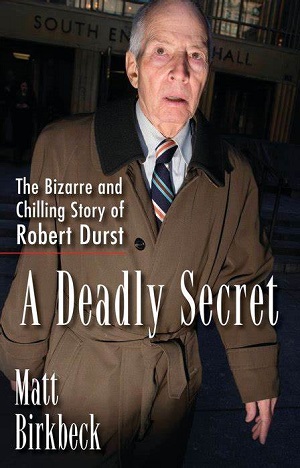
A Deadly Secret: The Bizarre and Chilling Story of Robert Durst
By Matt Birkbeck

The crime:

Robert Durst was heir to a New York City real estate fortune whose wife Kathleen disappeared in 1982. For years there were suspicions that Durst had murdered her, and as the investigation ramped up Durst went into hiding. In 2000 a long-time friend of Durst’s, Susan Berman, was found murdered in Los Angeles. In 2003, while staying in Galveston, Texas, Durst killed a man named Morris Black, chopped Black’s body up, and threw the remains (minus Black’s head) into the bay. Claiming self-defence at trial, Durst was found not guilty of murder. But in 2021 he was found guilty of killing Berman. Durst died in 2022.
The book:

If you know the name Robert Durst it’s probably because you were either following the tabloids closely back in the early 2000s or you saw the six-part HBO documentary on him by Andrew Jarecki called The Jinx: The Life and Deaths of Robert Dust. The Jinx aired in 2015, making it one of a trio of docuseries that all came out around the same time, signaling an explosion of interest in true crime – the others being Making a Murderer (also 2015) and the podcast Serial (which began in 2014).

The first thing to say about A Deadly Secret then is that it was first published in 2002, with later updates in the form of very brief notes that take us up to the point of Durst’s arrest for the murder of Berman (which followed immediately upon the airing of the final episode of The Jinx). So while it does a good job covering the initial investigations into the disappearance of Durst’s first wife, it only skims over the later parts of the story, which are also the ones that you’re probably more familiar with. While Durst died in 2022, Jarecki made a sequel, The Jinx Part 2 that came out in 2024 and brought the story even more up to date. For true crime addicts the Durst saga was the gift that just kept on giving.

I think everyone at the time realized the story was gold. Multiple murders. An unsolved mystery. And at the heart of it a superrich eccentric. And because it was such a great story, everyone involved in its telling wanted a piece of it, to claim some degree of ownership over it. This was a criticism leveled at Jarecki, whose The Jinx Part 2 was seen as being a little too self-congratulatory about having bagged Durst in the first docuseries. But it was the same with Jeanine Pirro, the New York DA who saw the case as her meal ticket for greater things. In addition to forbidding anyone in New York from talking to the media, Pirro would jet about the country (Texas, California), insinuating herself into all the different Durst investigations even when her presence was neither welcome nor necessary. Other jurisdictions came to dislike her, feeling she was just playing to the camera and “talked too much.” They hadn’t seen anything yet.

Another figure who tried to take ownership of the story was a friend of Kathleen’s named Gilberte Najamy. She would play the media with the same skill as Pirro, and it wouldn’t take long before the two would be working together. Both Pirro and Najamy come off looking pretty bad in Birkbeck’s book, and I don’t think he was being unfair to either.

But the figure who did the most damage to Durst’s case by talking too much was Durst himself. This was his undoing at the end of The Jinx, when a hot mic caught him confessing that he “killed them all.” But that’s a moment foreshadowed here after Durst is caught shoplifting a chicken-salad sandwich from a Wegman’s when he had $500 in his pocket. Sitting in the back of the police cruiser taking him to his booking he was overheard muttering to himself about how stupid he’d been.

His biggest mistake, however, wasn’t the hot mic moment so much as his agreeing to sit down and be interviewed for The Jinx in the first place. This surprised Birkbeck, as up until then Durst hadn’t talked to anyone. But as Shakespeare knew, people are no good at keeping secrets. Murder, in particular, will out. This is the logic behind Hamlet’s staging of The Mousetrap:

I have heard
That guilty creatures sitting at a play
Have, by the very cunning of the scene,
Been struck so to the soul that presently
They have proclaimed their malefactions;
For murder, though it have no tongue, will speak
With most miraculous organ.

Dostoyevsky and Freud both said something similar. The way people give themselves away, even if through a process of subconscious compulsion, has long been recognized.

As long as you keep in mind that this was a very early take on the story and so leaves a lot out, I think people with an interest in the Durst case will find it worthwhile. It offers a fuller perspective than you get in The Jinx, especially from the point of view of some of the police investigators. But I have to confess that I started off really digging my heels in against the way Birkbeck was presenting things. What I mean is that he goes for a novelistic style that often had me shaking my head at how he could possibly be recounting events in such detail. Here, for example, is how things kick off:

It was late November 1999, and a misty haze enveloped the northern New York City suburbs, soaking the landscape. [New York State Police investigator Joe] Becerra, who ran his usual four miles on the muddy trails, never once had to call out to his dogs to keep up, and worked up a good sweat in the unusually warm, late-fall-morning air. Becerra was drenched, beads of sweat and rain falling from his brow. At the end of the run, which took him in a full circle back to his cottage, he stood bent over, breathing heavily, his palms down on his knees.

The dogs were right with him, their paws, lower legs, and underbellies muddied. They barked and reached up to Becerra on their hind legs.

Becerra pushed them off, then wiped the mud from his sweatpants.

“C’mon, you guys. You’re filthy,” he said, still taking deep breaths.

The dogs still continued to bark.

“Okay, I know,” he said.

Is this exactly what Becerra said? An approximation? Did he stand bent over, hands on knees? Did he wipe mud from his sweatpants? This is very cinematic, and made me think of the opening of The Silence of the Lambs. But it seemed too perfectly visualised to be an exact recollection.

Then a few pages later we have this scene:

Becerra thought for a moment, then looked over to Luttman, who was still reading his paper. . . . Becerra walked over to Luttman’s desk.

“Henry, did you ever hear of a woman named Kathie Durst?”

Luttman quickly took his eyes off the paper.

Really? And later, as part of the same episode: “Luttman folded his newspaper, took a last sip of coffee, and stood up.” How does Birkbeck know that’s what Luttman did on that particular day? How would Luttman have remembered? It’s impossible to recreate moments like these at this level of detail. It does make for an easy read, but these are dramatic reconstructions and can’t be taken as entirely factual.

As a final point relating to when this book was written, there’s a lot of time spent considering whether or not a case could have brought against Durst either for the murder of his wife or Susan Berman. Because we know he was later convicted of killing Berman and almost certainly at least had a hand in killing his wife, it’s easy to be critical of the police and prosecutors in this regard. But what were the prosecutors in particular supposed to do? They might have got to Berman quicker, but it’s unlikely she was going to talk. And if Durst was acquitted in the murder of Morris Black in Texas, a case where he was caught dead to rights, what were the chances of getting convictions in New York or L.A., where they had far less evidence? In fact, as the one detective puts it, they had “nothing.” I’m usually all for criticizing the police, but in this case it doesn’t seem fair. Unless you want to call out the two-tier justice system that makes it so hard to convict rich clients like Durst of anything in the first place.

Noted in passing:

The New Jersey Pine Barrens are huge: just over a million acres of forest and wetlands. I’d recently read a magazine piece on the Jersey Devil, a resident evil spirit, so I should have been more up on it, but I was still surprised at how a big chunk of Jersey the Barrens constitutes. For various reasons – ease of digging, a reputation as a favourite place for mobsters to hide bodies, the phone record of a call from the area – it’s thought that Durst might have disposed of Kathleen’s body there, and there were some preliminary efforts made to search parts of it. Which would have been a tall task indeed if we’re talking about having to cover the entire Barrens. But I wonder if it would have been possible to narrow things down quite a bit. Durst wasn’t a big guy, so you’d figure a burial site would have to be somewhere near a road. And on the evidence of what he did with Morris Black’s remains, Durst was no genius at getting rid of bodies.

Takeaways:

Guilty or innocent, it doesn’t pay to talk to anyone about possible crimes you’re being investigated for. As one of the detectives working Durst’s case remarked before The Jinx interview, the only way of pinning anything on him would be “if Bobby Durst himself would tell the world what happened to his long-lost wife.” That seemed a long-shot at the time. But maintaining silence requires a lot of discipline. Most people want to tell their story, in their own words. Robert Durst certainly did. And you can see where it got him.

True Crime Files

TCF: The Best American Crime Reporting 2008

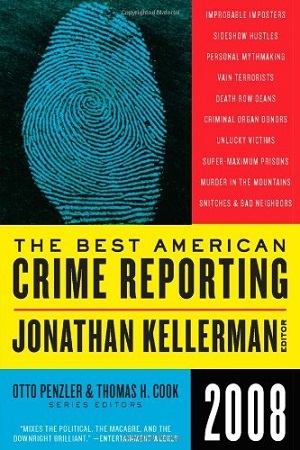
The Best American Crime Reporting 2008
Ed. by Jonathan Kellerman

The crimes:

“The Story of a Snitch” by Jeremy Kahn: snitches get stitches, or in Baltimore they’re shot multiple times and left for dead.

“A Season in Hell” by Dean LaTourrette: an American finds himself on the wrong side of the criminal justice system in Nicaragua.

“I’m with the Steelers” by Justin Heckert: claiming to be a member of the Steelers (an NFL team) gives a boost to a romance scammer living in Pittsburgh.

“The House Across the Way” by Calvin Trillin: a fight between neighbours on a New Brunswick island gets nasty.

“The Caged Life” by Alan Prendergast: Tommy Silverstein spends a very long time in isolation.

“Badges of Dishonor” by Pamela Colloff: the case of a pair of border guards who shoot an illegal and then try to cover it up becomes a political football.

“Dangerous Minds” by Malcolm Gladwell: the “science” of criminal profiling may only be a parlour trick.

“Dean of Death Row” by Tad Friend: a profile of Vernell Crittendon, who was in charge of executions at San Quentin for thirty years.

“The Tainted Kidney” by Charles Graeber: serial killer Charles Cullen (whose crimes were covered by Graeber in more depths in The Good Nurse) wants to donate a kidney. This turns out to be more difficult than it would be in, say, China.

“The Ploy” by Mark Bowden: army interrogators track down an al-Qaeda leader in Iraq by interviewing people connected to him.

“Day of the Dead” by D. T. Max: author Malcolm Lowry died after drinking heavily and taking a bunch of barbiturates. His wife may have helped him along.

“Just a Random Female” by Nick Schou: the capture of serial killer Andrew Urdiales.

“The Serial Killer’s Disciple” by James Renner: child murderer Robert Buell is executed, protesting up until the end that he was innocent of one of the murders he’d been implicated in. James Renner suggests Buell’s nephew may have had some responsibility for that one.

“Mercenary” by Tom Junod: the security manager at a nuclear power plant in Michigan imagines a fantasy life as a super-soldier.

“Murder at 19,000 Feet” by Jonathan Green: Tibetans looking to escape China by crossing over the Himalayas are shot by border guards, but the incident is viewed, and filmed, by Western mountaineers.

The book:

I’ve talked before about how I’m a big fan of this series, and how disappointed I was that it was cancelled. That said, I found this to be one of the weaker entries. For starters, there were a few stories I don’t think I would have included, for various reasons. One outlier would be acceptable, but even though true crime is a big tent I wouldn’t have included the Malcolm Lowry story here (which is just speculation), or the stories about the security manager who is a fabulist, the army “gators” at work, or the Chinese border incident. That’s not to say they aren’t good reads – I found “Mercenary” to be particularly intriguing – but I just didn’t think they belonged here.

I also didn’t think any of the stories stood out as being particularly memorable, aside from maybe Malcolm Gladwell’s critique of the science of criminal profiling. I even remembered much of that one from when I first read it in the New Yorker almost twenty years ago. I’m no fan of Gladwell, not even a little bit, so you can take it from me that it’s a piece worth checking out. Though his take really isn’t original. Indeed, it draws on a lot of work that had been done in the field, and various other true crime writers and reporters had been saying similar things. By coincidence, in one of the other pieces collected here, “The Serial Killer’s Disciple,” the police go to the FBI to get some help hunting a killer preying on young girls. I’ll let Renner tell the story:

The FBI commissioned a criminal profile of the perpetrator by Special Agent John Douglas, whose pioneering studies of the habits of serial killers inspire the book The Silence of the Lambs. Krista’s killer should be in his early to late 20s, Douglas said. He is a latent homosexual.

“When employed, he seeks menial or unskilled trades,” wrote Douglas. “While he considers himself a ‘macho man,’ he has deep-rooted feelings of personal inadequacies. Your offender has a maximum of high school education. When he is with children, he feels superior, in control, non-threatened. While your offender may not be from the city where the victim was abducted he certainly has been there many times before (i.e., visiting friends, relatives, employment). He turned towards alcohol and/or drugs to escape from the realities of the crime.”

Even without knowing how things turned out, I would have thought this unhelpful. Who doesn’t feel superior, in control, and non-threatened when among children? In any event, the police arrested Robert Buell only after one of his victims escaped.

At the time, Buell was 42 years old. He had a college degree and was employed by the city of Akron, writing loans for the Planning Department. He was dating an attorney. He had a daughter at Kent State. Those who knew him described a neat, clean, orderly man, almost to the point of obsessive-compulsive disorder. He didn’t exactly fit the FBI’s profile of their child killer.

So that’s the second burn of John Douglas in the book, which you’d think would be two too many for someone with his reputation as a legendary mindhunter. As I’ve said before, there are good reasons why the public has stopped trusting experts.

Though it’s hard to characterize an annual anthology like this as having a particular theme, the fact that they have editors with presumably different interests and points of view does mean that each volume has its own character. In the inaugural collection edited by Nicholas Pileggi I noticed a recurring interest in the theme of bad fathers. In 2007 I found a lot of the stories had to do with a betrayal by individuals in a position of trust. If I had to point to a theme for the 2008 edition I might say it’s community.

Before the advent of the digital age, with its romance scammers and crypto frauds, most crime was local. It matters that the first story here is set in Baltimore, the second takes place in Nicaragua, the third in Pittsburgh, and the fourth on an island just off the coast of New Brunswick. In each of these stories the place plays an active part in the events, as do the later stories dealing with border incidents. But community isn’t just about these sorts of locations. It’s also about places like death row, and the community of prison officials and inmates.

In the early twentieth century there was a literary movement known as Naturalism that saw humanity as basically bound by deterministic laws. One’s fate was a combination of heredity (genetics) and environment. This is something a little different than nature and nurture, the terms most often used in explaining criminality, and the question of whether criminals are born or made. Obviously an emphasis on community puts the focus on the environment, but it’s not an equation that’s being argued for here, or even a strict chain of causation. It’s more that place and community do a lot to define what constitutes criminal behaviour in the first place. Is “snitching” worse than witness intimidation? Is taking a shot at a noisy newcomer who’s wrecking the neighbourhood by running a purported drug house a crime? It depends on the neighbourhood and its community values.

Noted in passing:

Over the years I’ve come back many times to an essay by Tennessee Williams called “The Catastrophe of Success,” which was about the impact the success of The Glass Menagerie had on his life. It seemed to me to be the kind of paradox that isn’t often addressed, either by artists themselves or the people who write about them. The point being that it can actually be harder to follow-up a critical or commercial triumph than to break through in the first place, and that success itself can be a crushing creative burden or otherwise be destructive to the conditions that made the breakthrough possible. As Williams put it:

The sort of life that I had had previous to this popular success was one that required endurance, a life of clawing and scratching along a sheer surface and holding on tight with raw fingers to every inch of rock higher than the one caught hold of before, but it was a good life because it was the sort of life for which the human organism is created.

Success, however, brought not only the comfort of “an effete way of life” but a sense of “spiritual dislocation.” “Security,” Williams concluded, “is a kind of death.”

For Malcolm Lowry life never became that cozy, but after Under the Volcano there would be no second act. And he might have recognized something in what Williams said. “Success,” Lowry wrote to his mother-in-law, “may be the worst possible thing to happen to any serious author.”

Takeaways:

Crime is defined by a community, and though not always restricted by place it at the very least always has a specific cultural context. From the Histories of Herodotus:

Just suppose that someone proposed to the entirety of mankind that a selection of the very best practices be made from the sum of human custom: each group of people, after carefully sifting through the customs of other peoples, would surely choose its own. Everyone believes their own customs to be by far and away the best. From this, it follows that only a madman would think to jeer at such matters. Indeed, there is a huge amount of corroborating evidence to support the conclusion that this attitude to one’s own native customs is universal. Take, for example, this story from the reign of Darius. He called together some Greeks who were present and asked them how much money they would wish to be paid to devour the corpses of their fathers – to which the Greeks replied that no amount of money would suffice for that. Next, Darius summoned some Indians called Callantians, who do eat their parents, and asked them in the presence of the Greeks (who were able to follow what was being said by means of an interpreter) how much money it would take to buy their consent to the cremation of their dead fathers – at which the Callantians cried out in horror and told him that his words were a desecration of silence. Such, then, is how custom operates; and how right Pindar is, it seems to me, when he declares in his poetry that “Custom is the King of all.”

True Crime Files

TCF: Deadly Little Secrets

Deadly Little Secrets: The Minister, his Mistress, and a Heartless Texas Murder
By Kathryn Casey

The crime:

When Kari Baker was found dead by her husband Matt on April 7, 2006 it was judged to be a suicide by drug overdose, mainly because that is what Matt, a Baptist minister, told the authorities had happened. He also showed them a suicide note. Kari’s family, however, didn’t believe she would have killed herself and pursued a wrongful death civil case against Matt. After much prodding the police filed charges and, with Matt’s mistress testifying against him, he was found guilty of murder and sentenced to 65 years in prison.

The book:

There’s a blurb of praise from Ann Rule on the cover of Deadly Little Secrets and I think that’s entirely apt as Kathryn Casey has always struck me as the Texas version of Ann Rule. What I mean is that while both authors cover a fair bit of ground, their real specialty is doing these deep dives into marriages and relationships that hit the rocks in a big, bad way. And I’m not knocking that, since I think there’s a real value in digging into such stories, precisely because they are so commonplace. If you’re going to be murdered, chances are pretty good it will be at the hands of a domestic partner. It’s certainly a lot more likely than being killed by a stranger. So it helps to be familiar with some of the warning signs.

Matt Baker’s murder of his wife Kari was a terrible tragedy but at the same time it was nothing much out of the ordinary. I was even a bit surprised that national news programs like 48 Hours and 20/20 ran segments on it, as I would have thought it was mainly a story of local interest. But I guess the “murdering minister” angle, which is all that sets it apart from countless similar stories of husbands killing their wives, played well in the media.

That a so-called “man of god” could go bad, or be bad in the first place, didn’t strike me as being news. I’m more concerned at how many people there still are who think individuals in positions of trust and authority are deserving of so much respect and deference. Cops, doctors, and clergy, to take just the most obvious examples, are no better or worse than anyone else out there. Given that, and the fact that at over 400 pages this is a book that goes into Matt and Kari’s break-up in granular detail, what lessons can we learn?

I think the red flags with Matt were all the obvious ones. He was overly possessive and controlling. He had no friends. He couldn’t stick with any one job for very long, usually being dismissed for some inappropriate conduct that wherever he was working wanted to keep hushed up. He was a sex addict. None of this meant he was bound to end up killing his wife, but they were bad signs. Only being a minister bought him a lot of trust, and Kari never wanted to believe the worst.

The other thing that stood out to me for it’s not being remarkable was the way the police investigation got off on the wrong foot and then only got worse because people in authority never want to admit making a mistake. By sheer coincidence I read David Wilson’s A Plot to Kill right after Deadly Little Secrets and both books deal with murders involving drug overdoses that were originally considered to be suicides or accidents so that the authorities didn’t have to perform an autopsy. When Wilson tried to get a copy of the coroner’s report on Peter Farquhar he was shut down in a way that he clearly felt miffed by. But I think he also understood why he was getting that treatment, and it’s not because he was a famous author. There are few rules more absolute when it comes to corporate culture than CYA (Cover Your Ass), and the police are nothing if not a corporate bureaucracy.

As with any bureaucracy, the failure of the police in this case wasn’t the result of corruption or incompetence but instead could mainly be put down to simple laziness. In my experience this is the Occam’s Razor of explaining how things go wrong in most organizations. It’s not the fault of bad people so much as people who can’t be bothered doing anything more than the bare minimum to keep their jobs. In this case, the police were offered an easy explanation for Kari’s death so they just took it at face value (a typewritten suicide note?) and called it a day. No need to bother with an investigation.

Because there was so little physical evidence collected the trial itself turned into a very near-run thing. Matt might have even been able to beat it if he’d known enough, or been better advised, to keep his mouth shut. You should always keep your mouth shut in such situations. This was the takeaway I offered in my review of The Count and the Confession: “Innocent or guilty, you have nothing to gain by talking to the police. It won’t do you any good and could get you in a lot trouble.” Talking to the police almost sent Beverly Monroe to prison for life, and she was innocent. It’s what nailed Matt, who otherwise had a good chance of walking out of court  a free man.

Noted in passing:

Guy James Gray, Matt’s defense lawyer, got angry with Matt when he found out that Matt had been lying to him about not having an affair with the younger woman he hooked up with after Kari’s death. Indeed, Gray was so furious that he filed a motion to be taken off the case, citing a “serious breach of confidence.”

That didn’t sit well with Gray, who’d convinced himself early on that he had an innocent client. Suddenly Gray, like the prosecutors, had Baker pegged as a liar. “I think the judge should have let me leave,” he says, with a frown. “From that point on, I never talked to Baker unless I legally had to. I wanted nothing to do with him.”

This isn’t how it works. Or at least it’s not how it’s supposed to work. In the first place, Matt had only confessed at this point to lying about his affair, he hadn’t admitted to killing Kari so was still at least potentially an “innocent client.” But more than that, a defense attorney has a professional duty to present his or her client’s case as best they can, and the question of whether their client is actually guilty or innocent doesn’t come into it. For Gray to suggest he gave up on the case, a sort of “quiet quitting,” when he wasn’t allowed to resign (which would have been very difficult given how late in the day it was) is something I found really surprising.

Takeaways:

One can make any number of stupid mistakes in killing someone and still get away with it. Matt Baker was no criminal genius and should have been caught dead to rights but for the fact that he was a minister. What finally tripped him up though was the fact that his wife had a lot of close family members and friends who weren’t going to let the matter of her death slide and who had the resources to pursue Matt when the police and DA didn’t want to get involved.

There’s a reason so many serial killers manage to keep murdering for years without getting caught. They tend to prey on individuals who are socially isolated or who exist on the fringes of society. Runaways, homeless people, the down-and-out. Killing people with stronger connections to their community is a lot riskier.

True Crime Files

TCF: Summer for the Gods

Summer for the Gods: The Scopes Trial and America’s Continuing Debate Over Science and Religion
By Edward J. Larson

The crime:

A media circus came to Dayton, Tennessee for a couple of weeks in July 1925 as high school teacher John T. Scopes was put on trial for teaching evolution in a state-funded school. William Jennings Bryan joined the prosecution, while Clarence Darrow served on the defence team. Scopes was found guilty and fined $100, a verdict that was later overturned on a flimsy technicality so that there was no conviction to be appealed.

The book:

In my review of Blood & Ink I brought up the subject of a “trial of the century.” I don’t know if the Hall-Mills trial was ever referred to as such, but the author Joe Pompeo uses it as a chapter heading in that book. In any event, the Scopes Trial took place the year before and Edward Larson notes how calling it the trial of the century was already a “shopworn designation,” especially since Darrow’s previous case, the Leopold and Loeb trial that took place just the year before, had been widely referred to in the same terms.

Was the Leopold and Loeb trial the first trial of the century, or the first trial to be named as such in the media? I don’t know. But the Scopes Trial was a big deal and so probably belongs on a shortlist of contenders for that title. There is a strong counterargument to be made against its inclusion in such a list though. Just for starters, it was always meant to be a media event – a symbolic statute, a show trial – and very little was at stake. Technically it was a criminal misdemeanour case, though as the Chicago Tribune would sniff at the time, “It is not a criminal trial, as that term is ordinarily understood.” But then, they were saying that because they were broadcasting it live via radio and they wanted to allay concerns that this wasn’t in some way improper. Then, after the verdict, the media were quick to dismiss the whole show as a sort of nine days’ wonder. The New York Times would say that the abrupt end of the trial saved “the public from having its ears bethumped with millions more of irrelevant words.” This from the paper of record that, as Larson observes, had “used as many as five telegraph wires at a time to carry reports from Dayton.”

Another point against its century status is that it was unclear, even at the time, what the trial was actually about or what the different sides were trying to prove. For Bryan, the issue had to do with the principle of majority rule. “It is the easiest case to explain I have ever found,” he wrote to a fellow prosecutor at the start of the trial. “The right of the people speaking through the legislature, to control the schools which they create and support is the real issue as I see it” (emphases in the original). Darrow was playing for different stakes: “Nothing will satisfy us but broad victory, a knockout which will have an everlasting precedent to prove that America is founded on liberty and not on narrow, mean, intolerable and brainless prejudice of soulless religio-maniacs.”

Given these different agendas, both sides were able to claim victory: “The prosecution claimed a legal victory; the defense a moral one.” At the same time, neither side was satisfied: the defence complaining that nothing had been settled while supporters of the statute “could scarcely hail a ruling that all but directed prosecutors not to enforce the law.” Which makes you wonder to what extent a win-win is always a lose-lose.

A final point against calling it a trial of the century is that the verdict seems never to have been in doubt. This was evidenced by its immediacy:

The jury received the case shortly before noon and returned its verdict nine minutes later. They spent most of this time getting in and out of the crowded courtroom. “The jurors didn’t even sit down to think it over,” one observer noted, “but stood huddled together in the hallway of the courthouse for the brief interval.”

Nine minutes! I’m not sure, but that must be some kind of record, especially for a case this long.

Given the larger-than-life personalities of Bryan and Darrow the table was set for high drama, but the great debate between the two comes off, at least to my ear listening to it a century later, sounding scripted and pointless. Maybe it’s the effect of having Inherit the Wind playing in my head (a text that’s duly questioned here). But more than that, you really can’t defend the Bible as history or science. Religion doesn’t make any kind of sense if you look at it that way. So all the back-and-forth about when God created the world is silly, as I think most people understood at the time.

But, to advocate for the other side, you can still make an argument for its “trial of the century” status. But this is mainly because of its long cultural afterlife. “Dozens of prosecutions have received such a designation over the years,” Larson concludes, “but only the Scopes trial fully lives up to its billing by continuing to echo through the century.” That probably has more to do with political developments though, and in particular the rise of evangelicalism as a political force in the U.S., than with the trial itself. In the battle between modernists and fundamentalists that the Scopes trial represented it seemed at the time as though the fundamentalists had been thoroughly beaten. They would, however, rise again, gaining strength from a resurgent Southern pride and sense of regional identity.

Given its now “mythic” status, it’s nice to have something like an authoritative version of the events setting the record straight. That said, I can’t say I enjoyed Summer for the Gods very much. It’s not a great read and the characters are poorly drawn. Darrow comes off a bit worse for wear and Bryan a bit better. The secondary players are indistinguishable and the legal maneuvering difficult to follow. It did win the Pulitzer Prize for history and I’m guessing that was for its research.

Noted in passing:

I don’t think Bobby Franks is properly described as a “former schoolmate” of Leopold and Loeb. He lived across the street from Loeb, to whom he was related, and went to the same high school Leopold had attended, but he was quite a bit younger.

Takeaways:

Trying to establish the “truth” of a religion, whatever that might mean, is pointless. And even if that were your goal, a criminal trial wouldn’t be the place for it.

True Crime Files

TCF: The Con Queen of Hollywood

The Con Queen of Hollywood: The Hunt for an Evil Genius
By Scott C. Johnson

The crime:

Hargobind “Harvey” Tahilramani, an Indonesian of Indian descent who was partly educated in the U.S. and who for most of his working life resided in England, seems to have made a living (how, I’m not sure) out of impersonating various Hollywood power players. His main scam involved calling up individuals looking to get into the movie business and pretending to be a big-shot producer offering them a break. He would then send his marks running around Indonesia, racking up expense bills that he profited from in some way. After being tracked down by a private security firm and a reporter on the case he was arrested in Manchester.

The book:

I had deeply divided feelings on this one.

On the plus side, I thought the story itself was fascinating, and the gradual uncovering of the scam by Scott C. Johnson played a bit like that of the journalists tracking down the mail-fraud operation in A Deal with the Devil, which was a book I loved.

On the other hand . . .

I didn’t think Johnson did a great job explaining the operation of Tahilramani’s scam. Perhaps, as the book was written before there’d been any trial (we leave with “Harvey” still awaiting extradition to the U.S.), little was known or could be said for sure. Johnson did try his best to follow up various leads, but I found myself scratching my head as to how money was being made off of the people Tahilramani was sending on various wild goose chases. Kickbacks on taxi fares? If most of the money spent went to what would have been legitimate expenses on any trip (travel, accommodations) how much of it went into Harvey’s pockets? The FBI estimates he might have made around $5,000 per person he sent to Indonesia, and maybe a million dollars over the years, but that strikes me as perhaps inflated and in any event no more than a guess. He was almost certainly lying when he told Johnson that there was another figure further up the chain of fraud who was making the real money, but it’s a lie that makes more sense than the truth.

The point is stressed by Johnson, however, that Tahilramani wasn’t in it for the money. Which then leads to an attempt at understanding exactly why he was doing it. Was it only for amusement? He confessed to that much. Did he have “a penchant for deception”? Given all of his pseudonyms (among others: Harvey Taheal, Gavin Ambani, Anand Sippy, Gobind Tahil) and the sheer amount of time he spent calling people (the better part of every day was spent on the phone) one feels that there was something like an addiction in play. Was pretending to be someone else empowering, or even an expression of gender dysphoria (he specialized in impersonating women, and when caught he claimed he would take his punishment “like a man, or a woman, it’s the same thing to me”)? Perhaps there was some of that too. Did he just like yanking people’s chains? Absolutely. Was he sadistic? This is a label Johnson applies a few times, though to me it doesn’t feel right. Sadists, at least in the classic understanding of the term, derive some sexual stimulation from inflicting pain on others, and Tahilramani seems to have been asexual. Indeed he claimed to be impotent and there’s no evidence here that he ever had intimate relations with anyone of either sex. Of course, it goes without saying that he had no friends.

But while Tahilramani is a hard character to figure out, it would be a mistake to extend him any sympathy or respect. In the case of the former, it’s part of every villain’s playbook, at least in the twenty-first century, to claim victim status. Tahilramani seems to have been gay, and may have been subjected to some form of gay conversion therapy while institutionalized in Indonesia, but that’s as far as his victim credentials extend. When being interviewed by Johnson he “hammered away at the victim narrative” of his life by blaming his sisters for the way he turned out, which seems to be far from the mark. What he understood, however, is the way being a victim gives one a pass for any amount of bad behaviour. We are even told that he held the view that Harvey Weinstein, the disgraced movie producer he admired, was “a tragic victim of the #MeToo movement,” which tells you something about the kind of lessons he took from that.

As for respect, that was even extended to Tahilramani by one of his marks. An aspiring screenwriter named Gregory Mandarano (who’d go on to write a script about the Con Queen) initially

expressed admiration and even awe at what his deceiver had been able to achieve. It had been a feat of spectacular creativity, a virtuoso display. As the years went on, his view began to change and, in the end, he felt disappointed – not so much by what he had suffered, but by what the scammer had failed to achieve. As a character in one of Gregory’s screenplays, Harvey could use his grifting talents to perform some truly ingenious, worthy crimes. If only the truth had been different, he might have created “something of value.”

By “ingenious, worthy crimes” I think something like the crimes of a Tom Ripley is meant. But then Harvey wouldn’t have been caught, and in the end nothing of value would have been created except I guess a life as a work of art.

Harvey was good at doing voices. I’ll give him credit for that. But the bottom line as I see it is that Tahilramani was just someone who held an intense hatred of the human race almost from birth. I don’t know where such bitterness comes from. He was born into a family of privilege and his parents both doted on him. His mother’s love in particular was an example of “rare codependency.” When you spoil people (young or old, makes no difference) it rarely turns out well. But this is a point I’ve remarked upon before.

The result was the kind of person an acquaintance of mine once described as “a black hole of shit.” One of his sisters, who perhaps knew him better than anyone, refused to refer to him by name, calling him only “the Monster.”

She saw him as a social predator devoid of empathy or remorse, a man without conscience who viewed other people as sources of personal gratification and gain. He was unable to love, a manipulative liar who had alienated his entire remaining family. He had no friends, no one to rely on. She described him as a “malignant tumor,” and said that even employing the terms brother or relative to describe their biological kinship was itself “cruel.” People who wished him harm, she said, were justified.

Even more succinct a condemnation is the assessment made by an “old acquaintance”: “He was, she believed, a dark malignancy in semi-humanoid form, glomming on to souls and retching on their dreams.”

Not, properly speaking, a human being at all then, but a form of life, like a “cancer” or “malignancy,” that feeds on humans. The final section of Johnson’s book is simply given the name “The Entity,” deriving from his sister’s description of her brother as “an evil entity.” Which I think is good, even if it does constitute a sort of throwing up of one’s hands.

What bothered me the most about The Con Queen of Hollywood though was the way Johnson kept trying to shoehorn in bits of his own family history, for no reason whatsoever that I could see. His father was a CIA agent and his mother had been sexually abused (I think) by his grandfather. None of this has any connection at all to Tahilramani’s story. Now I didn’t mind his account of tracking Harvey down to the apartment he was renting in Manchester, England. That was fine, and Johnson was aware of how it marked “the moment I stopped being merely an observer and became a character in his [Tahilramani’s] story.” But the family background was an unnecessary distraction and I felt like it led to the book losing focus on the portrait being drawn of the Con Queen, and indeed drawing us away from a better understanding of him.

Noted in passing:

Scammers have been around forever, and as with so many other unpleasant things we have today the Internet has only made the problem worse. What the story here underlines are the various ways this has happened. For one thing, there is no longer a barrier “that once separated the relative safety of ‘reality’ from the constant intrusions of online life.” Our virtual and real lives have merged. In addition, while the Internet has a global reach (Tahilramni had victims on six continents) it also fosters “the illusion of proximity”: “people who would otherwise be far removed and inaccessible are made to seem closer and more familiar.” And of course the cost of such scams is reduced to nearly zero, while at the same time making them exponentially more damaging.

How to defend yourself? Well, to be brutally honest there is no defence aside from staying off the Internet entirely. Even a group of Navy SEALs were taken in by Harvey, and indeed made to put on sexual performances for him (that they considered such behaviour to be at least somewhat normal is another sad fact of the digital age). But one bit of advice I remember from the early days of the Internet might help: your online presence should not be about you, but about what interests you. In the days of carefully curating a personal online presence (or brand) this is worth keeping in mind, especially if you’re really engaged with social media.

While some [of Harvey’s] victims were talented photographers, by and large their true dominion was social media. They had mastered the art of self-promotion, and were comfortable posting – advertising – the details of their lives. Masters of the selfie, they crossed back and forth between journalism and the more nebulous but profitable world of branding. . . . [Harvey’s] deep knowledge base could be scraped off the internet, an open vault where ambition and oversharing collided. Once in possession of a mark’s professional trajectory, along with the names of past collaborators or clients, [Harvey] could weave a tale to suit each one.

Again, I don’t think there’s any way to avoid risk completely. But you need to be aware of the risk and try to limit your exposure to it.

Takeaways:

I think one of the hardest things for any parent to do is to recognize that their child is, in fact, a completely worthless piece of shit and menace to society. Parents are, all too often, the enablers of last resort for such monsters. Which, in turn, leads into the point I made earlier about the disastrous effects of codependency.

All the more credit then to Tahilramani’s father Lal, who on his deathbed cut his son out of his will and “urged his daughters to distance themselves from him. He explained that they would face two great challenges in life: cancer [a family predisposition] and Harvey.” Again the link between the Monster and malignancy. Lal told his daughters he was sorry for what they’d gone through and that if there was any silver lining it was that they had already seen “the worst human in our midst.”

This is the correct response to have, but I’ve only personally known a couple of parents who have gone so far. The thing is, you owe your child a lot, but not a blank cheque supporting a lifetime of bad behaviour. So don’t bother with “tough love.” Just cut the damn cord and move on, even if it’s the last thing you do.

True Crime Files

TCF: The Bayou Strangler

The Bayou Strangler: Louisiana’s Most Gruesome Serial Killer
By Fred Rosen

The crimes:

Between 1997 and 2006 Ronald Joseph Dominique raped and murdered (mostly by strangulation) 23 men and boys in the bayou region of southern Louisiana. In order to avoid the death penalty he pled guilty to eight counts of murder and was sentenced to life in prison.

The book:

In his book American Serial Killers: The Epidemic Years 1950 – 2000, Peter Vronsky describes that time frame as a sort of demonic golden age of murderous predators, both in terms of their activity and their fame. Here’s how I summarized the point Vronsky makes in my review:

The numbers are remarkable. In the 1950s there were 72 reported serial killers in the U.S. In the 1960s, 217, in the ‘70s 605, in the ‘80s 768, and in the ‘90s 669. But then a trailing off, with 371 in the 2000s and 117 in the 2010s.

There’s more to the story than just these statistics. Anyone who reads much in this area will know that these same epidemic years (1970-2000) didn’t just produce a greater number of serial killers but all of the names that are still most recognized today: Ted Bundy, John Wayne Gacy, David Berkowitz (Son of Sam), Richard Ramirez (the Night Strangler), Jeffrey Dahmer, and many others known almost exclusively by their nicknames: the Hillside Strangler, the BTK Killer, the Green River Killer et al. But since Dahmer, what killers have caught the public’s imagination and the media’s eye in the same way? Vronsky lists off eighteen of the more prominent, only to say “If you haven’t heard of them, you are not the only one. Some didn’t even have monikers.” I count myself among the ignorant, pulling a blank on all eighteen.

Have serial killers changed? Has the way we cover them changed? Or are we just not as interested as we used to be?

And as for after those eighteen post-Dahmer killers I pulled a blank on, here’s another list from Vronksy:

The few hundred “freshmen” serial killers (as opposed to “epidemic era” Golden Age carryovers) apprehended over the last twenty years are just as anonymous as those arrested in the 1990s following Jeffrey Dahmer. Who has heard of Terry A. Blair, Joseph E. Duncan III, Paul Durousseau, Walter E. Ellis, Ronald Dominique, Sean Vincent Gillis, Lorenzo Jerome Gilyard Jr., Mark Goudreau, William Devin Howell or Darren Deon Vann?

Did you catch the name of Ronald Dominique dropped right in the middle there? Because it’s this anonymity that Fred Rosen begins with as well. “You’d think,” he begins, that “the serial killer who killed more victims than any other serial killer in the United States during the past two decades . . . would have been enough to generate books, movies-of-the-week, films, TV-magazine broadcasts, and podcasts.” But that didn’t happen in the case of Dominique.

Why not? “The sexuality of the killer and his choice of victims got in the way.”

I’m not so sure about this. John Wayne Gacy makes Vronsky’s list of famous killers of the golden age, and of course Jeffrey Dahmer is one of the best-known serial killers in history. Both were gay. I think the thing about Dominique is he just wasn’t very interesting in any way. His crimes were merely brutal and callous, without anything about them to make them stand out. He wasn’t a cannibal or a killer clown but just a short, chubby loser without any friends who lived in a trailer hooked up to his sister’s power, drifting from one dead-end job to another (meter reader, pizza delivery guy, etc.) before finally being arrested in a flophouse. The fact that he was for a time a drag performer who liked to dress up as Patti LaBelle was about the only bit of colour in his drab existence. As Rosen’s references to films and movies-of-the-week suggest, Dominique had no star power. Even his crimes weren’t media sexy, with no signature elements, which left the police able to work in relative peace because the murders weren’t being played up. Indeed, they were barely covered at all.

Invisibility is a super power enjoyed by many serial killers. I don’t mean this in reference to Dominique’s mostly invisible victims, though that was in play here. A lot of serial killers prey on victims who are not immediately missed when they disappear. I think Rosen is probably right when he says that “Dead black men, gay or not, doesn’t sell on the news,” and that “If Dominique had only chosen different victims, whose lives were more valued by society, then the state might have acted earlier.” But that’s not what I mean by invisibility.

What I mean is that Dominique was himself someone who nobody cared about. When finally arrested few people believed him capable of killing so many people, and this was not a moral judgment. He was just so unprepossessing. This in turn allowed him to work quietly for nearly a decade without anyone seeming to notice. He didn’t seek notoriety by writing letters to the police or to newspapers, but at the same time he did little to conceal his tracks. Even his use of a condom when raping his victims was probably attributable to his fear of infection, as he was a pronounced hypochondriac, rather than a desire not to leave any DNA evidence.

In such cases I’m reminded of the scene in The Collector where the kidnapped Miranda says to her captor Freddie “Look, people must be searching for me. All of England must be searching for me. Sooner or later, they’re going to find me.” He coolly replies: “Never. Because, you see . . . they’re looking for you, alright, but nobody’s looking for me.” Like Dominique, he was invisible.

And so “the worst serial killer of the new millennium” is someone even true-crime buffs may know nothing about. Rosen tries to build him up, saying things like “If Dominique were a nineteenth-century gunslinger, he would have twenty-three notches on his gun,” but it just doesn’t work. Dominique wasn’t a gunslinger, but a violent, lonely, and bitter gay man who may have been motivated to kill people as much by boredom as anything else.

I can’t say I really liked the book. I found it disappointing. Perhaps a lot of this was because I had been looking forward to it, seeing as I’d never heard of Dominique before this. But I subsequently felt like I got more information out of a 40-minute documentary I watched on his murderous career than I did from Rosen. I appreciated the book clocking in at under 200 pages, but one effect of being so quick was that the events started to blur and it got hard to keep track of Dominique’s location and employment at various times. The photo section at the back was inadequate and I felt like maps of the region would have been really helpful. There were also a number of little flourishes I didn’t care for, like the aforementioned references to the notches on a gunslinger’s gun. Another moment came when an acquaintance of one of the victims describes him as being “a little off mentally” and so incapable of selling dope. “Not that you had to be smart to be a drug dealer,” Rosen can’t help adding. I thought this was being flip. I think that to be a successful drug dealer (meaning at a minimum one who is capable of making a bit of money and staying out of jail) you probably do need to be pretty smart.

Noted in passing:

“Louisiana’s Most Gruesome Serial Killer”? This struck me as a bit of cover-bait sensationalism on at least two counts. First: what was the competition? While I’m no great student of serial killers, I had heard of the infamous Axeman of New Orleans. Wasn’t he more gruesome? He did hack people to death with an axe, after all. Second: is “gruesome” the right word? The dictionary definition is “inspiring horror or repulsion,” but I think every serial killer does that. The actual etymology goes back to a Germanic word for “shiver.” Personally, I’ve always linked it to gore. But Dominique didn’t butcher his victims. In fact, he seems to have been a tidy killer, leaving very little in the way of physical evidence behind. Rosen tells us that during his taped confession, “the gruesomeness of [Dominique’s] crimes made even seasoned pros cringe,” but I don’t know what evidence there was for that. Dominique raped his victims and then strangled them, disposing of their bodies later by throwing them on the side of the road. Which, while brutal behaviour, isn’t what I’d characterize as gruesome.

Sticking with preliminaries, the epigraph comes from Ernest Hemingway: “There is no hunting like the hunting of man, and those who have hunted armed men long enough and liked it, never care for anything else thereafter.” This is a blustering bit of machismo taken from a column Hemingway wrote for Esquire magazine about fishing that later turned into the core of The Old Man and the Sea. I don’t know what it has to do with Dominique’s hunting humans. He certainly didn’t hunt armed men, the most dangerous game, but rather, like most serial killers, sought out the weakest and most vulnerable members of society.

In my notes on Monster I was impressed at the number of gay bars in big cities. Apparently there were 8 in Milwaukee at the time, and over 70 in Chicago. According to Rosen, in the 1990s there were “exactly two gay bars” in the town of Houma, Louisiana. This surprised me, as the population of Houma was only around 30,000 at the time, and it doesn’t seem like it was a very “metro” community. I live in a university town of just over 140,000 and when I checked online we didn’t have any gay bars, but only LGBTQ-themed nights at a couple of establishments.

The attempt to take fingerprints from one of the victim’s skin is something that one of the detectives learned from watching CSI. “Somewhere,” Rosen writes, “CSI star and producer William L. Peterson must be smiling. His TV show was helping to solve a real-life serial-killer case!” That’s a feel-good moment, I guess, but it made me wonder why a homicide detective hadn’t picked up on this from any of his training.

Takeaways:

If a stranger asks if he can tie you up, the correct answer is always No.

True Crime Files

TCF: Empty Promises

Empty Promises and Other True Cases
By Ann Rule

The crimes:

“Empty Promises”: Jami Hagel married Steve Sherer in 1987 but things didn’t go well. Sherer turned out to be a nasty drunk and a violent control freak. Jami disappeared in 1990 and ten years later Sherer was convicted of her murder, though her body was never found. Later, while in prison, Sherer tried to hire someone to kill his in-laws.

“Bitter Lake”: a brutish man beats his ex-girlfriend and her 3-year-old son to death.

“Young Love”: when a young fellow’s girlfriend breaks up with him and heads off to university he continues to stalk her and eventually blows himself up in her dormitory.

“Love and Insurance”: a gay librarian meets up with a man who promptly gets him to take out a life insurance policy.

“The Gentler Sex”: two stories both dealing with women who enlist partners in plots to kill their husbands. The second woman doesn’t realize she’s trying to hire an undercover cop to do the hit.

“The Conjugal Visit”: a convicted kidnapper and killer escapes from a motel while enjoying a conjugal visit . . . with his niece. Such visits were new at the time and the system clearly had a few bugs.

“Killers on the Road”: a pair of bad guys rob a bank and go on a murder and kidnapping road trip.

“A Dangerous Mind”: a woman lets her brother stay with her in Seattle, forgiving of the fact that he is a violent psychopath. He kills her daughter.

“To Kill and Kill Again”: 18-year-old Gary Grant kills and rapes a couple of young women and then a couple of even younger boys.

“The Stockholm Syndrome”: a young couple meet up with a killer while out camping. He kills the husband and gets the wife to go along with a cover story until she breaks free from his sinister influence. This was also the final story in the Rule collection Without Pity.

The book:

“Empty Promises” runs just over 200 pages and the nine other stories 30-40 pages each. This made sense as there wasn’t as much to them. Ann Rule does her usual proficient job with the material, but it’s very familiar ground, especially for her millions of devoted readers.

But then let’s face it, most murders are pretty routine. As Poirot explains to Hastings in Peril at End House, there are really only a couple of motives for murder, excluding “homicidal mania” and “killing done on the spur of the moment.” The two motives are (1) gain (that is, greed), and (2) crime passionnel: hate, “love that has turned to hate,” or jealousy. Or, as Rule lays it out when describing female killers (and the point she starts out by making is equally applicable to men):

There are really only two reasons why the vast majority of women kill: for love – very broadly defined to include passion, revenge on a faithless lover, jealousy, or a desire to clear away obstacles to an affair – or for money. The promise of riches tends to bring out the wickedness in some women. Whether it be for love or money, women plan murder with far more care than do men. They seem to be able to delay gratification longer than their male counterparts. One might say that, even in homicide, women enjoy more foreplay than men.

I don’t know if this is strictly true, but the point about “love or money” – Poirot’s “gain” or crime passionnel – is spot on. Most murders are committed by people who know their victims, and take place in domestic settings. And so the same situations repeat again and again, and we see the same red flags being ignored by those at risk.

The early stories here are of the relationship variety, with the last few being examples of “homicidal mania.” And the relationship angle is always pretty much the same. Rule even gives a road map in her Foreword:

we can see long before relationships escalated to a point where murder was committed, there were lies. There are people, both men and women, who pretend to be someone they are not. They make commitments, agreements, assurances, pledges, and vows – promises – to get what they want. When they abuse the trust of those who believe them, those empty promises often lead to violent death.

This is a bit of a shoehorning to get the book’s title into the mix, but the basic point about escalation stands. Before things get to murder there are usually lots of red flags. In previous reviews I’ve done for the True Crime Files I’ve flagged some of these. For example, my takeaway from All That is Wicked was that

If your whole family is against you marrying someone, best give the matter further consideration. If they become even more insistent that you leave your spouse when the marriage goes south, you should admit you made a mistake and get out before things get any worse. Because they will.

Definitely advice Jami Hagel might have taken in the title story here. Though as I also said in my notes on She Wanted It All, there’s no talking to someone who has convinced him or herself that they’re in love. And this is a point I know I’ll be making again.

Another red flag has to do with partners suddenly taking out large life insurance policies on you. I mean, you’d think that one was pretty obvious but it seems not to have made much of an impact on the unfortunate librarian in “Love and Insurance.” Indeed, life insurance policies play a major role in several of the stories here. Not saying that life insurance is a bad thing, but these policies definitely lead to what’s known in the industry as a moral risk. Rule underlines the takeaway here: “Perhaps all marital insurance policies should read ‘And to my beloved wife, the proceeds of my life insurance . . . with the express exemption that this policy is null and void if she kills me.’”

Other lessons to be learned from relationships that go south in such a dramatic fashion? Well, “open” marriages are probably a bad idea. And if you are planning or in the midst of a divorce it’s best to make a clean break. Don’t go back to the house or agree to a private meeting with your ex (or soon-to-be ex). This is what led to the murder of Charla Mack as recounted in John Glatt’s Love Her to Death. Again, Jami Hagel received due warning about this. Her mother didn’t want her seeing Steve again but she arranged a meeting where he immediately stole her purse. Then she went back to her house after her lover pleaded with her not to. In the story “Bitter Lake” the victim is also warned about meeting up with her brutish ex-boyfriend “but she believed she could handle him.” There’s definitely a lesson to be learned here. If it’s over, it’s over. Don’t just move on, run away and don’t look back.

So if the sort of information you can glean from these cases isn’t new, it is at least useful. That’s one of the benefits of reading enough true crime that it comes to seem generic: the key points and takeaways get drummed into your head. And the early cases here are quite generic, for all their tragedy. Even the book’s cover is a throwaway effort. I originally thought that big red maple leaf meant there was going to be some Canadian content, but there’s none of that. Then there’s a picture of a computer mouse and cord, but most of the stories are quite old, set in the 1970s. And even in the newer ones PCs don’t play any part. So no maple leaves and no computers. That’s a really misleading cover. A wedding ring does play a role in “Empty Promises” and another ring has a particularly nasty part to play in “Bitter Lake,” but that’s it for relevance.

Noted in passing:

“Experts on domestic violence have a rule of thumb; it takes seven beatings before a woman or a man will find the strength and the courage to leave.” I’d never heard of this before. It struck me as high. I would have thought a “three strikes and you’re out of there” rule would have been more the norm. I’m also familiar with the saying that if a spouse or partner hits you once, they’re going to do it again. So once should be enough. I don’t know if it’s always a matter of having strength or courage to leave though. I think a lot of people fool themselves into thinking things are going to get better, and they’ve already got so much invested in a relationship they don’t want to just write it off as a sunk cost in a failed joint enterprise. Of course they should, but that’s another matter.

Takeaways:

You’re most likely to be killed by someone you know, and indeed someone you’re living with. Staying single has its upside.

True Crime Files

TCF: 22 Murders

22 Murders: Investigating the Massacres, Cover-Up and Obstacles to Justice in Nova Scotia
By Paul Palango

The crime:

On the night of April 18, 2020, Gabriel Wortman got dressed up as an RCMP officer and into a car made to look like a police cruiser, then went around shooting up the community of Portapique, Nova Scotia. The next day his murder spree continued as he hit the road. By the time he was finally shot by police at a gas station he had killed 22 people. In the days that followed the RCMP would come in for a great deal of criticism over the way they handled the situation and many questions remain unanswered.

The book:

As the subtitle indicates, this is not a narrative history of Wortman’s 13-hour rampage, setting out to provide a definitive account of what happened and why. That’s a story that may never be told, some of the reasons for which are gone into here. Instead, what we get is more of a reporter’s notebook on the tragic events and their fallout, with much to say about the RCMP’s response to it and its media coverage.

Though I’ve never been one to rush to the defense of the police, I initially resisted being taken where Paul Palango was clearly going, which is that the RCMP were involved in a cover-up of their actions (and possibly a cover-up of some deeper relationship they might have had with Wortman). This is the sort of thing that is usually sneered at as conspiracy thinking, with calls for tin-foil hats and the theme from The X-Files playing in the background. But that’s unfair, as conspiracies do exist and in fact can be perfectly mundane, which seems to have been the case here.

“The more research we did,” Palango writes, “the clearer it was becoming evident that this was no conspiracy theory, as my detractors would have it, but rather a bona fide conspiracy.” The thing is, conspiracies are often equated in the public’s mind with highly-involved and sinister machinations when in fact they are often just part of the normal operation of many large bureaucracies or big corporations (Adam Smith: “People of the same trade seldom meet together, even for merriment and diversion, but the conversation ends in a conspiracy against the public, or in some contrivance to raise prices”).

That seems to have been the case here, as the RCMP, an almost entirely unaccountable organization, has become the preserve of what Palango (borrowing language from The Wire) derides as “house cats”: public employees who have become comfortable in well-appointed sinecures. Within such a government bureaucracy, the code of silence and CYA (Cover Your Ass) are the only operational rules. One rises through the system not by being productive or particularly good at one’s job but by being well connected (family matters in the RCMP) and by steadily advancing to positions that come with higher pay and better benefits but that are really just empty titles without any duties or responsibilities. And all the time the force becomes more and more top-heavy, with proportionately fewer boots on the ground. And these house cats cost a lot of money. One of the numbers Palango throws out is that government employees who move for work (soldiers, civil servants, and Mounties) cost the public purse $500 million a year. Wow! $35,000 per homeowner! That’s a hell of a perk.

In short: welcome to the blighted and bloated world of middle management and office administration. A world that isn’t a conspiracy so much as just the kind of thing you get given the natural and universal habit of people in positions of power and privilege to use those positions to feather their nests. One needn’t attribute to malignancy what is simple laziness and self-interest.

Where conspiracy enters the picture is with the cover-up. Or, as Palango puts it, “a massive cover-up . . . one that tested the natural laws of conspiratorial physics.” Is this going too far? To be sure, police were put in a difficult situation, as Wortman was no ordinary mass killer. There was a lot of confusion on the ground. But right from the get-go the Mounties had trouble keeping their story straight and clearly misinformed the public on several occasions as to what they knew and when they knew it (Palango isn’t reluctant to call them out for “lying”). With the help of a deferential and even pliant media they sought to put forward their own narrative while attacking anyone who would question it.

The official story about Portapique was shaping up to be a perfect modern fairy tale – the Monster and the Maiden. It was a macabre morality play and just about everyone in the media was eager to put it to music. The RCMP’s excuses for its failures were treated with less than an ounce of skepticism. The belief that the media have a duty and responsibility to hold institutions accountable seemed to be overridden by the undeniable and unhealthy deference to authority that permeates much of the Canadian psyche.

So true. So very true. Sing it, Paul!

For example, that reference to the Monster and the Maiden is directed at something Palango spends a lot of time trying to understand: what was going on between Wortman and his wife just before he went on his homicidal bender. Unfortunately, he keeps coming up against the “feminist lens” that was being used to portray her as a victim of domestic abuse. Palango refers to this as “coddling,” but it worked, and it’s still unclear what happened to her on the night of April 18.

As we all know, there are powerful incentives for claiming victim status. Victim credentials absolve you of all responsibility for your actions and allow you to make calls upon public sympathy that can be further exploited. The most egregious example in this case was the number of Mounties who claimed stress leave immediately after Wortman’s rampage. Apparently there were seventy of them. Seventy! In order to deal with their trauma they took the summer off, which came with a bill to the province of Nova Scotia of $3.75 million for hiring replacement officers. Meanwhile, as Palango reports, “The ‘sick’ Mounties got full pay and lounged around their vacation properties, many posting photos on social media.” This shit has to stop. I’ve posted before about the abuse of diagnoses of PTSD and I’ll just repeat here that it’s a disgrace. But I digress.

Given the combination of silence and misinformation the public began to lose trust in the official line. And this is the really bothering point. We live in a post-truth age of alternative facts and false narratives, thinking that shadowy elites in the media and the deep state are lying to us about everything. So when we see a case where something is clearly wrong about the story government spokespeople and newspaper editorials put forth, it deeply damages the foundation of our social bonds. I mean – and I say it this time without irony – if you can’t trust public institutions like the CBC and the Mounties, and I don’t think we can, then who can we trust? Put another way, what if all the sketchy-sounding podcasters who inveigh against the mainstream media and who are always “just asking questions” turn out to be right? Or if not right, at least have a point? This is something Palango is very aware of, pointing out “repeatedly that this is the kind of situation that leads to the flourishing of so-called conspiracy theories.”

It’s not a good place to find ourselves in. There was, inevitably, a board of inquiry into Wortman’s rampage. The Report of the Mass Casualty Commission came out in March 2023 (after this book was published) and it was highly critical of the RCMP, but this is not accountability. At some point something has to be done to restore public trust in such basic institutions as the police and the media or we are in trouble. It’s interesting that just a year before 22 Murders came out there were a couple of other Canadian true crime books that also raised disturbing questions about police (mis)conduct: Justin Ling’s Missing from the Village, on the Bruce McCarthur case that shook the gay community in Toronto, and Silver Donald Cameron’s Blood in the Water, which focused on the ineffectiveness of the Nova Scotia RCMP in dealing with a Cape Breton ne’er-do-well who ended up being killed (I reviewed both books together). Something isn’t working here, and whether you agree or disagree with Palango’s approach you have to give him credit for addressing what has become a real and growing problem.

Noted in passing:

A couple of points came up while reading 22 Murders that I’ve addressed before, but they’re worth returning to for further context.

The first has to do with how swiftly some crimes, no matter how sensational at the time, disappear from our memory. Wortman’s murderous rampage was a huge story, especially in Canada where these kinds of mass killings aren’t everyday occurrences. That said, I have to admit that only a few years after these events I’d already confused them in my head with the 2014 shootings in Moncton, when Justin Bourke shot five RCMP officers, killing three.

Palango has his own experience of this on a visit to a local pharmacy a little over a year after Wortman’s spree.

The thirtyish pharmacy assistant knew a little about me from the pharmacists, who knew a lot about what I had been doing.

“I hear you’re writing a book,” she said. “What’s it about?”

“Gabriel Wortman,” I said.

“Who?” she asked, raising an eyebrow.

“The Nova Scotia massacres,” I responded. Noting that she was still drawing a blank, I added, “The shootings last year.”

“Someone got shot?” she asked with a look of both astonishment and concern.

It’s surprising the assistant hadn’t heard of the shootings, but maybe not so surprising that she didn’t twig to Wortman’s name. This brings me to the second point I wanted to bring up: the policy in many media outlets, in Canada and internationally, of not providing the names of mass shooters in news reports.

As I’ve said before, I understand where this is coming from, especially in cases where a killer is looking to gain notoriety for a repugnant cause, for which they’ve prepared a manifesto. Think cases like Anders Behring Breivik, Elliot Rodger, and Brenton Tarrant. It’s also true that, with celebrity, or attention, as the only coin of the realm, one doesn’t want to give such individuals anything that smacks of a posthumous victory, much less a platform. That said, deliberately setting out to turn mass killers into anonymous unpersons strikes me as too ideological, while taking the news media away from its core duty to report all of the facts. We don’t call Hitler “the German dictator” by convention. No, the “five Ws” of journalism begins with “Who?” and that’s the way it should be. Alas, in 2020 this was no longer true, or even considered best practices:

A month or so after the massacres, just about every major news outlet had taken the same “ethical” position that it was not going to name Gabriel Wortman. He would only be known by his initials or some euphemism – the shooter, the madman or the denturist. His was a name not to be spoken.

On the front page of the Halifax Chronicle Herald the official editorial policy was announced: “we will only publish the murderer’s name and photo responsibly, when it serves the public good.” This struck me as very dangerous. Who decides what serves the public good? I can get on board with not publishing photos of the crime scenes, but the name of the perpetrator? As Palango puts it, “The rationale for this proud self-censorship was that naming Wortman would only glorify his actions and provide a model for others like him.” How so? Wortman wasn’t looking to go out in a blaze of media glory. He didn’t leave any manifesto or suicide note that I’m aware of. What sort of a model for others would his name provide? His use of a car made up to look like an RCMP cruiser was widely reported, with pictures of it popping up everywhere, and that’s the only aspect of the case that I would have thought another mass shooter might want to imitate.

I’m just not buying it. In such cases the killer’s name is part of the story, and it belongs in the story and not hidden behind some virtue signaling by the press. As Palango demonstrates, there was already far too much ideological and political shaping of the narrative of these events going on in the press and in statements made by the authorities.

Takeaways:

Does it matter that the truth is out there if nobody cares?

True Crime Files

TCF: El Jefe

El Jefe: The Stalking of Chapo Guzmán
By Alan Feuer

The crime:

For nearly thirty years Joaquín Archivaldo Guzmán Loera, commonly referred to by his nickname El Chapo (“shorty” or “stocky”), was one of the biggest drug traffickers in the world, being the leader of Mexico’s notorious Sinaloa cartel. After a long and colourful history of evading and escaping the law he was finally tracked down and apprehended by Mexican and American authorities in 2016, extradited to the U.S., and sentenced to life in prison.

The book:

I didn’t like this one much. It’s very limited in scope, telling the story of the pursuit of El Chapo from the perspective of American FBI and DEA agents. So don’t expect to find out much about the operation of Guzmán’s empire, or what was happening in Mexico. Also, Alan Feuer’s reporting deals primarily with the various ways agents tried to locate and track the boss through his communications network, which is something that either wasn’t explained all that well or was just over my head since I couldn’t follow any of the details. At no time did I fully understand how the monitoring of Guzmán’s messaging system actually worked.

As for the gangster lifestyle, for all of his money, influence, celebrity, and power it doesn’t seem like Guzmán enjoyed himself much. He was, of course, always on the run, and lived a fair amount of the time in very primitive conditions, even in caves. Then there was the constant threat of violence from other gangs and having to respond to ever-changing market conditions, or the more mundane work of a CEO. It all sounds like a grind to me, not to mention dangerous.

But the Hollywood image of a drug lord – think of Pacino’s Scarface in his trashy Florida mansion – looms large in the popular imagination. And I guess there’s some truth to the tales of excess. Pablo Escobar had his hacienda, stocked with hippos and other exotic creatures. And El Chapo had a gold-plated AK-47 and lots of mistresses. But mostly the life just seems, like Guzmán himself, nasty, brutish, and short.

Even so, Guzmán seems to have been aware of the Hollywood mythology, and sought to promote it. One of the more interesting sub-plots here involves the fact that he kept a screenwriter on staff and was planning on making a movie about himself (with the rather unoriginal working title of El Padrino, Spanish for The Godfather). One of the raids to grab him was even thrown for a loop when it was discovered that Sean Penn had scheduled a visit at the same time. Penn was interested in interviewing Guzmán for Rolling Stone while Guzmán and his team were hoping the Hollywood actor would want to get involved in their film project.

This conflict between Guzmán’s notoriety, or celebrity status and his need to stay anonymous and hidden is one of the more interesting parts of his story. As Feuer puts it, “The ‘paradox of visibility’ was paradoxical only in the sense that Guzmán never wanted to be invisible; he wanted to be seen.” But I don’t think this is quite right. Guzmán did want to be invisible some of the time. He just also wanted to be famous. This is typical of most celebrities: they want to be in complete control of their brand, enjoying all the perks of fame without any of the downsides. But that’s not the way it works. At least not yet.

This isn’t a book about Guzmán though, so we don’t get any deeper into his psychology on this matter. Instead, the main reflection I was left with had to do with Guzmán as folk hero. Not so much for being a provincial big shot, the hometown boy who made good and gave a boost to the local economy while showing up the federal government as corrupt and incompetent fools, as for his fighting against the ineluctable web of digital surveillance. The story here is of an incredibly complex and long-running police investigation that was basically driven by tech people and all their wonderful toys and software. Guzmán was alert to the dangers, and seems to have done a good job protecting himself, but if you want to communicate in the digital age you’re going to be vulnerable to hackers. As terrible a person as Guzmán was, this does make you almost want to root for his escape. Because if he couldn’t free himself from the web, who can?

Noted in passing:

As Guzmán expanded his drug trade into Canada we’re told by Feuer that “It hadn’t gone unnoticed that a kilo of cocaine sold for almost ten thousand dollars more in Montreal and Toronto than it did in Chicago or Los Angeles.” This surprised me a bit. Cocaine costs that much more in Canada? So I did some Internet sleuthing and found that prices for cocaine (this is mostly from the Global Drug Surveys that can be accessed online) vary widely not just between countries but different regions within countries. Overall though, it seems that Canada, which consumes a lot of cocaine, enjoys (if that’s the right word) low cocaine prices. The main rule seems to be that the further the distance from the source (Colombia, say), the higher the price. So cocaine costs a lot in Australia and Dubai. I don’t think Canada is a very difficult country to smuggle drugs into, but I’m guessing most of the cocaine we get comes through the U.S. first so crossing two international borders drives up the price. Still, the amount of mark-up that Feuer cites sounds high.

“Whenever his safety and schedule permitted it,” Feuer writes, El Chapo “loved slipping off to havens like Los Cabos where he could eat well, drink among his friends and have his pick of the local professional talent.”

Is this use of “talent” widely understood? My own understanding is that what’s being referred to are escorts or prostitutes, but that’s mainly an inference from the word’s use in the porn industry, where “talent” refers to performers, with everybody else being business or tech support. I didn’t think “talent” meaning prostitutes was that common an expression, capable of being tossed off here in such a casual way. But I might just be out of the loop.

Takeaways:

Certain human beings have the power to hold a gaze. Without even asking for it, they command our attention, the most valuable commodity we have. . . . Guzmán had been right about one thing: the world had been watching him, much like it had always watched him, millions of people, across the planet, for nearly thirty years. The important questions – Why had it been watching? Did he deserve it? And what was the point of all that concentration? – never seemed to have occurred to him. Perhaps he took it for granted. Or perhaps he understood what we did not: that no matter what he did and no matter what he said – no matter what happened – all of us were going to look at him.

True Crime Files

TCF: Tangled Vines

Tangled Vines: Power, Privilege, and the Murdaugh Family Murders
By John Glatt

The crime:

Scion of a long line of powerful South Carolina lawyers, Alex Murdaugh killed his wife and youngest son in June 2021, just as he was about to be exposed for having stolen millions of dollars from clients in order to pay for his drug habit.

The book:

For reasons not worth getting into I had CNN on a lot in the background when this case exploded with wall-to-wall coverage. I didn’t pay much attention to it then, figuring a book was soon on its way, from which I would learn more. That book didn’t take long to arrive, though I can’t say I was keenly anticipating it. From what I could gather, it didn’t seem like a particularly remarkable crime. Why had it caught the public’s interest?

I think mainly because it fit a popular archetype: “a roller-coaster of murder plots, financial crimes, and drug addiction, straight out of a Southern Gothic novel.” The story of a powerful family’s decline into criminality, madness, and degeneracy may have had people thinking of Faulkner or even Poe, but I don’t think either of those authors is ever mentioned. Instead, Glatt goes further back and likens the fall of the house of Murdaugh to Greek tragedy. In fact, I think he makes that connection four times (and once, just for good measure, to Shakespeare). Is this a fair comparison?

The Murdaughs were big fish in the small pond of South Carolina’s Lowcountry, so I guess they qualify as being of tragic stature. Of Alex Murdaugh Glatt writes that “His greed and hubris were limitless,” which has an Aristotelian ring to it. But by the time of the main events recounted here the family was guttering out in a big way, to the point where it’s hard to see how Alex and his son Paul were functioning at all given the amounts of booze and drugs they were consuming. Alex was also more of a Shakespearean villain than a hero with a tragic flaw. In a final judgment that made me sit up and take notice Glatt concludes that “Whether or not Alex is a sociopath is not for me to say, but in all the true crime books I have written, I have never come across anyone as dark and totally devoid of conscience as he appears to be.”

That’s a bold claim – I believe this is Glatt’s twenty-fifth book – but it has some merit. The curious thing I found was that despite shooting his wife in the back with an AR-15 and then standing over her body and “firing again and again,” and then blasting a shotgun at his son’s head and chest at point-blank range, the murders seem not to have been crimes of passion. I didn’t even see where Murdaugh was particularly angry at either of them. They had just become inconveniences. That’s cold.

Was it the drugs Murdaugh was taking? There seems to have been little evidence that his mental or moral functioning was greatly impaired. To be sure he was an addict, but I don’t see where that changed his personality much. Where did all his rage come from? Or was it rage?

Nor was what was happening on the financial front easy to understand. This is usually a place where true crime books shine. My basic question was just why Murdaugh was in such financial distress, or, as described by Glatt, “drowning in debt.” He was presumably well remunerated as a partner in the large law firm his great-grandfather founded back in 1910. Then, by the nearest accounting we get here, he stole some $10 million from clients over a roughly ten-year period. Was it all going for drugs? I guess it’s possible. He claimed at the end to be spending up to $60,000 a week on pills, taking more than two thousand milligrams of oxycodone a day. That adds up, but I don’t think he could have been medicating that heavily for a decade. Glatt mentions how he was also involved in some kind of drug dealing operation, but if so it apparently wasn’t making him rich or else he was too busy getting high off his own supply.

While he and his wife liked to live large (as an exercise in family branding she posted pics of their opulent lifestyle on Facebook “to burnish the Murdaugh image”) it just seems to me that with that kind of money in such a relative backwater he should have had more to show for it. I mean, his home property was a whopping 1,772 acres, complete with hunting lodge and dog kennels, but was put up for sale after his arrest for only $3.9 million. I know neighbourhoods near where I live where a decent-size detached home on a suburban lot will put you back close to that. My point being that with a million bucks you could have been a very rich man in the Lowcountry, and Murdaugh had a lot more than a million.

Overall I thought this was just a decent, quick look at the case, thankfully without too many of the howler typos that often mar such timely productions. I guess the end of Chapter 39, which tells us that “Prosecutors and the defense are now busily preparing for Alex’s upcoming murder trial,” was originally conceived as being the end of the book, as we do get an account of the trial immediately after this. And while there weren’t many typos, I did get a smile out of Murdaugh’s lawyers arguing that he should be “afforded a release on his own reconnaissance.” That’s great.

An interesting aside: In one of Glatt’s previous books – Love Her to Death – an estranged wife looking for a divorce is killed when her husband talks her into meeting him in person, something that she wanted to avoid. That’s what happens here as well, as Maggie, who was also considering a divorce, didn’t want to go see Alex alone but felt obliged. There’s a warning for you, ladies! If you’re nervous about meeting your soon-to-be ex on your own, listen to your gut.

The bigger point that’s illustrated though is that of the corrupting effect of privilege. At bottom, privilege means a freedom from consequences, and a little of it can let you get away with a lot. The Murdaughs had a lot of it, and the suspicion shared by many is that they may have even got away with murder. The deaths of Stephen Smith, Murdaugh housekeeper Gloria Satterfield, and Mallory Beach have all been connected to the family, and Glatt provides enough background on each case for readers to make up their own mind as to what, if any, culpability they may have had.

There is, however, always a point where you can’t take things any further. In the case of privilege that point is a long, long way down, but just as the Peter principle has it that you rise to the level of your incompetence, so the privilege principle holds that the only thing that can really erase one’s privilege is the total destruction of oneself or others. Insulated by his wealth and social position, Murdaugh got to live in a bubble that atrophied any sense he had of personal responsibility or morality. Power just isn’t good for people: not for the people who don’t have it and suffer at its hands, and not for the people who do have it and who are debased by it. But still everybody wants some.

Noted in passing:

When he was in prison Murdaugh made a lot of calls, to family members mainly, talking about financial matters and encouraging his remaining son to return to law school. These calls were recorded, as I suppose is usual. What I did not think was usual was that the recordings of these calls were considered to be in the public domain. Indeed, I was quite surprised to find out that reporters filed a Freedom of Information request for the recordings of these calls and it was approved. They were subsequently released.

Murdaugh’s lawyers then “filed a federal lawsuit in US District Court in South Carolina to prevent any further calls going public, citing the federal wiretapping statute. It stated that although inmates were made aware that every call would be monitored and recorded, they were not told it would go public.”

This sounds like a valid complaint. While an inmate has no expectation of privacy when it comes to prison calls, I wouldn’t have thought the calls were public information. But after a pause allowing for a judicial ruling, a higher court agreed to release more calls. In his notes, Glatt refers to these “highly revealing jailhouse phone calls to his family” as providing “a real insight into his true character.” Which I’m sure they did, but I’m still not sure it’s right. Unless the material in the call has some bearing on the case, or can be interpreted as relating to the planning of some further crime, it seems to me that the press has no business publishing what are private conversations, no matter how psychologically revealing they may be.

Takeaways:

On the subject of family fortunes there’s an old saying that the first generation makes the money, the second conserves it, and the third loses it. “Shirtsleeves to shirtsleeves in three generations,” is the adage. And like many an old bit of folk wisdom, there seems to be some truth to it. According to a couple of reports I found online from the 2010s, some 70% of wealthy families lose their wealth by the second generation, and 90% by the third.

In other words, family decline is real. This is something borne out in the history of most dynasties, business and political. Even without their violent end the Murdaughs were locked on a familiar downward spiral, aided and abetted by Alex and Maggie’s staggering incompetence as parents. Paul’s death was tragic, but it’s hard from the evidence to see how he was going to turn things around.

The founder or patriarch of a family dynasty is usually at least a figure possessed of some qualities, though he may be an immoral scoundrel. The second generation are just inheritors. And by the time you get to the third generation – or, as in the case of the Murdaughs, the fourth and the fifth – you’re really scraping the bottom of the barrel with spoiled degenerates who were rotten with privilege, destructive of wealth, and not much good for anything.

True Crime Files