Black Panther: The Complete Collection Volume 1
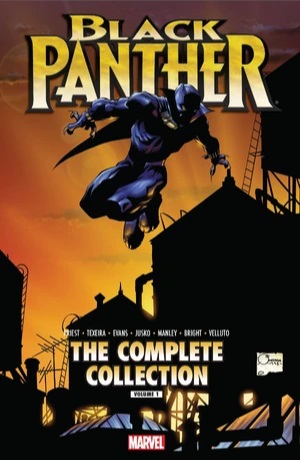 This is a collection of the run of Black Panther comics written by Christopher Priest (not the British novelist who wrote The Prestige) and published under the Marvel Knights imprint in 1998. The date is worth mentioning because if you don’t remember the ‘90s (and boy does it make me feel old to write that) then you might not get the references to the likes of Bill Clinton (not named, but clearly the “Bubba” president who goes chasing our nebbish narrator Everett K. Ross through the halls of the White House), Ken Starr, and Dan Quayle. Even I pulled a blank on knowing that LeeAnn Rimes recorded a cover of “Purple Rain” that was released in 1998.
The name of Donald Trump, however, has stayed with us, though he wasn’t a politician yet.
The date is also worth mentioning because the presentation is expressly in the manner of Tarantino’s Pulp Fiction (1994), with everything jumbled out of order and most of the story being told in flashbacks. The second number basically has to retell the events of the first and fill in the blanks, and later we have to wait several issues to find out why Ross has been exiled to Iceland, and by the time we’re told, if you’re like me you may not care anymore. Meanwhile, whole episodes seem to come out of nowhere and are hard to place. I couldn’t figure out the chronology of the Kraven business, for example, though it was nice of him to drop in.
That said, I did think the jumbled storyline was well executed. I was a little less interested in the story itself though, and didn’t find it very involving. Achebe and his hand-puppet were an interesting double act, but for the life of me I couldn’t figure out what he was really up to, and at the end couldn’t even remember what happened to him. I assume he was himself a puppet of dark forces in the U.S. government. Killmonger shows up and . . . doesn’t have much to do. His agenda only becomes a bit clearer later on. Ditto the Avengers. The best of the bad guys is Hydro-Man, but he’s not long for this world, or series. Kraven the Hunter is fun and acquits himself well, but he’s quickly dealt with too, as is the team of B-list villains who take on the Black Bloc of superheroes and basically just get slapped around. The Fantastic Four make it onto the cover of issue 3, which is egregious mislabeling as they only show up in a single panel in the comic, and that’s part of a dream. Meanwhile, it was disappointing that we didn’t get to see the fight between the two bloated warrior egos of Thor and Zuri. That sounded like it was going to be epic.
One thing I did find interesting was the change in the line-up of artists, which added to the narrative scrambling to give another layer of fragmentation to the proceedings. We move from the thick shadowing and blurry outlines of Mark Texeira’s Claymation-style figures, through the Saturday-morning animation of Mike Manley, to the jagged striations of Sal Velluto, who draws torsos with more muscle groups than seem possible. Visually it makes for quite a change of gears, but it fits with the overall sense of continuity in chaos. If I had one complaint about the Panther’s appearance it would be about that strange semi-belt thing he wears. Is it just decorative? I thought it seemed odd. Plus, I know the colour has to be adjusted to show off the Panther’s physique, but it’s weird how blue he is. I would have gone with more greys.
In 1998 Priest thought it a real challenge to reinvent “one of Marvel’s least appreciated and dullest characters.” He mainly went about it by not focusing on T’Challa (or “the client”) at all, mainly letting us see him through the eyes of Ross, the “friend of the reader” who undercuts the heroic action every chance he gets with voiceover and play-by-play. It’s all knowing and ironic, but that was very 1998 too.
In sum, there’s a lack of clear conflict and rising dramatic tension, in large part due to the complexity of the storyline and the manner in which it unfolds. I still quite enjoyed it, but in many ways it’s a sort of anti-comic in that it doesn’t go for the kind of thing that we normally expect comics to do. I think that was what Priest was aiming for though and it’s a difficult mission that he accomplished.

