TCF: Evidence of Things Seen

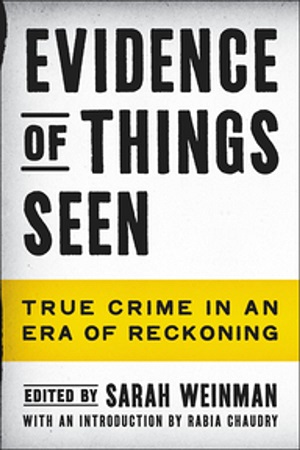
Evidence of Things Seen: True Crime in an Age of Reckoning
Ed. by Sarah Weinman

The crimes:

“A Brutal Lynching: An Indifferent Police Force, a 34-Year Wait for Justice” by Wesley Lowery: the cold case murder of a Black man in Georgia is solved simply by following up reports of how one of the killers had been bragging about it for years.

“The Short Life of Toyin Salau and a Legacy Still at Work” by Samantha Schuyler: a Black activist is killed in Florida and the police don’t seem to care very much.

“‘No Choice but to Do It’: Why Women Go to Prison” by Justine Van Der Leun: some women may only be guilty of “acts of survival.”

“The Golden Age of White-Collar Crime” by Michael Hobbes: it’s never been a better time to be a corporate scofflaw.

“Picturesque California Conceals a Crisis of Missing Indigenous Women” by Brandi Morin: there’s a need for better reporting on and police investigation of MMIWG.

“How the Atlanta Spa Shootings – the Victims, the Survivors – Tell a Story of America” by May Jeong: pocket bios of the victims and survivors of the 2021 Atlanta spa shootings, who were mainly Asian immigrants.

“Who Owns Amanda Knox?” by Amanda Knox: after becoming an unwilling focus of the media as well as the Italian judicial system, Amanda Knox considers the alternate life of her celebrity.

“Tie a Tourniquet on Your Heart: Revisiting Edna Buchanan, America’s Greatest Police Reporter” by Diana Moskovitz: a Miami true crime writer turns out to have been more a person of her time than a pioneer.

“The True Crime Junkies and the Curious Case of a Missing Husband” by RF Jurjevics: a woman’s Facebook post about the disappearance of her husband triggers an Internet investigation that turns up a darker story.

“Has Reality Caught Up to the ‘Murder Police’?” by Lara Bazelon: the Baltimore homicide detectives who inspired David Simon’s creations Homicide: Life on the Streets and The Wire turn out to have had a less than stellar track record.

“Will You Ever Change?” by Amelia Schonbek: inside a program that pairs survivors of domestic violence with surrogate offenders for therapeutic dialogue.

“The Prisoner-Run Radio Station That’s Reaching Men on Death Row” by Keri Blakinger: a radio program is broadcast very locally out of a Texas prison.

“To the Son of the Victim” by Sophie Haigney: a reporter recalls her brief interaction with the son of a shooting victim.

The book:

Well, if that “age of reckoning” didn’t give it away then I’ll give it you in a word: this is an anthology of woke true crime.

I don’t mean that in a bad way. What editor Sarah Weinman has wanted to do (here and in her earlier anthology Unspeakable Acts, to which she considers this to be “a companion volume and an extension”) is to expand on the popular understanding of “true crime” to bring in less familiar elements and storylines. In particular, she sees this collection as “a testament to the discomfort we live in, and must continue to reckon with, in order to hold the true crime genre to higher ethical standards and goals.” Whew! That’s setting a high bar. Does the book deliver?

Things get off to a bad start. The Introduction is by Rabia Chaudry of the podcast Undisclosed, and she duly brings the killing of Hae Min Lee up, patting herself on the back for clearing Adnan Syed. This is a case that still divides people though, and I personally lean toward thinking that Syed was at the very least involved in Lee’s murder. Chaudry herself has also been the target of some fair criticism for her advocacy and I can’t say she’s a voice I trust very much. Her Introduction also wrong-footed me from the get-go: “The debate about whether the true crime genre, across all forms of media, does more harm than good in society is long-standing and contentious.”

A long-standing debate? Sure there have been critiques of true crime, but Chaudry’s evidence for a debate is pretty thin, or what the grounds of such a debate might be. A couple of sources are quoted for the claim that consuming true crime content is bad for us, but then these are quickly dismissed. A tone is set of looking for an argument, even when none is available.

One point Chaudry brings up is worth flagging though because it plays an important part in several of the stories to come. This is the critique that “monsters like Ted Bundy and Jeffrey Dahmer have left permanent marks in pop culture while their victims have been forgotten.” There’s nothing new in this observation and it’s been given a lot more play in the demand for new perspectives not just in true crime reporting but in every facet of our culture, perspectives that seek to tear down the celebrity of (typically white male) villains while prioritizing the stories of their victims.

This is a moral position to take, and also one that very much feeds off of the priority given to victims, however broadly defined, in our culture. Perhaps the most prominent recent example of this in the context of crime reporting was New Zealand prime minister Jacinda Ardern’s refusal to name the perpetrator of the Christchurch mosque shootings and her urging others to “speak the names of those who were lost rather than the name of the man who took them. He may have sought notoriety but we, in New Zealand, will give nothing – not even his name.” This is a directive heeded by May Jeong in her piece here on the Atlanta spa shootings where the killer (Robert Aaron Long) is only referred to as “the suspect” while the reporting itself is almost entirely given over to pocket bios of the people he killed.

This is not just a moral position to take – most killers are monsters and their victims innocent – but it’s also one that has a political argument behind it as well. Should the media broadcast or even make available the manifestoes of mass killers like Elliot Rodger, Anders Breivik, and Brenton Tarrant? A fair question. In a culture like ours, where celebrity is the coin of the realm, there’s something wrong about using one fame or notoriety to promote hate. At the same time . . . it is the coin of the realm. This is something everybody understands. Theodore Kaczynski by his own admission became the Unabomber because he knew it was the only way he could get people to pay attention to his manifesto.

That said, I don’t think true crime writers, or the genre in general, make heroes out of wrongdoers. But the matter of celebrity and what gets our attention leads to a further point. We read true crime because it deals with the exceptional: the pathologies of human nature and behaviour. We don’t read about serial killers because we admire them but to learn something about them, like what went into making them and how they can be identified. Meanwhile, what can be learned from their victims, who are all too often simply people who found themselves in the wrong place at the wrong time? It’s not that we don’t care about them, it’s just that they’re normal, and we’re not that interested in normality.

But while defensible on some levels, I think there are serious caveats to be entered when reading true crime that comes at us from the margins, as woke or victim-based.

In the first place, and I’ll use Jeong’s piece as the test case, it’s writing that has an agenda and it can strain too hard to score political points, occasionally becoming tendentious in the extreme. Here, for example, is a description of Long’s hometown:

Woodstock, Georgia, was Cherokee country before its original inhabitants, who had been in the area for 11,000 years, were displaced by white settlers around the mid-1700s. On May 28, 1830, President Andrew Jackson signed the Indian Removal Act, codifying into law the forcible removal of 15,000 Cherokee people from what is today their namesake county. The white settlers panned for gold in nearby rivers, purchased Black people as slaves, and opened chicken processing plants, still in operation nearly two centuries later.

Woodstock today enjoys a median family income of $76,191, and is almost 80 percent white. It is the hometown of at least two notable figures: Dean Rusk and Eugene Booth. Rusk, who later became secretary of state, was responsible for splitting the Korean peninsula in two using a foldout map from a copy of National Geographic. The line “made no sense economically or geographically,” he later admitted, but it allowed American occupying forces to take control of Seoul, a decision that would divide families for generations. Booth was a nuclear physicist and core member of the Manhattan Project, which led to the bombings of Hiroshima and Nagasaki in Japan, killing as many as 250,000 civilians, according to some estimates. Woodstock is proud of their native sons, naming a middle school after Rusk.

What is the point of all this? Does Jeong not eat chicken? How personally responsible was Dean Rusk for the division of the Korean peninsula? Where was he supposed to draw the line on the map? Should Seoul have been given to North Korea? Was Booth wrong to work on the Manhattan Project? What does the dislocation of native tribes from Woodstock 200 years ago have to do with Long’s motives? Is it just meant to be taken as being all part, somehow, of the same racist, imperialist matrix?

Second, does the erasure of the killer’s name make this a better piece of reporting? Does it add something by subtraction? It’s hard not to feel like we’re reading an ideologically cleansed version of the first draft of history here. And it’s the sort of policy that goes beyond true crime reporting. There are no Wikipedia pages, for example, for Elliot Rodger, Brenton Tarrant, or Robert Long but only for the 2014 Isla Vista Shootings, the Christchurch mosque killings, and the 2021 Atlanta spa shootings respectively. I think that must be part of the site’s editorial guideline. Is it justified? And finally there’s the fact that Jeong’s article on the shootings is 25 pages long, providing biographical sketches of six of the seven women killed and of the one man, an immigrant from Guatemala, who was injured but survived the attack. Jeong also has a couple of pages where she talks about her own Korean-American family. The one man who was killed, along with the other woman, have their names mentioned briefly in a single paragraph together. They were the only two white victims. This isn’t a full story or accounting then. But what kind of a story is it?

Third: I don’t think it should make a difference where the author is coming from. I prefer most true crime writing that adheres to traditional standards of objectivity, and (as I’ve said before) there are few things I despise more than the trend toward “true crime memoir.” But this sort of writing, which often plays up group identity, invites authors to stake their writing in their own experience. And so Jeong adds that section I mentioned on her own family’s American experience as Korean immigrants, and Mallika Rao does the same while writing on an Indian family in Texas.

I understand Rao’s point, that Texas cops don’t understand something that she does just “by virtue of being born to Hindus in Texas,” but how far can we take this? Rao mentions how the defence counsel for the mother accused of killing her child was going to call an expert witness to say that the defendant “had all the markings of a truth teller, a woman in grief.” But Rao doesn’t “need an expert to tell me that. I felt it just by watching her.” Because of some cultural fellow feeling? Superior empathy? Then only two pages later she takes the trial transcript to task for using the word Hindu instead of the correct Hindi to describe the language the accused was speaking in. “As I saw that repeated typo, I wondered if the error had been the court reporter’s or if it had been spoken by those in charge of Pallavi’s fate, in that courtroom. I wondered how much of any case is built and tried on fact and how much on feeling, instinct. No one in the court had been of Indian origin except the defendant and her husband.”

Is this an injustice? Are the only feelings and instincts that can be trusted those of individuals from the exact same cultural background or ethnic identity? Should all true crime writing become a form of memoir, a personal identification between the author and the victim (never, of course, the perpetrator of violence)?

And what if the roles are flipped from the usual script? How are we to handle the “True Crime Junkies” story, where the villain of the piece is a predatory woman who destroys the life of an innocent man? Should we say her name? Should we be more interested in telling his story? What would we learn from that?

So I did have some caveats. But this is a nice anthology with some good stories in it and some fine writing. I found the piece on white-collar crime, the one by Amanda Knox, and the True Crime Junkies story, to be particularly thought-provoking. And even Jeong’s take on the Atlanta killings was quite good, only needing six or so pages taken out of it. But in the final analysis I’m not sure the case was made for this being representative of true crime writing that’s setting “higher ethical standards” or even providing more truthful (fuller? more objective?) accounts. Instead, what it highlights is the fact that every piece of writing, of whatever genre, comes from a particular point of view, if not with a full-blown agenda.

Noted in passing:

The essay by Lara Bazelon on how the writer and show runner David Simon presented an airbrushed picture of the Baltimore police in his 1991 non-fiction book Homicide: A Year on the Killing Streets (which in turn led to the NBC series Homicide: Life on the Streets and the HBO show The Wire) struck a familiar note with me. Simon had followed a group of Baltimore homicide detectives around for a year but hadn’t reported on any of their misdoings, a pattern of conduct that would lead to many ruined lives, overturned convictions, and tens of millions of dollars in judgments against the city.

Was this inevitable? A former head of the Baltimore Innocence Project calls the book “a cautionary tale for embedded journalism.” Simon’s collaborator Richard Price, in a foreword to a later edition of Homicide, asked “Are writers like us . . . who are in fact dependent in large part on the noblesse [what an odd choice of word] of the cops to see what we have to see, are we (oh shit . . . ) police buffs?”

I think Price is letting writers off easy by calling them fans in such a case. As journalists covering war zones have been pointing out for decades now (Robert Fisk was one of the most outspoken), being “embedded” with the military puts one in a hopelessly compromised position. Indeed, the whole point of embedded journalism, and I think the term was first used with regard to media covering the first Gulf War, was for the army, and the state more broadly, to control news coverage. What nobody (or at least nobody working for the military) wanted was “another Vietnam.” The army wasn’t letting reporters be embedded for altruistic reasons but rather as a way of co-opting their voices and controlling the coverage.

The reason this had a particularly familiar note to me though has regard to a different context. As I’ve written on at length in other posts (please see here, here, and here), reporters and biographers writing about living figures who are given special or exclusive access to their subjects are always compromised. Access comes with strings attached. If you’re going to write about the armed forces, or the Baltimore police, or some celebrity, no matter how minor, and they let you follow them around or give you an interview, it’s because they are looking to shape the narrative and are expecting you to follow their ground rules. It’s a symbiotic relationship, with the writers as parasites that are only allowed to function if they perform some useful task for the host.

Takeaways:

Perspective matters when it comes to the writing of true crime, and changing things up does add a lot to our understanding of matters relating to the criminal justice system. However, not all that a different point of view adds is helpful or instructive, and it’s also the case that sometimes something can be lost.

True Crime Files

TCF: The Forever Witness

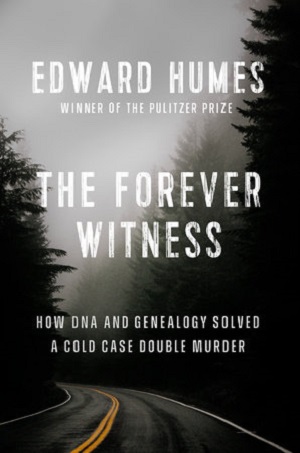
The Forever Witness: How DNA and Genealogy Solved a Cold Case Double Murder
By Edward Humes

The crime:

In 1987 a pair of young Canadians, Jay Cook and Tanya Van Cuylenborg, were killed on a trip to Seattle to pick up a furnace part. Over thirty years later William Earl Talbott II was convicted for their murder, having been caught by the new science of genetic genealogy.

The book:

This is a great book, both for how well Edward Humes tells the story – offering different perspectives into the killing and subsequent investigation – and for the importance of what it tells us about modern forensics.

The basic elements of the crime weren’t exceptional. Jay and Tanya were a normal couple whose only mistake was being in the wrong place at the wrong time. That place being the state of Washington, a.k.a. Ann Rule country. “In the 1970s and 1980s (and continuing through the 1990s), Seattle and the Pacific Northwest had become home to an extraordinary number of serial killers, rapists, and killers.” Among the lowlights we find names like Ted Bundy, Gary Addison Taylor, Gary Ridgway, and Robert Lee Yates. I’m not sure why this should be. Humes says that “from a practical standpoint, the region served as a predator’s ideal habitat” because Seattle “was a big city . . . surrounded by . . . extensive woodlands and wild areas.” But I don’t think the urban or natural environment has much if any influence on the creation of a serial killer. And Talbott was, somewhat surprisingly, not a conventional killer. A moody child who tortured animals and then escalated to extreme and methodically planned violence, you would have thought he’d go on to a bloody criminal career. But apparently Jay and Tanya were a singular outburst.

In any event, Seattle wasn’t the place to be visiting in 1987. But Jay and Tanya’s fate, like most such tragedies, was the product of contingency:

so many other factors contributed to what happened, so many seemingly inconsequential events and decisions. They all had to occur just so and in precise sequence, like a once-in-a-lifetime alignment of the planets, without which Tanya and Jay’s trip wold have concluded uneventfully and there would have been no BOLO [a “be on the lookout” advisory], no manhunt, no case at all. First there had to be a broken furnace on Vancouver Island. Then a usually reliable Canadian heating supply company had to fall through, and a Seattle supplier had to have just the right vintage furnace and parts. There had to be a customer who needed that installation before the weekend and a business partner who could not make that happen. Jay had to have just lost a job so he had time to go to Seattle, and Tanya’s best friend had to be sick so she could not come and provide strength in numbers. The travelers had to reject a simple, foolproof route in favor of a complicated scenic course where a wrong turn was practically inevitable. Jay and Tanya had to arrive in Bremerton hours late, yet in time for the last ferry to Seattle. Omit or change any one of these links in the chain of events, and the couple from Vancouver Island would never have reached the same spot at the same time as a stranger determined to do evil.

Perhaps because Talbott was such an oddity and the murders a one-off, and perhaps because of the unfortunate series of accidents leading up the killings, the case remained cold for a very long time. But then came what Humes refers to as the third revolution in DNA profiling: snapshot DNA phenotyping (generating an image of a suspect based on their DNA) and even more significantly genetic genealogy.

Humes provides a good backgrounder on the history of the science behind genetic genealogy. Basically it means identifying a source of DNA by using vast online genealogy databases. Previously, using DNA “fingerprinting,” you could only match DNA found at a crime scene with the individual who shared the exact DNA – that is to say, the very person the police were looking for. If that individual’s DNA wasn’t already on file somewhere as a previous offender, you were out of luck. With genetic genealogy investigators could drill down to virtually any individual by way of their family DNA. It wasn’t even that hard. What was originally thought impossible turned out to be simple. It took CeCe Moore, the DNA detective on this case, only a couple of hours sitting on her couch at home with her laptop to identify Talbott, an individual with no prior record.

It all sounds like science-fiction. When combined with the snapshot image generator it’s even a bit like Minority Report. But there’s no denying it’s effectiveness. What concerned people was the potential for misuse in such a technology. Who had the right to such information? What could they do with it?

I’ve always had two responses to these concerns. In the first place, the toothpaste is out of the tube. Now that we have the technology available, we’re going to use it. Or at least somebody’s going to use it. And how and why did things get to this point? Not because of governmental overreach but because we voluntarily gave up all this information. I’ve never understood why people complain about the government invading our privacy when we’ve been more than willing to let private companies invade it even more. I’ve gone on about this before, and had made notes to say more on the subject here, but at the end of the book Humes himself says it better and he’s worth quoting at length because this is important:

Focusing on law-enforcement use of DNA databases as a major threat to privacy is like regulating matches in order to address the problem of rampant wildfires. Attention is being misplaced – or diverted from – much larger potential threats to privacy and democracy.

While we obsess on what the police are up to when ferreting out a few names and emails from public genetic databases, millions of Americans are blithely uploading their complete genomic information to largely unregulated private profit-making companies who monetize customers’ precious, extremely valuable DNA in a multitude of ways, including highly lucrative biomedical research. And, rather incredibly, the DNA donors are paying these companies to do it.

More than forty million people had taken a consumer DNA test by the end of 2021. That’s nearly double the number reached in 2018. What the police can access in their searches is nothing compared to the vast information these millions of customers are giving to the private companies. It may go out the door as just a tube of spit in the mail, but to these companies, your spit is liquid gold from which your most sensitive, private self and secrets can be extracted: Are you prone to heart disease? Cancer? Alzheimer’s? Mental illness? Depression? Do you have children with more than one spouse? Are you adopted? Are you related to a criminal?

People are giving away the keys to stuff even they may not know about themselves to profit-making companies who answer only to their shareholders. And the information you turn over to these corporations also informs them about your children and your parents and your other close relations – everyone who shares your DNA. You might as well send them your diary, your checkbook ledger, and your tax returns. But all the critics want to talk about is what the police are going to do with those names and emails they extract while hunting for serial killers.

It would only take one Enron of DNA, in an otherwise respectable industry – or one well-lace database hack of companies whose vulnerability has already been demonstrated – to cause more damage than anything imagined by those who worry about cops using genetic genealogy. What would the data be worth to an insurance company looking to deny coverage? To companies looking to screen their potential hires? To lenders and underwriters who make millions for every fraction of 1 percent of risk they can avoid? What would sensitive private information be worth to political operatives, domestic and foreign spies, to those who would blackmail leaders or manipulate and game an election? And the DNA doesn’t have to be from the person being coerced. Malefactors can get to them through a cousin. Or an aunt. Or a child.

It’s painful when your credit card is hacked. But you can cancel it and get a new one. Once your genome is hacked, there’s no undoing it. It’s the only one you’ve got.

There is much here that needs to be flagged. What the police can access in their searches is nothing compared to the vast information these millions of customers are giving to the private companies. People are giving away the keys to stuff even they may not know about themselves to profit-making companies who answer only to their shareholders. You might as well send them your diary, your checkbook ledger, and your tax returns. Once your genome is hacked, there’s no undoing it.

The possibilities for using these new tools to catch bad guys are endless. But the downside is also unimaginable.

Noted in passing:

Humes mentions at one point that the series finale of Roots was watched by 71 percent of households in the country. This struck me as being very high. I found a list of the most watched television broadcasts in history and the numbers quoted were all for the number of viewers. Apparently the Apollo 11 Moon landing was the most watched broadcast ever (around 125-150 million viewers), which I can believe. The next eight shows on the list were all Super Bowls, then Richard Nixon’s resignation speech. The top primetime program was the series finale of M*A*S*H. The series finale of Roots came in tied for sixteenth with The Day After.

But, as I said, these rankings are all for number of viewers, not percentage of households. If you’re talking about that latter figure, 71 percent is incredible. Given the splintering of the audience today and the fact that streaming viewing has largely taken over from television it’s a number we’re not likely to see again.

Takeaways:

In the twenty-first century, we’re all just part of the database.

True Crime Files


TCF: The Best American Crime Reporting 2007

The Best American Crime Reporting 2007
Guest Editor: Linda Fairstein

The crimes:

“The Loved Ones” by Tom Junod: were the operators of a New Orleans nursing home that didn’t evacuate before Hurricane Katrina struck guilty of negligence? Or did they care too much?

“The Inside Job” by Neil Swidey: the owner of a construction and landscaping business hires an accountant from a temp agency who proceeds to embezzle millions from him, largely without him even being aware of it.

“The Talented Dr. Krist” by Steve Fennessy: the perpetrator of a ghastly kidnapping does his time and even becomes a doctor, but can’t help getting into trouble.

“The Case of the Killer Priest” by Sean Flynn: a priest in Toledo is charged with having killed a nun a quarter-century earlier.

“Double Blind” by Matthew Teague: British efforts to infiltrate the IRA are so successful the double agents don’t even know whose side everyone is on.

“The School” by C. J. Chivers: an account of the Beslan school massacre in North Ossetia, as experienced by various survivors.

“A Kiss Before Dying” by Pamela Colloff: a high school football player in Texas kills his ex-girlfriend by shooting her in the head with a shotgun and throwing her body in a stock pond, apparently all in accordance with her wishes. He is acquitted at trial.

“The Devil in David Berkowitz” by Steve Fishman: the Son of Sam killer finds God in prison, or so he says.

“The Man Who Loves Books Too Much” by Allison Hoover Bartlett: a swindler steals rare books from second-hand bookshops across the U.S. He’s caught, but remains largely unrepentant.

“Dirty Old Women” by Ariel Levy: female teachers have affairs with underage male students.

“Who Killed Ellen Andross?” by Dan P. Lee: a pair of high-profile medical examiners face off in the murder trial of a husband accused of killing his wife.

“Fatal Connection” by David Bernstein: a Chicago escort is murdered not by one of her clients but by her financial adviser.

“Last Seen on September 10” by Mark Fass: a woman living in Lower Manhattan goes missing the day before the attack on the World Trade Center. Her family think she died in the bombing but others have their doubts.

“My Roommate, the Diamond Thief” by Brian Boucher: a man rents out the bedroom in his one-bedroom apartment to a mysterious fellow who turns out to be a jewel thief on the run.

“The Monster of Florence” by Douglas Preston: an American writer living for a while in Florence befriends an Italian journalist and they start looking into the case of a serial killer who terrorized the area years earlier. This gets them both into trouble with the authorities.

The book:

Like all the entries I’ve read in this (now sadly defunct) series, it’s great. I didn’t think there was a bad story. Levy didn’t do much with her quick look at teachers-in-heat, and Boucher’s piece is also a bit light, but they’re also the two shortest stories and still manage to be interesting and fun.

On the other end of the scale, C. J. Chivers on the Beslan school massacre is the longest piece and still feels as though it needed more room. It really should have been a book, complete with photos and maps, as it’s basically a collage of first-person accounts (or “a museum of words,” as Chivers puts it) and isn’t always easy to follow. Meanwhile, the fact that at least two of the stories included here – the ones by Bartlett and Preston – were later turned into successful books gives you some idea of the quality of the material.

I don’t go into such an anthology expecting much in the way of continuity in terms of the subject matter, so I was surprised to find a strong recurring theme. Perhaps guest editor Linda Fairstein had a predilection for a particular kind of crime story. However it came about, a lot of the stories deal with a betrayal by individuals in a position of trust.

We begin with the operators of a nursing home who put their residents at risk as a hurricane bears down on New Orleans. Next up an accountant embezzles funds from her employer. Then we have a bad doctor and a killer priest. Also we’ll have teachers having sex with their students and a financial advisor who steals money from his client before killing her. And finally the Italian police in “The Monster of Florence” demonstrate not so much ignorance and corruption (though there was probably some of that) as provide evidence that they’re not the kind of people you’d want to put in a position of authority.

A lot of this is a sort of sub-set of a message that a lot of true crime writing carries: that you can’t trust anyone. Put another way, “if delusion is our enemy, it equally may be said that trust is no friend of clear-thinking” (this is from the Introduction by the series editors). Or, as Duncan says of the treacherous thane of Cawdor:

There’s no art
To find the mind’s construction in the face.
He was a gentleman on whom I built
An absolute trust.

Indeed there is no art, as Duncan is about to find out by putting his trust in Macbeth. He’s learned nothing. That said, we learn from books as much as example and experience, which is one of the things that I think gives true crime real value. If not an art, there’s a skill to reading people that we can always get better at. It begins with realizing that there’s no one deserving of “an absolute trust.”

Noted in passing:

In my notes on Kathryn Casey’s She Wanted It All I talked about some of the stupid ways that not-very-bright criminals find to blow their ill-gotten money. I thought of that again reading about Angela Platt bilking her boss for millions and then spending it on not just a new house, a big-screem TV, and time-shares in Florida and the Bahamas but also “the kind of bizarre crap you’d expect to find if you could journey through Christopher Walken’s brain”:

A hot rod fashioned into a green monster with teeth the size of fence pickets. A 1931 Plymouth with the faces of Bonnie and Clyde and lots of bullet holes painted on it, bearing the Rhode Island license plate UMISED. Collections of rare guns and wretched movies. Talking trees inspired by The Wizard of Oz.

OK, I’m not sure what this has to do with Christopher Walken, and I have a small collection of wretched movies myself, but this sounds pretty bad. And there was more! Platt also had a life-sized statue of Al Capone wearing a white suit and chomping on a cigar. For her brother’s wedding she hired the entire Riverdance touring troupe (at a cost of over a quarter million dollars) and Burt Bacharach (nearly $400,000) to perform. Given that her boss hardly even noticed the money she was siphoning off to pay for all this, I really had to laugh.

I’d forgotten how David Berkowitz had been caught. A woman had seen his car being ticketed on the night of one of the killings and reported it. When police investigated they turned up a lot of suspicious information relating to Berkowitz, and when they tracked down the car (Berkowitz hadn’t changed his plates) they found he’d left a gun lying unconcealed in the back seat.

It’s interesting how these routine traffic violations have played a role in catching famous bad guys. Peter Sutcliffe, the Yorkshire Ripper, was caught because an officer noticed that his car had false plates. Timothy McVeigh was only stopped while leaving Oklahoma City because he hadn’t attached plates to the vehicle he was driving. It’s the little things that trip you up.

Takeaways:

While not everyone is a potential killer, it’s a safe bet that nobody is exactly what they seem to be. In any event, you should always question people in positions of trust and authority unless you know they’ve earned it. They rarely have.

True Crime Files

TCF: Homegrown

Homegrown: Timothy McVeigh and the Rise of Right-Wing Extremism
By Jeffrey Toobin

The crime:

On April 19, 1995 (the second anniversary of the end of the Waco siege) Timothy McVeigh detonated a truck bomb in front of the Alfred P. Murrah Federal Building in Oklahoma City. There were 168 dead, including 19 children. McVeigh was quickly apprehended and after being found guilty executed by lethal injection. His associate Terry Nichols, who helped him build the bomb, is serving a life sentence.

The book:

Homegrown is the opposite of a timely book, coming out nearly thirty years after the events it describes and the extensive media coverage it attracted. Ten years ago I reviewed a book on the subject – Oklahoma City: What the Investigation Missed – and Why It Still Matters by Andrew Gumbel and Roger G. Charles – that took a very critical look at the investigation and the question of whether McVeigh and Nichols were working alone. Jeffrey Toobin doesn’t mention Oklahoma City and I don’t know if he even read it, but he takes the opposing side, praising the efforts of law enforcement and arguing that there were no shadowy connections between McVeigh and various right-wing militia movements.

Which is not to say he doesn’t see McVeigh as part of the same tide of extremism that was swelling in America at the time and that later crested in the Capitol riots of January 6, 2021. The connection to the Capitol riots, and “the rise of right-wing extremism” more generally in the wake of the Oklahoma City bombing is the main point Toobin wants to drive home. This he does repeatedly. Flipping to the index I found January 6 referenced over 30 times. It usually sounds like this:

The right-wing extremists of the 1990s employed the same kind of violent imagery that their successors would use more than twenty-five years later. Before Oklahoma City, [Rush] Limbaugh spoke of how close the nation was to “the second violent American revolution,” just as Donald Trump told his armed supporters on the Ellipse on January 6 to march to the Capitol and “fight like hell.” On both occasions, actual violence followed broadcast incitement. Clinton believed that this kind of language had real-life consequences, but that wasn’t the kind of conclusion that could be tested in a court of law. In contrast [Merrick] Garland and others in the Justice Department refused to tie the bombing case to contemporary politics, believing that such analyses could only confuse a straightforward criminal trial. Thanks to the reticence of Garland and his colleagues, as well as the tunnel vision of the journalists covering the case, the impression lingered that McVeigh was an aberration, a lone and lonely figure who represented only himself and his sad-sack co-defendant. This notion, as history would show, was mistaken.

Or:

The events of January 6, 2021 saw the full flowering of McVeigh’s legacy in contemporary politics. McVeigh was obsessed with gun rights; he saw the bombing as akin to the revolutionary struggle of the Founding Fathes; and he believed that violence was justified to achieve his goals. So did the rioters on January 6.

And so on. From their embrace of violence, performative rage (“the fight – was the end in itself”), fetishization of the Second Amendment, invocation of the spirit of ’76, and inspiration drawn from The Turner Diaries (elevated into a kind of sacred text), a clear line runs from McVeigh to today’s right-wing militias. What has mainly changed is the way the Internet and social media now allow for greater mobilization of the “army” that McVeigh could only dream of. McVeigh read books and listened to the radio and shortwave. He wrote letters to the editors of local newspapers and to his representatives in congress. He met up with kindred spirits in the flesh at gun shows. What he “lacked was something that hadn’t been invented.” “The digital radicalization of McVeigh’s descendants,” Toobin notes, “was much faster and more efficient.” “More than any other reason, the internet accounts for the difference between McVeigh’s lonely crusade and the thousands who stormed the Capitol on January 6, 2021.”

I’m in broad agreement with this point of view, as it’s part of a larger question that historians and pundits have been discussing ever since the rise of Trump: to what extent did Trump and his MAGA movement mark a significant break with traditional Republican values, and to what extent was he the culmination of the American right’s long slide into violent insanity? Toobin clearly comes down on the side of continuity, and I think he makes a strong case. There were some places, however, where I thought he pressed too hard. At one point, for example, he tries to rope McVeigh in with “incel” culture:

McVeigh came of age before the term “incel” – involuntary celibate – came into wide use. Like the incels of a later day, McVeigh was unable to attract the sexual interest of women and responded with rage toward them.

This appears to be mistaken just on the basis of Toobin’s own reporting. For starters, I wasn’t sure what rage he was referring to, aside from McVeigh’s anger at his mother. But more to the point, McVeigh himself claimed to his lawyers that he’d had eight sexual partners, “three of them the wives of friends” (including the wife of Terry Nichols). A serial cuckolder isn’t an incel, and I wouldn’t have thought having eight partners by one’s early 30s was considered batting at such a low average as to be described as “unable to attract the sexual interest of women.”

Even without knowing anything of McVeigh’s sexual history, my own knee-jerk reaction against calling him an incel had to do with his height. Are there many tall incels? According to dating data, height is a primary (if not the primary) sexual selector, and McVeigh at 6’3” would be considered pretty much ideal in this regard. In comparison, famous killer incels Elliot Rodger and Alex Minassian were both 5’9,” which isn’t short but didn’t make them irresistible.

I’ve noted this dangerous predilection women have for tall men before in these notes, and the point here is that just by being 6’3” McVeigh seems to have had no problem attracting at least some women, despite having no job, living out of his car, and only possessing average looks combined with a rebarbative personality. But he also seems to not have been that interested in women anyway, or bothered seeking them out, which sort of kills your chances. In any event, it’s interesting that he took exception to a New York Times story that considered him to be “asexual” because he did his own dishes – a judgment that shows how facile such analyses can be.

Calling McVeigh an incel though isn’t just another way to tie his case in with more recent cultural trends but is part of the usual pattern, at least among not very good writers, of painting a villain as black as possible every chance you get. McVeigh was an evil man, but having said that, what purpose is served by calling him an incel, or a coward? Here is Toobin trying to explain “the real reason” why McVeigh didn’t shoot Charlie Hanger, the officer who arrested him:

In Iraq, McVeigh could fire a projectile from a Bradley and still strike a target far off in the distance. In Oklahoma City, he could put in his earplugs and set off a bomb that targeted faceless federal employees he would never see. But McVeigh never had the guts to kill a man face-to-face.

This struck me as a really cheap shot, and stupid. Because why does it take guts to kill someone face-to-face? I would have thought that this was just the mark of a psychopath. Would killing Hanger have made McVeigh more of a man?

I guess this is a minor point though, when placed in context. Overall I thought Toobin did a good job here retelling the story, though I was surprised given the amount of material he had to mine (courtesy of McVeigh’s lawyer rather dubiously donating all of his material on the case to a library in Texas) how little here is actually new. But did we not know all about McVeigh before this? What was there to find out? Toobin seems mainly intent on putting to rest ideas that McVeigh had help from anyone other than Nichols and Michael Fortier. This seems pretty convincing, though I wouldn’t be surprised if some of the “clutter” that the prosecution didn’t want to bring into their case might have also included other individuals or even groups who were to some degree in the know.

I also wasn’t as impressed as Toobin by the efforts of law enforcement and the prosecutors. They did their job. But the fact is this was as open-and-shut a case as you could imagine. Toobin frankly calls McVeigh’s defence to be “hopeless.” It’s also true that McVeigh was apprehended by accident, after being pulled over for failing to attach a licence plate to his car (much the same way Peter Sutcliffe, the Yorkshire Ripper, would be caught). Nichols, for his part, would basically turn himself in. Then, after McVeigh was in custody he pretty much gave himself up and wanted to sound a call to arms/become a martyr to his cause. The fantastic sums his lawyers were provided to defend him seems mostly to have been wasted on what were basically just expensive vacations.

The most disturbing thing in the book though is the conclusion Toobin draws: that what was once extreme has become mainstream. The so-called Overton window has shifted. To take just one example:

The McVeigh prosecutors put the “civil war” issue in front of the jury to show how extreme and exotic the defendant’s views were. But a quarter century later, McVeigh’s view was close to the conservative movement norm. This view – about the possibility of civil war – became mainstream as the passions underlying the January 6 insurrection roiled conservatives during the Biden presidency. According to an Economist/YouGov poll in the summer of 2022, 43 percent of Americans believe it’s at least somewhat “likely” that “there will be a U.S. civil war within the next decade.” More than half of Republicans feel that way, and 21 percent of “strong Republicans” believe a civil war is “very likely.” McVeigh’s extremism had spread to much of the contemporary Republican Party.

First you imagine these things happening. Then you calculate their possibility. Then you start talking about them as inevitable. And then they happen.

Noted in passing:

There’s long been a theory about how the American West has traditionally acted as a kind of safety valve for the discontents of “civilized” modern life. I don’t know if McVeigh was aware of this, but on some level he clearly was tapping into it in his understanding of the kind of American past he wanted to return to: “I want a country that operates like it did 150 years ago – no income taxes, no property taxes, no oppressive police, free land in the West.” The frontier thesis of Frederick Jackson Turner is still in play, at least in some minds.

I’ve written before about the strange way that some cases strike the fancy of the public and stick in the public consciousness more than others. At around the same time as the Oklahoma City bombing trial was going on (in Denver) there were the O. J. Simpson civil trial and the JonBenét Ramsey murder, and it’s hard to say if the bombing will last longer in memory than either of those. That may sound callous and even cruel, but as Toobin points out at one point it may have been technically inaccurate to say, as many media figures and even the FBI did at the time, that the bombing was “the deadliest act of homegrown terrorism in U.S. history.”

It was not; indeed, the bombing was not even the deadliest terror attack in Oklahoma history. In June 1921, a white mob in Tulsa conducted a pogrom and killed about three hundred Black residents of the city’s Greenwood neighborhood. In the aftermath of the Oklahoma City bombing, the Tulsa race massacre was scarcely mentioned.

Actually, before there was a spate of interest thrown up by a book and documentary recently, I think the Tulsa race riots had been almost completely forgotten. Similarly, the Bath, Michigan school bombing of 1929, which killed 44 people (38 of them students) is an event that very few people know anything about today. Or take this list that Toobin provides in talking about the 1994 bill before Congress to ban assault weapons:

Assault weapons – that is, short-stock semiautomatics, with magazines for multiple rounds – had figured in several recent mass murders at the time. In 1989, a teacher and thirty-four children were shot by an intruder in an elementary school in Stockton, California, in 1991, a gunman killed twenty-three people at a Luby’s restaurant in Killeen, Texas; eight people were killed in a San Francisco law firm in July 1993. (Notably, as the roll call of mass shootings continued in subsequent decades, these horrors have been largely forgotten.)

Guilty as charged. I pulled a blank on all of these, though the Luby’s shooting did ring a distant bell.

It really is impossible to say what historical events, or cultural artefacts, are going to stay with us. Here, for example, is a bit Toobin takes from the summation of McVeigh’s lawyer, Stephen Jones:

Forty years ago this very month, there was a major literary event in this country. James Gould Cozzens’ great novel, By Love Possessed, was published. And for people of my generation and my mother and father’s generation, and I’m sure some but not all of you, that novel remains with us today, though its author has long since been forgotten. The book was an instantaneous best seller. It stayed at the top of the New York Times best seller list for over a year. It was a Reader’s Digest condensed book. It won for the author not only the Howell prize but a cover story on Time magazine. And eventually as you might expect, it was made into a movie and then translated into some 14 or 15 languages throughout the world.”

Again, and perhaps with even greater embarrassment, I have to plead guilty. I couldn’t remember ever having heard of By Love Possessed, book or movie, before this, or for that matter of the Howell Prize (technically the William Dean Howells Medal, which Toobin also must not have known anything about). I know I must have at least read Dwight Macdonald’s review, but there’s no memory of any of it now. The author, I can testify, has indeed “long since been forgotten.” This is just the way cultural memory works. Or doesn’t work.

Takeaways:

There’s nothing new about violent right-wing extremism in America. What has changed is how mainstream it has become. A lot of that is probably due to the Internet and social media, as people bring the poison into their homes and their phones, but it’s also due to the rot now spreading down from the top. All of which makes me think that it’s probably impossible now to root out.

True Crime Files

TCF: American Demon

American Demon: Eliot Ness and the Hunt for America’s Jack the Ripper
By Daniel Stashower

The crime:

Between 1935 and 1938 at least twelve people are believed to have been the victims of an unidentified serial killer in Cleveland, Ohio. The bodies were found in a dismembered state, mostly in the area of a shantytown known as Kingsbury Run. Eliot Ness, Cleveland’s Public Safety Director at the time, was in charge of the investigation.

The book:

I’m surprised that the case of the Cleveland Torso Killer, or Mad Butcher of Kingsbury Run, isn’t better known. But it’s an interesting question – one I’ve addressed before and will again – as to why some crimes grab hold of the public imagination and have more staying power in the culture than others. As an unsolved series of murders with the highest possible gore quotient – “those two qualities guaranteed to compel enduring fascination,” in the words of James Jessen Badal – you’d think it would have attracted greater attention than it has. As it is, American Demon takes its place on my shelf alongside Badal’s In the Wake of the Butcher: Cleveland’s Torso Murders and the comic adaptation Torso by Brian Michael Bendis and Marc Andreyko, but that’s all I have and I don’t think there’s a whole lot else out there.

Maybe, in part, it’s the absence of good information. As Badal reports (and his book remains the authoritative account), the original case files have vanished and it’s not clear they’d add much anyway. The victims mostly were, and to this day remain, unknown, and the couple we can name we can’t say very much about. Nor is the killer easily pigeonholed. He (assuming it was a he, which seems to me a pretty safe bet) killed men and women, making the sexual nature of the crimes, if there was one, hard to figure. Usually unsolved crimes give us a little more to go on. Here, even the leading suspect – a disturbed ex-doctor named Francis (Frank) Sweeney – seems only the most likely candidate in a thin field.

That said, there was a lot of forensic evidence, from the actual body parts to their distinctive wrappings. I don’t think it’s just the so-called “CSI effect” that makes me think such murders would be easy to solve today. The police at the time were hard working, but before the invention of the term “serial killer” no one seemed sure how to proceed, or what they were looking for. “Is there someone in Cuyahoga county a madman whose god is the guillotine?” a Cleveland newspaper asked. “What fantastic chemistry of the civilized mind converted him into a human butcher?” As Stashower points out, “This was a question that the Cleveland police of 1936 were ill-equipped to answer.” You can tell just from the way the questions were put, the sort of language used (“fantastic chemistry” of the mind), that they had a problem. And when Ness’s external help came in the form of “the first policeman in America with a PhD,” who also happened to be one of the people credited with inventing the pseudoscientific “lie detector” machine, then you get some idea of the lack of professional expertise available.

Still, you would have expected the police to come up with something more. As it is, they couldn’t even identify the “tattooed man” – whose tattoos were far from generic. Nor was forensics up to the job. One coroner mistook a classroom skeleton for a victim of the Butcher, while a couple of others might have missed the fact that the body of one of the later victims had been embalmed. These were not little mistakes.

This general lack of fitness for duty went right to the top. Ness himself had no experience in chasing after killers, and what’s more didn’t see it as his job. “The director of public safety [Ness’s actual title] wasn’t expected to hunt murderers any more than he was expected to put out house fires or rescue cats stranded in trees.” Instead, he saw his mission as busting vice networks and cleaning up police corruption while modernizing the force. And in that he had some success. He apparently wanted nothing to do with the murder investigation and only finally got involved when the job was thrust upon him. That’s not a likely recipe for success.

Did his failure to apprehend the killer contribute to his subsequent breakdown? Or was the golden boy of Untouchables fame just another example of celebrity burnout? Given that this book is as much about him as it is about the Butcher’s killing spree you get enough information to make up your own mind. Whether you actually want this much Ness material mixed in is another question, as I felt it didn’t add much to the story. Ness had an interesting life story, but as this isn’t a biography a lot of it feels out of place and doesn’t add much.

As a final note I have to call out the supporting apparatus. There are no maps provided (and they would have been useful), and only a poor selection of photographs. There actually are a lot of good photos relating to the torso killings available, many of them reproduced in Badal’s book. They aren’t included here, and instead what we get are mainly pictures of Ness, some of them looking like publicity shots. Plus photos of all of Ness’s wives. These were unnecessary, and the way the photo section is tucked away at the back is another thing I didn’t care for.

It’s a good read, but I wouldn’t call it either the best book out there on the Cleveland killings, or the best book available on Ness. As an introduction to these subjects though it doesn’t hurt.

Noted in passing:

Soon after the killings stopped and Ness’s life started to circle the drain he was involved in a car accident in which he was intoxicated. He left the scene and might have got away (he hadn’t identified himself to the other driver) but for the fact that someone had taken note of his distinctive license plate: EN-3.

I think it was about thirty years ago that a thoroughly disreputable person (not a friend) told me to never get vanity license plates. When another person I was with asked him why not he simply replied “Too easy to identify.” So I guess he had a point.

Takeaways:

In the 1930s having six small tattoos about your body was enough to make you a “tattooed man,” and most likely a sailor or ex-con. Today it just means you’re a guy with some ink.

True Crime Files

TCF: Sacco and Vanzetti

Sacco and Vanzetti: The Men, the Murders, and the Judgment of Mankind
By Bruce Watson

The crime:

Nicola Sacco and Bartolomeo Vanzetti were a pair of Italian immigrants accused of killing two men in the commission of an armed robbery in Braintree, Massachusetts. Despite a weak case against them they were convicted at trial, in part because of prejudice due to their being immigrants and anarchists but also because of poor representation by a grandstanding defence lawyer at trial. They were sentenced to death in 1921, and after years of appeals (but no retrial) and a global outcry were finally sent to the electric chair in 1927.

The book:

The trial of Sacco and Vanzetti actually wasn’t that big a deal initially, and nowhere near “trial of the century” billing. But it became an enormous cause célèbre, attracting media attention around the world. As I understand it this book is the fullest treatment of a case that had enormous political significance at the time and that has become something of a legend in the annals of criminal justice.

It was also a very complicated case, and I don’t think Bruce Watson explains it all that well. To be sure, this is a fair-minded and exhaustive account, but I got confused trying to follow things like the ballistics evidence and the varying eyewitness reports. Though in fairness they seemed to confuse the jury too. The witnesses in particular were all over the map with their testimony, not just because eyewitnesses are notoriously unreliable but because some people will do anything for attention, to feel important, or just to be listened to. It has always been thus.

Watson doesn’t argue a side but I think he lines up with what is the general consensus, which is that Sacco and Vanzetti were railroaded. So how did things go so wrong?

Albert Einstein remarked, with specific respect to this case, that “even the most perfectly planned democratic institutions are no better than the people whose instruments they are.” As we’ve seen in our own time, the guardrails can’t be expected to hold if there’s something rotten in the culture. And it seems there’s always something rotten in the culture. Watson speculates on the social and political psychology of the jazz era in ways that really strike home today.

In Watson’s analysis the 1920s were a time of “culture war,” driven by cults of celebrity, newness, and consumerism. “But of all the decade’s casualties,” Watson writes, “the least lamented was the death of compassion.” In such a time the defence lawyers “would never rally the American masses to their cause.”

An amusement park is a poor place to gather marchers. Radicals had been shouting for decades – about the McNamaras, Tom Mooney, the “capitalist” war, and now Sacco and Vanzetti – and what good had their carping done? Labor unions were shrinking, the war had whipped patriotism to an all-time high, and the flu’s staggering toll suggested how unforgiving this world could be. In the midst of frivolity, the idea of risking one’s reputation for two down-and-out anarchists seemed quaint. . . . Had they been condemned during a sober decade, they might have tapped a collective sense of justice. Yet Sacco and Vanzetti were men of their times, and their times were too hurried to care about immigrants, radicals, or so-called frame-ups. Besides, hadn’t the papers said they were guilty?

Reading this I had to wonder what decade in America’s history Watson would count as “sober.” Certainly in the years since compassion hasn’t had much of a rebound, and I don’t think there’s any evidence of a growing “collective sense of justice” in our own time. Perhaps among the so-called “greatest generation,” those who survived the Depression and the Second World War, there might have been the requisite sobriety for the guardrails to have held. But I can’t think of any other time I would have bet on it.

Noted in passing:

Watson mentions the discomfort of the (all-male) jury, who had to swelter sequestered through a miserably hot trial and who had not been able to bathe in more than two weeks before being taken to the basement of a local jail to wash up. I’m sure they were in need of a good bath, but it’s also true that it’s only in our present day and age, with the convenience of modern baths and showers, that daily bathing has come to be seen as a requirement. It was typical of working men just a generation older than me to only properly bathe once a week. This was usually on a Sunday. They did, however, wash their hands and face more frequently than people do today.

Takeaways:

One of the worst things that can happen to anyone is to become the target of a police investigation. The dreaded “tunnel vision” locks in and the whole point of the investigation becomes to prove, even frame, your guilt, to the exclusion of any other function. Even worse is when the judicial process has run its course and found you guilty. From that point on the establishment (police, judiciary, media), backed by all the resources of the state, will go to any length to defend itself, doing anything to “protect the verdict” and their own reputations. Even if you can overturn the verdict and gain your freedom, it’s unlikely you’ll get any admission from the authorities that they did anything wrong or made any mistake, since apologies only lead to liability. The case of Ron Williamson, as described in John Grisham’s The Innocent Man: Murder and Injustice in a Small Town, is a good true-crime example. That of Tom Mooney and Warren Billings, mentioned here as precursors to the Sacco and Vanzetti hysteria, is another. Of course the classic historical instance was the Dreyfus case, which also illustrated how public opinion can join establishment forces and ally itself against the innocent.

This was the terrible situation Sacco and Vanzetti found themselves in. While there was a groundswell of sympathy and support for them nationwide and globally, this only made local media dig in more strongly against them.

To “Cold Roast Boston,” Sacco and Vanzetti were more than symbols; they were the line between the venerated Victorian age and the chaotic twentieth century. If a Massachusetts judge and jury could be overruled by a worldwide radical uprising for “these two murderers,” then the old Commonwealth and all its institutions would be fair game for modern mayhem. “No two lives,” one lawyer told a civic club, “are of greater import than the stability of our courts.” In the prideful state there were few dissenters, very few. . . . Touring New England, the populist editor William Allen White sensed only “bitterness and hate” toward the demonized men. Before visiting Massachusetts, White wrote [Massachusetts Governor] Fuller, “I had no idea that one could let their passions so completely sweep their judgment into fears and hatreds, so deeply confuse their sanity. I now know why the witches were persecuted and hanged by upright and godly people.”

This is a takeaway that I’ve expanded on because of its importance. Even proving your innocence, a near impossible task, won’t always be enough. The “stability” of the system will always take precedence, even at the cost of innocent lives. There is no worse trap to be snared in than the law.

True Crime Files

TCF: Under the Bridge

Under the Bridge: The True Story of the Murder of Reena Virk
By Rebecca Godfrey

The crime:

On the night of November 14, 1996 14-year-old Reena Virk was attacked by a group of six teenage girls and one boy under the Craigflower Bridge in the town of View Royal on Victoria Island. Virk managed to walk away from the initial beating but was followed across the bridge by two of the gang – 15-year-old Kelly Ellard and 16-year-old Warren Glowatski – who then proceeded to further assault and then drown her.

The book:

Rebecca Godfrey came to this book with solid credentials for the job, being raised in Victoria and having previously published a novel called The Torn Skirt about teenage girls in Vancouver who are involved in drugs, gangs, and prostitution. Under the Bridge isn’t what I’d call “novelistic” though, and its main literary flourishes are relatively subtle ones like the use of repetition for rhythmic effect. It’s a good read, and as a work of true crime it also indulges a more subjective point of view than you’d expect from say a journalist. But at the end of the day I wasn’t sure if this was a plus, or even if Godfrey really understood these kids all that well.

Moral judgment comes with the territory when writing true crime. One expects condemnation of the wicked and sympathy for their victims. And in what I have to say here I don’t want to be mistaken as saying that the wicked here weren’t truly wicked, and Virk not a tragic victim. But I felt that Godfrey was telling the story slant or leaving things out. Virk herself, for example, was a very troubled kid, but Godfrey doesn’t go into any of her history at all.

Obviously Godfrey despises the two main “bad girls”: Ellard and Nicole Cook (whose name is changed to “Josephine Bell” for legal reasons here). But Cook’s explanation of her initial motive for attacking Virk wasn’t “embarrassing and petty.” Apparently Virk had stolen an address book that belong to Cook and was phoning up Cook’s friends and spreading rumours about her, including that she had AIDS. “Her anger at Reena’s transgression,” Godfrey writes, “seemed to Josephine a perfectly normal response.” I think it was. Obviously things went much too far, but I can’t find fault with Cook being very angry at Virk. These things don’t just matter to high-school girls.

Then, much later, a big deal is made out of the low-cut red top Ellard wore to court the day she was granted a new trial. Most of the shock and outrage over this comes from the report of a journalist who attended the court that day, but Godfrey quotes it approvingly. And I wasn’t sure why. I see girls wearing more revealing outfits at the mall or walking around downtown all the time. Isn’t this just slut-shaming?

Godfrey’s loathing of Ellard and Cook is justifiable, though in examples like these I found her oddly out of touch with the lives of the people she was writing about. But what makes her telling of the story even more slant is that her attitude toward the girls is in marked contrast with the way she treats Warren Glowatski. She seems charmed by Glowatski, which is in keeping with the effect he is said to have had on many women, both girls his own age as well as teachers and parents. Was Godfrey another of his conquests? I can’t see why he gets off so easy here otherwise, as he seems to have been just as culpable as Ellard in Virk’s death. The main difference is that he appeared to be remorseful after the fact, but one can question how big a difference that should make or how sincere it was. Certainly Ellard didn’t do herself any favours with her long denial of any responsibility, but what are we to make of this description of Glowatski leaving the courtroom after the announcement of the verdict against him: “When he looked at the little boy [Virk’s brother], it was then that Warren knew, as if for the first time, what it was that he had really done.” How does Godfrey know this? Is it something Glowatski told her? It seems a sneaky way to enlist our sympathy and I wasn’t buying it.

That said, Godfrey does an exemplary job getting us through the many trials of Ellard quickly and efficiently, though the various police interviews come across as just pages of transcripts and the description of the high-school milieu and the personalities involved in the case struck me as missing something. Or a couple of things in particular . . .

Noted in passing:

Among the things Godfrey doesn’t talk about, I found it very odd that she didn’t explore the issues of race and sex more. Indeed, they’re both avoided entirely. I didn’t have any prurient interest, and wasn’t looking for salacious details, but I was wondering how sexually active these kids were. The suggestion is certainly made that boyfriends and girlfriends were having sex, but it’s just left at that.

Then the race of the various actors is also left largely unmentioned. The police would later declare that Virk’s murder wasn’t racially motivated (she was of Indian ethnicity), but this was later called into question. Meanwhile, the various high school gangs modeled a lot of their behaviour after American “gangsta” or rap culture, with one group even calling themselves the Crips. This all seems ridiculous now but probably really did mean something at the time to the kids in question. But what? Were these mostly white high schools? Was the girl (Godfrey names her “Dusty”) who wrote “Niggers rule” on the group-home wall in strawberry jam even Black? Or was this just the kind of thing white suburban kids said in the 1990s?

I don’t think Godfrey needed to go into these matters very deeply, but leaving race and sex totally out of the book seemed like quite an omission. I’m sure they both played a part in what happened.

A more minor point I flagged came when the school guidance counselor asked Glowatski if he’d come in with his girlfriend and talk to some of her other students about “being a couple. A nonviolent couple.” She wanted them to present as role models that “worked out their problems non-violently.”

Really? They were 15 years old. It reminded me of Anissa Weier, one of the girls involved in the Slenderman assault, being part of a program in her high school “helping younger students . . . make good decisions and stay out of trouble.” Would Glowatski be a better role model than her? But I guess the guidance counselor adored Warren, so thought it would be a good idea.

In any event, I understand kids listen to their peers more than they listen to adults, but this still struck me as weird. Were there that many “violent couples” among these adolescents that this was an issue needing to be addressed? Again I have to think that Godfrey might have gone into more detail about the nature of these relationships in order to provide some context.

Takeaways:

It’s easy for adults to forget, or just not appreciate, how truly hellish an experience high school is for many kids.

True Crime Files

TCF: Rogues

Rogues: True Stories of Grifters, Killers, Rebels and Crooks
By Patrick Radden Keefe

The crimes:

“The Jefferson Bottles”: a billionaire oenophile makes it his mission to take down a fraudster selling new wine in old bottles.

“Crime Family”: a Dutch woman turns informer on her crime boss brother.

“The Avenger”: a documentary filmmaker goes after one of the key figures behind the Lockerbie bombing.

“The Empire of Edge”: insider information fuels a high-profile hedge fund.

“A Loaded Gun”: a university neurobiologist goes postal at a faculty meeting.

“The Hunt for El Chapo”: the Mexican, and ultimately U.S. authorities, finally get their man.

“Winning”: television producer Mark Burnett and the making of Donald Trump.

“Swiss Bank Heist”: a tech guy blows the whistle on a Swiss bank.

“The Prince of Marbella”: the pursuit of a high-rolling arms merchant.

“The Worst of the Worst”: a top death-row defence lawyer represents one of the Boston Marathon bombers.

“Buried Secrets”: an Israeli billionaire gets involved in the dirty business of resource development in Guinea.

“Journeyman”: a look at the life of chef/author/TV personality Anthony Bourdain.

The book:

All of these stories first appeared in The New Yorker. But even having such a prestigious publication behind you doesn’t always land you access. Keefe begins his prefatory remarks by talking about how many of these pieces were “writearounds”: “an article about a subject who declines to grant an interview.” But, he goes on to say, this does not diminish them. “Some journalists hate writearounds,” he tells us, “but I’ve always enjoyed the challenge they pose. It takes a lot of creative reporting to produce a vivid portrait of someone without ever getting to speak to them, but these pieces are often more revealing than the scripted encounters you end up with when the politician or CEO actually cooperates.”

What Keefe says here rhymed with something Michael Lista talks about in his true-crime collection The Human Scale, a book I was reviewing at the same time as I was reading Rogues. Lista describes “end-runs” (it means the same thing as writearound) and says that writing his own fair share of them “proved something profound to me: the interview isn’t necessarily the best way to know the subject of a story.”

I agree wholeheartedly, and indeed I would go even further and say chances are that a writearound or end-run is more likely to reveal something significant about the subject of a piece than one where there is a formal sit-down interview “for the record.” Because what are most interviewees going to say? Only what you would expect them to say. They have no interest in telling the truth while (ostensibly) setting the record straight or explaining themselves. They only want to shape the narrative in what are obviously self-serving ways. The reporter or biographer is better off just ignoring them and doing their own research. But writing about celebrities or people in a position of power, and the compromises that are necessarily made, is something I’ve considered at length elsewhere.

Turning to the people Keefe is writing about here, what would talking to Mark Burnett or Donald Trump have told him? I would expect Burnett to be smarter and more careful in how he expressed himself, but I’m pretty sure neither individual would say anything but what I’d expect them to say. In other words, nothing much. The futility of interviewing people like this is underscored when Keefe does, somewhat surprisingly, get to talk to Beny Steinmetz (“by some estimates, the richest man in Israel”) about his buying up mountains of iron ore in Guinea. It goes down in a totally predictable way. The point isn’t that Steinmetz just blows a lot of smoke, it’s that all he ends up saying is exactly what Keefe must have known he was going to say. He did nothing wrong. Other people are out to get him. They’re the bad guys. We all know how this story goes. So why even bother?

And why would the subjects bother, assuming they knew Keefe wasn’t just going to be a tool? At least for wealthy rogues it makes more sense to operate in the darkness. This ties into another connected theme: privacy.

In my notes on The Missing Crypto Queen I talked about how, whatever their other functions, the main reason for having cryptocurrencies is that they do an end run around the law (taxes and other financial regulations) and are used mainly for the purpose of money laundering and to keep shading dealings away from the prying eyes of law enforcement. I was thinking of that again when I came to a part in the story about sketchy Swiss banking practices and how fanatical they were to maintain their clients’ privacy. And not just their clients. Called before a committee of the British House of Commons, one bank CEO named Stuart Gulliver talked about how, at his institution, he had implemented “root and branch” reform:

But it was hard to see him as an agent of change. When committee members inquired how he chose to receive his personal compensation from the bank, Gulliver acknowledged that for many years he was paid through an anonymous shell company that he had set up in Panama – through Mossack Fonseca [the Panamanian law firm that was shut down after being exposed in the so-called Panama Papers as being involved in various tax evasion and money laundering schemes]. Gulliver insisted that he had always paid his taxes and that he employed the Panamanian shell simply for “privacy.” But he admitted his “inability to convince anyone that these arrangements were not put in place for reasons of tax evasion.”

I can see why that might be a hard sell.

It’s easy to feel ambivalent about privacy. It’s not well known, but the U.S. Supreme Court’s decision in Roe v. Wade was based on finding a Constitutional right to privacy. And fifty years later, privacy is seen as an important right in an age of non-stop monitoring and surveillance. But at the same time, privacy is also used as a shield by bad actors, particularly those with deep pockets, who can afford to buy the sort of cover that allows them to work in secret. Like people being paid in crypto, or setting up shell companies in offshore tax havens. When Keefe starts looking into Beny Steinmetz he begins by noting how “Despite his great wealth, Steinmetz has maintained an exceptionally low profile.” Despite? I think most billionaires avoid appearing on Lifestyles of the Rich and Famous or as one of the Rich Kids of Instagram. “He’s a very private guy,” one of Steinmetz’s friends tells Keefe. This is said, by the friend, to be mainly because Steinmetz is a family guy, but it has other obvious benefits. When being investigated on charges of corruption, it comes in particularly useful.

But how do you prove corruption? By its nature, corruption is covert; payoffs are designed to be difficult to detect. The international financial system has evolved to accommodate a wide array of illicit activities, and shell companies and banking havens make it easy to camouflage transfers, payment orders, and copies of checks. . . . The result . . . is “a web of corporate opacity” that is spun largely by wealthy professionals in financial capitals like London and New York. A recent study found that the easiest country in which to establish an untraceable shell company is not some tropical banking haven but the United States.

So what do you want? Protection for the little guy, a right to be left alone and to not have your data harvested with every click and text? Or more transparency for billionaires and corporate bad actors? It’s hard not to think that the rich and powerful are always going to find some way to weaponize every nice thing that comes along, so I guess we’re stuck with taking the bad with the good. All you can do, and probably should do, is be suspicious of any rich person with secrets.

This is a solid collection of reporting that reads long in a good way. The last story on Anthony Bourdain seemed the most of out of place, though I guess his drug use made him into a bit of a “rogue.” In any event, I can understand Bourdain’s popularity though his beat – food and travel – are subjects that don’t interest me much and I never watched his show. I also managed to avoid ever seeing more than maybe a couple of episodes of The Apprentice, and it’s interesting how I guess it’s taken for granted that Trump (and maybe Burnett) were both rogues without being involved in anything illegal. That we know of. But of course, we’d likely never know.

Noted in passing:

It’s often remarked how stupid even highly educated and indeed highly intelligent people can be. I was thinking of this when reading about Amy Bishop’s meltdown at a meeting of the faculty that had recently denied her tenure, which ended with her killing three of them. One of the profs in attendance who had voted against Bishop receiving tenure considered herself to be close to Bishop, and before things went to hell had “made a mental note to ask Bishop how her search for a new job was going.”

I have a hard time imagining how she thought Bishop, who she must have known was someone who did not enjoy robust mental health, was likely to take such a friendly inquiry. As it is, she ended up on her knees begging Bishop to spare her and her life was only saved because Bishop’s gun jammed. Bishop did actually try to shoot her twice.

I may have already known that the bulletproof glass in the president’s armoured car (nicknamed “The Beast”) was 5 inches thick, but it still surprised me. How do you see anything out of glass 5 inches thick?

Even more impressive though was the front door to one of El Chapo’s safe houses. Breaking this down turned out to be no easy matter.

The marines readied their weapons and produced a battering ram, but when they moved to breach the front door, it didn’t budge. A wooden door would have splintered off its hinges, but this door was a marvel of reinforced steel – some of the marines later likened it to an air lock on a submarine. For all the noise that their efforts made, the door seemed indestructible. Normally, the friction of a battering ram would heat the steel, rendering it more pliable. But the door was custom-made: inside the steel skin, it was filled with water so that if anyone tried to break it down, the heat from the impact would not spread. The marines hammered the door again and again, until the ram buckled and had to be replaced. It took ten minutes to gain entry to the house.

That’s some door! Provides quite a bit of privacy, I would think.

I’m always amazed at how cheap really rich people can be. Beny Steinmetz made a killing flipping part of his company’s interest in the iron ore range, turning a profit of over $2 billion. However, his company apparently only offered one of the parties to the deal $1 million to destroy some documents they were supposed to have. The payoff would have gone up to $5 million, but only if the company was able to win at trial and hold on to the assets. If I’d been offered such a cheap bribe I would have rejected it just on general principle.

Takeaways:

It’s hard to go through life trusting no one, but at the very least you shouldn’t extend trust to anyone who doesn’t trust you.

True Crime Files

TCF: The Count and the Confession

The Count and the Confession
By John Taylor

The crime:

On the morning of March 5, 1992 the body of 60-year-old Roger Zygmunt de la Burde was discovered lying on a couch in the library of his Virginia estate with a revolver next to him and a bullet in his head. Originally considered a suicide, police investigators began to suspect Burde’s lover, Beverly Monroe, of being his killer. Monroe had been with Burde the previous evening and was the last person known to have seen him alive. After a long battery of coercive interrogation Monroe seemed to confess to killing him. Upon being formally charged she denied having been involved and claimed to have been brainwashed by the police. She was convicted at trial, but the decision was reversed on appeal in 2003 and Monroe was released from prison. It’s still unknown who killed Burde, or if it was a case of suicide.

The book:

A year or so ago I did a bunch of research into the culture that has grown up online that deals out supposed “hard truths” about dating and relationships grounded in evolutionary psychology and big data.  A lot of this on the male side – the manosphere or red-pill community – is openly misogynist, though there are similar hard truths, culled from the same sources, for women to take aim at men with.

I found myself thinking about these findings when reading The Count and the Confession because they provided a helpful paradigm for thinking about the relationship between Roger de la Burde and Beverly Monroe. Helpful in the sense of making understandable what, on the face of it, made little sense to me. This isn’t to say that I took the book as endorsing any of these paradigms, whose validity I find open to question in various ways, but I do think they provide an interesting entry point to the case. With that caveat registered, let’s dig in.

In the first place you have the question of what men want. At the most basic biological level this can be boiled down to reproductive success for young men and end-of-life health care for older ones. Burde wanted both. In terms of reproduction this was mixed in with a twist of Old World chauvinism, as only a male heir would do. He had daughters but they really didn’t count. He wanted someone to carry on his (made-up) family name. This became nothing short of an obsession in his final years, as he took to basically looking for any available womb and inquiring if it might be for rent. And I very much don’t mean he was looking for sex with younger women. He wanted a woman who was capable of having children and that was it. When he found one it was straight off to the fertility clinic and drawing up a legal agreement laying out how all this was going to work (Item 3: “Child/children will carry de la Burde name. This name cannot be changed until maturity or marriage.”).

The last part of the written arrangement, however, also provided for the second biological imperative. Item 6 states that the surrogate “obliges herself to help care and cater to R. B. in his advancing age.” One suspects this is why he kept Monroe around as well. She was past child-bearing age but could still function adequately as a nurse. Oh, those selfish genes!

Then you have the question of what women want. Again staying at the most basic level, this is usually reduced to resources. In cultural terms this translates as status, which is something that even outlives the reproductive imperative. Which is to say, even after menopause women are still mating for status.

But the thing about status is that it isn’t a real thing. The perception of status is the reality. This, at least, is the only explanation I had for Monroe’s attraction to Burde. As far as can be gleaned from the story here, Burde wasn’t just a complete phoney (his claims to being a Polish aristocrat were entirely bogus and even some of his much ballyhooed art collection was apparently forged) but someone who alienated many of the people who knew him best, including his own kids. Despite living in a big house he wasn’t that rich, and money troubles may have been one of the things weighing on him at the end. But he was educated and he did go to swank parties and he dressed well and he lived on that big estate. In short, he had status.

I wasn’t the only one scratching my head over Monroe’s attraction. Even she had to sit down and write out her thoughts on why she stayed with him to try to understand. Meanwhile, the jury found Burde “so despicable a person” that while finding Monroe guilty of murder “it was almost justifiable homicide.” The incredulity of one lawyer at the trial sums the matter up pretty nicely:

Warren Von Schuch, who had not known what Krystyna’s testimony would be [Krystyna was the woman Burde had gotten pregnant just before his death], listened with mounting incredulity to her story. The feminist movement would not be pleased, he decided. Beverly with her master’s degree  and Krystyna with her Ph.D. in biochemistry and they’re fighting over Roger de la Burde. Twenty-five years of feminism and this was far as they’d gotten.

Even Monroe’s defence lawyer had to go out of his way to address the point. “You may ask yourself why . . . why did this lady, this nice-looking lady sitting behind me, why did she put up with all this malarkey, this junk? Why didn’t she say, ‘I want out of here,’ ‘Hit the road,’ ‘Forget it fellow’? And the answer is . . . she loved him.”

And I’m sure she did. But this begs the question of what is meant by “love.” Wasn’t what Roger felt for the future mother of his children love? Wasn’t it love he felt for the woman, or women, who would promise to “care and cater” to him in his old age? This is where I find the harsher, evolutionary psychology approach to relationships comes into things. It’s incredible to me that Monroe could have loved someone like Burde, but if you translate “love” as an attraction to a man who had status and presumably some charm, however false, then it makes sense. One of the harsher mantras among the red-pill community is that women don’t fall in love with a man but a lifestyle. The lifestyle is something Burde had. The man was worthless.

I don’t know if that’s what was going on. It’s just a way of viewing the personalities involved through a particular lens. But in a “true murder mystery” like this you naturally start looking around for guideposts. For what it’s worth, it seems highly unlikely to me that Monroe killed Burde. Her behaviour after the fact, especially in relation to the police, doesn’t make any sense if she did. Her “confession,” such as it was, was so obscure as to seem almost surreal even when placed in context. It also appears to have been co-opted, and the behaviour of the police went beyond the usual (and inevitably disastrous) tunnel vision into something altogether darker. One of the investigators hired by the defence made a note on how he thought the agent in charge might even have been insane.

John Taylor provides a very full reckoning of the case. Indeed, I thought there was more here than I cared to have, especially with regard to Monroe’s family (one of her daughters played a key role in her appeals). Though not a particularly long book, it feels heavier than its page count and I could have wished it a hundred pages shorter. It does read well, however, and for anyone interested in the psychology of the false confession, or just looking for a true crime story that has the drama of a well-scripted podcast without playing fast and loose with the facts, it can be heartily recommended.

Noted in passing:

Why are polygraph devices or “lie detectors” (I have to put the scare quotes on such a name) still in use? Just to manufacture evidence in cases where the police have nothing else to go on? I think they must be like diet pills for obese people: a magic bullet that will make the problem go away without having to actually do the hard work of losing weight/investigating a crime. They’ve never been shown to have any significant scientific validity and yet they’re still widely employed by law enforcement.

So why are they still with us? Wikipedia provides one answer:

In 2018, Wired magazine reported that an estimated 2.5 million polygraph tests were given each year in the United States, with the majority administered to paramedics, police officers, firefighters, and state troopers. The average cost to administer the test is more than $700 and is part of a $2 billion industry.

Takeaways:

Innocent or guilty, you have nothing to gain by talking to the police. It won’t do you any good and could get you in a lot trouble.

True Crime Files

TCF: The Missing Cryptoqueen

The Missing Cryptoqueen
By Jamie Bartlett

The crime:

In 2014 OneCoin became just another one of the many newly minted cryptocurrencies looking to cash in on the success of Bitcoin and the much ballyhooed blockchain revolution. What made OneCoin, the brainchild of Bulgarian-born Ruja Ignatova, different was its promotion through a multi-level marketing (MLM) scheme and the fact that there may never have been any actual, or virtual, OneCoins in the first place.

After years of muttering from sceptics over whether OneCoin was a Ponzi or pyramid scheme (in fact it was both, a combination that “rendered facts and logic irrelevant”), the system eventually broke down, a victim of its own success. Billions of “real-world” dollars disappeared, along with tens of billions of “fictitious losses” (an accounting based on what OneCoin was supposed to be worth). Most of the higher-ups in the organization would end up convicted of various financial crimes, but Ignatova herself disappeared in October 2017 and remains missing. Some reports say that she is dead, killed by Russian or Bulgarian mobsters, while others have it that she’s swanning about the Mediterranean on a yacht (which is the conjectural conclusion that’s reached here). As of this writing, she is the only woman on the FBI’s Ten Most Wanted list.

The book:

I made a post a couple of years ago expressing my scepticism of all things crypto. My feeling at the time was that it was mainly a tool being used by bad actors or the very rich to hide their financial dealings. But I also said I didn’t understand the first thing about blockchains and mining. And, since one of my maxims is to not invest in things I don’t know anything about, I’ve always stayed away from crypto. Which I think is pretty good advice for anyone.

The people who put their faith (and life savings) into crypto thought differently. In the digital economy it’s never been a problem if “what exactly investors were buying was vague and unclear.” But never mind the investors. It’s doubtful if Ignatova understood what she was doing either. Her OneCoing co-founder certainly didn’t. Nor did anyone in their MLM network. As Jamie Bartlett puts it when telling the story of one befuddled OneCoin promoter, his “job wasn’t to understand OneCoin, it was to sell it.” Or take this account of OneCoin’s launch:

The genesis block was now launched and the first set of new coins was being “mined.” People in the room must have wondered what that phrase actually meant. Oh, they all repeated the words – genesis block, mining, algorithms – but few had any idea about the technology behind it all. What exactly was happening? Bitcoin’s mining was transparent and distributed – anyone could join, and thousands did. But OneCoin’s mining process was mysterious and secretive. Some in the crowd had heard rumors that two “supercomputers” at hidden locations were cracking puzzles and getting the newly generated coins, which would then be sent to investor accounts, depending on how many packages they’d bought. Most people didn’t care about the finer details though. They’d just heard it was the next Bitcoin.

“Good scams aren’t about facts or logic.” What could possibly go wrong?

Meanwhile, the psychology behind OneCoin’s success is worth unpacking, which is something Bartlett does a good job with:

Greed or desperation alone doesn’t explain why OneCoin hit momentum so fast because those emotions are present in every MLM company, including the ones that fail. Something more powerful was at play: the fear of missing out . . . FOMO. Most OneCoin investors who put money in around this time said the same thing: They didn’t understand the technology but they’d heard of Bitcoin and regretted having not invested. When Bitcoin went stratospheric in 2013, stories proliferated of ordinary people making life-changing money not because of any particular skill or specialized knowledge, but because they got in early. The majority of these early investors weren’t destitute, but they were often just getting by. OneCoin felt like, for once in their life, they’d finally got a break.

Not so different then from buying lottery tickets, only shadier. “FOMO is driven by a desire to get rich quick, a willingness to replace work or effort with a risky bet.” As Glenn Frey sang in “Smuggler’s Blues”: “It’s the lure of easy money, it’s got a very strong appeal.” You don’t need “any particular skill or specialized knowledge.” It’s all a matter of timing. And this is a point that I think is worth underlining. Timing is everything precisely because you know the next big thing isn’t going to last. At some fundamental level you don’t believe in what you’re investing in. You know it’s a scam. You just think it’s a scam that you’ll be able to walk away from, leaving the proverbial “greater fool” holding the bag.

Of course none of it could stand very much looking into, but then who could look into it? Even if you were one of the dozen or so people in the world capable of figuring out their blockchain, OneCoin was a black box. An empty black box, at that. In any event, for investors, “It was nicer to dream than to think.”

“Money has a funny way of fencing off difficult questions and incentivizing strategic and defensible ignorance.” Because what would you rather believe? You can see how magical thinking feeds into stories like this. Just keep the faith and you too can be a crypto millionaire. You only need what a Bernie Madoff biographer described as a “well-defended mind.” And this isn’t all make-believe. With enough money you really can make your own reality and build a wall between yourself and a world that doesn’t play by your rules.

Given how complicated a story this is on anything but the most basic, crypto gold-rush level, it’s not too surprising that I had trouble keeping up with Bartlett’s narrative in places. The financial shenanigans were as opaque, and as deliberately opaque, as the crypto stuff. The whole enterprise was shell companies inside shell companies and money stuck into hidey-holes in secret accounts in tax havens all over the world. Curacao in the Caribbean, Vanuata in Oceania, Dubai. Again I had to wonder if even the experts who set some of this stuff up understood what they were doing. But complexity was the point.

The global reach of the scheme was amazing. Obviously there have been global criminal operations before, but the Internet really kicked this kind of thing into overdrive. All of Europe went into making Ruja: born in Bulgaria, raised in Germany, and with a master’s degree in Comparative European Law at Oxford (the prestige of which helped a lot). When OneCoin took off (or achieved “momentum,” as they say) it hit hardest in Malaysia, Singapore, and Hong Kong. From there it spread quite literally everywhere. “Nowhere symbolized the OneCoin craze better than Uganda,” Bartlett writes. The company grew in almost every country on earth, “but nowhere was quite like China.” Then, as the mature markets dried up in Europe, America, and Asia, growth continued in places like Colombia, Malawi, South Africa, Brazil, Trinidad, and Argentina.

As with global financial crises, a scam like OneCoin had no borders.

Despite a lot of it going over my head, I thought Bartlett did a great job telling the story and relating the essential points. He is sympathetic to some of the lower-rung investors while at the same time registering their culpability. He even draws a brief, devastating portrait of “MLM people”:

Despite their ostentatious conviviality, Konstantin [Ruja’s brother] noticed there was an emptiness to the MLM people he was introduced to. All they talked about was money: their cars, their new recruits, their Dolce & Gabbanas, their rank. Conversations revolved around the new downline they’d just opened or their weekly business volumes. Normal human interactions had been hijacked by a commissions parasite that turned everything meaningful into plastic talk disguised by self-help mantras about “first helping others.” They talked about the books they had read, not for enjoyment but to learn how to win friends and influence people. They met relatives for coffee, not to catch up but to propose an exciting new opportunity. Years in MLM does that to people.

Eventually it does it to Konstantin too. He starts out as a somewhat likeable guy but ends up infected with the dirt of the grift. It’s like another fall of man.

Noted in passing:

At one point Bartlett refers to Bulgaria as “the most corrupt country in Europe.” I can’t say this surprised me, but it did make me want to do a fact check since I don’t know what the most corrupt countries in Europe are.

There are different rankings and metrics available. It does seem that Bulgaria was ranking near the top of the corruption chart a few years ago (2019), but has since improved. Or maybe its change in position is more a relative thing. The most recent tables I found had Lithuania, Russia, and Ukraine all rating as more corrupt.

I’d also note that Europe scores well on these indexes and that globally the most corrupt nations are far more likely to be found in Africa, the Middle East, and Latin America.

This is another podcast that’s been turned into a book. There seems to be a lot of this happening, especially in the case of true crime. I’m not complaining, as it makes sense as a way of building interest and some of the books with such an origin have been pretty good (though most, at least in my experience, have been below average to downright poor). I just flag it here because it’s now become such a significant part of the evolution of publishing.

Takeaways:

Obviously, if it seems too good (the money too easy) to be true, then it probably is. Alas, this is a lesson that’s undercut by the everyday operation of our lottery economy. Why shouldn’t the legendary “little guy” get rich off the crypto gold rush? Why shouldn’t they get a break? Because, as a very wealthy investor once told me several decades ago about how to get rich in the stock market, the little guy is always the first to lose when there’s a correction and the market flushes out all the suckers.

True Crime Files