TCF: Blood & Ink

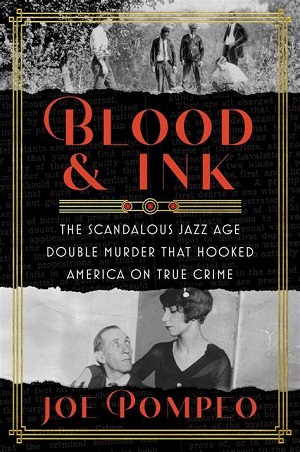
Blood & Ink: The Scandalous Jazz Age Double Murder that Hooked America on True Crime
By Joe Pompeo

The crime:

Edward Wheeler Hall, a priest, and Eleanor Mills, a choir singer, were found dead on the morning of September 16, 1922, their bodies arranged together under a crabapple tree. Both Hall and Mills were married, but not to each other. The prime suspects were Hall’s wife Frances and her siblings, but after  years of investigation and the circus of a huge trial they were found not guilty and the case remains unsolved.
The book:

The title tips you off that Joe Pompeo is going to come at the story from the angle of its media coverage, which I think is justified given how big a deal the Hall-Mills case was at the time. I don’t think it’s as well known today, though among true-crime connoisseurs it remains a favourite: a fun case to dig into, both for being unsolved and for the colorful cast of characters.

It’s a bit misleading though to say the case hooked America on true crime, and in his conclusion Pompeo admits that the press coverage only “arguably laid the groundwork for the genre as we know it.” I don’t think he’s as interested in the genre of true crime anyway as he is in the rise of tabloid journalism. The two were connected, though not the same thing. Joe Patterson, one of the first tabloid impresarios, had it down to a formula: the subjects that most interested readers were “(1) Love or Sex, (2) Money, (3) Murder.” He also believed that readers were “especially interested in any situation which involved all three.” The Hall-Mills case hit the trifecta. As one reporter covering the trial put it, “It has a combination of every element that makes a murder case great.”

So the story of the case and how it was covered go together, especially when the tabloids themselves, mainly in the person of New York Daily Mirror editor Phil Payne, became the driving force in the investigation. And like the best cultural history it reflects a critical light back on our own media ecosystem. When the Daily Mirror launched it promised readers “90 percent entertainment, 10 percent information.” Clearly the days of infotainment were upon us. As William Randolph Hearst (publisher of the Mirror) understood, “People will buy any paper which seems to express their feelings in addition to printing the facts.” So the foundations for today’s media silos were being poured as well.

Other points of reference are even more intriguing. The Evening Graphic made use of an innovation called the “composograph” that apparently worked by superimposing the faces of story subjects on body doubles, thus creating deep fakes a century ahead of schedule. And the publisher of the Evening Graphic was also a health and fitness nut who wanted to use the paper to “crusade for health! For physical fitness! And against medical ignorance!” What this meant, among other things, was a competition to find ideal human specimens (“Apollos and Dianas”) who would be “perfect mates for a new human race, free of inhibitions, and free of the contamination of the smallpox vaccine!” A eugenicist and anti-vaxxer then.

This is all interesting stuff, but in the drive to get to the totemic 280 pages there’s still a fair bit of filler. I was uninterested in the details of Payne’s life and death, or the story of cub woman reporter Julia Harpman, as inspiring a figure as she may have been. Payne in particular seems to have been more than a bit of a jerk, and it’s hard to tell if he really believed any of the trash news he was trying so hard to manufacture out of nothing, or if he cared about any of the people he might have been hurting along the way.

As for the crime itself, it’s continued to cast its spell over armchair sleuths for generations. There’s the sex not only at the heart of the story but also creeping around the edges. The bodies were discovered just off the local lover’s lane by Ray Schneider and Pearl Bahmer, a pair who authorities discovered were up to no good. This grand jury confrontation between the lead detective on the case and the young man involved must have been shocking stuff:

“Did you go up there,” Mott demanded, “knowing that [Pearl] was having her period, for the express purpose of lying down on your back, as you did, and [having] her do the vile thing she did to you? Wasn’t that why you were there?”

“No, sir,” Ray lied. “It was not.”

In addition to the sex (I’m still going off Patterson’s trinity here) there was the money. Or class. Hall represented money, even if only by marrying into it. Mills came from a less privileged background. But the split was also there in the arrest of a young man named Clifford Hayes, who was soon cleared of any involvement. Harpman drew the storyline in clear terms:

The law says certain things about equality of rich and poor. But the law speaks with its tongue in its cheek. The law says the rich Mrs. Frances Stevens Hall . . . deserves no more consideration than Clifford Hayes, the young man who was thrown into prison on the unsupported accusation of an irresponsible character. But the eyes of reality see an impassable gulf – a chasm cleft by the sinews of wealth – between the preacher’s widow and the swarthy young sandwich cook, who worked, when he did work, in a side-street lunch cart.

Later, when Frances herself was arrested, the conflict was drawn between “the masses and the classes.” Which was a divide that everyone in 1920s American could relate to. It’s interesting that in our own time, where the level of inequality has managed to regress to the level of those years, the language of class has mostly been retired. As cited by Paul Fussell in his excellent book on the subject, class is America’s “forbidden subject.” We’re still drawn to stories of rich people behaving badly, but there’s no sense of an “us against them” anymore.

Finally there’s the murder, and “the million dollar question” that remains of Whodunnit?

My own take is close to that of Bill James, as laid out in his book Popular Crime (in which there was also a lot I did not agree with). Given the nature of the crime – basically the execution of an adulterous pair who were not robbed – I think it very likely that the killer(s) knew the victims very well. Indeed, that they knew where and when they were meeting the night they were killed. That basically leaves two groups of suspects: Frances and her brothers, or James Mills (Eleanor’s husband). Pompeo sees Frances as “the most obvious” solution to the mystery, reasoning that “there was too much smoke around Frances and her brothers for there not to have been any fire.” Unfortunately, a lot of the smoke was proven to be just that. Meanwhile, I agree with James in seeing the disproportionate violence directed at Eleanor as significant. Edward Hall was shot once while Eleanor was shot three times in the head and had her throat slit. This suggest a special order of anger. It’s possible that Frances or one of her brothers might have felt this same level of rage, but it seems to me that James Mills was more likely to have gone over the edge.

Noted in passing:

There’s a wonderful moment in the trial for all lovers of language and anyone interested in how the meaning and usage of words changes. The prosecutor Simpson is questioning Frances:

“When you got up,” Simpson said, referring to the morning after Edward’s disappearance, “you telephoned police headquarters?”

“I did.”

“You were looking for information about your husband?”

“Yes.”

“You thought you would get it from the police?”

“I thought I would hear of any accidents.”

“Accident was in your mind?”

“Yes.”

“But you said to the police, ‘Have there been any casualties?’”

“Doesn’t that mean accident?”

“Weren’t you looking to see if the dead bodies had been found?” Simpson pressed. “If you used the word ‘casualties,’ and you had accidents in your mind, why did you use the word ‘casualties’?”

“It means accidents,” Frances replied. “It is the same thing.”

“It also means death, doesn’t it?”

“I do not know that it does.”

“So, with your understanding of the meaning of the word, you telephoned police headquarters, you did not give your name, and you asked for casualties? You thought, you say, maybe there had been an accident, maybe your husband had been hurt in an automobile accident?”

“Yes.”

Today I think most of us take “casualties” as referring to lives lost either in battle or in natural disasters (though non-fatal injuries in both cases are still considered casualties). But Frances is correct, in an upper-class sort of way, that it could refer to any loss through accident or misfortune, to life or property and possessions. In the insurance industry it still has this broader meaning, though it too has evolved and mainly refers today to liability insurance. I love how Frances and the prosecutor can’t understand the words they’re using, even when they are the same words.

Takeaways:

Pompeo uses the term “trial of the century” as a chapter heading, and it may be that in 1926 Hall-Mills deserved that appellation. However, I don’t recall any of the journalists covering it using those words. In any event, in 1935 the Lindbergh kidnapping trial effectively supplanted it and would go on to hold that title at least for another seventy years. The only challenger I can think of would be the O. J. Simpson trial in 1995. But as F. Lee Bailey said in the aftermath of the Simpson circus, “trial of the century” is just “a kind of hype. . . . It’s a way of saying, ‘This is really fabulous. It’s really sensational.’ But it doesn’t really mean anything.”

True Crime Files
Wordchecked

In his recent collection of essays The End of Solitude, William Deresiewicz has a fun little piece on watching “the decline of the English language,” with “all the old interesting meanings . . . dying off one at a time.” He begins with a few of what have become stand-bys:

“Vagaries” now means, vaguely, “vague bits.” “Penultimate,” of course, means “really ultimate” (to go along with “very unique”). “Hoi polloi” is now the upper crust, rather than its opposite, presumably by assimilation of hoi (Greek for “the” – polloi means “many”) to “high.” “Beg the question” is a lost cause; the universal definition is “raise the question,” not “takes the answer for granted.” As for “disinterested,” that lovely not-quite-synonym for “impartial,” forget it.

I love stuff like this, but I think to play along I have to be fair and admit to my own failings. I don’t think I have ever used the word “vagaries” and was unclear of its exact meaning (“unexpected or inexplicable changes in a situation or someone’s behaviour”). The others I was all clear on, though I agree very much with “beg the question” being a lost cause, to the point where its original meaning can now be taken as obsolete. I don’t think anyone except maybe a professional philosopher uses it in its proper, technical sense any longer. We may now say that “raises the question” is now the correct definition.

I guess everyone has their list of other favourite examples. My own would have “travesty” somewhere near the top, which I think is used everywhere today as an intensified form of “tragedy.” But Deresiewicz goes on:

I especially relish the errors of experts – the blunders committed by well-known writers and/or authoritative outlets. Writing in the New Yorker, Nicholas Lehmann, then the dean of Columbia School of Journalism, used “locus classicus” to refer to a person (though one would think that “locus” would be clear enough). The New York Times has given us “probative” to mean “representative,” “full boar” in a column by Maureen Dowd that was not about pigs, and “apologist” to signify “one who apologizes” (in an editorial, no less). Like everybody else, the New York Review of Books believes that “bemused” means “amused” (not “confused”) and “willy-nilly,” “higgledy-piggledy” (not “by compulsion”). NPR has perpetrated “notoriety” for “fame,” “misnomer” for “misconception,” and “per se” for “so to speak” – all of them now apparently ubiquitous. The Nation has offered “bugaboo” for “taboo”: Sandra Tsing Loh, in the Atlantic, has equated “wax” with “talk” (an increasingly common howler that derives from “wax eloquent”); and Ann Beattie has contributed “reticent” for “hesitant” or “diffident,” which is well on its way to becoming the standard meaning. I told you I’m a pedant.

Nothing pedantic about it! All of these are worth pointing out. The transformation of “reticent” is one of my own favourites, to go along with “travesty.”

Unfortunately, while we have spell-check and (a semi-functional) grammar-check we don’t really have a usage-check yet to catch these slips. That is, if they are still slips, which some of them probably aren’t anymore.

One corrective is to look up words you don’t know or that you’re not sure how to use. I do that regularly around here, and damn the embarrassment! Deresiewicz got me, in this same book, in his essay on the literary critic Harold Bloom. “Bloom doesn’t explicate,” Deresiewicz writes, “he davens.” This completely mystified me, sending me to various dictionaries for help. “Daven” (which is pronounced dah-ven and not, as I would have said it, day-ven) is the Yiddish word for “pray” and so has the meaning of “to recite the prescribed prayers in a Jewish liturgy.” Which is, in turn, something a little different than what may be a more familiar (or Christian) understanding of sending up a prayer. Apparently the origins of “daven” are obscure. It is not a word I will ever use, but I still found it interesting, and worth adding to my little list.

Words, words, words

TCF: Hell’s Half-Acre

Hell’s Half-Acre: The Untold Story of the Benders, a Serial Killer Family on the American Frontier
By Susan Jonusas

The crime:

The Bender family – consisting of Ma and Pa Bender, daughter Kate and son (or son-in-law) John – ran a trailside inn during the early 1870s in Kansas. Some who checked in never left. After being brained with a hammer and having their throats cut they were robbed of whatever cash and valuables they had and their bodies buried in a nearby orchard. As suspicions mounted over the number of disappearing travelers in the area the Benders fled to parts unknown. They were never apprehended and their ultimate fate remains a mystery.

The book:

The Bloody Benders, as they were later designated, are famous frontier figures, but what Hell’s Half-Acre brought home to me was how little about them is actually known. In large part this is because they were never captured and made to stand trial, with a full public hearing of the evidence against them. As it is, we don’t know where they came from or where they went, if John and Kate were siblings or married, or if John was a half-wit or just someone who behaved in an odd manner and giggled a lot. Susan Jonusas doesn’t definitively answer any of these questions in this full account, but I think that’s because they’re probably unanswerable now.

This is not for a lack of contemporary reporting. The Benders were big news back in their day. But newspapers had more flexible standards then, as Jonusas notes in her Introduction:

. . . nineteenth-century newspapers can be unreliable, as proven by the wild variations in the number of victims attributed to the Benders, with some claiming the number as high as 150. Along with embellished figures come misspelled names, seemingly random locations, and widely varied physical descriptions of the Benders themselves.

So we are left with these same basic questions. How many people did the Benders kill? Can we just go off the number of bodies dug up in the orchard? No, because they disposed of at least one other victim in a nearby river. What did they look like? Even among those who knew them descriptions varied quite a bit and there was no “paper of record.”

Like the frontier rumor mill, regional newspapers were a mixture of fact, hearsay, and complete fiction. Out-of-state newspapers that could not afford or be bothered to send reporters to Labette County pooled information from local articles, selected the narrative they liked best, and reprinted it as fact.

Meanwhile, I don’t know what to think of when Jonusas says that the Benders regularly appear in top 10 lists “where they routinely secure the top spot above other murderous families.” What other murderous families have there been? I couldn’t think of any. I did a quick search for some of the lists Jonusas might have had in mind (none are mentioned in the notes) and found several, but they mainly consisted of couples or other pairings, which I categorize as folie à deux and not families. The only other “family” I saw mentioned was the Sawney Bean clan, who were figures out of Scottish folklore (that is, not real). Would you include the Manson “family” in such a list? Or mafia crime families as serial killers?

This may seem like a minor point, but it gets at the historical uniqueness of the Benders. There’s nothing else quite like them in the annals of true crime, at least that I’m aware of. The serial killer family is more likely to be encountered in crime and horror films like Bloody Mama, Texas Chain Saw Massacre, and The Hills Have Eyes, along with all of their descendants (House of 1000 Corpses, et al.).

And Jonusas does give Hell’s Half-Acre a good squirt of horror-movie juice. The Bender cabin is evoked as the kind of place that did in fact creep a lot of guests out (including a few who only narrowly escaped). I did think, however, that in several places she crosses over a line in trying to make the proceedings more novelistic. There are scenes she describes where the only people present are members of the Bender family and I don’t see how she has any idea what they were doing, saying to each other, or thinking. I appreciate this being a good read, but there are still rules when it comes to writing non-fiction.

Otherwise, I’d fully recommend this as being a decent look at the case. Some of the historical material, like the fad for spiritualism, are worked into the mix well, though I felt the final chapters wandered off a bit into the trial of a pair of women who were falsely accused of being Ma and Kate Bender.

Noted in passing:

The question of how smart criminals are is one that gets a lot of attention from true crime writers. I think a lot of this is driven by media representations. Here’s something from my review of The A-Z Encyclopedia of Serial Killers by Harold Schechter and David Everitt that I think is on point:

What undercuts the expertise of the profilers even more is the fact, amply demonstrated (it seems to me) by the case histories in these volumes, that most serial killers aren’t very bright. Contra the FBI’s profiling program, that found the mean IQ for serial killers to be “bright normal,” and Schechter and Everitt’s conclusion that “serial killers tend to be smart,” the best that can be said for the best of them is that they were able to live functional double lives. Smart people don’t think they can get rid of bodies by cutting them up and flushing the pieces down the toilet. And yet this is how both Dennis Nilsen and Joachim Kroll were caught. Again we can blame Hollywood for the entirely fictional figure of the serial killer as cunning genius and criminal mastermind – someone like Hannibal Lecter who can lecture on Dante and play the Goldberg Variations from memory. In the real world some of the most successful serial killers, like the cretin Ottis Toole or the degenerate Wests, were borderline retarded.

But underestimating the intelligence of criminals can also be a trap. Think of Eliot Spitzer’s remark about how most crooks are stupid, just before his own fall. Or how, as described in The Suspicions of Mr. Whicher by Kate Summerscale, Constance Kent, who everyone seemed to think was just a stupid girl, initially got away with murdering her step-brother, even fooling the great detective Mr. Whicher himself.

A similar dynamic was at work with the Benders. When Alexander York, who hadn’t followed up on suspicions of the Benders earlier, digs up his brother’s grave he sees “only his own obstinate refusal to believe that the Bender family was clever enough to commit such an atrocious crime.” And years later, when newspapers speculated on the fate of the family, it was thought by some that they must be dead because “They were simply too stupid to have evaded the authorities for so long.”

Attitudes like this confuse me. I’m never sure what people mean when they describe someone as being either smart or stupid. Intelligence takes many different forms – from book learning to social skills and mechanical proficiency. And it can be put to infinite uses. Were the Benders stupid or cunning in their criminal careers? Were they clever and resourceful or mostly just lucky in evading the law? Surely it’s a mix of all of the above. My sense is that Kate was not only the scheme’s honey trap but its directing intelligence. How clever she was is impossible to say now, but I wouldn’t underestimate her.

Takeaways:

In strange settings, always sit with your back to a wall. That way no one can sneak up behind you.

True Crime Files

The road to Trump

Over at Good Reports I’ve added an omnibus review of a bunch of books on the Republican Party’s corruption/decline into madness in the years both leading up to and subsequent to the arrival of Donald Trump (who this week was indicted for the fourth time).

It’s a long haul (over 7,000 words) and made me wonder how many people actually read such long pieces online. I don’t think many people do. That’s part of the reason why I wanted to keep the reviews I’ve been posting at Alex on SF so short. But it really makes you think, again, about the fate of writing and reading in this age of screens.

TCF: Monster

Monster: The True Story of the Jeffrey Dahmer Murders
By Anne E. Schwartz

The crime:

Jeffrey Dahmer killed (at least) sixteen men and boys mainly in the late 1980s and early ‘90s, working out of a small apartment in Milwaukee. A necrophiliac and cannibal as well as a serial killer, his case is one of the most notorious in the annals of American crime.

The book:

Some preliminary matters are worth talking about.

In the first place, Monster is described on the copyright page as having been “originally published as The Man Who Could Not Kill Enough” in 1991 and again in 2011. Such a quick publication date (Dahmer killed eight of his victims in 1991, when he was really spinning out of control) is something you often see with timely books, and the original title really was in need of a do-over, but the information still didn’t make sense to me as I don’t think The Man Who Could Not Kill Enough was published until June 1992. Which would make sense as Dahmer’s trial was only in January 1992. As far as I can tell, this is the same book as “originally published” in 1991 (or 1992) and 2011 (a second edition), with the addition of an Afterword bringing the story up to 2021, the publication date for Monster.

I bring up this chronology because it’s a bit misleading thinking of this as a 2021 book. It’s still basically the book that Schwartz, a reporter at the time who broke the story for the Milwaukee Journal, wrote thirty-plus years ago. Which means it’s not a full account of the case and there were a number of places where it seemed like some clarification might have been in order. Were all of Dahmer’s victims gay, for example, or were some only gay-for-pay? Did he have sex with his first victim, Steven Hicks, or was he rebuffed? Did he drill holes in the skulls of his victims before killing them in order to turn them into zombies, or did he do this only after they were dead? We’re told that one court-appointed psychiatrist thought it unlikely he did it while his victims were still alive, but wouldn’t this be easily ascertained? For what it may be worth, I believe Dahmer himself admitted to doing this to his victims while they were drugged. In any event, I don’t bring this up out of any ghoulishness, but it makes some difference if Konerak Sinthasomphone had been so lobotomized when he was returned to Dahmer by the police. Was a hole in the skull something the paramedics didn’t identify? Also, Zombie, the Dahmer-inspired novel by Joyce Carol Oates, took the drilling business as a major plot point, so I was curious.

The new (sub)title says this is going to be a book about the “Jeffrey Dahmer murders” but it’s not really focused on the murders. In each case these are presented in a perfunctory manner, obscuring matters like those I just mentioned. Again, this isn’t an appeal to go into excessive detail, but some points in the story needed to be nailed down better as there are different versions out there. This was what I meant by bringing up the matter of when the book was written. After thirty years, an authoritative book on Dahmer should be possible, but I don’t feel like this is it.

Instead of digging deeper into Dahmer’s biography, psychology, and criminal career, Schwartz turns more in the direction of a reporter’s memoir, something that would later become a marked trend in true crime.

In Schwartz’s case some of this is actually quite interesting. It’s jaw-dropping that on the very night of Dahmer’s arrest she just breezed into his apartment (“for a single man’s dwelling, it was tidy”), and got to look around. Being on the police beat and knowing some cops apparently has its advantages. Indeed, it was a source within the police who first tipped her to something big going down, which turned into what literally became the scoop of a lifetime. That Schwartz was also there on the ground in Milwaukee also allowed her to report knowledgeably about the way the case played out in terms of city politics, given the fact that so many of Dahmer’s victims were gay and Black. On the specific matter of police culpability in the tragic case of Sinthasomphone’s near escape she provides a full defence of the officers involved, which I thought had some value but really failed in the end to present an objective account. Personally, I don’t think the police were criminally negligent, but there’s no doubt they screwed up.

This isn’t a bad book, but to return to my main point: after thirty years you’d expect a fuller treatment of the case then you get here. The attempt to go “Inside a Murderer’s Mind” is only cursory. Dennis Nilsen is a good starting point, but there’s little follow-up. Some notice might also have been taken of Dahmer as a cultural phenomenon that has seemingly only grown, looking at texts like the aforementioned Zombie, the Netflix series Monster: The Jeffrey Dahmer Story (admittedly this came out a year later), and Derf Backderf’s comic My Friend Dahmer and the subsequent film they made of it. Backderf’s personal account of Dahmer’s high school years is a particularly valuable source that needs to be taken into account.

Put another way, Schwartz should be recognized as having had the first word on Dahmer, and she did a good job covering the story. But even as late as the 2020s the last word on this monster has yet to be written.

Noted in passing:

Dahmer’s parole officer rarely had any meetings with him, electing to just contact him by phone. This was due in large part to the fact that Dahmer lived in a rough part of town and the officer didn’t feel safe visiting him in person. I thought this a bit slack. Don’t a lot of people on parole live in rough parts of town? Isn’t visiting them part of the job?

As a single gay male on the prowl, Dahmer frequented a number of Milwaukee gay bars. I was surprised to hear so many different ones mentioned by name, but according to one source Schwartz talks to there were 8 in the city in the early ‘90s. This struck me as a lot. By coincidence, I read Kathleen Hale’s Slenderman a couple of weeks after this book, where she says that Milwaukee had a “tiny gay district” when Dahmer was active. If you have 8 bars that sounds like a fair size village, not a tiny district. But then Schwartz mentions that Chicago, which Dahmer visited on at least one occasion, had 76 gay bars at the time. I would have never guessed that even a city as big as Chicago would have so many.

Takeaways:

“‘Oh, my God. How horrible! How awful! Tell me more.’ Those comments conveyed the mood of the city in the first couple of weeks.”

True Crime Files

TCF: Without Pity

Without Pity: Ann Rule’s Most Dangerous Killers
By Ann Rule

The crimes:

“The Tumbledown Shack”: the still unsolved case of two young women found murdered in a remote shack in 1975. A man confessed, but he was mentally unstable and the police were never sure if he was telling the truth.

“Dead and on Tape”: a paranoid petty criminal records his own murder at the hands of a dirty cop.

“Fatal Obsession”: a bank manager (well, vice president of personnel) has a breakdown and kills his wife and son.

“Campbell’s Revenge”: a giant brute goes to prison for raping a woman. He gets early work release and returns to kill her and her child along with a neighbour.

“One Trick Pony”: a man decides to kill his wife rather than bother with a costly divorce. He tries to make it look like one of her horses kicked her in the head, a story that the police buy but that her sister doesn’t.

“The Last Letter”: an Alaskan businessman falls in love with a younger woman, who he eventually divorces his wife to marry. He becomes an alcoholic, loses all his money, and kills her, but not before mailing out a dozen or more copies of a long letter he’d written blaming her for everything that happened.

“I’ll Love You Forever”: A con man marries a wealthy widow, takes out an expensive life insurance policy on her, then throws her off a cliff.

“Murder and the Proper Housewife”: a woman hires the grown-up version of a kid she used to know to kill her friend’s estranged husband. Because that’s what friends are for, I guess. “To this day, I’m not sure why they did what they did,” Rule says in her introduction.

“The Most Dangerous Game”: a pair of naïve Seattle teens run away from home to rough it in the Cascades. In winter. The cold turns out to be the least of their worries though when they meet up with a weirdo who tries to kill them.

“The Killer Who Never Forgot . . . or Forgave”: race car-driver husband kills his wife and baby after taking out a double indemnity policy on their lives. Just a stupid and sad story.

“The Lost Lady”: Marcia Moore, a wealthy New Age/spiritualist, disappears while experimenting heavily with ketamine. Her remains are later discovered but there are no messages sent back from the other side and it’s never determined what actually happened to her.

“The Stockholm Syndrome”: a young couple go camping in the woods and a psycho drifter kills the husband and gets the wife to go along with his story of it being an accident. Later, she recants.

The book:

This is a collection of stories previously published in volumes 1-8 of Ann Rule’s Case Files. Things kick off with three new cases, and there are brief introductions and even briefer updates to a few of the reprints to basically just let us know if the perps have died in the meantime. In other words, the book itself feels very much like a cash grab, with the publisher banking on Rule’s name to repackage some old material.

There doesn’t even seem to be any thematic cohesion. Look over the case summaries and see if you can find any connecting threads. In a very brief introductory Author’s Note Rule tells us that “Some [of the perpetrators] are wealthy and some are drifters, but they all have a special gift with words, a rather negative talent that lets them hide what they really think from friends, enemies, victims, and even detectives – for a while.” Was that the case with Charles Rodman Campbell? Or the bank manager in “Fatal Obsession”?

Nor does the title help much. I doubt very much if these were Ann Rule’s “most dangerous killers.” Some of them weren’t even killers, but just attempted murder. Then there are the comic pair in “Murder and the Proper Housewife.” They were nearly as big a danger to themselves. And why Without Pity? I suppose anyone who plans murder is missing some degree of empathy, but even here it feels like this was generic verbiage and just part of the packaging, in no way a reflection of the book’s contents.

You’ll have guessed I wasn’t thrilled by this one. Even the photo section is terrible, with pictures so blurry I honestly had no idea what some of them were supposed to be of, despite being labeled. But sticking with the text, if these were the greatest hits from Ann Rule’s Case Files I don’t feel inspired to go back and read any more (though I probably will). I also trust Rule’s judgment in determining which cases were worth full book-length treatment and which weren’t. None of these did (though her one novel, Possession, was based on the case related in “The Stockholm Syndrome”). I think part of what turned her away from exploring these particular cases in more depth is that there just wasn’t enough in the way of character and motive to go on. I found myself particularly mystified by the events of “Dead and on Tape.” What was going on there? Did anyone ever find out?

If there’s no common thread there are at least some recurring themes. The most interesting of these I found to be the American urbanite’s nightmare vision of the backwoods, the lost traveler landing up in Deliverance or Texas Chain Saw Massacre country. The girls who went to orchard country at harvest time and ended up dead in “The Tumbledown Shack.” The even younger girls who went roughing it in the bush in “The Most Dangerous Game.” The young couple who were ambushed when led off the beaten path in “The Stockholm Syndrome.” If true crime caters to our curiosity with horror it’s no surprise that there’s a strain of it that’s shared with one of the most popular tropes in horror films: the sinister cabin in the woods, the wrong turn off the highway, nature not as a source of spiritual renewal but as destroyer.

Noted in passing:

In the first story, “The Tumbledown Shack,” Washington’s Lake Chelan is called “the second largest inland lake in America.” When I read that I didn’t understand what it meant. I’d never heard of Lake Chelan and when I went to look for it in a compact atlas I keep handy I couldn’t even see it marked.

It’s a long, thin body of water but is nowhere near the second largest lake in the U.S. In fact, when I went to check on Wikipedia it ranked 97th in size. Even if you discount binational lakes, like four of the five Great Lakes and Lakes Champlain and St. Clair, it’s still way down the list. This made me wonder where Rule was getting her information. Does “inland lake” have a special meaning? Aren’t all lakes inland by definition? I did find one website that said that the designation “inland lake” excludes the Great Lakes, but I wasn’t sure why. Because they have an outlet to the ocean? Even if that is part of the definition I still don’t think Lake Chelan ranks so high.

Takeaways:

When a wife or husband is murdered, the surviving spouse is usually the prime suspect, and for good reason. That being the case, taking out an insurance policy on one’s wife only a month or so before killing her is being a little too obvious.

True Crime Files

Hungry for more

In Anthony Burgess’s biography of William Shakespeare he draws a comparison between Shakespeare and Ben Jonson concerning the matter of their attitude toward food and drink.

He [Shakespeare] did not drink much — there is the tradition that he would decline invitations to beery bouts with the excuse that he was “in pain” — but it is doubtful whether he ate much either. There is gulosity in Ben Jonson’s plays, but no slavering in Will’s.

Slavering is a word you don’t hear much anymore, though I have used it a couple of times over the years. It just means drooling or (in the case of large dog breeds) slobbering in anticipation of eating. Gulosity is also a word that once was fairly well known but you will almost never see today. The WordPress spell checker didn’t recognize it when I drew up this post, and I pulled a blank when I came across it in the book. It comes from the Latin for gluttonous. The meaning is basically the same as gluttony, and like gluttony it can be extended to any kind of excessive greediness or appetite (like being a “glutton for punishment”).

This seems to be another case where one word, gluttony, has bumped another, gulosity, out of use since we don’t need two words for the same thing. I think I may try to use it though, since I also try to throw “esurient” in the mix every now and then.

Words, words, words

TCF: A Convenient Death

A Convenient Death: The Mysterious Demise of Jeffrey Epstein
By Alana Goodman and Daniel Halper

The crime:

While awaiting trial at Manhattan’s Metropolitan Correctional Center, the notorious sex-trafficker Jeffrey Epstein was found dead in his cell on the morning of August 10, 2019. The official story is that he hanged himself, but questions have since been raised.

The book:

With any unsolved crime you’ll be able to find plenty of armchair sleuths willing to tell you that they know whodunit. They know the real identity of Jack the Ripper. They know that Lee Harvey Oswald was a patsy. They know who killed JonBenét Ramsey. And they know that Jeffrey Epstein didn’t kill himself.

All we can do is assign probabilities to the various theories in each of these cases. My own feeling is that Epstein really did kill himself, but that’s only on a balance of probabilities. It’s not something I’d say has been established beyond a reasonable doubt. As has been endlessly pointed out, his demise was surrounded by a web of suspicious circumstances: what the authors describe as “a confluence of egregious mistakes” and what then Attorney General William Barr called “a perfect storm of screw-ups.” Most notably, the guards who were supposed to be checking in on Epstein every 30 minutes left him alone for 8 hours while they slept or were online shopping, all while the video camera monitoring his cell wasn’t working.

A general rule I’ve invoked before is that we shouldn’t ascribe to malice what is more easily explained by incompetence and laziness. That may be all that was happening here – and I loved how the prison guards’ union tried to defend its members here by complaining about how “severely overworked” they were, a condition that made such an event as Epstein’s death “inevitable.” That said, I can understand seeing darker forces at work.

I’ve already given some of my thoughts on the Epstein case in my review of Julie K. Brown’s Perversion of Justice. Goodman and Halper are more gossipy, though not conspiratorial, but they also delve into some of the other points about Epstein’s case (that is, other than his “convenient death”) that remain most mystifying. In particular, his sexuality and how he made his money.

When considering Epstein’s sex life I found myself thinking of Alfred Hitchcock. There has been a lot of in-depth biographical research into Hitchcock but the matter of his sexuality has never been clarified. Indeed, it’s been reported as being all over the map. Some say he was impotent and asexual (he described himself as “Hitch . . . without the cock”), others say he was a sexual predator, and still others offer up that he was gay.

The same range of interpretations have been placed on Epstein. He apparently received “massages” three to four times a day, and one woman who knew him says that he explained to her that he needed to have three orgasms a day. “It was biological, like eating.” One of the masseuses, however, also said “he can never get fully hard, ever. . . . I don’t know if that’s some sort of thing that’s wrong with him, but it definitely was not normal.” Was there some connection between this and his plan to use his New Mexico ranch as a base where women would be inseminated with his sperm and give birth to his babies? Why insemination? Was he, as several people who were close to him and knew him well insisted, gay? And was he so ashamed or closeted that he adopted a macho persona to compensate? That was the theory of one associate, who immediately adds that it’s only speculation.

The second point has to do with how Epstein made his money, and more broadly what exactly it was he was good at and whether he was all that smart.

Julie K. Brown writes that “One thing that most people agree on was that Jeffrey Epstein was brilliant.” Really? What exactly did they mean by that? Epstein wasn’t some autodidact genius. It’s not even clear he was above-average smart. He was good at math and could play the piano. To be sure, intelligence can be measured in many different ways and take many different forms, but while smart people are often associated with being good at math and music I still think they’re very different things.

Nor was he particularly book smart. He’d dropped out of college, and while surrounding himself with prominent intellectuals for exclusive get-togethers this was all for show. As his “best pal” Stuart Pivar, himself a scientist, put it: “He brought together scientists for the sake of trying to inculcate some kind of higher level of scientific thought, even though he himself didn’t know shit from Shinola about science. . . . He never knew nothing about anything.” Large donations got him designated as a Visiting Fellow at Harvard, but it was just a title meant to impress people.

Did any of that matter? Not if he was good at making money, or making rich people richer. But was he? As the authors here insist, his business “most assuredly was not – and never was – money management.” Like everything else about him, his financial acumen seems to have been in large part a fraud and a con. What did people pay him for then? It’s questions like these that lead to deeper speculation, some of it related to his sexuality. Rumour was apparently rampant, for example, that he was his chief benefactor’s secret lover, and that he was blackmailing other rich and famous personages with secret surveillance tapes he’d made.

It’s a short book and a quick read, with an obsessively right-wing political bias. The chapter on Bill Clinton’s links to Epstein is the longest in the book, with contempt dripping from nearly every paragraph. It’s even suggested that without Trump’s election in 2016 Epstein would have gone free, since “the whole reason . . . or at least one of the rationales” for the Miami Herald running their “Perversion of Justice” series was to take down Alex Acosta, Trump’s labor secretary.

Even on a more personal level the Clinton-bashing is egregious, with the hunt for dark connecting threads between the two “friends” (they actually didn’t like each other) taken down to the level of insisting on their shared personality traits. Yes, in a facile and not very significant way. Personally, I thought something more might have been made about how both Epstein and Trump used charities and foundations as piggy-banks (the Clinton Foundation, in comparison, was a model of probity). I think it’s also likely that Epstein and Trump shared similar attitudes toward women: not liking them very much, paying them (as little as possible) for sex, and otherwise just using them as trophies. Clinton certainly had issues relating to women as well, but they seem to have been of a different order.

Finally, I did get a guilty kick (the book has a number of guilty kicks) out of the depiction of some of the most distinguished intellectuals and academics in the world being such shameless money-grubbers.

Noted in passing:

Epstein didn’t care about his legacy. This is a subject that interests me, and that I’ve written about with relation to American politicians in the Trump years. I feel like it’s related to the old question of how we can be good without God. If we’re just here to make as much money and live as large as possible, wouldn’t we all behave really badly? It’s similar to the question of fame. Is it an absolute good, so that it doesn’t matter what you get to be famous for as long as it gets you attention that you can monetize? In any event, here’s Epstein’s deep thoughts on the matter: “I don’t care about my legacy. The minute I’m dead, I’m dead. It’s over. . . . I don’t care what people think of me. I only care about what’s happening to me while I’m alive.”

Takeaways:

I still lean toward suicide, but it’s easy to suspect the worse of the worst people in the world. By which I mean not Epstein himself but his enablers. As the authors conclude:

It’s only fair to say . . . that we will probably never know the true story in full. The reason for this is simple. Consider this question: Who would you believe to tell you what happened? The elite, the press, our political leaders, or law enforcement? These are the institutions every American has been told since childhood that can and should be trusted, because they have the best interests of all people at heart. But these are the very same institutions that shielded Jeffrey Epstein for years.

The Epstein case didn’t break public faith in these institutions, but it revealed a hole in the social compact that had been growing for years.

True Crime Files

DNF files: Wild Massive

Wild Massive

By Scotto Moore

Page I bailed on: 62

Verdict: I actually started out getting into this. I liked the idea of Carissa zipping between the infinite floors of the Building in her elevator, and when a stranger came knocking he (or ze, as ze is a shapeshifter with no gender) was nicely introduced.

But then the next few chapters had me feeling like I was drowning in pages and pages of backstory and exposition that I gave up any hope of keeping straight. This overload was something I didn’t like in Moore’s previous book, Battle of the Linguist Mages, and I felt like there was going to be even more of it here. Add in other annoyances like the messy mix of science, theoretical physics, and magic and the heavy use of trendy gender pronouns that nobody is likely to recognize ten years from now and it wasn’t long before I just couldn’t take any more. I don’t like magic in my SF, and I don’t want to sound anti-trans or anti-woke but it’s hard reading sentence like this:

Ze had been nude when ze first dropped into the elevator, but now ze seemed to be constructing clothing for zirself, style yet to be determined, zir skin rippling this way and that.

The DNF files

TCF: Perversion of Justice

Perversion of Justice: The Jeffrey Epstein Story
By Julie K. Brown

The crime:

A full accounting of the crimes of Jeffrey Epstein will probably never be made, both because he’s dead now and because any accomplices (of which there must have been many) will want to keep the details hidden. At the very least he was involved for many years in underage sex trafficking and sexual assault. He died in prison, under mysterious circumstances, in 2019 while awaiting trial.

The book:

True crime has a cathartic function, in the Aristotelian sense of a purging of the emotions of pity and fear. But a book like Perversion of Justice aroused another feeling in me: anger. I got so angry reading it that it was hard to finish. What Julie K. Brown, the reporter for the Miami Herald who broke the story (or re-broke, by not letting it slip away), chronicles is an outrage to any understanding of justice or decency. Much of what was going on remains hidden by people intent on covering their own asses, but enough corruption has now been revealed to make you sick.

Even basic questions like how rich Epstein actually was and what he did to get so rich remains a mystery. How did he make his money? As his extensive Wikipedia entry puts it: “The exact origin of Epstein’s wealth is unknown.” Apparently he was a kind of money manager, but it’s not clear what this entailed, how good he was at it, or whether what he did was all legal. Some of it at least was very shady.

What really seemed to be going on was that he operated as a kind of parasite on the very rich. As one early observer remarked: “He was very smart and he knew how to woo people, how to schmooze. He’s personable and makes good company.” Not the sort of skill that one would have thought paid so well, but rich people are as susceptible to flattery and being manipulated as anyone else. A lot of them just gave Epstein their money. And I don’t mean gave it to him to manage, but just . . . gave it to him. Of course, to outsiders this made no sense. “I tried to find out how did [Epstein] get from a high school math teacher to a private investment adviser,” one unimpressed businessman remarks, “There was just nothing there.” Was there something suspicious then in his attachments to rich and powerful men, especially given all that later came out? Indeed there was, but all we can do is speculate now.

Epstein himself was a creepy guy who did nothing to conceal his perversions, which is another thing that makes you question why people would associate with him. An arrogant social climber, his hyperactive sex drive makes one wonder when he could have done any real work, had this ever been his ambition. Brown reports that girls were being brought to him “morning, noon, and night” and he was having sex “three or four times a day.” Which may sound nice to some, but really isn’t healthy.

But massages (which is how things usually got started, if they weren’t just a euphemism) were only a perk. The very rich, and even the semi-rich, have two abiding anxieties that always have to be addressed. In the first place, they have to feel secure in their lives of affluence and privilege. Private islands and offshore accounts can help with this. You certainly don’t want the government getting their dirty hands on your stash. Second, their wealth has to be justified in some way. This is mainly the work of staffers and a pliant press. Epstein knew the game here very well, presenting himself as a sort of intellectual philanthropist, despite having little claim to either title. Particularly nauseating were his forums on how to save the world from such challenges as climate change, which involved jetting celebs to the private Caribbean island that he’d had bulldozed in order to build his pedo playpen, paying off fines or donating to charity to get around environmental regulations.

In short, Epstein was a phoney. But isn’t great wealth always a bit of a fraud? Thinking about Epstein’s rise to a position of such wealth and status reminded me of how completely the myth of a meritocracy has been exploded in our own day. This is a subject I’ve written about in recent book reviews, most notably of Christopher Hayes’s Twilight of the Elites and Michael Sandel’s The Tyranny of Merit. But it goes back to such cases as the collapse of Enron (see my review of Power Failure: The Inside Story of the Collapse of Enron by Mimi Swartz and Sherron Watkins). Were the corporate heads of Enron The Smartest Guys in the Room? Only at being frauds. Which, granted, does require a certain kind of intelligence. But Team Enron were heralded as financial geniuses!

The belief that rich people have to be smart is hard to kill (though I’ve tried). That the emperor has no clothes is, I think, the defining fable of our time. But who was going to point out Epstein’s nakedness? Wealth provides a high degree of insulation, both from the media and the police. Epstein even bragged of owning the police, and it was not an empty boast, while Brown’s book shows how much of an effort it was just to bring Epstein’s case back into the public eye of the mainstream media.

“I didn’t really, at the time, believe that any media network would have succumbed to pressure to ignore or drop such an important story,” Brown confesses at one point. “I was, however, naïve and wrong.” It’s because of all the hard work she did, and the risks she took, that I cut Brown some slack for injecting so much of herself into the narrative. There’s a lot of me-journalism here, with most of it irrelevant to Epstein’s story. The way newsrooms were being squeezed in the twenty-first century is an important point worth addressing, but do we really need to know about Brown’s dating life with her Mr. Big? Or her kids getting into college? None of this adds anything to the book, even in just telling us where Brown is coming from as a reporter.

A final way that the Epstein case was emblematic of the times we live in was how it fit with the explosion of interest in pedophile sex rings. I’ve also written about this before, and it really is a cultural curiosity. Of course it would fully flower around the same time in the base mythology of the QAnon movement, but I can’t explain its roots given that Epstein is probably the closest reality has come to the kinds of stories that were so big in contemporary novels and TV shows. But Epstein’s crimes weren’t as lurid: he didn’t kill anyone (that we know of), and it’s hard to say if he was only part of a larger ring of rich and well-connected predators. Were his pals just casual acquaintances? Marks? Co-conspirators? Guilt by association went a long way with Epstein.

Even if his posse weren’t all onboard the Lolita Express (the name soon given Epstein’s private jet), the fact remains that Epstein had no shortage of powerful enablers. The most grating of these being in the criminal system and legal profession. Of course, the excuse made by criminal defence lawyers who have clients like Epstein is well rehearsed. Even if lawyers know their clients are guilty of terrible crimes an accused still has the right to a full and fair defence in a legal system that rightly puts the burden of proof on the state. The problem in this case was that Epstein had, at least in practical terms, greater resources than the state prosecuting him, and he used those resources to run a defence that while not breaking any formal rules involved the wholesale corruption of the system of justice: hiring friends of the prosecutors, essentially bribing others, attacking witnesses and complainants even before the case came to court or tampering with them in other ways. This is the sort of behaviour that I should have thought lawyers would have been bothered by or even refused to be involved in. I’m not sure if any of them demurred in the slightest.

Noted in passing:

Epstein was Jewish, which for some reason means he has to be linked to the Holocaust. But really, why? His grandparents on both sides were Eastern European Jews who emigrated to the U.S. around 1900. Some forty years later, as Brown reports, many of his maternal grandparents’ extended family were executed by the Germans. This seems a tenuous connection to me, and it’s never said what effect this might have had on Jeffrey. In A Convenient Death: The Mysterious Demise of Jeffrey Epstein the authors go further, describing Epstein’s parents as among “the lucky few from their respective families who had not perished in the Holocaust.” But both of Epstein’s parents were natives of Brooklyn, his father and mother born in 1916 and 1918 respectively. Of what significance is it to Epstein’s story to make them into Holocaust survivors?

Takeaways:

“This is not unique to one party over another. The divide is not Republican versus Democrat; it’s the rich and powerful versus everyone else.”

True Crime Files