Saga of the Swamp Thing Book Three

Saga of the Swamp Thing Book Three

I really liked this volume of Alan Moore’s Saga of the Swamp Thing run, I think mainly because Moore stayed grounded. In his Introduction, penciller Stephen Bissette mentions the “steady hand of editor Karen Berger” on the series and I don’t know how much she helped curb some of his excesses, but especially after the swamp-sex issue that ended the previous volume there was a need to get back to basics.

And by back-to-basics I mean the X-Files-style “monster of the week” storylines on tap here. There’s a frame that isn’t explained but that introduces us to the character of John Constantine (whose looks were modeled after Sting). Constantine just drops by to tease at some coming darkness and then sends Swampy around the U.S. on a series of adventures Moore thought of as American Gothic. The first story, not part of this series, has a toxic homeless guy named Nukeface who actually kills Swamp Thing. Temporarily. After Swampy reconstitutes himself, Constantine drops by to tell him that he’s the world’s last plant elemental and that he has the power to die and be born again anywhere in the U.S. Or presumably the world. Or, as we’ll later see, the cosmos. This struck me as weird, because (1) Swamp Thing is born of science (Alec Holland’s biorestorative formula), he’s not some fantasy elemental, and (2) why does Constantine think it’s so obvious that Swampy can do this instant-teleportation thing? He seems shocked at how slow Swampy is to understand, but how does the teleportation work on any sort of level that makes sense? Yes, this will be explained later with the concept of “The Green,” but I hate The Green and if this is the thin edge it came in through then to hell with it.

Anyhow, from the Nukeface story we return to the drowned city of Rosewater, site of an earlier battle with vampires, to find out that they haven’t gone away but have instead become far creepier aquatic vampires. Then we’re on to “The Curse,” which is a werewolf story that links lycanthropy to women’s menstrual cycles. Not what I was expecting and I was kind of surprised they went there in such a bold way. Apparently it was controversial at the time. And finally we’re back in Louisiana and a film being made on a former slave plantation that has Swampy fighting voodoo zombies.

That pretty much covers what a pull quote on the back cover from National Public Radio calls “A cerebral meditation on the state of the American soul.” We get the environment, gender issues, and race. Today any comic handling these topics could be expected to be annoyingly preachy, but Moore somehow pulls it off. We get the message, but he’s not afraid to give an extra half-turn of the screw. Swampy is the straight man or conscience in every case. Paradoxically, as he’s now all plant he’s also become more human. He’s understanding, and almost reluctant to lower the boom on the baddies, but at the same time he’s less passive than he was earlier in the series.

So on brand with “sophisticated suspense” and contemporary horror stories. And best of all, at no point does Moore go spinning out into the ether, where he all too often crashes and burns. This is basically meat-and-potatoes stuff, served up with Moore’s signature poetic sauce. The meditation on what the buried dead dream at the beginning of the plantation story has him at his best: “When the summer earth swelters, when roots press against their backs like creases in the bedsheets . . . When sleep won’t come, what notions do they entertain in those frail parchment bulbs that once were skulls?” And there are also some great sign-offs, like Nukeface getting ready to say hello to America and one of the zombies going to work as a ticket collector at a grindhouse cinema. This may not be the splashiest work Moore did on Swamp Thing, but I’d rate it among his best.
Graphicalex

DCeased

Dceased

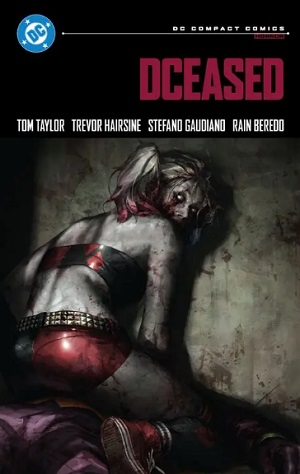
The first thing to note about this series is that it was late to the party. When Marvel Zombies started in 2005-2006 they were hitting the market at what I’ve called the moment of peak zombie. I was actually a bit surprised to see that DCeased (or DC Zombies) didn’t come out until 2019, long after the point when zombies had gone out of fashion. Though that didn’t stop the series from becoming a huge bestseller and spawning several sequels.

OK, technically these aren’t zombies. They’ve been infected with the Anti-Life Equation, which arrives on Earth as a sort of computer virus and starts turning people into undead creatures who go around biting chunks out of the living and so infecting them and turning them into . . . zombies. Apparently the equation spreads just as well by digital imagery as it does by infected blood. “I always suspected we’d have to destroy the Internet to save the world,” Green Arrow says. “I just didn’t know it would be like this.”

Batman figures all this out, and just to clear up any confusion gives us this quick fact check: “They’re not zombies. They’re not consumed by hunger. They’re not feeding. They’re spreading death. They’re stealing life. These are the anti-living.”

Oh, just stop already. This is DC Zombies. The zombie pathogen is a hybrid, both being a blood infection and spread through our phones like in the Pulse films or Stephen King’s Cell. We might almost say the virus is undergoing a cultural mutation, evolving from gene to meme.

Batman himself only figures all this out after he’s been infected, and later he’ll turn into one of the (ahem) “anti-living.” As will most of the rest of the DC pantheon. Yep, Batman, Green Lantern, Superman, the Flash, Wonder Woman. It’s up to the B-listers and a bunch of successors and superkids to save the day, which they do by loading the Earth’s uninfected onto space arks and heading out to Earth 2. Where the adventure will continue . . .

While I’ve called this DC Zombies, it’s actually hard to compare to Marvel Zombies. They’re both quite dark, obviously, but they feel different. Tom Taylor’s writing has less of Kirkman’s black humour, but I thought the storyline was more coherent. Which means that taken as whole I enjoyed the series a bit more. Though that isn’t a full endorsement, as I thought Marvel Zombies disappointing. I should also say that I read this in a “compact comic” edition. These are smaller format reprints (like the Marvel Masterworks volumes) so the art doesn’t have the same pop or impact and I sometimes had to strain to read the text. Even so, I liked the dark palette and Trevor Hairsine’s penciling.

Graphicalex

Indestructible Hulk: Agent of S.H.I.E.L.D.

Indestructible Hulk: Agent of S.H.I.E.L.D.

The Hulk is perhaps the most basic, meat-and-potatoes superhero you can imagine, and the Indestructible Hulk series is, in terms of its narrative structure, as basic and meat-and-potatoes a contemporary comic as you’re likely to see.

The frame story has it that Bruce Banner is tired of working in the shadow of such genius benefactors of humanity as Reed Richards and Tony Stark. As he complains to Maria Hill, Director of S.H.I.E.L.D.:

Tony Stark and Reed Richards use their genius to save the world every other week. That’s how they’ll be remembered in history. Meanwhile, I . . . I who, forgive me, have just as much to contribute – will be lucky if my tombstone doesn’t simply say “Hulk smash!”

So here’s his pitch to Hill: if S.H.I.E.L.D. will fund him and set him up in a lab with a team of scientists to work under Bruce Banner, then they can have the use of the Hulk whenever they need him. And it’s a deal.

What follows is a series of comics where Hulk is let loose on baddies like the Mad Thinker, the Quintronic Man (both of these guys are basically evil geniuses operating battlebot suits), and Attuma the Lemurian. There’s nothing subtle about how the Hulk goes about these missions. The bad guys just blast him with everything they’ve got, which they reckon should be more than enough to destroy him, but guess what? He’s the Indestructible Hulk. So he ends up smashing them.

Like I say, meat and potatoes. But what made this a winner for me was the art by Leinil Francis Yu. This guy can really draw, delivering the goods whether it’s two people talking in a diner or a bunch of sea monsters taking out a fleet. And with great art you can never go wrong.

Graphicalex

The Pitiful Human-Lizard: Far from Legendary

The Pitiful Human-Lizard: Far from Legendary

There’s a sort of Holy Grail not just of superhero comic writing but of superhero and monster movies and basically any story where the emphasis is on action and effects. The Grail I mean is making the rest of the story, if not compelling on its own, then at least not dead weight. Are you just interested in Spider-Man, or do you really care about Peter Parker and what’s going on in the rest of his life? If you are interested in Peter Parker, or Bruce Wayne, or the scientists and military men trying to stop Godzilla, then that’s a huge win.

I thought Jason Loo, doing double duty as author and artist of The Pitiful Human-Lizard, aced this part of the test. Lucas Barrett may be a bit of a stereotype of the young urban male who’s stuck in a nowhere job doing data entry and looking for love on the side (i.e., the Internet), but I still found him a likeable, relatable figure. He dresses up in a strange costume with sticky gloves he uses to climb walls. This wall climbing is (1) a habit he inherited from his father, who was the original Human-Lizard, and (2) the only thing vaguely lizard-like about him. I actually didn’t think Human-Lizard was a very appropriate name, and the “Pitiful” part really mystified me. He’s just an average Joe, not pathetic.

Anyway, one day Lucas, looking to make some extra money, volunteers to be a guinea pig for a drug company. They give him a serum that endows him with super restorative powers. Basically he’s like Deadpool: no matter what sort of injury he suffers his body will always heal itself back to normal. So now he really is a superhero, even if he’s out of his depth taking on most of the bad guys he faces. Which means he needs the assistance of other heroes like the powerful Mother Wonder (“a working woman and the finest superhero in Toronto”) and the psionic Lady Accident, who doubles as his would-be girlfriend.

Yes, I said Toronto. Loo really enjoys hitting all the landmarks, with fights being staged at the Royal Ontario Museum, the Eaton Centre, and Honest Ed’s. I think these comics were first published in 2015 and Honest Ed’s closed in 2016, but I still remember it. In fact, I still remember when there was an Eaton’s store in the Eaton Centre. I’m getting old. Also part of the Toronto spirit are the “Terrorno Girls” who get dressed up like the Toronto Raptors team mascot so that they can whale on people with their dinosaur tails. They despise Human-Lizard and his loserish superhero buddy Majestic Rat. This latter fellow is a sort of Jughead figure who can control the city’s rodent population.

I liked all these characters, and the oddball plots hatched by the bad guys, including a mastermind influencer who sets up a team of villains called the Frustrated Four and a team of scientists who are creating Kirby-esque monsters underneath the city. Where I thought the comic fell down a bit is in the action scenes. Loo does the hard parts well in creating a bunch of fun and original characters, but then the meat and potatoes of a superhero comic, the fisticuffs and explosions, aren’t as impressive. He has trouble rendering figures in motion, for one thing.

So one’s usual expectations when coming to a superhero comic, even one as ironic as this, are inverted. I got so I was actually looking forward more to seeing Lucas hanging out with Barb, or Mother Wonder wrestling with her kids, than to another monster eruption. But there’s enough of both to enjoy.

Graphicalex

Chew Volume Four: Flambé

Chew Volume Four: Flambé

Are things coming together, or breaking further apart? I’m not sure. The previous Chew volume, Just Desserts, ended with strange letters in flames being written in the sky, presumably by aliens. In this book a couple of people seem to have a vision of what the letters mean, but one of them is a voresoph – someone capable of superhuman mental feats after consuming vast quantities of food (so the more he eats, the smarter he gets) – and he basically eats himself to death, while the other is the mysterious Mason Savoy, and at this point in the story nobody knows what he’s up to.

Some old characters are back doing their thing, like Poyo the killer cockerel, the busty lethal ladies of the USDA, and the murderous Vampire, while we’re finding out more about others, such as the fact that Tony’s sister, Toni, as well as his daughter Olive, are cibopaths as well. One very fringe figure comes back from an earlier comic, reborn as the high priestess of a chicken cult, while other characters that were fairly central (Tony’s girlfriend Amelia Mintz and Ray Jack Montero, the guy who was trying to make frogs taste like chicken) are MIA.

In short, more weirdness. But I liked it and respected that it felt like Layman and Guillory were still stretching the limits of what they could do with all this.

Graphicalex

MAD’s Al Jaffee Spews Out More Snappy Answers to Stupid Questions

MAD’s Al Jaffee Spews Out More Snappy Answers to Stupid Questions

The title is quite the mouthful, but it was a follow-up to a previous volume of Snappy Answers to Stupid Questions. Al Jaffee explains the background in an introductory interview with Nick Meglin:

NM: Is this book a sequel to “Snappy Answers to Stupid Questions”?

AJ: No, it’s a sequel to the Bible!

NM: Was the first book a success?

AJ: No, it was a failure! They always do sequels of failures!

NM: Was it difficult coming up with entirely new situations and gags?

AJ: No, it was easier! It’s always easier after you’ve done it all and there’s nothing else to write about!

That should give you some idea of the sort of humour that’s on tap. And surprisingly it works. You’d think such a simple idea, repeated over and over again, would get tired pretty quickly, but Jaffee mixes things up well. For example, he includes mini-stories told in the form of a series of snappy answers to stupid questions, one of which is even done in rhyme, with a “smart aleck Hippie” getting blown up by some hardhat workers.

Now personally I don’t like snappy answers to any questions when I encounter them in the real world or online. I think it’s just people trying to be smart and usually succeeding only in being rude. But I didn’t mind the insults here, plus there were also some “stinging comebacks to snappy answers” and other jabs at the snapsters along the way (including what happens to the aforementioned hippie). So it was all fun in MAD’s typical early ‘70s style. A style that’s maintained right down to the plugs and the book’s dedication:

To the people at MAD who made it possible, and the people at the Internal Revenue Service who made it necessary!

Graphicalex

Daredevil: Know Fear

Daredevil: Know Fear

This volume is the beginning of a Daredevil story arc written by Chip Zdarsky and illustrated by Marco Checchetto. It’s a bit of a “born again” theme, again, but it’s an odd sort of a launch because Daredevil is coming back to life from a near fatal collision (the “Death of Daredevil”) only to get the crap kicked out of him by nearly every bad guy he meets and then being argued into retirement by Spider-Man

The overall tenor is quite dark. Wilson Fisk is mayor of New York City in this timeline, and you know he’s up to no good. Daredevil himself is a diminished thing. He hasn’t fully recovered from his last near-death experience, has a few days’ worth of stubble growing under his mask, and has trouble even taking out street thugs, much less bona fide supervillains. Even the tough-as-nails Chicago cop Cole North can beat him up in a fist fight. On different occasions he has to be bailed out by superpals like Luke Cage and Iron Fist, or the Punisher (who often pops up at such moments). At one point he’s shot, but (you’ll never guess) it’s only in the shoulder, so he can keep going by taking pain meds. On top of all this he’s starting to wonder if he’s maybe doing more harm than good, especially when he accidentally kills a perp. This leads to lots of tortured reflections and flashbacks to his Catholic upbringing, and his eventual decision to get out of superheroing altogether. He’s not only the man without fear now, but a man without a real purpose in life.

When I say the tenor is dark this is what I mean. It’s Batman dark, and that’s the main feeling I got reading it. Matt Murdock is feeling some Bruce Wayne-level angst, and being the Red Knight is the cross his therapy bears. There isn’t a whole lot of story going on either, as it’s mostly character- and world-building. Which is normally not something I’d go in for, but I thought Zdarsky did a good job with it and I came away wanting to read more. You know DD just has to get back up, dust himself off, and start all over again.

Graphicalex

Batman: Reptilian

Batman: Reptilian

I went through a range of responses while reading Reptilian. For example, at first I found myself really grooving to the art by Liam Sharp, which has a thick, painterly atmosphere to it. If that art was dark, well, that’s the Batman universe. And not just any Batman universe, but the DC Black Label Batman universe.

But then I didn’t like how the art stayed so dark, and how the thickness started to just seem muddy. There were action sequences where, even going back to examine them more closely, I honestly couldn’t tell what was going on. There were climactic moments, such as Killer Croc appearing with an external womb like Nola in The Brood, that I couldn’t see at all. I had to take cues from the text to understand what was happening. This was a shame because Sharp really imagines the characters in interesting and original ways but I felt like I was only seeing them through a glass, darkly. Batman himself is all shadow and silhouette, which I guess is apt for the character but also got tiring after a while.

I felt the same mix of good and bad with the writing. Garth Ennis is a writer known for pushing the boundaries of what I’ll call good taste. This title isn’t as crazy as some of his stuff, but then he was writing for an established DC character and they probably had him on some kind of leash. As it is, his Batman is a cold, sarcastic bastard and Killer Croc a sympathetic villain. There’s also a violent plot (though the violence is mostly witnessed in the aftermath) that involves a lot of xenosexual shenanigans. In sum, it wasn’t what I was expecting, but it was something new, which isn’t easy to pull off when we’re talking about a Batman comic. Some of the dialogue felt awkward, and given the aforementioned issues I had with the art the story became hard to follow in places. But on a second reading I did think it all made sense.

So I came away respecting it. I could see a real Batman purist taking offense, but that’s the Black Label brand. The art at least had a lot of interesting design elements, though the monster looked a bit too Giger-ish and as noted it’s all far too dark. And Ennis did come up with a story that I think even his detractors will admit is hard to forget. There aren’t many comics that give us that much.

Graphicalex

The Superior Spider-Man: Goblin Nation

The Superior Spider-Man: Goblin Nation

As you know from my previous reviews of a couple of the Superior Spider-Man Team-Up collections, I’m a fan of the character. In brief, he’s a version of Spider-Man where Otto Octavius has taken over Peter Parker’s body and thus the identity of Spider-Man, creating a new and improved (“superior”) webslinger. The original Peter Parker had apparently died, but in fact his consciousness is still floating around in the SSM’s head, and in this issue he finally emerges triumphant as Octavius relinquishes control back to him so that he (the real Peter Parker) can save his (Octavius’s) girlfriend.

Did you follow all that? It doesn’t really matter. The main plotline has the Green Goblin (or the Goblin King, who is Norman Osborn having had plastic surgery to look like one of his corporate underlings) and the Goblin Nation (a bunch of characters turned into goblin freaks by the goblin serum) trashing NYC. The Goblin King knows that Spider-Man is now a cosplaying Doc Ock and offers him an alliance (as junior partner) but nobody with a name like Octavius is going to agree to play second fiddle to a little green guy so they end up fighting each other. Meanwhile, Spider-Man 2099 has time-traveled back to help out and J. Jonah Jameson, the mayor of New York, has unleashed his army of robot Spider-Slayers to kill Spidey because you know Jameson just has a hate on for him.

Did you follow that? I’ll admit, I had a hard time with it. And there’s more going on, including a psychomachia in Peter Parker’s head and a battle between the corporate entities Parker Industries and Oscorp/Alchemax. I thought this struggle between the wannabe tech bros to be an angle that had more potential, but as this synopsis has already made clear there’s plenty enough going on.

Probably too much. If you’re not up on this iteration of the Spiderverse then you’re probably going to be lost with regard to all of the supporting characters. I know I was. And I wasn’t impressed with the Goblin King’s ambition to take over all the crime in New York City. Why not just focus on growing Oscorp and take over the world? What would Elon do? OK, probably try to take over NYC. But you know what I mean.

I didn’t like this one as much as I did the other Superior Spider-Man titles I’ve read, but it’s still a better-than-average comic and shouldn’t disappoint the fans who wanted to see Peter Parker come back. I just wasn’t missing him that much.

Graphicalex

Druuna: Creatura

Druuna: Creatura

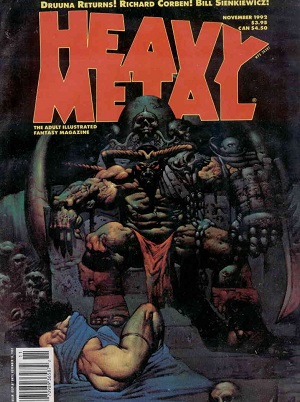
This comic (which I don’t have as a standalone but only as it appeared in the November 1992 Heavy Metal) is a sequel to the Morbus Gravis Druuna books, and there is a sort of continuity, at least insofar as continuity is a thing in the Druuna universe. The spaceship that was the setting for the earlier books has been overgrown by the Evil virus and now constitutes a sort of fleshy asteroid or floating tumor. Another spaceship captained by a man named Will comes across the asteroid, which seems to be communicating psychically with Will by giving him visions of Druuna. An away team lands on the asteroid, indeed enters it in a highly suggestive manner, and as they explore their surroundings reality seems to come undone and it’s not clear how much of what is happening is real and how much is a dream. Druuna’s lover Schastar, for example, appears to have melded into a cyborg creature that is part Schastar and part Lewis. Furthermore, he/it might have died eons ago but for the fact that time no longer has any meaning.

There’s a doctor (he seems to be a psychologist, primarily), who’s based on Serpieri himself, and he shows up to try to explain some of this to Will but I found his theories hard to follow. Otherwise, we’re just lost in the same world as before, consisting of a diseased superstructure built upon a cauldron of id that keeps looping out its tendrils to snag the buxom Druuna or any other nubile creature. The crew-cut Terry giving herself up to something called the Prolet project is another sexual-surrogate stand-in, like Hale in Morbus Gravis. In fact, she might be Hale. I don’t know.

Trying to make sense of all this is impossible. And this despite the fact that Creatura is a lot talkier than the Morbus Gravis comics. I’m just not sure how much of the supposed exposition was meant as a joke, how much was lost in translation, and how much was confused to begin with and then became progressively more complicated. It seems that something is being said about humanity existing in a parlous state between the poles of what I called the id (the Evil virus, carnality, violence, and lust) and a superego (the computer, robots, technology). While Druuna in all her lush voluptuousness would seem to be more closely aligned with the organic, that’s not represented as being an attractive alternative. Sex can be beautiful (especially on the beach), but more often it’s something cruel and degrading. Meanwhile, technology is more closely identified with what we might think of as civilization and a condition of order that we have to fight to preserve.

I won’t try to read anything more into it than that. Most of the pontificating done by the doctor and others strikes me as just a bunch of pretentious bafflegab. And by this point in the story I think it’s clear that there is no linear story being told. “Past, present and future mean nothing here,” Druuna is told by the robot Schastar/Lewis. And so she keeps running in place. There’s no escaping the human condition, even in space!

Graphicalex