Solo: The Deluxe Edition

Solo: The Deluxe Edition

Solo was a limited run of comics consisting of a dozen 48-page issues, with each issue being illustrated by a different artist. Some of the biggest names in the biz were recruited and given creative freedom to tell whatever stories they wanted, using DC characters as they saw fit. In some cases the artists also wrote their pieces but they also worked with writers. This Deluxe Edition collects the complete run.

Here’s the line-up:

#1 Tim Sale (with Jeph Loeb, Brian Azzarello, Darwyn Cooke, and Diana Schutz)

#2 Richard Corben (with John Arcudi)

#3 Paul Pope

#4 Howard Chaykin

#5 Darwyn Cooke

#6 Jordi Bernet (with John Arcudi, Joe Kelly, Andrew Helfer, Chuck Dixon, and Brian Azzarello)

#7 Mike Allred (with Laura Allred and Lee Allred)

#8 Teddy Kristiansen (with Neil Gaiman and Steven Seagle)

#9 Scott Hampton (with John Hitchcock)

#10 Damion Scott (with Rob Markmam and Jennifer Carcano)

#11 Sergio Aragonés (with Mark Evanier)

#12 Brendan McCarthy (with Howard Hallis, Steve Cook, Trevor Goring, Robbie Morrison, Tom O’Connor and Jono Howard)

I’ll say right away that the art here is great. I have my favourites and others that I didn’t like nearly as much, but I have to acknowledge that even the ones that weren’t my thing were highly creative. As a portfolio of some of the best people working at the time (the series ran from 2004 to 2006) it’s a treasure chest.

That said, I really didn’t think much of most of the stories. They’re all over the map in terms of genre and tone, even within some of the individual issues. And a lot of the time they just felt like flimsy excuses for the art. Which I guess you should expect in what was a consciously art-driven project. Darwyn Cooke won an Eisner Award for his issue and I had no disagreement with that, as in my notes I had it down as one of the best. But overall I thought there were more misses than hits when it came to what was actually being illustrated, and I can’t say that any of the stories stayed with me for long.

Just as a final note, I have no idea why, for such a deluxe hardcover edition, they put Mike Allred’s drawing of Batman doing the Batusi on the cover. That’s no way to sell a book.

Graphicalex

Utterly MAD

Utterly MAD

In my review of the Visions of Poetry edition of Poe’s “The Raven,” illustrated by Ryan Price, I mentioned how I had memorized the poem as a kid from a Mad magazine adaptation. Well, the book I read that adaptation in was Utterly MAD. I’ve kept it around a long time now.

The stories collected here are mostly long-form satires of established properties like Robin Hood, Tarzan, Little Orphan Annie, and Frankenstein. And then there are a couple of cultural pieces, one on adapting novels to the big screen and the other on supermarkets. The latter I guess being something new at the time (the book’s first printing was in 1956).

Most of the humour hasn’t aged well. There are a lot of little gags that play out on the edges, but the verbal ones especially don’t land. Plus I think you’d probably want to be acquainted with the source material. “G. I. Shmoe” is a take-off, I think, of a G. I. Joe comic, but I didn’t get the punchline every woman delivers where they ask him if he’s got gum. And “Little Orphan Melvin” won’t work unless you have some idea of the original characters, how they talk and relate to one another, and the sorts of situations Annie finds herself in. Other stories, like “Robin Hood” and “Melvin of the Apes” just weren’t funny. Maybe they thought the name Melvin was funny. Also the Yiddish word “fershlugginer.” Sometimes the crammed visual style does work passably well, as with the “Frank N. Stein” story and the trip to the supermarket, but overall it wasn’t working for me.

That said, I love this little paperback for two stories that, for whatever reason, have stayed with me. Obviously one is the adaptation of “The Raven.” This is typical of the crammed style I mentioned, with lots of different stuff going on in every cell, including a lot that’s totally unrelated to the poem, like a dog that outgrows the narrator’s apartment. But where I give them the most credit is in including the full text of the poem and having all kinds of fun with it, from emphasizing the fearfulness of the narrator, hiding in his room, to presenting the lost Lenore as a beefy, cigar-smoking lady who presses clothes. To some extent, I’m still not sure how much, this interpretation of the poem has for me become a part of it that I can no longer disentangle from what Poe wrote.

The second story that stands out is “Book! Movie!” This is meant to illustrate how Hollywood takes gritty, realistic novels and cleans them up, turning them into tinselly trash. Which is something that I think probably happened a lot more often in the 1950s than it does today. Anyway, the Book part tells the story of a loser living in terrible poverty who cheats on his wife and is caught by a blackmailer (though I don’t know what the blackmailer could be thinking he’d get out of it). The guy then kills his mistress and the blackmailer (with lots of “Censored” dots covering up the gouts of gore) and is pursued by demons back to his home, where he learns that his wife, who he hates, has invited her twin sister to live with them “forever.” The man collapses in despair, saying: “This miserable hopelessly hopeless situation is just perfect for a book ending.”

The Movie part turns the man and his wife into an affluent couple who even sleep in separate beds. As was the custom on screen at the time. The man is pursuing an affair (because he can’t stand that his wife is a slob), and is caught by a blackmailer. He then kills his mistress and the blackmailer with a revolver, which mysteriously doesn’t leave any traces of blood (the man in the Book story had used a knife). Returning home, his wife runs to his arms and says that from now on she’ll be a perfect helpmeet and keep a tidier house, and they skip off together over the rainbow while singing about joy.

As I say, I think this phenomenon of the Hollywoodized/sanitized novel is probably not as big a thing today, but the outline presented here has always stuck with me as a way of thinking about how page-to-screen adaptation works.

As for the cover, I’m not sure how well it would fly in the present age. Probably a little better than Token MAD, and in both cases I’m hoping the sense of irony would help it out.

Graphicalex

Clive Barker’s Hellraiser: Pursuit of the Flesh

Clive Barker’s Hellraiser: Pursuit of the Flesh

Not just Clive Barker’s Hellraiser, meaning his intellectual property, but a comic actually written by Clive Barker (and Christopher Monfette). Which I can’t say pays off very much as I didn’t care for the writing. There’s a lot of heavy breathing from the Cenobites that’s all just mumbo-jumbo. If you go back and watch the first movie, Pinhead doesn’t actually talk much. Just a handful of lines. In Pursuit of the Flesh he’s making speeches like this: “It is fruitless to wonder how this came to pass . . . History has no place in hell. We live our deaths within a final, unending chapter. Unraveling, unfolding, forever. And there is no prologue for us but pain.” There’s a lot of this stuff, and while it may sound cool, it means exactly nothing.

As far as I could understand it, the flesh being pursued here was that of poor Kirsty Cotton. Why? I think it has something to do with Pinhead wanting to become human again and he needs to provide her as some kind of blood sacrifice to the demonic powers that be. But I don’t know. And the reason I don’t know is that this book only contains the first four comics in a series and it’s not a complete story arc. It breaks off with a cliffhanger. So I’m not sure what was really going on.

If you want gore, you got it. Those chains with the hooks at the end get a lot of play. Many bodies are torn apart, and the art renders it all quite well. It’s a good looking comic. The story, however, was hard to follow. Something about a team of hell-hunters who each have experience dealing with the Cenobites trying to turn the tables and shut them down. Kirsty seems to be their leader. But it all’s kind of hazy and I didn’t grasp the mythology. The Clockwork Cenobite was a neat addition though.

Not sure I’ll keep going with this series. I’m curious, but not eager. And I watched all the movies!

Graphicalex

Tales from the Crypt Volume 1

Tales from the Crypt Volume 1

Another EC horror comic series, very like The Haunt of Fear and The Vault of Horror. Same editor, same stable of artists and writers, same back story of migration from being part of an earlier title (Crime Patrol, in this case) to being its own series (originally The Crypt of Terror and then Tales from the Crypt).

As with the other EC horror comics there’s a genial host in the form of the Crypt-Keeper, who along with the Vault-Keeper and the Old Witch formed a triumvirate that EC tried, unsuccessfully, to brand as the Three Ghoulunatics. There were also a lot of crossovers between the three titles, and in one case there’s even a reprint of a story. “House of Horror” appeared first in The Haunt of Fear #15 (May-June1950), where it’s credited to “Ivan Klapper.” It runs again here in Tales from the Crypt #21 (December 1950-January 1951) where Al Feldstein is named as the author. I assume Ivan Klapper was a pseudonym Feldstein used but I haven’t been able to find any source for this.

Sticking with writing credits, the flash-fiction short stories interspersed with the comics aren’t attributed to any author. In The Haunt of Fear and the The Vault of Horror writing credit is given to either Feldstein or publisher Bill Gaines. I’d assume that they were responsible here as well, but I thought these stories were really inferior in quality so I can’t say for sure.

The contents are mostly in line with what you’d expect from EC at this time. There are werewolves. A vampire. And lots of digging up corpses and burying the living. The writers also seemed to have a thing for the use of quicksand as a plot device. I wonder what happened to quicksand. You used to see it a lot in the pop culture of the 1950s and 1960s. Not so much today. Same as those mail-order chemistry experiment kits that were advertised for $1. “Safe! Harmless!” they say, but I don’t think they’d pass muster now.

One thing that I thought set these stories slightly apart is that they’re more inclined toward rational explanations for a lot of the seemingly supernatural goings-on. A villain may be trying to drive someone insane by manufacturing spooky happenings, or it may be left up in the air as to whether the horrors were all just being imagined. Also, whenever possible scientific explanations are reached for to make things seem a little less crazy. So reviving the corpse of an executed killer by giving it an electric shock? Sort of Frankenstein-ish, but you can roll with it. And the best story in this volume, “℞ . . . Death” (written by Feldstein, art by Graham Ingels) also has a pseudo-scientific explainer thrown in at the end where the prescription that a fellow has been taking turns out to be digestive enzymes that eats him alive, turning him into a puddle of black tar.

Finally, keeping with “℞ . . . Death” I was also pleased to see that it was voted the readers’ favourite story in the next issue’s Crypt-Keeper’s Corner. This led me to think that maybe they weren’t just making those polls up, which is something I’ve always been suspicious about.

Graphicalex

Simpsons Comics Colossal Compendium: Volume Three

Simpsons Comics Colossal Compendium: Volume Three

Not a bad collection. Some interesting longer stories, especially a huge three-parter about Krusty’s attempt to revive the flagging fortunes of the Radioactive Man comic. Radioactive Man seems to be a popular figure in these comics, perhaps for all the self-referential humour. They certainly do a number on the overuse of crossover plots here.

There’s also a lot of the usual surrealism, as when Professor Frink’s “Cool Juice” turns all the male inhabitants of Springfield into hipster Rat Packers, or when Milhouse’s dream life interacts with reality in chaotic ways. But there are also the jokes that land closer to home, like Homer telling Bart not to get angry at the news (“The TV can’t hear you, no matter how loud you yell, boy. Believe me, I’ve tried!”) and the way the Springfield Library is saved by becoming a homeless shelter. Also worth noting is the inking by Andrew Pepoy, which goes deep into heavy shadow effects. I liked the way it looked.

I thought the shorter stories were all duds, and to be honest I couldn’t see the point in several of them.

The papercraft Springfield building is the Kwik-E-Mart. It looks like it’s just a box with no add-ons, so not very interesting.

Graphicalex

Alien: Black, White & Blood

Alien: Black, White & Blood

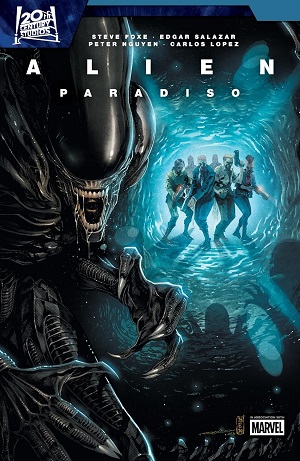
This oversized volume is part of Marvel’s Black, White & Blood series, which is distinguished by its use of a mostly black-and-white format with coloured accents in red to show blood (with a bit of green mixed in for Xenomorph blood here). You may think of the sort of thing that was done with colour (and its absence) in Frank Miller’s Sin City comics, and I think that’s a good analogy for both the level of violence on display as well as the noir sensibility. Noir referring both to the heavy and dramatic shadow as well as a lack of traditional good guys in an amoral universe.

The Alien run consisted of four issues, each with a part of a long story, “Utopia,” as well as two short pieces. They all have different writers and artists, but the same letterer (Clayton Cowles), which actually provides a lot more of a sense of continuity than you’d expect. I would have even appreciated cover pages for each of the individual stories because it’s easy to miss where one ends and another is getting started.

The large format makes covers and full-page spreads into poster-size art that you just want to enjoy. I’ve commented before on the cheaper reprints in the Marvel Masterworks and DC compact comics lines and how hard they can be to read, and it’s a real treat to read a big book like this that looks so good throughout. I especially liked the chonky stylized turn that Claire Roe gives her story, with illustrations that look almost like woodcuts.

If you want one word to describe the general sensibility I’d say it’s bleak. And that’s saying something considering these are Alien comics. There are no happy endings, and most of the stories are very unhappy in brutal and ironic ways. Even “Utopia,” about a ship full of socialists looking to colonize a new planet as a worker’s paradise, took a dark turn I found surprising. Mankind is clearly something to be surpassed. The final line in the book is “Any chance to eradicate humanity’s ugliness is beautiful.” That gives you some idea of where you’re going.

Graphicalex

Druuna: Carnivora

Druuna: Carnivora

Another part of the Druuna saga, a story cycle that runs in place, never really going anywhere because time and place have no meaning in the Druunaverse. We’re told that Druuna’s boyfriend Shastar has become pure energy and his mind integrated with the ship’s computer, within which he is joined with the ship’s captain, Lewis. But they can both still make themselves manifest either through dreams or virtual reality. Meanwhile the monsters are proliferating and creating “replicants” of the crew members: exact doubles who don’t even seem to know that they are replicants. Well, some of the time they do, but most of the time they don’t. So Druuna doesn’t even know if she’s a replicant. In her human form she’s something special, not quite a sub- or ur-human “prolet,” but also something different from the more civilized crew members. More civilized, I think, mainly because they wear more clothes. Druuna doesn’t like wearing clothes. Or maybe she does but just often finds herself without any.

There’s sex. And violence. And sexual violence. And various attempts, all futile, to explain what’s going on. I love how Shastar actually tries to draw a diagram to show Druuna what’s happening . . . and it’s of no use at all. As near as I can figure it, there are two dimensions, one good the other evil, and the ship has come up to the boundary between them and the monsters are spilling over from the evil dimension and contaminating our own. At the end the character of Doc figures out some way to go back in time and avoid all this. Or maybe he doesn’t and it’s a dream and they’re all replicants now. I couldn’t tell you.

You just have to learn to let go with Druuna. It’s not meant to make sense. Judged against the other books in the series I’d probably rate Carnivora near the bottom because there’s more talk and less coherence than usual. Even the minimal structure of the hero’s journey is dropped, as it’s not clear if Druuna is actually on her way anywhere or has any particular mission. I barked out a laugh when, after talking to Shastar (or his avatar) she says she has to return to the ship’s crew to pass on the message that they’re in danger. As if they hadn’t figured that out! Most of them have already been killed and eaten! But if you’re a fan then none of this really matters. Nor, I would argue, is the sex all that important. You’re just here for the crazy.

Postscript: My hardcover edition of this book is basically in mint condition. When I last checked there was only one for sale, used, on Amazon for $545. If I just hold on to mine for another thirty years I’ll be rich.

Graphicalex

Big Trouble in Little China (Legacy Edition Book Two)

Big Trouble in Little China (Legacy Edition Book Two)

I enjoyed the first volume of this series so much that two years later I had no trouble remembering where it left off: with Jack Burton being transported into the twenty-first century as a roadside attraction. Usually two years is more than long enough for me to forget plot lines entirely.

This collection contains three main storylines. In the first, after being brought out of suspended animation in the year 2015, Jack meets up with some of his old pals (and their children), and gets involved in a plot to take down a billionaire who collects pop culture artefacts from the 1980s. One such artefact being Jack’s rig the Pork Chop Express.

We’re introduced here to the girl who will become Jack’s new sidekick, his buddy Wang’s daughter Winona. Though of course Winona thinks of herself as more than a sidekick, and it’s her skill in martial arts that saves Jack’s bacon more often than he saves her. She’s also helpful in explaining the changes that have taken place in America since the Reagan years, which is the source of lots of the usual kinds of jokes stemming from Jack and Winona speaking what amount to different languages.

The second story has Jack and Winona and the rest of the gang heading off to Macao to take part in a poker tournament and rescue Margo Litzenberger from Koschei the Deathless. Here they are reunited with Egg Shen, who inadvertently sends Jack and Winona back to 1906 San Francisco, just before the earthquake is about to hit. This marks the beginning of the third story. In San Francisco Jack and Winona meet a younger Egg Shen and also get the origin story for the evil wizard Lo Pan before sorting out their respective timelines.

I liked this just as much as the first volume. The period gags are all on point, from the A-Team spin-off in the first story, to the Harry Potter kid in Macao, to Jack’s ongoing hunt for a payphone. And plot-wise it keeps spinning off in all kinds of crazy directions, including a crossover event revisiting scenes from the movie. The only place it dragged for me was in the primer on the rules of Texas hold’em, as presented by the Three Storms. And I guess the land developer/casino operator who becomes a nativist politician in San Francisco was a bit unnecessary. It’s interesting to note how often this character kept popping up in comics around this time.

Graphicalex

Saga of the Swamp Thing Book Four

Saga of the Swamp Thing Book Four

In my notes on Saga of the Swamp Thing Book Three I talked about how I preferred the back-to-basics Swamp Thing stories that played like X-Files “monster of the week” episodes to the epic storylines involving some grand cosmic battle between good and evil. I felt that way again here, as I really enjoyed the introductory stories about the druggies eating some sweet potato that has fallen off Swampy’s back and going on hallucinatory trips, and “Ghost Dance,” about the legacy of a gun manufacturer playing out in a haunted house (a story that was a personal favourite of Alan Moore’s). But once we get back into the preparation for a final battle between a newly awakened power of evil and the forces of light, I thought things weakened. Sticking with the comparison to the X-Files, you spend all this time building up the main storyline or “mytharc” about Fox’s missing sister and alien abductions and black oil, but when you finally go on board the mothership you know you’re going to be disappointed. I mean, where do you go from a build-up like what we get here: “This is ultimate dark, ultimate light. The forces and the stakes here are fundamental and absolute . . . and whichever side meets its final destruction this day, everything will be changed.”

That said, I thought the final battle was well choreographed. A host of characters are assembled. John Constantine is holding a completely useless séance with a group Neil Gaiman describes as “the detritus, the flotsam and jetsam of the DC occult universe.” Swampy is in hell (or thereabouts) and is joined by Deadman, Phantom Stranger, the rhyming demon Etrigan, and the Spectre. They’re trying to stop the aforementioned evil. Or maybe it isn’t evil. Maybe it’s just misunderstood. In any event, the glowing hand of God descends from heaven and the world just continues on its merry way. “Nothing has happened. Everything has happened.” Good and evil are necessarily linked, you see. Can’t have one without the other. According to Gaiman’s introduction, Moore thought this had something to do with the Manichaeism of American culture, and what happens is an answer to Swamp Thing’s questioning if there is “some truth . . . that may be divined . . . from the entrails of America.”

Well, colour me unimpressed with these flabby conclusions. Getting to them was a lot of fun though, even if Swampy himself remains a remarkably passive as well as ponderous figure throughout. I think maybe Moore came up with the character of John Constantine just to liven things up. I do like what Moore did with this series, but at the same time I don’t think he was ever as interested in Swamp Thing as he was in doing his own thing.

Graphicalex

The Owl and the Pussycat

The Owl and the Pussycat

I’ve said before how much I love this Visions in Poetry series, and in particular how the illustrations really offer up new interpretations of classic poems. Stéphane Jorisch’s take on Edward Lear’s “The Owl and the Pussycat” is another great example, presenting the poem in a way that I’d never thought of before.

My own sense has always been that the Owl and Pussycat were an odd but natural fit. After all, opposites attract. Jorisch, however, emphasizes their difference, making them into a sort of Romeo and Juliet coupling. The beautiful pea-green boat takes them away from an apartheid society where dogs and cats and owls never mix. The other species look on at the Owl and the Pussycat and whisper. The couples that cruise by on the Chez Noah stare (no interspecies sex there!). Even the fish in the sea stick their heads out of the water to watch them sailing by. And so our happy couple, who only have eyes for each other, have to go to the land where the Bong-Tree grows to be married by a singular turkey, after buying a ring from a singular pig. Mythical beasts like unicorns and mermaids approve.

As I say, this is never the way I’ve read “The Owl and the Pussycat,” and I don’t think it’s a reading I’d adopt as my own. Jorisch does, however, very much make it his own and I thought the book another splendid entry in a series that never disappointed. I only wish they’d published more!

Graphicalex