Daredevil: Know Fear

Daredevil: Know Fear

This volume is the beginning of a Daredevil story arc written by Chip Zdarsky and illustrated by Marco Checchetto. It’s a bit of a “born again” theme, again, but it’s an odd sort of a launch because Daredevil is coming back to life from a near fatal collision (the “Death of Daredevil”) only to get the crap kicked out of him by nearly every bad guy he meets and then being argued into retirement by Spider-Man

The overall tenor is quite dark. Wilson Fisk is mayor of New York City in this timeline, and you know he’s up to no good. Daredevil himself is a diminished thing. He hasn’t fully recovered from his last near-death experience, has a few days’ worth of stubble growing under his mask, and has trouble even taking out street thugs, much less bona fide supervillains. Even the tough-as-nails Chicago cop Cole North can beat him up in a fist fight. On different occasions he has to be bailed out by superpals like Luke Cage and Iron Fist, or the Punisher (who often pops up at such moments). At one point he’s shot, but (you’ll never guess) it’s only in the shoulder, so he can keep going by taking pain meds. On top of all this he’s starting to wonder if he’s maybe doing more harm than good, especially when he accidentally kills a perp. This leads to lots of tortured reflections and flashbacks to his Catholic upbringing, and his eventual decision to get out of superheroing altogether. He’s not only the man without fear now, but a man without a real purpose in life.

When I say the tenor is dark this is what I mean. It’s Batman dark, and that’s the main feeling I got reading it. Matt Murdock is feeling some Bruce Wayne-level angst, and being the Red Knight is the cross his therapy bears. There isn’t a whole lot of story going on either, as it’s mostly character- and world-building. Which is normally not something I’d go in for, but I thought Zdarsky did a good job with it and I came away wanting to read more. You know DD just has to get back up, dust himself off, and start all over again.

Graphicalex

Batman: Reptilian

Batman: Reptilian

I went through a range of responses while reading Reptilian. For example, at first I found myself really grooving to the art by Liam Sharp, which has a thick, painterly atmosphere to it. If that art was dark, well, that’s the Batman universe. And not just any Batman universe, but the DC Black Label Batman universe.

But then I didn’t like how the art stayed so dark, and how the thickness started to just seem muddy. There were action sequences where, even going back to examine them more closely, I honestly couldn’t tell what was going on. There were climactic moments, such as Killer Croc appearing with an external womb like Nola in The Brood, that I couldn’t see at all. I had to take cues from the text to understand what was happening. This was a shame because Sharp really imagines the characters in interesting and original ways but I felt like I was only seeing them through a glass, darkly. Batman himself is all shadow and silhouette, which I guess is apt for the character but also got tiring after a while.

I felt the same mix of good and bad with the writing. Garth Ennis is a writer known for pushing the boundaries of what I’ll call good taste. This title isn’t as crazy as some of his stuff, but then he was writing for an established DC character and they probably had him on some kind of leash. As it is, his Batman is a cold, sarcastic bastard and Killer Croc a sympathetic villain. There’s also a violent plot (though the violence is mostly witnessed in the aftermath) that involves a lot of xenosexual shenanigans. In sum, it wasn’t what I was expecting, but it was something new, which isn’t easy to pull off when we’re talking about a Batman comic. Some of the dialogue felt awkward, and given the aforementioned issues I had with the art the story became hard to follow in places. But on a second reading I did think it all made sense.

So I came away respecting it. I could see a real Batman purist taking offense, but that’s the Black Label brand. The art at least had a lot of interesting design elements, though the monster looked a bit too Giger-ish and as noted it’s all far too dark. And Ennis did come up with a story that I think even his detractors will admit is hard to forget. There aren’t many comics that give us that much.

Graphicalex

The Superior Spider-Man: Goblin Nation

The Superior Spider-Man: Goblin Nation

As you know from my previous reviews of a couple of the Superior Spider-Man Team-Up collections, I’m a fan of the character. In brief, he’s a version of Spider-Man where Otto Octavius has taken over Peter Parker’s body and thus the identity of Spider-Man, creating a new and improved (“superior”) webslinger. The original Peter Parker had apparently died, but in fact his consciousness is still floating around in the SSM’s head, and in this issue he finally emerges triumphant as Octavius relinquishes control back to him so that he (the real Peter Parker) can save his (Octavius’s) girlfriend.

Did you follow all that? It doesn’t really matter. The main plotline has the Green Goblin (or the Goblin King, who is Norman Osborn having had plastic surgery to look like one of his corporate underlings) and the Goblin Nation (a bunch of characters turned into goblin freaks by the goblin serum) trashing NYC. The Goblin King knows that Spider-Man is now a cosplaying Doc Ock and offers him an alliance (as junior partner) but nobody with a name like Octavius is going to agree to play second fiddle to a little green guy so they end up fighting each other. Meanwhile, Spider-Man 2099 has time-traveled back to help out and J. Jonah Jameson, the mayor of New York, has unleashed his army of robot Spider-Slayers to kill Spidey because you know Jameson just has a hate on for him.

Did you follow that? I’ll admit, I had a hard time with it. And there’s more going on, including a psychomachia in Peter Parker’s head and a battle between the corporate entities Parker Industries and Oscorp/Alchemax. I thought this struggle between the wannabe tech bros to be an angle that had more potential, but as this synopsis has already made clear there’s plenty enough going on.

Probably too much. If you’re not up on this iteration of the Spiderverse then you’re probably going to be lost with regard to all of the supporting characters. I know I was. And I wasn’t impressed with the Goblin King’s ambition to take over all the crime in New York City. Why not just focus on growing Oscorp and take over the world? What would Elon do? OK, probably try to take over NYC. But you know what I mean.

I didn’t like this one as much as I did the other Superior Spider-Man titles I’ve read, but it’s still a better-than-average comic and shouldn’t disappoint the fans who wanted to see Peter Parker come back. I just wasn’t missing him that much.

Graphicalex

Druuna: Creatura

Druuna: Creatura

This comic (which I don’t have as a standalone but only as it appeared in the November 1992 Heavy Metal) is a sequel to the Morbus Gravis Druuna books, and there is a sort of continuity, at least insofar as continuity is a thing in the Druuna universe. The spaceship that was the setting for the earlier books has been overgrown by the Evil virus and now constitutes a sort of fleshy asteroid or floating tumor. Another spaceship captained by a man named Will comes across the asteroid, which seems to be communicating psychically with Will by giving him visions of Druuna. An away team lands on the asteroid, indeed enters it in a highly suggestive manner, and as they explore their surroundings reality seems to come undone and it’s not clear how much of what is happening is real and how much is a dream. Druuna’s lover Schastar, for example, appears to have melded into a cyborg creature that is part Schastar and part Lewis. Furthermore, he/it might have died eons ago but for the fact that time no longer has any meaning.

There’s a doctor (he seems to be a psychologist, primarily), who’s based on Serpieri himself, and he shows up to try to explain some of this to Will but I found his theories hard to follow. Otherwise, we’re just lost in the same world as before, consisting of a diseased superstructure built upon a cauldron of id that keeps looping out its tendrils to snag the buxom Druuna or any other nubile creature. The crew-cut Terry giving herself up to something called the Prolet project is another sexual-surrogate stand-in, like Hale in Morbus Gravis. In fact, she might be Hale. I don’t know.

Trying to make sense of all this is impossible. And this despite the fact that Creatura is a lot talkier than the Morbus Gravis comics. I’m just not sure how much of the supposed exposition was meant as a joke, how much was lost in translation, and how much was confused to begin with and then became progressively more complicated. It seems that something is being said about humanity existing in a parlous state between the poles of what I called the id (the Evil virus, carnality, violence, and lust) and a superego (the computer, robots, technology). While Druuna in all her lush voluptuousness would seem to be more closely aligned with the organic, that’s not represented as being an attractive alternative. Sex can be beautiful (especially on the beach), but more often it’s something cruel and degrading. Meanwhile, technology is more closely identified with what we might think of as civilization and a condition of order that we have to fight to preserve.

I won’t try to read anything more into it than that. Most of the pontificating done by the doctor and others strikes me as just a bunch of pretentious bafflegab. And by this point in the story I think it’s clear that there is no linear story being told. “Past, present and future mean nothing here,” Druuna is told by the robot Schastar/Lewis. And so she keeps running in place. There’s no escaping the human condition, even in space!

Graphicalex

Simpsons Comics Colossal Compendium: Volume Two

Simpsons Comics Colossal Compendium: Volume Two

This is more like it. I was a little underwhelmed by the Simpsons Comics Colossal Compendium Volume One, though this was mainly because I judge the writing in these Simpsons comics to a high standard. I know the Simpsons universe well, at least from its earlier years, and I’ve been impressed at how the stories in the comics are still so fresh and funny decades into the franchise now.

There are some good storylines here, including a number of superhero spin-offs. There’s a Bartman story where he meets a supposed Bartman of the future (one guess as to who that is!), another where all three of the Simpsons kids are superheroes (Stretch Dude, Clobber Girl, and Bouncing Battle Baby), a blast from the past courtesy of Comic Book Guy and issue #100 of Radioactive Man, and an adventure where Homer becomes a sort of accidental costumed crimefighter as a way of losing weight.

The best story though is “No Cause for Alarm,” a comic written and illustrated by the legendary Sergio Aragonés. This follows a series of mishaps that arise when Homer gets lazy with the alarm at the nuclear power station. It’s the kind of gag humour Aragonés does well, and the story has a lot of the chaotic crowd scenes he’s famous for, made all the better for the fact that Springfield is so full of easily identifiable characters you can enjoy these pages for a while as you try to locate where your favourite citizens are hiding.

If there’s any negative comment I’d make it’s the inclusion of a couple of short Itchy & Scratchy vignettes. I’ve never understood why they kept with these. Basically they’re an ultraviolent version of Tom & Jerry, with the cat (Scratchy) always being dismembered or destroyed by the sadistic mouse Itchy. I don’t find these comics offensive or shocking, but I don’t think they’re funny either. And they always play out the same, with no twists or surprise endings (unlike Mad’s Spy vs. Spy, for example), so they’re not very interesting in that respect either. But since these only amount to a few pages of filler it’s not a big deal.

Finally, the papercraft Springfield landmark is of Moe’s Tavern.

Graphicalex

Malignant Man

Malignant Man

It’s likely the main initial selling point for Malignant Man is that, as the back cover tells us, it was “written by Saw director James Wan.” But even this needs some unpacking.

In the first place, on the title page inside James Wan is credited with “Created and story by.” The comic itself was “Written by” Michael Alan Nelson. This put me in mind of the way the BRZRKR comics were credited as co-written by Keanu Reeves. I expressed some doubt as to how much writing Reeves actually did on those comics, but since (to be fair, after getting off to a decent start) they were terrible, and his co-writer Matt Kindt was a capable hand, it’s possible he was at least somewhat involved.

The other thing to note is that Wan did go on to produce and direct a 2021 horror film with the title Malignant, but that movie has nothing at all to do with this comic (which came out in 2011). There was apparently a deal in place to make a movie out of Malignant Man, with Wan originally slated to direct, but it never got off the ground. At least I’ve never heard of it.

On to this comic. Our hero is one Alan Gates, a fellow who has been diagnosed as dying of brain cancer. But don’t worry, he’s not going to turn into the Jigsaw Killer. Instead, after being shot in the head by some punk who he tries to stop from stealing a woman’s purse, he’s taken in for surgery where the doctors find out that his brain tumour is actually an alien parasite called a malignant that gives him super powers.

Just as an aside, I think that’s supposed to be him on the cover, but that person doesn’t look anything like the guy in the comic. Which seems like the kind of thing someone should have flagged.

Unfortunately for Alan, there are other malignants out there. Actually there are two secret societies of them, one good and the other bad. The bad ones, who look like the Agent Smith clones from The Matrix, start sending hit squads after Alan. Along with a malignant buddy named Sarah Alan kills them all, utilizing his glowing malignant blade and prosthetic shotgun.

I didn’t think there was anything special or very new about this idea, and for a short run of four comics they tried to put too much mythology into the mix. For example, we never do figure out what the malignants are up to. Maybe if the series had gone on some of that would have been explained, but this seems to have been the end of the line.

Graphicalex

Velvet Volume 2: The Secret Lives of Dead Men

Velvet Volume 2: The Secret Lives of Dead Men

I’m happy I stuck with this series. I thought Before the Living End was generic and uninteresting spy stuff, but The Secret Lives of Dead Men drew me in. It’s still terribly generic, but I found myself genuinely curious as to what the game behind the game was and who was being played. Even though the answer to that latter question seems to be everyone.

So sexy superspy Velvet Templeton, clad in her skin-tight prototype stealth suit (bullet proof, and with wings for gliding off of tall buildings) is running around Europe with stolen passports trying to find out who framed her for the murder of secret agent X-14. Apparently it all goes back to some shit that was going down in the 1950s (the story is set in 1973) and Velvet’s husband, codenamed Mockingbird.

Don’t think you’re going to get any answers here! Just a lot more questions. But I enjoyed all of it, and was even glued to long stretches of dialogue that take place between two people sitting in a bar or together on a train. You know these conversations are games as well, but it’s fun to watch Velvet playing them as she follows the bread crumbs to whatever final twist Ed Brubaker has up his sleeve.

Graphicalex

Aliens: Dust to Dust

Aliens: Dust to Dust

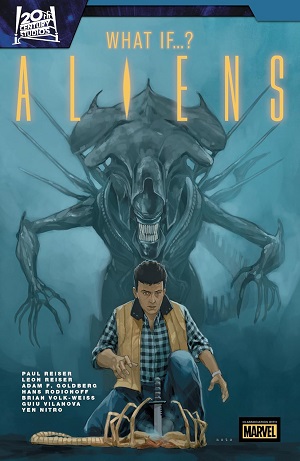
In my thoughts on Aliens: Dead Orbit I offered up the opinion that sometimes with comics where one person does double duty as artist and writer you end up wishing they’d split the labour with someone else. In that case I loved the art by James Stokoe but had trouble following the story. Dust to Dust reverses this, as I thought Gabriel Hardman’s story was solid, if pretty basic, while his art wasn’t to my liking.

First the story. In his Introduction Hardman expresses his (in my opinion, correct) understanding of the mission. “You have to bring in different ideas while still fitting the tone of the Aliens universe or you’ll end up with a stagnant pool of a franchise.” This is what I meant when I said of the Aliens: The Original Years Volume 2 omnibus that the stories have to deliver fan service but also “just enough stuff that’s new that every story has its own character.” And in fact this is the challenge faced by every genre writer.

So in most respects Hardman presents us with a classic Aliens story here. On a planet that’s been undergoing an only partially successful terraforming program there is a Xenomorph outbreak. And, as is the nature of these things, pretty soon the nasty creatures have overrun the human colonies, leaving everyone scrambling to get on the last escape shuttle out. Two such people are 12-year-old Maxon and his mom, the latter having recently had an intimate encounter with a facehugger. So yeah, she’s expecting. After Maxon and mom get on a shuttle, mom gives birth in the usual way, and within a couple of minutes the chestburster is a full-grown adult Xenomorph. How do these things grow so fast?

Anyway, the shuttle has to crash land back on the planet, which is an inhospitable environment riven by dust storms. The passengers all survive the crash, but so does the Xenomorph, minus an arm. This is significant because it brings in the “different idea” that jazzes the story up. You see, as one character puts it, “everybody says the Xenomorphs take on the traits of their hosts.” And since this particular Xenomorph was born of Maxon’s mother that means there’s still a kind of shared bond. She (the one-armed Xenomorph) may kill everyone around Maxon, but she’ll leave him alone. Or even protect him, as needs be.

The idea that Xenomorphs borrow something from their hosts had, I think, been suggested in the Aliens mythology before this, but the step taken here goes quite a bit further. These aliens even take on the personality of their hosts. That’s new, and it’s an interesting twist in what turns out to be, as promised on the back cover, a story “equal parts the horror of Alien, and the action of Aliens!”

But then there’s the art. It’s very much the sketchy style of drawing (and lettering) that I’m not a fan of. The work of Jesús Hervás and Vanessa R. Del Rey on The Empty Man series being a good example. I like the art here better than in that title, but it suffers from the same drawbacks of being hard to read at times. There’s one fight with the Xenomorph, for example, where it gets knocked off its feet when attacking Maxon. How? I can’t make it out. I think a giant robotic arm is swung at it, but I had to wonder how that would work. It’s just not clear.

Now to be fair I do like an individual artistic style, and I’d rather see a comic drawn this way than in the plastic visuals of the mainstream Marvel manner. Also, the scratchy quality of the images goes with the fact that a lot of the time the characters are caught out on the surface in a raging dust storm. But still, it’s not my thing.

Graphicalex

Velvet Volume 1: Before the Living End

Velvet Volume 1: Before the Living End

It’s fine. Just nothing special.

A vintage spy story, set in 1973 but in James Bond’s Europe, so definitely not the disco era. There’s a spy organization known as ARC-7 that only a graphic in the corner of one of the cover pages tells us stands for the Allied Reconnaissance Commission. So sort of like the Five Eyes? I don’t know. Their headquarters is in London. James Bond again.

One of the ARC-7 superspies is gunned down in the streets of Paris, which sets off alarms back at HQ. It seems they have a mole. The chief suspect is one Victoria Templeton, a mid-40s beauty with a shock of white hair who works as the personal secretary of the Director. Ms. Templeton is, however, a lot more than a secretary, being a super-spy herself. And now she’s on the run.

Exotic settings. Luxury acccomodations. Gunfights. Martial arts. Car chases. Victoria in lingerie and swimsuits. Like I say, it’s fine. But really generic and just not that interesting. Maybe the next volume will throw in some change-ups, because that’s what I think it really needs.

Graphicalex

Batman Arkham: Hugo Strange

Batman Arkham: Hugo Strange

I like these DC Arkham volumes (and Marvel does something similar with their MCU tie-in books) because they show the evolution of a villain through time. And when I say through time I mean a lot of time. The character of Hugo Strange first showed up in 1940 and the last comic collected here is from 2016. So it’s been a slow evolution.

In Dr. Strange’s debut Batman describes him as “the most dangerous man in the world! Scientist, philosopher and a criminal genius . . . little is known of him, yet this man is undoubtedly the greatest organizer of crime in the world.” This makes him sound a bit like a DC version of Professor Moriarty, which may have been the original idea. As things went on, however, he turned into something a little more specific. I assume he’s still a great mind and polymath, but in his later iterations he seems more specifically to be a psychiatrist or psychologist. His appearance also became more distinct: coke-bottle glasses or goggles, bald and with a beard, and a grin that flashes both top and bottom rows of teeth. It’s also revealed that he’s quite buff, to the point where he can fill out a Batman suit well enough to pass as the caped crusader, only hairier. Or even go toe-to-toe with the champ in fisticuffs, if need be.

This made the data page provided as a bonus at the end of this volume all the more surprising when it gave his personal stats as 5’10 ½” and 170 pounds. Do you know anyone else who is 5’10 ½” and 170 pounds? Yes you do! The fellow writing this review! And I can tell you, I don’t have a superhero’s build.

Another quick aside: Why is he Professor Hugo Strange? I assume he has a Ph.D. from somewhere, and so could be called Dr. Strange (albeit not of the mystic arts), but the title of professor usually means someone who has a teaching position somewhere. I don’t see any evidence of that in these comics, and I’m not sure how it would work for Hugo, given his criminal record.

In any event, like a lot of shrinks (and yes, I’ve known a few), this Dr. Strange has lots of his own mental issues to work through. The chief being an obsession not just with defeating Batman but becoming Batman himself. Hence the way he keeps dressing himself up as Batman, which seems almost like a kink. When Robin asks him why he’s so into cosplay we get this explanation: “Batman is more than a person, child. Batman is a force, a power of archetypal potency! The Bat is in all of us! I am the Bat! He has no right to keep the mask to himself! No right!”

I don’t know if that makes any sense. It probably does to him, but as Robin realizes, he’s not someone who knows himself very well. I mentioned, for example, his thing for dressing up as Batman being a sort of kink, and there were a few points in these comics that reinforced that notion. In his debut for example, when Professor Strange captures Batman he ties him up and starts whipping him. Or, in his words, giving him “a taste of the lash!” This struck me as kind of weird. Then in a later comic there’s a two-page wrestling match between a totally nude Bruce Wayne (fresh out of the shower, you see) and a “mandroid” version of Robin. This made me think of Saturday Night Live’s Ambiguously Gay Duo. Is there some homoerotic fascination then that Strange has for Batman/Bruce Wayne? (For years Strange was the only villain that knew Batman’s real identity, which he discovered by the simple expedient of taking off his mask when he captured him.) As for his dating preferences, his data page gives his marital status as single and whatever else he envies about Bruce Wayne’s lifestyle, it’s not having hot girlfriends like Silver St. Cloud, who he finds to be a nuisance.

Leaving all that aside and just focusing on the comics, I thought the two-parter from 1977, and 1986’s “Down to the Bone” (that reads a lot like Frank Miller’s Daredevil: Born Again storyline, which came out the same year) were both very good. Do you know what elite status markers were in 1986? Yachts and . . . VCRs! Alas, “money is not just yachts and VCRs,” we’re also told. So I guess I wasn’t that rich after all. Moving along, the four-part “Transference” story from Gotham Knights though struck me as poor and the final story, the climax of the “Night of the Monster Men” arc, wasn’t worth including. In other words, the storytelling hit a peak in the ‘70s and ‘80s and has been in a trough since. That’s not really an issue with the evolution of the character of Hugo Strange though, but says more about the declining quality of writing everywhere.

Graphicalex