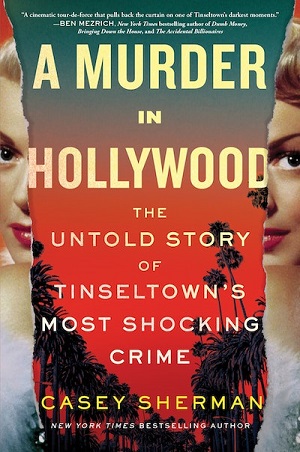
A Murder in Hollywood: The Untold Story of Tinseltown’s Most Shocking Crime
By Casey Sherman
The crime:
On April 4, 1958 gangster and gigolo Johnny Stompanato was killed by a single stab wound to his belly in the bedroom of his then girlfriend Lana Turner. There had been a long history of Stompanato being a violent domestic abuser. At the coroner’s inquest it was found that Turner’s 14-year-old daughter, Cheryl Crane, had held the knife, but the jury found it a case of “justifiable homicide” so there was no criminal trial.
 The book:
My previous attempt at a Casey Sherman book hadn’t gone well. His account of the serial killer Tony Costa’s rampage on Cape Cod, Hell Town, even made it into my DNF files. It was bad. But I still wanted to give this one a shot, mainly because it’s a case I’d often heard of but didn’t know much about.
As usual with true crime, the title oversells things. Was this really Hollywood’s “most shocking crime”? I’m not sure a woman (or a woman’s daughter or other family member) killing an abusive husband or boyfriend counts as very shocking. I mean, also on the cover there’s a blurb from Ben Mezrich calling it “one of Tinseltown’s darkest moments,” but even that seems like a stretch to me.
Even more questionable though is the subtitle’s assertion that this is an “untold story.” Really? The case was given saturation coverage by the media, for obvious reasons. And the fact is that Sherman’s sources consist mainly of the published memoirs of the main players in the drama, including Turner, Crane, and L.A. crime kingpin Mickey Cohen. Does Sherman add anything new to the mix? I don’t see where he has, and keep in mind that the most recent of these memoirs is over 25 years old. I also didn’t register a single point where he called into question the accounts of events described by Turner, Crane, and Cohen, despite the fact that autobiography is the least trustworthy genre of non-fiction writing there is.
As it is, we’re left with a number of scenes that we just have to take on faith. And not only faith in the memoirist making an honest report, but in their having an accurate recollection of events that may have happened thirty years before they set them down. When I reviewed Hell Town I called Sherman out for his description of events that I didn’t see how he could know so much detail about. Here he at least has a source for most of his stories, but if you don’t trust the source this doesn’t always help very much. Take the following two incidents, which I just flagged at random. The first describes Turner coming home to her husband Lex Barker after learning that he’d been molesting her daughter Cheryl:
While Cheryl remained at Mildred’s [Turner’s mother], Lana drove back to the house she shared with Barker. With rage building inside her, she walked quietly upstairs and into their bedroom. Lana had kept a pistol by her bedside after the foiled kidnap attempt of her daughter. Barker slept soundly while Lana reached for her gun. She stood over her husband with the weapon pointed directly at his head. One shot and he would be dead. Her finger rested on the trigger. She was ready to pull, but she stopped herself. If she murdered Lex Barker in cold blood while he was sleeping in their bed, she would undoubtedly get the gas chamber herself. And what good would she be to Cheryl then? Lana lowered the pistol and left the room. She stayed up for the rest of the night, smoking, crying, and contemplating her next move.
Of course the only possible source for this would be Turner, though the notes only refer to Crane’s memoirs. So I really don’t know how much to credit it. It makes for a very dramatic, even cinematic, moment (the book was immediately optioned for a film deal), but that just makes me more suspicious as to how much of it really happened.
A few pages later another dramatic scene plays out, this time with Frank Sinatra confronting Mickey Cohen. Stompanato had apparently been making a play on Sinatra’s then wife, Ava Gardner.
“Look, I want you to do me a favor,” Sinatra said, staring at Cohen with his famous blue eyes. “I want you to tell your guy Johnny Stompanato to stop seeing Ava Gardner.”
Cohen did not care how famous Sinatra was or what his deep connection to the underworld were. He damn sure wasn’t going to play Mr. Fixit for Sinatra’s love life. Cohen peered out his living room window and noticed the unmarked police car parked across the street.
“You mean to tell me you came all the way out here where they’re recording everybody’s name and number that comes near this house?” he asked rhetorically. “This is what you call important? I don’t get mixed up with no guys and their broads, Frank.”
Sinatra was not accustomed to getting dressed down in this manner. At that point, Cohen took out the proverbial dagger and stuck it in his back.
“Why don’t you go home to Nancy where you belong?” he asked spitefully in reference to Sinatra’s first and long-suffering wife, Nancy Sinatra.
Again, there is only one possible source for this story and that’s Cohen. Did he really “dress down” Sinatra in this fashion? Did he say these exact words? Or is he making himself the hero of his own story?
What makes the dependence on a few far-from-disinterested sources more troubling still is the fact that there is a real mystery at the heart of Stompanato’s murder. Is it true that Cheryl Crane killed him? She always claimed that she did, but many have their doubts, as do I. (If you’re wondering why the defence team would want to pin the rap on her, it’s because as a minor she wasn’t liable for the death penalty in California.) The narrative of what happened on the night in question is pretty shaky (per Sherman: “Lana went black for a moment. All the rage growing inside her had made her blind. Suddenly, there was a frenzy of motion in the bedroom . . .”), and the post-murder behaviour of Turner and her entourage was highly suspicious. In particular I’m talking about the staging of the crime scene. You don’t have to be as cynical as I am to raise an eyebrow skyward at what happened immediately upon the death of Stompanato. Did Turner call the police? No. Instead, she made “four frantic phone calls” to: her mother, a doctor, her ex-husband (Cheryl’s father), and her lawyer, Jerry Giesler. When Giesler arrived he then called “his clean-up man” Fred Otash.
Otash despised Stompanato and was happy to see his lifeless body sprawled out on the carpet of Lana’s pink bedroom. Otash looked around the bedroom and got to work. It took the private investigator two full hours to stage the crime scene to Giesler’s satisfaction. The attorney gathered Lana and Cheryl in the bedroom. . . .
Giesler huddled with Lana and her fourteen-year-old daughter and painstakingly walked them through his plan. Content with the narrative he was about to weave for police and the public, Giesler finally dialed the authorities.
When police officers were summoned to North Bedford Drive more than 120 minutes after Stompanato was stabbed to death, there was something peculiar about the setup in Lana’s bedroom. Investigators were surprised to see that there was little or no blood on the rug, and the bedroom walls were damp and appeared to have been recently scrubbed. Stompanato’s body looked like it had been moved from its original location. Also, the cover had been taken off Lana’s bed and was nowhere to be found. “It looked like a hog had been butchered on it,” Giesler reportedly told friends later on. The murder weapon, the kitchen knife, was located on the sink in the en suite bathroom. The fingerprints on the handle were wiped clean. It also looked like all the bathroom towels were missing from their racks, possibly used to soak up all the blood in the room. Were the bloody linens now stuffed in the trunk of Otash’s car to be burned later?
I don’t know about you, but this doesn’t inspire a lot of confidence in me that the “narrative” Giesler prepared had much relation to what really happened in Turner’s bedroom. It’s certainly something you’d think Sherman would want to look into a little more deeply, making some reference to later accounts of what Turner and others reportedly said about what went down the night of the murder. But he pretty much leaves the finding of the coroner’s inquiry alone, only tossing in suggestive tidbits like Lana dreaming of Johnny: “A long knife appeared in her subconscious, but who was wielding it? Was it her? Or was it Cheryl. It was all a blur to her now.” What are we to make of this? What is Sherman’s source? I couldn’t find any. In any event, for a book selling the “untold story” of Stompanato’s murder not having more to say about it than a sleepy “blur” is leaving a lot on the table.
“To me,” Sherman concludes in an Author’s Note, “Lana was a feminist hero and a pioneer.” Before the #MeToo movement, he writes, “we all must offer thanks to a female star from the golden age of Hollywood who broke a vicious cycle of violence and took her life back.” This is problematic on several counts. First of all, the #MeToo movement mainly had to do with “shitty” industry men preying on women who were trying to make it in the business. Harvey Weinstein was the totemic figure. But Turner sought out inappropriate men who the studio heads, most notably Louis B. Mayer, didn’t want her having anything to do with precisely because they would damage her career.
And in at least some cases she sought them out because they were bad boys. We want to tread lightly here because of the knee-jerk response to calling out a woman’s bad life decisions as victim-blaming. But the fact is that Turner, easily one of the most desirable women in the world at the time, was married 8 times to 7 different men (she re-married Stephen Crane, Cheryl’s father, when she found out she was pregnant). They were a line-up of drunks, losers, abusers, and one pedophile. And this isn’t including Stompanato, who she never married. Everybody is allowed one mulligan for making a bad choice of partner, but it’s only stating the obvious to say that Turner wasn’t just a poor judge of character in the men she dated but was setting herself up for serial disasters. After a while you have to own up to the fact that the problem is you.
Take her mésalliance with Stompanato, who endeared himself to her at one point by climbing a fire escape, breaking into her apartment, and attempting to rape her. “His consuming passion was strangely exciting,” she would later write. “Call it forbidden fruit, or whatever. But his attraction was very deep – maybe something sick within me – and my dangerous captivation [with him] went far beyond lovemaking.” That, at least, shows some self-awareness. But as a feminist “hero” I think Turner is compromised.
In sum, this is a pulpy read but not one that I thought added anything by way of new research or a fresh interpretation of the case. It’s basically just a recitation of what Turner, Cohen, and Crane had already said about it. And I’ll add another of my standard complaints about how the pictures are no good. They’re small, grainy, and mostly credited to Sherman himself, being pictures of locations as they appear now. Which isn’t always how they appeared back in the day. Why even include a recent picture of the famous Hollywood sign when (1) everybody already knows what it looks like, and (2) as the text makes clear, the sign at the time when Turner arrived in town read Hollywoodland (the “land” was only dropped in 1949). For a historical work of true crime like this there must have been a full archive of better pics to draw on. Could the publisher just not get the rights? There are even pics available online of the crime scene and the police looking at Stompanato’s body. You’d expect a photo section in a book like this to be stacked with pictures of Hollywood stars and the murder scene, but you get nothing like that. So in my opinion they would have been better off leaving pictures out entirely. If you’re not going to do it right then you might as well not bother.
Noted in passing:
“Cheryl had lost four pounds while being locked up at Juvenile Hall.” This statement was dropped in out of nowhere and I didn’t know how to take it. Was I supposed to think that losing four pounds in a week, or however long she’d been in for (it isn’t clear), was a lot? Because it isn’t. Even for a tall, skinny kid. I can easily lose four pounds in a couple of days by not eating as much, and I’m not obese. I suppose Cheryl didn’t care for the food in Juvie and wasn’t eating as much, so losing four pounds doesn’t strike me as either surprising or a big deal.
Takeaways:
Some women sure can pick them.
True Crime Files