Damn COVID

I thought it was over. Or at least that things would be getting better soon. I’ve always been aware of the fact that we’re never getting back to normal, if by “normal” is meant the way things used to be, but I thought we might return to at least an approximation of the status quo ante.

A couple of recent developments have shaken my faith in this a bit. In the first place there’s been an announcement on the status of the annual Friends of the Public Library Book Sale. I’ve posted before on this event (in 2016 and 2019). It’s something I look forward to every year. Of course it was canceled last year due to the pandemic but I thought there was a chance it might be a go now. Where I live we have a very high full-vaccination rate (over 80%) and the sale isn’t until October. But they’ve already said it’s off again.

Understandable. If they were going to hold it they would have to start accepting donations now, and they probably aren’t fully comfortable with that. Plus it’s an event that can only run with a lot of volunteer help and they might have had some trouble on that score too. So I get it. But it’s still quite disappointing and leaves me wondering if it might be in trouble next year as well, or even if it’s going to be viable at all going forward into our “new normal.”

The second bit of news is more upsetting. I’ve always been a bit of a gym rat, and with the gyms being closed for the past eighteen months I’ve been having to manage withdrawal symptoms. Well, the gyms are open now, but with two big caveats.

In the first place, you have to wear a mask. Now I agree this may be for the best. And I accept that it’s possible to work out while wearing a mask, if not a lot of fun. But I don’t want to wear a mask while exercising, and I’m certainly not going to pay to do so. Until the masks come off I’m not going back.

Also, and less understandable, is the fact that the hours have been severely restricted. The gym I was previously a member of was a 24-hour gym, which suited me perfectly, as I am a night owl. Since they’ve reopened their new hours are 5 am to 10 pm on weekdays and only 7 am to 7 pm on weekends. 7 to 7! Is that a joke? And is it the new normal? I’m afraid it may be, as one person on staff who I talked to let it slip that they had no plans to ever going back to being a 24-hour gym. Consternation! Is this the world that COVID-19 made? Damn.

Maigret: My Friend Maigret

The detective’s sidekick is almost as essential a part of mystery fiction as the detective himself. It’s testimony to just how indispensable a figure the sidekick is that even though Maigret doesn’t have a regular Watson or Hastings or Archie Goodwin — though he does have Lucas and Janvier, subordinates at the Police Judiciare — in many books a temporary sidekick has to be introduced. Like the sad drunken clown he employs in Maigret in New York, or the poor musician who volunteers to be his assistant in Maigret’s First Case.

In this book the sidekick is a Brit from Scotland Yard named Mr. Pyke, a fellow lawman who has come, like so many others, to observe the famous Maigret’s “method.” Only to find out, as those others had before, that Maigret doesn’t have any method. Or at least that’s what Maigret always says. Though I think it’s obvious that his anti-method is a kind of method all its own.

I thought this was one of the best in the series so far. Maigret comes to the island of Porquerolles to investigate the murder of a beachcomber who had, just before his death, publicly announced himself as a friend of the Chief Inspector. A nice little cast of suspects is assembled, leading Maigret to observe at one point that “there were only freaks on the island.” This gives the proceedings a tidier feel, with Porquerolles being a sort of locked room. The action is easy to follow with lots of wry human observations. The only thing I didn’t care for was the ending. The killer is someone who really upsets Maigret, leading him to verbally and physically abuse him in a manner I found quite out of keeping with his usual reserve and empathy. And yet they don’t seem any worse than many of the other criminals we’ve met in these novels. Nor does it seem to be the case that Maigret took the murder of his “friend” personally. So what is it about the killer that rubs him so much the wrong way? As with the horrible Madame Le Cloagulen in Signed, Picpus, I get the feeling that it has something to do with gender assumptions.

Maigret index

Maigret: Maigret’s First Case

April 15, 1913. Jules Maigret is twenty-six years old and working as secretary to the chief inspector of the Saint-Georges district police station. Tall but skinny, he looks like a “raw-boned adolescent” and doesn’t intimidate anyone. His new wife still calls him “Jules.”

In this flashback entry in the series (in superhero parlance something close to an “origin story”) we get to see the formation of the future celebrity chief inspector, as well as a template for much of what would follow. The plot is the familiar one of a wealthy family with dark secrets hidden behind the façade of their well-appointed home. Maigret investigates, uncovers the buried truth, but then learns a lesson not in his police manual about how it may not be worth pursuing justice in all cases. Sometimes this does more harm than good, so what would it really achieve?

The most notable part though is Maigret’s sense of his own calling.

The profession he had always yearned for did not actually exist. As he grew up, he had the sense that many people in his village were out of place, that they had followed a path that was not theirs, purely because they didn’t know what else to do.

And he imagined a very clever, above all very understanding man, a cross between a doctor and a priest, a man capable of understanding another’s destiny at first glance.

This is very optimistic, and expresses a worldview grounded in golden age detective fiction. For everyone and everything there is a proper place and order. Everyone has a correct destiny, and evil or crime only come about when people lose their way. It is the role of the detective as doctor/priest to heal any disorder and reaffirm the natural, healthy way things ought to be. There is, however, a tension between this and Maigret’s learning to let things go, as doing justice can’t really make anything better. In the end, rich people are just going to do what they do anyway, leaving behind a mess for others to clean up.

Maigret index

Crushing it

In an earlier post I talked about how I was playing a lot of online chess during the lockdown but that I still wasn’t getting any better. I’m a terrible chess player, and remain so. But every now and then I do have a good game. Here’s the brilliant checkmate I scored against Sven, the 1100 ELO avatar on Chess.com.

A great game by me? No. I have to be honest, Sven played very poorly this time out. Sometimes he does that. But I had no blunders or mistakes and totally dominated. I may have to move up to Nelson someday. But he’s a bully and usually beats me very quickly. I need to get better first.

Re-reading Shakespeare: Cymbeline

(1) Those opening lines are difficult. I get their sense but can’t precisely take them apart to see how they work. Their difficulty is instructive though, because it’s a pair of courtiers talking and they’re talking like courtiers. The theatre director Dominic Cooke was asked specifically about the difficulty of Shakespeare’s late style in this play and said the speech in the first scene is convoluted precisely because “the characters are speaking in a courtly code. It’s as if everyone is nervous about being overheard and potentially incriminated.” Let’s face it, even if a spy was writing down everything word for word, what would anyone make of this:

You do not meet a man but frowns. Our bloods
No more obey the heavens than our courtiers
Still seem as does the king.

Try translating that into English. What makes it even more difficult is that the two gentlemen are talking about the dissembling that is going on at court, and their mixed feelings at Innogen not marrying Cloten and Posthumus being banished. So are the frowns real or feigned? Are the courtiers in sympathy with the king, or pretending?

The contrast between the world of the court and the natural world of Wales, where real men live in caves, was standard stuff even for Shakespeare, but I feel like this is one of his most cynical takes on the theme. Everyone at court schemes and lies and backstabs as they try to get ahead. Iachimo has Posthumus pegged as a hypergamous toy-boy and tries to talk him down to the international set in Rome. It’s a special kind of jealousy he feels for Posthumus, a young man on the rise. Belarius was right to get the boys away from court life. It’s wicked!

(2) Of course the Queen – unnamed because she’s a type of the wicked stepmother – is a bad one. But what’s new here is that everyone knows she’s bad. As soon as she turns her head they’re telling us that they’re on to her villainy. “I do suspect you, madam,” Cornelius says, staying one step ahead of her poisoning scheme. Innogen knows she’s “a stepdame false,” while the Second Lord calls her a “crafty devil” as soon as he’s left alone. I think the only one who doesn’t see through her is Cymbeline, which makes his expostulation at the end when her machinations have been revealed – “Who is’t can read a woman?” – all the funnier.

Is she meant to be a comic figure? She’s not like Edmund or Iago. Tamora in Titus Andronicus is her most obvious precursor, but Tamora was far more fearsome, and Aaron, Demetrius, and Chiron more threatening than Cloten, who sounds perfectly awful but is all wind. He gets some shockingly violent and vulgar lines, talking about fingering Innogen or trying her with his tongue, or fantasizing about raping her beside Posthumus’ corpse, but in the end he’s as harmless as his mom. So are we just meant to laugh at them?

(3) Poor Lucius. In the final scene’s mad rush of recaps and revelations he gets brushed aside pretty quickly, even after standing up for Fidele/Innogen. “Save him, sir,” he asks Cymbeline, “And spare no blood beside.” Cymbeline does save him/her but immediately adds that Fidele should not thank Lucius for this mercy. Then, after Cymbeline grants Fidele in turn the chance to spare a prisoner Lucius says “I do not bid thee beg my life, good lad, / And yet I know thou wilt.” Ha! Talk about wishful thinking. “No, no, alack. / There’s other work in hand,” is how Fidele responds, leaving Lucius to bemoan such ingratitude in one so young.

The boy disdains me,
He leaves me, scorns me; briefly die their joys
That place them on the truth of girls and boys.

I’m pretty sure this is another point where we’re supposed to laugh. Fidele’s “There’s other work in hand” is part of the whole spirit of “Get on with it!” that dominates the final scene. For a long time Cymbeline was seen as being the work of a burnt-out writer, or one grown lazy. I think that’s possible, and maybe even likely, but if so it’s a burnout that Shakespeare could still have some fun with.

Another trip to the dictionary

There may be all sorts of reasons for my not knowing a word. It might be really old and not have been in use for a while. It may be slang that I don’t recognize. Or it may be part of a specialized branch of knowledge that I know nothing about.

The latter is my excuse for not knowing “dehiscence” when I came across it in H. G. Wells’s The Food of the Gods. In the context of the novel it’s clear that it refers to the bursting open of pollen sacs and that’s what I figured its only meaning was. On looking into it, however, I found it’s also a fairly common bit of medical terminology, referring to the rupture or splitting open of a suture or surgical wound. I suppose if you’re a medical professional you’d know this one right away (and maybe not know its botanical meaning), but I’ll confess I pulled a complete blank on it. Seems like the kind of word that could get plugged into a lot of other contexts though, so I’m going to keep it filed away.

Words, words, words

Maigret: Maigret’s Dead Man

A series of panicky phone calls leads not to a whodunit but rather into a police procedural, as Maigret tracks down a gang of brutal killers who are described as being little better than animals: “Where, in what lower depths, in what world of poverty, had their group been formed? . . . Given the way they were and behaved, they would in earlier times or other climes have lived exactly the same lives, naked, in forest or jungle.” They don’t even kill for money, but only to eat, drink, and rut.

“Civilized men fear wild creatures, especially wild creatures of their own kind who remind them of life in the primeval forests of ages past.” The gang’s well-dressed leader, however, is “an even more dangerous wild animal” for practicing a more refined and dangerous form of viciousness. Alas, we never get to hear any of these wild things speak, making them a lot less interesting than their countryman Radek from A Man’s Head. And what did Simenon have against Eastern Europeans anyway? [Note: In Maigret’s Memoirs he (Maigret) tells us that “on average, sixty-five per cent of crimes committed in the Paris region are committed by foreigners.” I’m assuming Simenon was pulling that number from somewhere, and if so it may help explain what’s going on here.]

A good read, and you can tell why it was one of the novels chosen for the short-lived ITV Maigret series starring Rowan Atkinson. The opening game of telephone tag plays well, so much so that you don’t stop to ask why Albert doesn’t just tell Maigret what’s going on. Only the business with Maria’s baby feels like a misstep. I think it’s the first time in the series that I found things getting corny. Something I’ll have to keep an eye on as I continue.

Maigret index

Shark week

Something fishy this way comes.

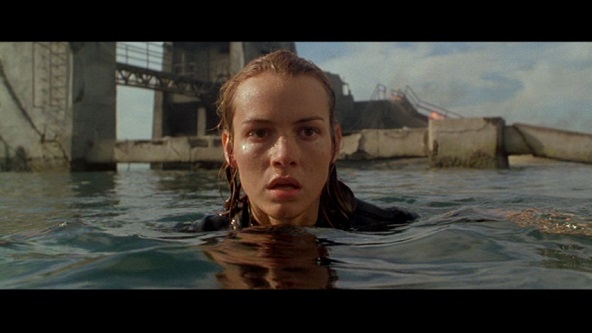
Over at Alex on Film I’ve been watching a bunch of shark movies. After the mega-success of Jaws there had to be plenty more of these, but sharks are hard to get right, whether of the mechanical or CGI variety. They also don’t have a lot of personality. So the results have been pretty dismal.

Jaws (1975)
Jaws 2 (1978)
Jaws 3-D (1983)
Jaws: The Revenge (1987)
Deep Blue Sea (1999)
Sharknado (2013)
Sharknado 2: The Second One (2014)
Sharknado 3: Oh Hell No! (2015)
The Shallows (2016)
47 Meters Down (2017)
The Meg (2018)
47 Meters Down: Uncaged (2019)

The getaway

Getting bored with Earth.

I’m trying hard to think of a news story that I cared less about that received as much coverage as the recent billionaire space race. A royal wedding? That’s the only thing I can think of that’s comparable.

Here’s a snippet from the wire story on Jeff Bezos’ 10-minute jaunt:

University of Chicago space historian Jordan Bimm said the passenger makeup is truly remarkable. Imagine if the head of NASA decided he wanted to launch in 1961 instead of Alan Shepard on the first U.S. spaceflight, he said in an email.

“That would have been unthinkable!” Bimm said. “It shows just how much the idea of who and what space is for has changed in the last 60 years.”

I wonder if Bimm was being ironic. This is what 60 years of space exploration has come to? An amusement park ride? This is what it was all for?


The great forgetting

I was recently reading a brief critique of the 1619 Project by Phillip W. Magness and I was a bit troubled by something he says about the misuse of a 1944 book by Eric Williams, Capitalism and Slavery. Apparently writers of what’s called the New History of Capitalism often refer to Williams’ book to support their thesis that capitalism today is a natural outgrowth of the plantation slave system in the United States, when in fact what Williams meant was something nearly the opposite. “If anything,” Magness writes, “they cite it for its pairing of the words ‘capitalism’ and ‘slavery’ and then unintentionally invert its thesis.”

The suggestion, and Magness is not alone in making it, is that NHC scholars haven’t actually read Williams’ book but only grabbed hold of the title. This brought home to me an issue in the Humanities that has been growing for some time now. The basic problem is this: no person can hope to read more than a small fraction of everything that has been published on any given subject. Also, because of the way scholarly research is supposed to work, most of one’s research has to be given over to staying up-to-date and reading only recently published work. This may be part of the reason why the New History of Capitalism has been accused of being a silo, failing to engage with other work in the field. It also may explain why so few people have actually read a book written nearly 80 years ago. As scholarship advances (at least in theory) a lot of previous research just drops off into the abyss of the unread. It’s a great forgetting.

What Magness says reminded of a similar feeling I had when reading the chapter on King Lear in Marjorie Garber’s Shakespeare After All. Garber cites very few secondary sources in her book. Indeed, in her essay on Lear she only references one:  an essay by Henry Turner that appeared in the journal Renaissance Drama in 1997. But why, I wondered, did she even bother? The point that the note provides authority for is wholly parenthetical: that in the text of the play the heath Lear rages on is never called a “heath.” The implication seems to be that nobody had noticed this before Turner, but in fact it’s long been common knowledge. It’s a point that A. C. Bradley mentions in passing in his Shakespearean Tragedy. Bradley’s book, however, is old. It first came out in 1904. So it doesn’t get cited.

I’m sure Garber has read Bradley. But Shakespeare is a good, perhaps the best, example of what I’m talking about here. Even fifty years ago it was understood that nobody could ever hope to read everything that had been and was being written on Shakespeare. As a result, there’s a cull when it comes to scholarship, which in turn means that wheels keep getting reinvented.

I think Garber citing a modern source for what was a commonplace observation more than a century ago is an interesting instance of how these things drop off the radar. I’ve often found myself reading contemporary literary criticism, or listening to a lecture or podcast, and thinking that the author or lecturer was saying nothing new while wondering if they were aware of that fact. It seems to me that a lot of American literary criticism in particular has now forgotten classic interpretive works from the mid-twentieth century, especially since author criticism and close reading has gone so much out of fashion. Large swathes of the Humanities now seem to be engaged in this great forgetting. It helps people get published, but it also leads to embarrassing mishaps like the kind Magness describes.