Archer: The Moving Target

When Ross Macdonald started writing mystery stories he was doing so consciously under the influence of a style of writing made famous by Dashiell Hammett and Raymond Chandler. Like film noir, this wasn’t so much a matter of the stories’ content, though there was a lot of overlap in that respect, as it was a function of style. It’s there on the first page of The Moving Target, with private detective Lew Archer visiting a wealthy enclave on the Pacific coast that’s beset with a light-blue haze that’s like “a thin smoke from slowly burning money.” You just want to stop reading and enjoy lines like that. On the drive to a nightclub we hear how Archer’s “tires whined like starved cats on the fog-sprinkled black-top” while “the neons along the Strip glared with insomnia.” Macdonald’s L.A. is a living thing, and the night club, though “no longer young” has a heartbeat that’s “artificially stimulated.” “An arch of weather-browned stucco, peeling away like scabs, curved over the entrance.” I love those scabs, just as I love the sedan we see later that’s “acned with rust.”

Then there are the babes. The young Miranda Sampson, “wearing a black-striped dress, narrow in the right places, full in the others.” She’s “the kind who developed slowly and was worth waiting for.” She makes “the blood run round in my veins like horses on a track.” But this sort of temptation only angers Archer, makes him hate her. She seems “like a dog, like a bitch in rutting season.” And then there’s the faded movie star that Archer meets at a bar. Faded, but she’s still got something going on.

I let my glance slide down her heavy body revealed by the open fur coat. It was good for her age, tight-waisted, high-bosomed, with amphora hips. And it was alive, with a subtly persistent female power, an animal pride’s like a cat’s.

Ah, women. Even the switchboard operator, a character briefly seen and of no importance, is swiftly appraised: “a frozen virgin who dreamed about men at night and hated them in the daytime.” How does Archer know this? Because that’s his job. He notices things. Plus he doesn’t really like women that much. Near the end of the book it will even seem to him “that evil was a female quality, a poison that women secreted and transmitted to men like a disease.” Probably not the kind of thing you’d say today.

To be sure, some of the slang is now obscure. When Archer tells one woman to “douse the muggles” I think he’s telling her to put out her cigarette, but I really don’t know. Then when Taggert complains that he doesn’t like “taking chicken from a lush” I can only try to understand what is meant in context. I think we’d be more likely to say that we don’t like “taking shit” from anyone.

Elsewhere the language can feel like it’s trying too hard. What does it mean that a face has “too many nerve ends showing like tortured worms”? Or how would you picture a face with “a violent nose like the prow of a speedboat inverted”? These really stumped me. Does the first simile refer to rosacea? I don’t know.

Who is Lew Archer? Well, he’s a tough guy. That doesn’t mean he wins every fight he’s in though. It’s just that he can take a beating and keep coming back. Which he does. One of the keynotes of tough-guy fiction is the ability to describe the hero’s slip into unconsciousness. Here Archer is swarmed by illegal Mexican immigrants who “kicked consciousness out of my head. It slid like a disappearing tail light down the dark mountainside of the world.” This is nice, and works well because Archer had been following taillights earlier. Then there’s this quicky:

The movement behind me was so lizard-quick I had no time to turn. “Ambush” was the last word that flashed across my consciousness before it faded out.

“Sucker” was the first word when consciousness returned. The Cyclops eye of an electric lantern stared down at me like the ghastly eye of conscience.

It goes without saying that Archer is a cynical bastard as well. When he started out as a detective he used to believe that “the world was divided into good people and bad people, that you could pin responsibility for evil on certain definite people and punish the guilty.” But now he’s just “going through the motions.” He’s come to realize that “evil isn’t so simple.” Everyone has it in them, and whether it ever expresses itself “depends on a number of things. Environment, opportunity, economic pressure, a piece of bad luck, a wrong friend.” So he’s become less judgmental, though harder as well. I’ll admit I laughed out loud when he drowns the ex-boxer Puddler after a fight in the ocean:

I had to let go of him to reach the surface in time. One deep breath, and I went down after him. My clothes hampered me, and the shoes were heavy on my feet. I went down through strata of increasing cold until my ears were aching with the pressure of the water. Puddler was out of reach and out of sight. I tried six times before I gave him up. The key to my car was in his trousers pocket.

That punchline is terrific. The way the passage is constructed it seems as though Archer is actually trying to save Puddler. But all he really wants is to get his keys.

The mystery itself is a bit muddled, which is again the Chandler fashion. What makes it confusing is that all of the characters are up to no good. There are some narrative points of interest though. There’s the way the dominating figure of oil tycoon and family patriarch Ralph Sampson is kept off-stage the whole book, only for his corpse to be revealed in a changeroom (or is it a toilet stall?) at the end. And then there’s the motif of Archer feeling that somehow everything around him is unreal. “I felt unreal,” he says on the novel’s first page. And then on the last page: “As we rolled down the hill, I could see all the lights of the city. They didn’t seem quite real.” In-between we get several other moments like this, the point of which I think is to underline how phony all these people’s lives are. Archer can move among them, but he is definitely not of them. In a dream he will cross over the “excremental river” of the city walking on stilts and then mount an escalator to rise above the “zones of evil.”

But only in his dreams. The all-too-real city of shit would exert a more powerful draw.

Archer index

No thanks, I’ll do it myself

I don’t like reading from a screen, and when I get sent books for review I usually ask for print copies if they’re available. But sometimes they aren’t, which usually means I get them sent to me in a pdf format.

Recently Adobe updated and I noticed that, in the evolution toward everything AI all the time, they’ve added a function that allows you to condense a 300-page novel down to less than 10 pages of summary. “This appears to be a long document,” the prompt says. “Save time by reading a summary using AI Assistant.” That’s probably helpful in some lines of work, and perhaps (more disturbingly) of use to students, but it’s not for me. I don’t read books in order to “save time,” and I don’t see the point of buying a book and then just reading what used to be known as the Reader’s Digest condensed version.

And yet that seems to be something that’s now being incorporated into the form books increasingly take. How many people will be able to resist clicking on that little button? I don’t think it’s alarmist to think that what is being presented as a helpful tool is just another step in the extinction of the book, and of reading.

Alien: Descendant

Alien: Descendant

What do Xenomorphs eat? You may think the answer is “Everything.” As apex predators it’s probably safe to assume they’re omnivores. But thinking back over the films and the comics I’ve seen and read I don’t remember seeing or hearing of them actually eating anything. They kill everything that moves, or use other species as baby ovens, and goodness knows they grow at an astonishing pace, going from infants to full-size adults in minutes, but where do they get the energy to sustain such a metabolism?

This book is a sequel to Alien: Thaw, and even though it takes place thirteen years later with a mostly different set of characters it’s  probably best to read Thaw first. Basically Zasha, the little girl who was the only survivor of the Xenomorph outbreak on the ice moon of LV-695, has come back with the usual gang of space marines, synths, and Weyland-Yutani jerks. And, again as per usual, the mission has something to do with W-Y grabbing some Xenomorphs. I don’t know why they’re so obsessed about this, but it’s a core part of the franchise mythology.

Things kick off here though with a backstory that has no dialogue (beyond Hssssss! Skreee! And Whrrrr!) explaining the genesis of a new strain of Xenomorph that was created when the Xenos first arrived on LV-695 and crossbred with some insect-like species. These new descendants are white Xenomorphs and now they spend most of their time battling with the regular Xenomorphs. At least until the fresh meat arrives.

This wasn’t my favourite Aliens comic. As with Thaw, Declan Shalvey handles the writing and Andrea Broccardo most of the art. Broccardo does well enough with action but I don’t like his human figures and faces at all. Shalvey’s story, meanwhile, doesn’t really go anywhere. There’s a flashback structure that isn’t very clear the first time through and I’m not sure if I understand the ending. Nor is very much done with the civil war between the different Xenomorph clans, despite all the time spent setting it up in the first issue. Because the series has set such a high standard, Descendant was probably the first Alien comic that I felt disappointed by. It has its moments though, particularly with regard to the underwater salvage operation, and is still a decent read.

Graphicalex

Archer: Death by Water

I mentioned in my notes on “Find the Woman” that it felt like a speedy trial run. It had, apparently, been written alongside this story in a single day, with the name of the detective in both stories being Joe Rogers. For the republication of “Find the Woman” Macdonald had changed the name to Lew Archer, a switch that editor Tom Nolan also performed for the first publication of this story in 2001.

“Death by Water” feels a bit different from Macdonald’s other Archer stories, though again the character of a wicked and damaged mother takes center stage. It’s more a traditional mystery, dealing with the drowning of a likeable lush in a hotel swimming pool. The plot is tight and there’s a neat little clue that its solution hinges on. I’d say William Goldman borrowed the idea when he wrote the screenplay for Chinatown, but seeing as “Death by Water” hadn’t been published at the time he couldn’t have known about it.

The age gap between the drunk and his wife is something nobody makes anything of, but I think even Miss Marple might have raised an eyebrow at it. He is 73 and she is in her “early forties.” So thirty years, and it’s something nobody found remarkable. Those were the days.

Archer index

Saga of the Swamp Thing Book Three

Saga of the Swamp Thing Book Three

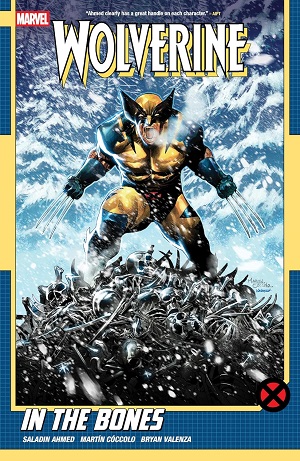
I really liked this volume of Alan Moore’s Saga of the Swamp Thing run, I think mainly because Moore stayed grounded. In his Introduction, penciller Stephen Bissette mentions the “steady hand of editor Karen Berger” on the series and I don’t know how much she helped curb some of his excesses, but especially after the swamp-sex issue that ended the previous volume there was a need to get back to basics.

And by back-to-basics I mean the X-Files-style “monster of the week” storylines on tap here. There’s a frame that isn’t explained but that introduces us to the character of John Constantine (whose looks were modeled after Sting). Constantine just drops by to tease at some coming darkness and then sends Swampy around the U.S. on a series of adventures Moore thought of as American Gothic. The first story, not part of this series, has a toxic homeless guy named Nukeface who actually kills Swamp Thing. Temporarily. After Swampy reconstitutes himself, Constantine drops by to tell him that he’s the world’s last plant elemental and that he has the power to die and be born again anywhere in the U.S. Or presumably the world. Or, as we’ll later see, the cosmos. This struck me as weird, because (1) Swamp Thing is born of science (Alec Holland’s biorestorative formula), he’s not some fantasy elemental, and (2) why does Constantine think it’s so obvious that Swampy can do this instant-teleportation thing? He seems shocked at how slow Swampy is to understand, but how does the teleportation work on any sort of level that makes sense? Yes, this will be explained later with the concept of “The Green,” but I hate The Green and if this is the thin edge it came in through then to hell with it.

Anyhow, from the Nukeface story we return to the drowned city of Rosewater, site of an earlier battle with vampires, to find out that they haven’t gone away but have instead become far creepier aquatic vampires. Then we’re on to “The Curse,” which is a werewolf story that links lycanthropy to women’s menstrual cycles. Not what I was expecting and I was kind of surprised they went there in such a bold way. Apparently it was controversial at the time. And finally we’re back in Louisiana and a film being made on a former slave plantation that has Swampy fighting voodoo zombies.

That pretty much covers what a pull quote on the back cover from National Public Radio calls “A cerebral meditation on the state of the American soul.” We get the environment, gender issues, and race. Today any comic handling these topics could be expected to be annoyingly preachy, but Moore somehow pulls it off. We get the message, but he’s not afraid to give an extra half-turn of the screw. Swampy is the straight man or conscience in every case. Paradoxically, as he’s now all plant he’s also become more human. He’s understanding, and almost reluctant to lower the boom on the baddies, but at the same time he’s less passive than he was earlier in the series.

So on brand with “sophisticated suspense” and contemporary horror stories. And best of all, at no point does Moore go spinning out into the ether, where he all too often crashes and burns. This is basically meat-and-potatoes stuff, served up with Moore’s signature poetic sauce. The meditation on what the buried dead dream at the beginning of the plantation story has him at his best: “When the summer earth swelters, when roots press against their backs like creases in the bedsheets . . . When sleep won’t come, what notions do they entertain in those frail parchment bulbs that once were skulls?” And there are also some great sign-offs, like Nukeface getting ready to say hello to America and one of the zombies going to work as a ticket collector at a grindhouse cinema. This may not be the splashiest work Moore did on Swamp Thing, but I’d rate it among his best.

Graphicalex

Bookmarked! #118: Panda Poo!

I’ve posted panda bookmarks before (see here and here), but this is a special one. Not because it comes from the Toronto Zoo but because it’s made, as the back of it proudly proclaims, “with real poo!” Or, at more length, it’s a “recycled and odorless paper product made from panda poo!” The company that does this says “We take the ‘oo” out of ‘poo’!”

Book: Crossroads by Jonathan Franzen

Bookmarked Bookmarks

Archer: Find the Woman

Not cherchez la femme, because that means something different: find the mysterious woman who is the complicating factor at the root of a crime. Private detective Lew Archer would drop this tag in a later novel, The Chill, so he was well aware of it. No, finding the woman here just refers to Archer being hired to locate a missing person.

Specifically, he’s hired by a damsel in distress, a woman of a certain age who shows up at his “brand-new office” (this was the first Archer story) wanting him to find her daughter. He heads out to the woman’s big house (“huge and fashionably grotesque”) and then drives around L.A. asking questions. Some of the people he meets don’t like being asked questions, and at one point he gets knocked out. This comes with the territory in hard-boiled detective fiction; you have to be able to take your lumps. But ut all turns out to be a red herring because, as will so often be the case in Ross Macdonald’s fiction, the real rot turns out to be closer to home.

There’s a lot here that Macdonald would return to, again and again. “Find the Woman” feels a bit like a trial run, at speed. Archer jumps from place to place so quickly there’s almost no connecting tissue between the different scenes, as though he’s using a transporter to get around. And what actually happened to the woman is a bit far-fetched. But the family nastiness, also a Macdonald trademark, is on point and gives an indication of where he wasn’t going to be afraid to go as he settled in with Archer for the long haul.

Archer index

DNF files: Manhunters

Manhunters: How We Took Down Pablo Escobar

By Steven Murphy and Javier F. Peña

Page I bailed on: 104

Verdict: The title was a bad sign. This is a book about a couple of Drug Enforcement Administration agents who were part of the international effort to “take down” the Colombian cocaine kingpin Pablo Escobar in the early 1990s. By the time I quit, a hundred pages in, I don’t think they’d even mentioned Escobar yet. It was all about the two agents telling their life stories and how they got into law enforcement.

I’m not a fan, to put it mildly, of the true-crime/memoir hybrid so this really wasn’t my sort of book. I didn’t care for El Jefe: The Stalking of Chapo Guzmán by Alan Feuerbook for much the same reason: the focus on the work of the agents rather than their target. Now for some readers that’s what they want, and to be fair neither book advertises itself as being anything else. But it wasn’t for me.

The DNF files

Bookmarked! #117: Remembrance Day

I have a lot of Remembrance Day bookmarks but couldn’t get them all in one picture. So here are a few from 2021, put out by Veterans Affairs Canada, marking the anniversaries of battles that Canadians played a major role in: Beaumont-Hamel (on the opening day of the Somme offensive), Vimy, and Kapyong in Korea.

I’ve looked in bookstores this past couple of weeks and haven’t seen any new ones. I don’t think anyone does bookmarks anymore.

Book: Marching As to War: Canada’s Turbulent Years 1899-1953 by Pierre Berton

Bookmarked Bookmarks