Reports on business

Over the past week I’ve been revisiting the 2007-08 subprime mortgage crisis, on page and on screen. A good place to start is Charles Ferguson’s documentary Inside Job, with more detail available in his companion volume Predator Nation. Also good as backgrounders are John Lanchester’s I.O.U. and (more journalistic) All the Devils are Here by Bethany McLean and Joe Nocera.

Hollywood has had several kicks at the can. The best, in my opinion, is Margin Call (2011), a taut drama focusing on character and condensing the crisis into the events of a single day. Oliver Stone’s Wall Street: Money Never Sleeps (2010) had a lot of potential, all of it unrealized. It’s a pointless sequel to an ’80s classic. Finally there is The Big Short (2015), a film based on Michael Lewis’s book of the same name. For some reason this film got rave reviews. I found it to be silly.

Ruination

A nice view from up there, but it's a bitch to get down.

A nice view from up there, but it’s a bitch to get down.

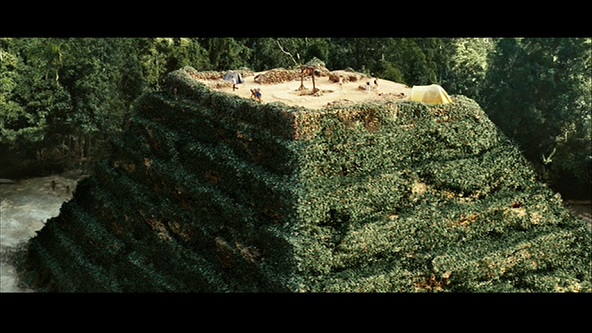
Over at Alex on Film I’ve added my notes on The Ruins (2008), a film based on a novel by Scott Smith that I reviewed when it came out. It’s one of the more original but also more ridiculous concepts for an American horror film from the past decade. That may not be a coincidence. Perhaps an original idea has to be kind of ridiculous, because otherwise someone would have already thought of it. Like a cursed videotape. Though I don’t want to give the book or the movie too much credit for breaking new ground. Man-eating plants are nothing new, and basically this is another variation on the tourists-in-trouble theme, and a cautionary tale for what might happen to you if you take the road less travelled.

The myth of the Marquis

I’m not a big fan of the writings of the Marquis de Sade. He seems long-winded, obsessive, and simple-minded to me. I’m also not a fan of the man himself, for what I think should be obvious reasons. He has, however, become a mythological figure, and not just in popular culture. In films like Peter Brook’s Marat/Sade (1967) and the more recent Quills (2000), we see him as a sexy rebel figure, representative of the counterculture’s struggle against authority. But even today’s biographers find him sympathetic. Francine Du Plessix Gray’s At Home With the Marquis de Sade and David Carter’s brief Marquis de Sade both seem to me to be overly apologetic. I don’t think we have to burn de Sade, but at the same time I don’t think we should romanticize him. That we continue to do so says a lot about our us and our need for a certain kind of hero. Who knew we were still so repressed?

Pirates!

seahawk2

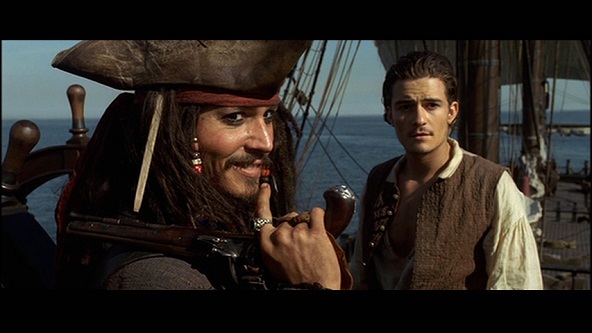
Over at Alex on Film I’ve been watching pirate movies. The pirate movie is a very conventional genre, quite limited in its necessary elements, and one that has only enjoyed a couple of Hollywood heydays. I think this is because a pirate movie is such an expensive proposition. You can’t do a pirate movie on the cheap. As for measuring up Errol Flynn and Johnny Depp, to each their own. I like the earlier films more, though I can appreciate the professionalism of the Pirates of the Caribbean franchise. It’s just that they seem so much.

The Black Pirate (1926)
Captain Blood (1935)
The Sea Hawk (1940)
The Black Swan (1942)
Pirates of the Caribbean: The Curse of the Black Pearl (2003)
Pirates of the Caribbean: Dead Man’s Chest (2006)
Pirates of the Caribbean: At World’s End (2007)

piratesofthecaribbean1

Goin’ to the prom

A typical hall monitor from the 1980s.

A typical hall monitor from the 1980s.

Over at Alex on Film I’ve added some notes on a few entries from the curious Prom Night franchise. Curious for two reasons: (1) all of these movies were terrible, and in no need of a sequel or re-set; and (2) they’re each terrible in their own way. I didn’t look at all of the Prom Night movies, but only the original Prom Night (1980), the first sequel, Hello Mary Lou: Prom Night: Prom Night II (1987), and the re-set Prom Night (2008). The first is a derivative and poorly constructed slasher pic, the second (which has no relation to the first) is a Nightmare on Elm Street rip-off, and the third is a surprisingly tame and totally uninspired re-set, the violence watered down so as to receive a PG-13 rating.

Dangerous Dining with Alex #8

Pizza Hut All-You-Can Eat Lunch Buffet

Overview: There is a deadly economic imperative that drives our response to buffet dinners. We want full value for our money, even if we’re spending less than $10. And by “full value” what I mean is all the calories and carbs you can handle.

Label: I can’t do a full breakdown here because I wasn’t ordering from a menu. My best guess would be that I took in around 2,500 to 3,000 calories. Must have been at least double my daily recommended fat and sodium. There’s no sugar-coating it (though the sugar coating on the apple turnover dessert was delicious): if you limited yourself to eating this buffet even once every couple of weeks, it would kill you.

Review: I got to the buffet a few minutes early, and the pizza hadn’t been set out yet. As my hostess pointed out, however, there was salad available as an appetizer. So I had a salad. Then I had another salad. It was very good.

Despite the fact that there were three full tables of people in the restaurant already seated when I arrived, I was the only one who had any salad. Everyone else was waiting for the pizza. Once the pizza arrived, they swarmed both sides of the buffet table. I had a booth close to the buffet and kept track of how many people had salad. Over the course of the next forty-five minutes I counted five trips to the salad bin.  This is out of approximately forty people who were in the restaurant during this time, making several visits each. Pity the greens.

They set out several different types of pizza. None were vegetarian, though one had green peppers on it. That was the only shade of green, or of anything healthy, appearing on the pizza. One girl took a slice of the green pepper pizza, telling her friend that she “had to get her veggies.”

I spent a lot of time observing the diners. They weren’t morbidly obese, yet. They were all big, but most of them were still young. There were a bunch of teenage girls there who were clearly heading down an express route to Fat City. The males all looked sloppy and out of shape. Fashion is cruel. The men were all wearing baggy jeans and sweats, while the women were wearing snug jeans, tights, or some variety of yoga pants. And, as I’ve said, they were not thin. Please, people.

I was surprised that the other major demographic represented was elderly women. There were a lot of them, in groups and alone. Perhaps their husbands had already died of blocked arteries and now they were just trying to keep up a matrimonial tradition.

At one point a young fellow dropped a slice of pizza onto the floor. I looked away. It was an embarassing position to be put in. I mean, what do you do? There was no garbage nearby. He couldn’t put it back on the buffet hoping no one would notice. He didn’t want to take it back to his table. So what then?

I like pizza. I think most people do. It’s also very, very bad for you. Especially when you eat it in large quantities. And at a buffet, you eat everything in large quantities. That’s the point. So this is very, very dangerous dining. But it was tasty (even the salad!), and if you’re really hungry this buffet offers up more calories per dollar than any other restaurant meal I can think of. Plus the service was great. The only thing I missed was a thin-crust option. That would have been nice.

So I know I’ll be back. But hopefully not for a couple of months.

Price: $8.49

Score: 8 / 10

Dangerous Dining

Our Miss Julie

Over at Alex on Film I’ve added my notes on two adaptations of August Strindberg’s play Miss Julie. The first is the 1951 Swedish version directed by Alf Sjöberg, which takes greater liberties with the text but is a more satisfying film. The 2014 version directed by Liv Ullman and starring Jessica Chastain and Colin Farrell is good, but finally seems to me to be less contemporary. Which is odd given that is was made over sixty years later. There’s an angry, nasty edge to Strindberg that both films miss. But it’s Strindberg’s Miss Julie who I still seem to run into the most.

Re-reading Shakespeare: Macbeth

(1) Shakespeare is credited with a huge vocabulary, and his plays also include the first appearances of many words. Scholars have a lot of fun tracking these down, and then speculating on possible meanings. Definitions are of course difficult when you’re dealing with a first usage. Take a line like this delivered by the sailor’s wife: “‘Aroynt thee, witch,’ the rump-fed ronyon cries.”

Nobody knows where “aroynt” (or “aroint”) came from. From the context here (and its use in King Lear) it’s assumed to be a curt form of dismissal. It could be a curse too. I wonder if Shakespeare just made it up because it sounds good. I wouldn’t put that past him.

Then there’s the “ronyon.” Is that, or was that, a word? Did anybody use it before Shakespeare? It’s usually given as derived from the French rogne for mange.

Finally, there’s the “rump-fed” part. In the edition I’m looking at a note says this has been “variously explained,” and gives four different readings. The editor is inclined to the fourth, which is “fed on the best joints, pampered.” I would have never guessed this. I think it’s closer to the second explanation provided: “fat-bottomed, fed or fattened in the rump.” The sailor’s wife is a fat-ass just sitting there mounching and mounching on bon-bons. I don’t think this makes literal sense of “rump-fed,” but I don’t think that’s important. The meaning seems clear.

(2) This is the tragedy of the bad man and his wife. As such it’s unique among the tragedies (I’m not including Richard III). Shakespeare’s other tragic heroes certainly have their flaws, but the Macbeths are villains and they know it. What’s more, they think that conscience is a sign of weakness and that things will start to get better once they wade a little further out in blood. They are but young in deed. “Things bad begun make strong themselves by will.”

Like a lot of bad people, they are paranoid. They are afraid that other people are just like them. Which is to say, as wicked as they are. It is the tyrant’s point of view. Once having overthrown authority and seized power, what’s to stop anyone else from doing the same to them? This is the source of their obsession over safety and security. To be thus is nothing, they need to be safely thus. Lady Macbeth fantasizes of being in a position where “none can call our power to accompt.” It seems to me that they worry about this more than they do about their souls. When they startle at various night sounds they probably hear the footstep of an assassin, not the devil.

(3) There’s a history of people wondering just how much Banquo knows about what’s going on. He tells us that Macbeth has “play’dst most foully for” the crown and I don’t think he’s giving private voice to mere suspicions here. As A. C. Bradley remarked:

He [Banquo] alone of the lords knew of the prophecies, but he has said nothing of them. He has acquiesced in Macbeth’s accession, and in the official theory that Duncan’s sons had suborned the chamberlains to murder him.

So call Banquo tinged with guilt. But what makes the play so much fun, at least for me, is the fact that everyone knows what’s going on. Immediately after Duncan’s murder Donalbain and Malcolm shift away, not dainty of their leave-taking. They know they’re next. The same can be said for Ross and Macduff, as is clearly implied in their brief conversation. Roman Polanski’s film version captured this well, with all sorts of knowing looks being exchanged between the various lords. It was no big secret. When Lady Macbeth starts walking and talking in her sleep, the doctor and her waiting-gentlewoman are less surprised (or embarassed) by what she’s saying than the fact that she’s saying it. They know right away who the old man is that had so much blood in him. And of course the witches not only know everything that’s going on, they know it all in advance. The evil spirits don’t have to hear Macbeth’s questions, they already know what he’s come to ask of them.

Macbeth is like any public figure today (politician or other form of celebrity) whose legitimacy is a fraud but who never gets called out for it because it’s in no one’s interest to do so. Until, of course, a tipping point is reached and they are exposed, leaving everyone who once enabled them (the time-servers like Ross) flying for plausible deniability and rushing to switch sides. This isn’t just the fate of tyrants, but that of all players. Not that they care much, in the end.
Gangsters!

scarface2

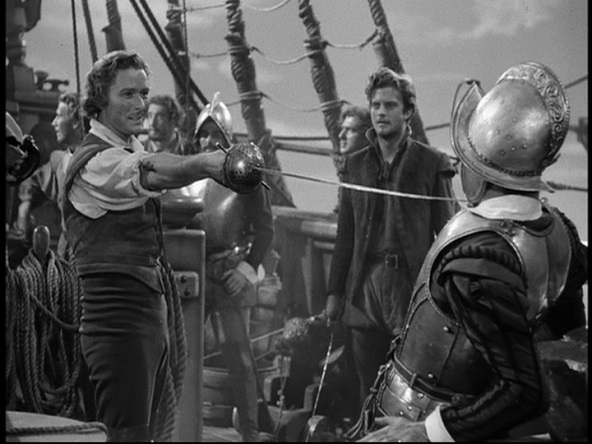
Over at Alex on Film I’ve spent the last few months watching gangster movies. Or crime movies. Or tough-guy movies. Pick your label. I’ve included links below to my notes on all the ones I covered. The dates tell a story. The golden age was the 1930s, and for a couple of decades after that the genre virtually disappeared, only to be revived by the New Wave and the New Hollywood. In later years style would overwhelm substance, turning the gangster into a fashionable form of costume drama (The Untouchables, Public Enemies). I’ve included a lot of the greatest hits, as well as some less well-known gems that are worth searching out (Caliber 9 being perhaps the best of these). Other titles on the list include some that are, in my eyes, wildly overrated (Once Upon a Time in America) or just terrible (Savages). Enjoy!

The Musketeers of Pig Alley (1912)
Little Caesar (1931)
The Public Enemy (1931)
Smart Money (1931)
Scarface (1932)
The Petrified Forest (1936)
A Slight Case of Murder (1938)
The Amazing Dr. Clitterhouse (1938)
The Roaring Twenties (1939)
High Sierra (1941)
Dillinger (1945)
Key Largo (1948)
White Heat (1949)
Bonnie and Clyde (1967)
Point Blank (1967)
Get Carter (1971)
Caliber 9 (1972)
The Italian Connection (1972)
The Boss (1973)
The Friends of Eddie Coyle (1973)
Mean Streets (1973)
Rulers of the City (1976)
The Long Good Friday (1980)
Scarface (1983)
Once Upon a Time in America (1984)
The Untouchables (1987)
The Killer (1989)
Miller’s Crossing (1990)
Bugsy (1991)
Reservoir Dogs) (1992)
Hard-Boiled (1992)
Killing Zoe (1993)
La Scorta (1993)
Casino (1995)
Jackie Brown (1997)
Donnie Brasco (1997)
Lock, Stock and Two Smoking Barrels (1998)
The Limey (1999)
Sexy Beast (2000)
Get Carter (2000)
Infernal Affairs (2002)
Sin City (2005)
The Departed (2006)
Payback: Straight Up (2006)
American Gangster (2007)
In Bruges (2008)
Public Enemies (2009)
Savages (2012)
Parker (2013)
Sin City: A Dame to Kill For (2014)

scarface22

Everyday rudeness #3: Not flushing

Many years ago, in a first-year Introduction to Sociology course, I learned about “cultural universals.” These were the relatively rare social customs that every people in the world, at all times, have respected. Usually they were taboos grounded in some biological imperative. Incest, for example, isn’t good for evolution as it restricts the gene pool. Avoiding coming into contact with excrement, another universal, is basic hygiene, as it cuts down on the spread of disease.

Well, some people never got the memo. Have you had to use a public washroom lately? Why is it that roughly a third of all the toilets in any given public washroom are full of shit or piss? I’m willing to bet they aren’t broken. And yet what could be easier, or, one would have thought, more natural and automatic, than to flush after using them? I’m sure none of the people doing this would leave the toilets in their house full of feces. Why do they think it’s OK to do it in public? Is this the tragedy of the commons?

It’s not just something that happens in the washrooms in bus terminals either. I remember a few summers ago finding the same proportion of toilets in the local university’s library had been left filled. And the reason I’m writing this post is because just this week when I went to use the washroom at my gym, which is a fairly upscale establishment, I found someone had not only left the bowl filled with pee, but, for good measure, had left the seat down and pissed all over that as well.

Why? As I say, flushing should be automatic. Toilet training is a cultural universal, and you do it so many times every day you’d have to make a conscious effort not to flush. And yet many people, not a majority by any means but a lot, simply walk away. Are they marking their territory? Trying to be funny? Or just being rude?