The blinding backlash

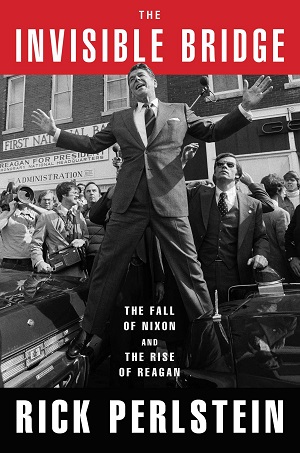
theinvisiblebridgeAdded my review of Rick Perlstein’s The Invisible Bridge over at Good Reports. This is a must-read for political junkies, offering a thorough and insightful interpretation of the ’70s. (For another book on the same subject written by a kindred spirit I recommend Dominic Sandbrook’s Mad as Hell. For a more academic analysis, James T. Patterson’s Restless Giant. Or, if your tastes are more right-wing, David Frum’s How We Got Here.) Perlstein’s book is quite long and detailed, but manages to forcefully argue a single thesis: that in these years Reagan turned America away from self-criticism toward simple optimism and feel-good nationalism. It describes, in other words, yet another example of the deep and abiding anti-rationality that seems to be inherent in most societies. We should stop being surprised by this. As Perlstein remarks at one point near the end of his survey:

Liberals tend to get into the biggest political trouble when they presume that a reform is an inevitable concomitant of progress. This is when they are most unprepared for the blinding backlash that invariably ensues.

Blinding and blind. “Progress” is neither natural nor ineluctable. We can, and do, go into reverse.


Ignoring the obvious

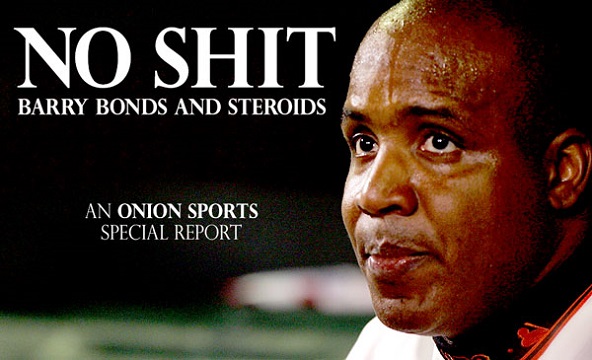
'Nuff said. (The Onion)

‘Nuff said. (The Onion)

In a recent comeback fight in the UFC, Anderson “Spider” Silva, considered by many to be one of the greatest MMA fighters of all time, tested positive for performance enhancing drugs. The news has been met with expressions of shock. Silva himself has denied any doping. And maybe, just perhaps . . . But when are we going to stop being surprised by stories like this? Barry Bonds, Lance Armstrong . . . and these are only to name a couple of titans. Rumours have circulated for years about other major figures, even in sports like golf. But of course little has been proven. The reason for this is simple. Aside from the fact that people don’t really want to know (hey, some people insist that professional wrestling is “real to them”), doping is almost impossible to prove. Testing is expensive and easy to beat. The legal process is even more expensive, ultimately less conclusive, and interminable (the long-drawn out Roger Clemens story being one example). Armstrong often roared that he was “the most tested man in sports,” which was probably true. And he was doping all the time. It’s common knowledge that you have to screw up or be really stupid to get caught, which is why Armstrong could lie about it so loudly and for so long. Or why UFC president Dana White could berate journalists only a year ago for suggesting that any of the organization’s fighters were juicing. From Kevin Iole’s report:

Nearly two dozen reporters sat silently around a long conference table as Dana White challenged them. Give me a name of any fighter you think is on steroids, the UFC president spat, and I’ll have them drug tested today.

He held his flip phone open in the palm of his hand, ready to dial.

No one said a word as White shot hard glances at the reporters staring at him.

Give me a name, he demanded, and I’ll test them today, or don’t ever say it to me again. He was yelling, his face reddened, the fury evident. He sounded more like he was looking for a fight than trying to promote one.

“Give me one [expletive] name right now, I’ll get them on the phone, and somebody will drive to their [expletive] house today and will test them,” White said. “Say it. Say it.”

After pausing for a second to silence, he resumed.

“Then don’t ever [expletive] say it to me again,” he said, defiantly. “You guys like to play these [expletive] games. Let’s do it. I’m ready. I’m down. Let’s do this right now. Give me one name. Give me 10 names. Give me all the names you want; I’ll test all these [expletives] right now.”

The reporters remained silent. It’s not a reporter’s job to make news; it’s to report the news. But White was gunning for a fight.

He raved on, often shouting loudly, as he defended his fighters against claims their ranks are full of performance-enhancing drug users and his company against allegations that it turns a blind eye to their usage.

The best defence is a good offence, as they say. Given this state of affairs, it’s only reasonable to be sceptical. As a general guide, here are the big three tip-offs that someone is doping:

(1) The eye test: Much derided as unscientific, in fact it’s a pretty good diagnostic. You know what an impossible physique looks like. Just think of a professional bodybuilder. Forget about good genetics, a healthy diet, or a non-stop training regimen — the usual excuses that are trotted out. That’s all smoke.

(2) The fountain of youth: Physically, an athlete is in his prime in his late 20s. Sometime after 30 you start to go into a decline that gradually picks up speed, with no reversals. Drugs can arrest this inevitable effect of aging. So when you hear about a sports star who is experiencing a career “resurgence” or who is described as “ageless” and is still competing at an elite level against people ten or even twenty years younger than he is . . . that’s probably the drugs talking.

(3) Quick recovery: Has an athlete come back at spectacular speed from a gruesome/catastrophic/(supposedly) career-ending injury? Have they come back even stronger? No doubt that’s all due to their superstar doctors, or X-men mutant healing powers! Or maybe not. Perhaps it was the drugs. All of which is pretty obvious. But then, we only believe what we want to believe.

Dreams of dark and troubled things

lagedor4

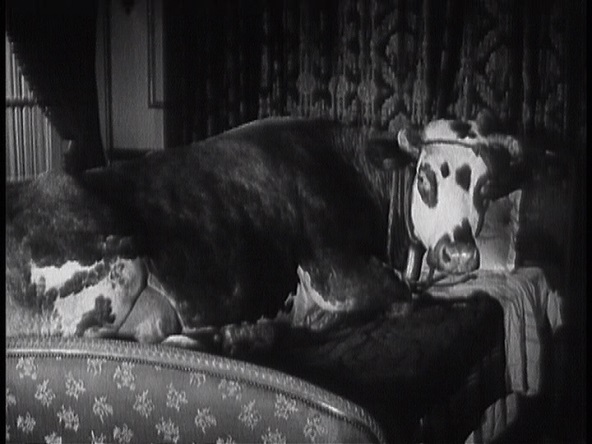
Added my notes on Un Chien Andalou (1928) and L’Age d’Or (1930) over at Alex on Film. It’s hard not to envy Buñuel a bit. It was easier to shock the bourgeoisie back in the day. I mean, back in the day when we still had a mass bourgeoisie. Of course you can still be a radical, but the propertied classes are both more powerful and angrier than they were. Taking them on isn’t as much fun, or as safe.

How secretive is the bourgeoisie!

offshoreFrom William Brittain-Catlin’s Offshore:

Yet no one was more adept at preserving himself in modernity than the bourgeois. Like the criminal, he would go undercover, but his cover was the interior of his home. He would escape into his private dwelling, where secrecy would become a fetish against the outside world. The bourgeois would cover up his traces in the interior as he would no doubt cover up the traces of his expropriation scams during the Hausmannization of Paris, with the proceeds and evidence of his criminality kept out of sight of the authorities. “To live in these interiors was to have woven a dense fabric about oneself,” wrote Benjamin: as the crowd was a veil for the criminal, so the interior became a veil for the bourgeois.

The criminal and the bourgeois both hid undercover from modernity, obliterating their traces and protecting their freedom. The criminal hid his traces from the police — undercover, underground. In the bourgeois interior, objects and ornaments were covered in plush and velvet, sealing away what was under them. The bourgeois preserved his freedom with covers and boxes; his home became a shell, his possessions and wealth “removed from the profane eyes of non-owners.” The bourgeois would seek refuge in his library, his art, in his assets, which were the sacred objects of his ideal, free identity.

That the bourgeois continues to preserve his traces in a shell is evident to this day in the private banking and asset management schemes that run through the global offshore financial system, where wealth is protected against its uncovering through mechanisms that completely remove the identity or trace of ownership. The offshore system, built for the bourgeois by a network of other bourgeois — lawyers and accountants — also provides cover for the proceeds of organized crime and white-collar financial crime, money launderers, and corrupt presidents who have stripped their countries bare of assets, proving Benjamin’s point that “a career criminal is a career like any other.” The offshore system today it to corporate, private, and criminal wealth what the nineteenth-century interior was to the bourgeois and what the crowd was to the criminal: a cover behind which to hide their traces from modernity, where the criminal is masked as a bourgeois and the bourgeois unmasked as a criminal.

Or, as the great chronicler of the bourgeoisie had it: The secret of great fortunes without apparent cause is a crime forgotten, because it was properly done.

What we talk about when we talk about conflict of interest

Why is the concept of conflict of interest so hard to understand? True, like any misdemeanour that has certain penalties attached to it, there is some room for debate when assessing culpability. But the thing is, we know it when we see it. And it’s precisely because we know it when we see it that we can say when it exists.

I say “exists” because conflict of interest is not a specific action or event. It doesn’t “occur.” One doesn’t have to actually do anything at all. Conflict of interest is a state of being. You are in a position where there is a conflict of interest or you are not.

This makes all the confusion over Amanda Lang’s “potential” conflict(s) of interest very strange. In brief, Lang, who is the chief financial correspondent for CBC news, has been hauled onto the carpet for supposedly trying to kill a story critical of the Royal Bank of Canada. Lang has accepted paid speaking engagements from the Royal Bank, went on to write an op-ed piece for the Globe and Mail on the subject (taking the bank’s side), and was in a relationship with an officer of the bank at the time.

A position of conflict? Of course. Writing in Britain’s Guardian newspaper, columnist George Monbiot even expressed amazement that “she remains employed by CBC, which has so far done nothing but bluster and berate its critics.”

This is probably a reference to a note from Jennifer McGuire, CBC’s general manager, seeking to “set the record straight.” If that was McGuire’s intention then she failed entirely. As did Lang herself, who had a remarkably tone-deaf piece in yesterday’s Globe and Mail.

Lang writes that “it is painful to me that public perceptions of my integrity may have been compromised because I have been accused of acting improperly by allowing myself to be seen to have been in a conflict of interest.” This is a mind-wrenching circumlocution. Apparently her crime was not that of being in a conflict of interest. Instead, her improper action was to allow herself to be seen in such a conflict. Is Lang saying it’s only a crime if you get caught?

This may sound like nit-picking, but one suspects this is a piece that went through many, many drafts, every word of which was carefully parsed before submitting it for publication.

Nevertheless, Lang may have twisted herself into the truth, which is that in cases of conflict of interest, perception is everything. What I think confuses the matter is the use of terminology like “apparent,” “perceived,” and “potential” conflict of interest. These words shouldn’t apply. As I began by pointing out, conflict of interest isn’t an act, it’s a position one finds oneself in. And it is all a matter of perception: perceived conflict of interest (by an objective observer) is conflict of interest. When Lang responds to “exact allegations” of improper behaviour she’s changing the subject.

Lang goes on to say: “It did not occur to me that others would question my motivation. That they would raise doubts about my integrity. That they would believe my perspective on this story was affected, for example, either by a relationship or by the fact that I have spoken for pay at events organized by business groups and companies.”

So what? That Lang thought (and apparently still thinks) there was nothing wrong with what she was doing only tells us that she possesses a typically Canadian attitude about what it means to hold a position of power within any group or establishment (media, financial, or both, as the case may be): that it entitles you to do whatever you want without being questioned or criticized.

Those who say I acted improperly seem not to care that they, in effect, are alleging deeply unethical behaviour, or worse. I’m not sure how to convince people that my principles, integrity and career are fundamentally important to me, that I have no trouble understanding right from wrong and reporting honestly and independently. Unfortunately, it appears that I can assert that as long as I wish and still not overcome suspicions that originate from unshakeable and, in my view, utterly unwarranted presumptions of venal behaviour.

But the problem is not an allegation of any unethical behaviour. You certainly can question that in the present case, but it’s not necessary to do so. The problem is simply being in the position of a conflict of interest, not exercising that position in any unethical way. And the reason for having such a hard rule is simple: because in most cases proving any wrongdoing or quid pro quo is impossible. The accused can then simply respond with a blank denial and that’s the end of it.

As Monbiot registers, it’s easy to be cynical about the “impartial media” having become “mouthpieces for the elite.” And the fact that in Lang’s case this is happening with regard to public broadcasting makes it even worse. The public has, with some justification, little faith in the news media in general, but Caesar’s wife (the CBC) must be above suspicion. What makes the Lang story remarkable, at least to my eyes, is the obliviousness on the part of the CBC and Lang to there being anything wrong with what happened. As I’ve suggested, they may simply be taking for granted the culturally ingrained deference toward authority in this country: that our betters know better than we do what’s right and wrong. Or perhaps they’re taking the matter to the next level with a sort of “everybody does it because that’s the way the system operates” argument. Which may be true as well, but doesn’t help build trust.

Update, January 23 2015:

Media critic John Doyle, writing in the Globe and Mail, has this to say: “It’s always bracing when outsiders look at Canada, its cronyism and system of privilege. Monbiot is correct – it is grotesque. ”

Update, March 6 2015:

An internal review by the CBC has found that Lang’s reporting “met CBC’s journalistic standards.” The review did however find problems with the CBC’s conflict of interest policies, concluding that they were too open to interpretation. “Going forward, CBC News will ensure that all of our staff adhere to the most rigorous interpretation of this standard.” This sounds good, but I’m curious as to what this rigorous interpretation will be.

Update, August 27, 2016:

The issue reared its head again during the 2016 U.S. presidential campaign.
There will be blood

ichi2

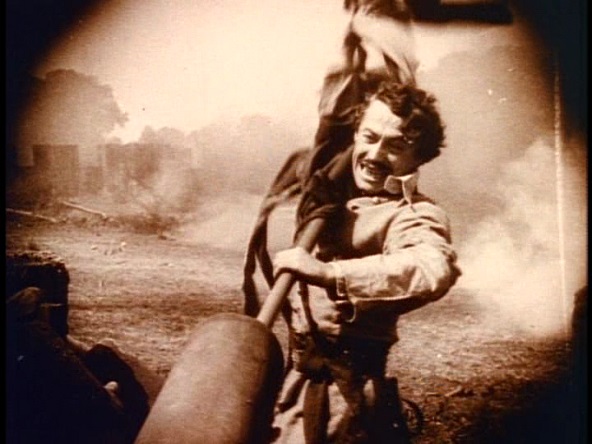
Added my notes on Ichi the Killer (2001) over at Alex on Film. This kicks off a mini-series of commentaries I’ll be doing on Takashi Miike films. Of course the violence in Miike’s movies can be alienating, but what I really respond to is his eye and ability to work in different visual styles. It’s incredible that he’s able to turn out work of such quality at the pace he does.

Devil in the details

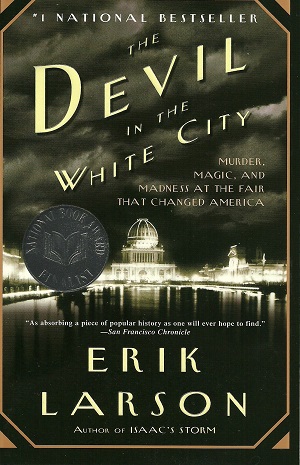
devil-in-the-white-cityAdded my review of Erik Larson’s The Devil in the White City (2003) over at Good Reports. In general I was unimpressed by this one, given how big a fan I am of true crime writing and how successful it was (a “major motion picture” is even reported to be in the works). Larson has been praised for his novelistic style, but I’m afraid this undercut some of my pleasure in the book. In brief, I thought he took liberties with the facts. He insists in his prefatory note that “However strange or macabre some of the following incidents may seem, this is not a work of fiction.” And at the end he mentions his agonizing over how to re-create some of serial killer H. H. Holmes’s murders when there were no witnesses to them. Buttressed by a reading of Capote’s In Cold Blood (perhaps not the ideal text in such a situation) he went on to build his murder scenes by using “threads of known detail to weave a plausible account, as would a prosecutor in his closing remarks to a jury.”

This sounds fair enough, but the fact is that Holmes had a rather bizarre and involved method of doing away with his victims and I think it would have been better if Larson had just admitted our inability to say for sure what happened. Far more troubling, however, was this account Larson gives of Holmes taking a pair of prospective victims on a tour of Chicago:

Holmes took the sisters to the Union Stock Yards, where a tour guide led them into the heart of the slaughter. The guide cautioned that they should watch their feet lest they slip in blood. They watched as hog after hog was upended and whisked screaming down the cable into the butchering chambers below, where men with blood-caked knives expertly cut their throats. The hogs, some still alive, were dipped next into a vat of boiling water, then scraped clean of bristle — the bristle saved in bins below the scraping tables. Each screaming hog then passed from station to station, where knifemen drenched in blood made the same few incisions times after time until, as the hog advanced, slabs of meat began thudding wetly onto the tables. Holmes was unmoved; Minnie and Anna were horrified but also strangely thrilled by the efficiency of the carnage. The yards embodied everything Anna had heard about Chicago and its irresistible, even savage drive toward wealth and power.

I was so struck by this passage that it was one of only two in the entire book that I made a note of. Did Chicagoans in the late nineteenth century really take young ladies out to the slaughterhouse on a date? As anyone who has been inside such a place will testify, they are truly horrifying. And yet Minnie was Holmes’s “wife” and Anna a newly-met sister-in-law.

Alas, this is what we are told in the notes by way of explanation:

Despite the stench and pools of blood, the Union Stock Yards were Chicago’s single most compelling attraction for visitors, and tour guides did indeed lead men and women into the heart of the operation. It seems likely that Holmes would have brought Minnie and Nannie there, partly because of the yards’ status,  partly because he would have derived a certain satisfaction from subjecting the women to its horrors.

“It seems likely . . .”? This will not do. Larson’s passage describing the visit is entirely made up, based on pure speculation. We don’t even know if Holmes ever visited the Union Stock Yards, much less what his reason would have been for bringing these two women on such a tour, or what their response would have been (“horrified but also strangely thrilled”?). Yes, it makes for a colorful passage with heavy thematic overtones (Holmes would run his own slaughterhouse in Chicago, where little would go to waste), but it’s a bit of writing that has no place in such a book.