You keep using that word . . .

Yesterday morning on CNN New Day co-anchor Alisyn Camerota was interviewing former Governor of New Hampshire and White House Chief of Staff John Sununu about investigations and broader speculations into the possibility of some kind of collusion between the Trump White House and Russia. Throughout the interview Sununu kept insisting on the lack of any evidence of “a veniality.” This is what it sounded like:

CAMEROTA: I’m trying to gauge your comfort level with all of this
SUNUNU: My comfort level? The only discomfort I have is with folks in the media trying to create a veniality without having the courage to specifically tell me what the veniality that I should be concerned about is. I don’t have . . . I have not identified a veniality. Have you?

Is “veniality” really the word Sununu wanted to use? It refers to a minor sin, easily forgiven. I don’t think that’s what anyone speaking about these matters is really interested in. My guess is that what he meant to say was “venality,” which means capable of being bribed or open to corruption. The two words are actually very different, coming from completely different roots. The weird thing is, I’m still not entirely sure what the intended meaning was, or if either veniality or venality were being properly used.

Killers!

Over at Alex on Film I’ve been watching three adaptations (I use the word loosely) of Ernest Hemingway’s short story “The Killers.” Of course, I just watched them together because they’re all included in Criterion’s DVD package. Robert Siodmak’s 1946 version is classic noir, and very good. For some reason Andrei Tarkovsky’s student film is the closest to the source. I’m not sure if he’d seen Siodmak’s movie. Finally, Don Siegel’s 1964 version, originally planned as a TV movie, has some interesting credits but struck me as a pretty lousy flick. It gave Lee Marvin a nice warm-up for Point Blank though.

That ’90s show

I was at university in the early 1990s, a period that we can now refer to in hindsight as the crest of the first wave of political correctness. There were even arguments over appropriation of voice and cultural appropriation that were loudly debated at meetings of the Writers’ Union of Canada. For those of you with an interest in such historical matters, Philip Marchand covered the moment in an essay later reprinted in Ripostes: Reflections on Canadian Literature (1998). Then things died down. When Russell Smith sent up the whole matter of identity politics in his novel Muriella Pent in 2004 he was very much looking back on matters that no longer seemed that relevant. Here is the first paragraph from my review of Muriella Pent, which I wrote 13 years ago:

Muriella Pent is a curious novel that could be easily mistaken as prematurely dated. It has, for example, a lot to say about fashions in the arts, about what’s in and what’s out, and it directs its satire toward subjects (like the debates over political correctness and appropriation of voice) that are now very out.

Ouch. In my defence, I did end the review by saying it would be wrong to write Muriella Pent off as “a blast from the past,” and closed with these now prophetic words: “I have a hunch it might be ahead of its time.”

Well, it’s been a while but the once “very out” topics of political correctness and appropriation of voice are now very much back in. For good and ill. Who would have thought in 2004 that in 2016 someone would come along and ride a crusade against the forces of political correctness all the way into the White House? That would have seemed even more preposterous than a President Trump.

Whatever you think of all this, it’s clear we’re now experiencing a second wave. Looking at the dates it’s hard to miss the generational ebb and flow. That may be one explanation anyway for the curious rise and fall and rise again of the same arguments, expressed with the same rhetoric, pro and con (roughly, freedom of speech vs. exploitation and oppression). We even have, in place of Smith’s Muriella Pent, Stephen Henighan’s Mr. Singh Among the Fugitives, a new satire on identity politics in Canadian cultural circles.

It’s déjà vu, but is it progress?

I’ll avoid entering into the arena here, mainly because I think there is a basic disagreement over the terms of the debate (or conversation, as it’s more gently styled). Well-meaning people seem to mean very different things when they use the term cultural appropriation. For some, every work of art necessarily involves cultural appropriation, while for others it is an act of genocide. Both sides have a point to make, but obviously, expressed in these terms, they have no common ground.

But why are these matters becoming so prominent now? Is it because of the generational ebb and flow I mentioned? Or the effect of so many highly publicized examples of the phenomenon in recent years, like the cases of Rachel Dolezal (the former head of the NAACP who was outed by her parents as being white), Joseph Boyden (whose Indigenous heritage has been called into question), and Pepsi’s Kendall Jenner commercial (co-opting the Black Lives Matter movement to sell cola)?

I’m sure that cases like these all provided fuel to the fire, but I don’t think they were the real drivers. For that, I’d point the finger elsewhere.

(1) The media. You can’t exaggerate how much the media plays this stuff up, and the effect that has. After the story broke about Hal Niedzviecki quitting his post as editor of the Writers’ Union of Canada’s magazine due to an editorial he wrote (that began “I don’t believe in cultural appropriation”) there was a barrage of high-profile, mainstream commentary. The CBC ran op-ed pieces, as well as broadcasting interviews and hosting discussions online and on their flagship news programs. I think the National Post had two columns a day for nearly a week talking about it, and other newspapers followed suit. When was the last time, if ever, that anything having to do with writers in Canada received half as much media attention?

(2) Universities. I’ve previously pointed out that matters of identity are now the only subject of interest in English departments. Identity politics now constitute the foundation of any English program, and are of far more importance than the practice of textual analysis or making judgments of aesthetic value. What this has led to is the current critical dispensation, where, for example, the only question we need to ask about Joseph Boyden is whether his voice can be established as authentic.

These were both drivers of the cultural appropriation debate twenty years ago, but they have since metastasized. The media, in transitioning online, is far more dependent on pushing people’s buttons in order to grab clicks and eyeballs, going after immediate responses and snap moral judgments. Meanwhile, universities have limited the accepted terms of critical discourse to include only such matters of identity as are now being re-argued. Working in tandem they have made this time around an amplified version of the same debate we had in the 1990s, but not one with much more to say. My guess is that the conversation will move away again after a while, but I don’t think we’ll be moving on.

Little people

Over at Alex on Film I’ve been looking at a couple of movies about guys who experience some excessive shrinkage. The Incredible Shrinking Man (1957), based on Richard Matheson’s classic novel The Shrinking Man, is a fun adventure story but also a surprisingly serious meditation on man’s place in the universe. I’m still not sure how they got away with that ending. Ant-Man (2015), on the other hand, is the usual Marvel fare, only sillier.

The Musgrave rituals

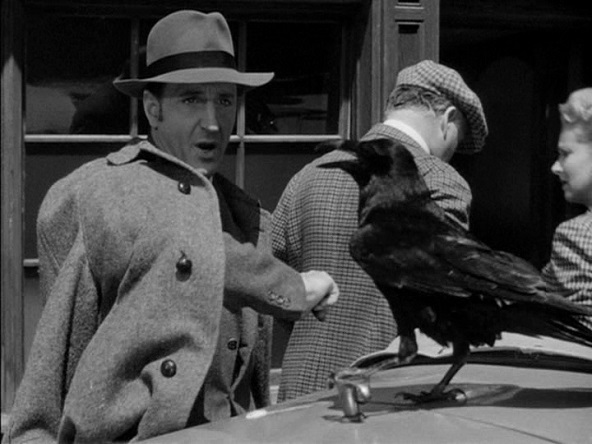
Holmes, getting some help from Poe.

Over at Alex on Film I’ve added notes on a couple of adaptations of the Sherlock Holmes story “The Adventure of the Musgrave Ritual.” First up is Le Trésor de Musgrave (1912), which is, surprisingly, the most faithful to Conan Doyle’s story, despite being a silent short. Then we have Sherlock Holmes Faces Death (1943), which is a much freer interpretation but still a great movie in its own right.

Bark at the moon

It’s more complicated than you think, Larry.

Over at Alex on Film I’ve been watching a bunch of werewolf movies lately. The werewolf, or wolf man, has proven to be a durable movie monster, in large part due to his plasticity. He can be mostly wolf or mostly man, sympathetic or wholly evil, as the case requires. The basic idea is that there’s something violent and predatory latent within all of us (or at lest all men, since it’s mostly a male phenomenon). Under the right circumstances the beast will out. Haven’t we all felt that way, every once in a full moon?

Anyway, here’s the list:

Werewolf of London (1935)
The Wolf Man (1941)
The Undying Monster (1942)
Frankenstein Meets the Wolf Man (1943)
House of Frankenstein (1944)
House of Dracula (1945)
She-Wolf of London (1946)
Abbott and Costello Meet Frankenstein (1948)
The Curse of the Werewolf (1961)
The Beast Must Die (1974)
An American Werewolf in London (1981)
The Howling (1981)
Wolfen (1981)
Howling II: Your Sister Is a Werewolf (1985)
Silver Bullet (1985)
Bad Moon (1996)
An American Werewolf in Paris (1997)
Ginger Snaps (2000)
Brotherhood of the Wolf (2001)
Dog Soldiers (2002)
Underworld (2003)
Underworld: Evolution (2006)
The Wolfman (2010)
Wer (2013)
Late Phases (2014)
WolfCop (2014)
Howl (2015)

Toxic shock

Near the end of the first volume of the David Hawkes translation of Cao Xueqin’s The Story of the Stone the hero, Bao-yu, is wandering about his family’s private park and runs across his nephew Jia Lan, who is clutching a tiny bow with which he is hunting deer.

“I’ve got no reading to do today,” said Jia Lan, “and I don’t like to hang about doing nothing, so I thought I’d practise my archery and equitation.”

“Goodness! You’d better not waste time jawing, then,” said Bao-yu, and left the young toxophilite to his pursuits.

While the Rong-guo family are a well-educated elite, Hawkes doesn’t spice his translation with a lot of fancy or archaic vocabulary. Nevertheless there were two words in this brief passage that I was unfamiliar with. In both cases the meaning was clear, but I went to the dictionary to see if I was missing anything.

I had a good idea what “equitation” referred to, and to be fair it is a word that, while not commonly known, is frequently used by people involved in equestrian sports. It just refers to the art of horse riding (or, more technically, a rider’s position while mounted) and I think what confused me was the fact that Jia Lan is not riding a horse while out hunting.

“Toxophilite,” on the other hand, really threw me. It’s another word where knowledge of Greek would have helped, as the Greek “toxon” means a bow, while “philia” is love or affection. So Jia Lan, who is carrying a bow, is a student or lover of archery. The actual English word is a relatively modern coinage, invented by Roger Ascham in a 16th-century book on longbow archery (the first printed book in English on archery, as it happens) titled Toxophilus. It was later adopted by an18th-century English archery society but never seems to have caught on. Archery itself wasn’t really mainstream in the modern era.

Anyway, from the context the meaning was clear and I really didn’t need to look it up, but I’m glad I did. One trivia sidebar I found online gave more background:

Today, toxophilite is a rarely used word but often occurs in vocabulary games and puzzles and in spelling bees. A more ubiquitous descendant of toxon is “toxic.” Toxic is an Anglicization of Latin’s word for “poison,” toxicum, which originally meant “poison for arrows” and is a borrowing from Greek toxikon, meaning “arrow.”

I thought this was interesting. It seems the line gets blurry between poison and bows when doling out the prefixes. Toxo- can be used to refer to poisons in some English words, though the preference seems to be for toxico-. An expert in poisons is a toxicologist, so presumably an expert archer would be a toxologist, though that word doesn’t seem to exist. “Toxology” for “archery” is listed by dictionaries as very rare, and is usually assumed by spell-check programs to be a misspelling of “toxicology.”

Words, words, words

Tight right spiral

In the wake of the election of Donald Trump and the British vote for Brexit a lot of pundits fell back on the famous line from Yeats’s “The Second Coming” about how “the centre cannot hold.” Specifically, what they meant by this was the disintegration of the traditional party systems in established democracies. More generally they were expressing a concern over the fate of democracy in our time.

I’m not going to try to predict how all this plays out, mainly because my lack of skill when it comes to political forecasting is a matter of record. I am, however, struck by a couple of things about recent developments.

In the first place, we are clearly seeing a total rejection of the current system. Before Donald Trump beat Hillary Clinton in the presidential election he first had to rout an entire field of establishment Republican candidates. You really couldn’t be a bigger political outsider than Trump. In turn, his status as destroyer or wrecking ball was the main reason he was able to defeat Clinton, who was the most establishment candidate imaginable.

This same anti-establishment wave has just washed over France, where the two winning candidates are both fringe figures in terms of mainstream French politics. The candidate with the most votes, Emmanuel Macron, is no outsider, but he is a newcomer to electoral politics who only founded his own party a year ago. His opponent, Marine Le Pen, is usually characterized as “far-right” if not fascist.

I think such a rejection of centrist, establishment politics is, though perhaps dangerous, certainly understandable. Large segments of the electorate now see the mainstream parties as having been unrepresentative, unresponsive, and incompetent during what has been a long downward spiral. And they have some valid reasons for feeling this way.

This leads me to my second observation. What we are seeing as the dust settles on the collapse of the mainstream middle is not political polarization. The new lines being drawn on the political map are between “centrist” politicians, often associated with banking and the financial sector, and the far right. Clinton and Trump. Macron and Le Pen. There is no movement toward the left. Bernie Sanders, Jeremy Corbyn, and Jean-Luc Mélenchon have all been widely derided, if not pilloried, sometimes even within their own parties, as dangerous cranks and kooks. They were either kneecapped by the process (Sanders), left in the dust (Mélenchon), or been assassinated in the press by fire from all angles (Corbyn). Some of this may have been their own fault, but however you want to see it the point remains that “there is no alternative” on the left. Which, in turn, means that the centre is being pulled ineluctably to the right. In a recent book about the failed Hillary Clinton campaign in 2016 the author (a Clinton supporter) admitted that Clinton herself may not have been a true progressive candidate, but she was as close as American politics was going to get. Which, if true, means there is no progressive movement in America today.

In short, the failure of the traditional party system and traditional politics — a politics which has been characterized, I think correctly, as being fundamentally neoliberal in nature — has led not to a rejection of that ideology but rather to a lurch even further down the same road. This is not a move that’s likely to help save a system that is in crisis, but rather one that will only hasten its eventual collapse.

What killed criticism?

Arts criticism — whether we’re talking about the film and book reviewing you read online or in newspapers or essays in a more academic form —  is going through a period I would describe as worse than a bit of a rough stretch. My own opinion is that it is a genre of writing (separate and independent) that is dying, and it won’t be coming back anytime soon. Since I’ve spent the last twenty years being a critic I’ve had to do some thinking about what has happened. Here are a few of the things I’ve come up with.

(1) Irrelevance: beginning a couple of decades ago we started hearing about certain blockbuster films and books that were “critic proof.” What this meant is that they were going to be successful regardless of what any reviewer thought of them. Since then, this is a phenomenon that has only advanced. Near universal critical condemnation of the Transformers film franchise or the Fifty Shades of Grey and Twilight novels has been laughed at, when not met with outright hostility, by “poptimists” (those who believe that commercial success is the only criterion for artistic merit).

(2) Information overload: I remember a book editor once telling me that back in the early 1980s it was possible to read every new Canadian work of fiction that came out. I don’t know if that was really true, but it’s the kind of thing that might be taken as expressing his sense of a now-lost, more innocent, less crowded, time. The fact is, there is no way to keep up with the avalanche of material that comes out of the publishing and film industry today. Especially if you want to do a responsible job. I mean by this that it’s still possible to go out and see every movie that’s worth seeing, but then there’s the background work you have to do. You can watch Psycho and Citizen Kane, but you can’t read everything that’s been written about these classics. And this is a situation that is metastasizing without remission. I love listening to DVD commentaries, but films like Fight Club and Hostel have four each. Then you have to make at least some attempt to familiarize yourself with what’s been written about these movies online. One person can’t keep up. Which leads to . . .

(3) The rise of the hive mind: in order to deal with information and opinion overload various review aggregators bring together as many reviews as they can find and condense them down to a simple score. Think of Rotten Tomatoes, MetaCritic, GoodReads, or Amazon reviews. These sources can be helpful, but they have two unfortunate results: (a) they erase individual voices in a giant whole-population melting pot (no single voice, however expert in its judgment, is worth very much); and (b) they tend to flatten out extremes so that most books, films, and songs end up with scores or rankings in the mushy middle.

(4) The end of evaluative criticism: is this book/film/painting/song any good? For years, answering this basic question has provided reviewing’s reason for being. But starting about a quarter-century ago the universities – the basic training ground for most professional critics – gave up on trying to answer it. “Good for what?” they asked. Everything was relative. Critical attention drifted elsewhere, in particular into the field of identity politics and what Robert Hughes dubbed the “culture of complaint” or victimology. As a result, the principle role of the critic was abandoned. Left without any function or purpose, not to mention audience, critics withdrew further into irrelevance.

(5) The economy: just how many professional critics are there today in Canada? In North America? Not many. It’s another job that has become part of the freelance or gig economy. Decent-paying, even semi-permanent positions have dried up and disappeared along with review sections and book pages. Hard times for journalists and the news media in general is, of course, going to mean hard times for movie and book reviewers. We’re not high on the masthead.

(6) Public indifference: this is either included in or an effect of much of what I’ve already said. For all of the reasons I’ve mentioned, and no doubt others as well, people really don’t care about what critics think, or do, any more. And a lot of the time I can’t blame them. Too many critics have resigned themselves to being little more than writers of ad copy for the system, leading to a massive loss of public trust. Reviewers have, in turn, met this increased public indifference with professional cynicism, leading to a downward death spiral.

Well, should we care? I’m sure most of us don’t, but should we?

I realize times are changing, but I do think something is being lost. I think it’s important that we try to think critically about everything, all the time, and arts criticism is a great way to exercise our critical muscles and to show how it’s done by way of practical, public demonstrations of the critical mind in action. And I don’t think it’s being at all alarmist to point out that it’s a slippery slope that leads from giving up on criticism of the arts to giving up on criticism of just about anything else you can think of. This leaves the field open for anyone with something to sell – whether it be a book, a car, or a political platform – to operate free of annoying counter-voices.

Critics are not expendable or superfluous parts of some bigger machine. Criticism has a function that it should perform with an integrity all its own, as much as some people don’t like to hear that. We need nay-sayers now perhaps more than ever. We need critics, even if we don’t want them. This is why I am concerned about their current endangered status. It’s the weakest of predictions to make, but nevertheless I’ll prophesy that we’re going to miss critics dearly when they’re gone.

Return to porno chic

Sometimes a banana is just a banana. But not in this case.

Over at Alex on Film I’ve posted my notes on Behind the Green Door (1972), which finishes up my take on the trilogy of films that all came out within a year of each other and defined the short-lived phenomenon of “porno chic.” (The other two films, both directed by Gerard Damiano, are Deep Throat (1972) and Devil in Miss Jones (1973).)

At the time it was thought that porno chic heralded the coming mainstreaming of porn, which is something that didn’t happen. In part because the movies themselves just weren’t very good. Deep Throat in particular is dreadful. Devil in Miss Jones, however, is still worth watching and Behind the Green Door, while no longer a cult film, has some historical interest.