A media battering

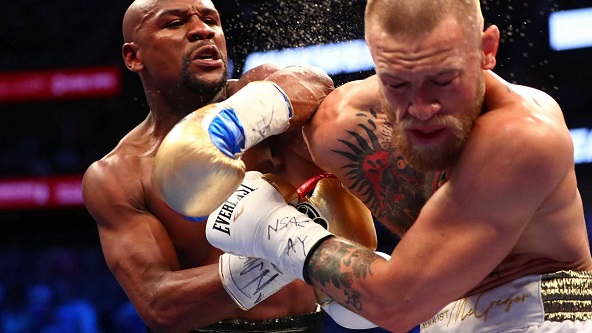
They hugged after the fight.

Last night Floyd Mayweather Jr. defeated Conor McGregor in a highly publicized (read: hyped) boxing match.

The result surprised no one, as Mayweather, despite being a much older man and coming out of retirement for the fight, as well as being (at least) twenty pounds lighter, had a record of 49 – 0 coming in, while McGregor had never boxed professionally.

Even the way it played out wasn’t surprising, as Mayweather simply let McGregor tire himself out in the first few rounds (as he has a known tendency to do) before walking him down later. I don’t think we can read much into the result. Though commentators would say after the bell that McGregor “acquitted himself well/didn’t embarrass himself/held his own,” the fight followed the script Mayweather had written, and the script was to put on a good show.

In most respects, then, it was a fight that was a pseudo-event. Though not fixed, the outcome was never in much doubt and everything pretty much went as expected. What really made it a pseudo-event, however, was the fact that it was such an artificial, manufactured spectacle. Despite not even being a real boxing match, and with no title on the line (though there was a gold, jewel-encrusted “Money Belt”), it became, reportedly, the biggest pay-per-view event in combat sports history. In the weeks leading up to fight night the big question sports reporters were asking was what it would all “mean” for the sport of boxing and MMA. It’s significant that they had to ask. The only real answer was that it meant nothing.

Even the build-up was a let-down. Three of the four public events held with Mayweather and McGregor, both legends in the trash talking department, were unmitigated disasters. But for a pseudo-event the hype is everything, no matter how good it is or whether or not it means anything.

McGregor made his usual boasts about knocking Mayweather out in the first round, and how his cardio was up to a full twelve rounds (which, of course, it wasn’t). “Trust me,” he kept repeating. It was all bullshit. Effective, to some degree, at pumping himself up, but how were we in the audience to take it?

That appeal to trust made me think of another supreme bullshit artist: the current president of the United States. “Trust me,” he said throughout the 2016 election campaign. He was going to build a wall. He was going to defeat ISIS. He was going to make America great again. It was going to be beautiful. Trust me.

The parallel points to a depressing truth. There seems to be little society can do to defend itself against such masters of self-promotion. One may criticize them, fact-check them, rail against them even, but it’s all for nought. The sports media rightly called Mayweather-McGregor a cynical money-grab and a joke, but so what? The mainstream news media, including most of the conservative media, rejected Trump right down the line. It didn’t make any difference. Simply by being talked about these celebrity brands and pseudo-events were winners.

This was brought home to me in a recent report done on the media coverage of the 2016 presidential campaign. Remember: the mainstream media overwhelmingly endorsed Hillary Clinton for president. Nevertheless, Trump won the war for the media, getting far more coverage, and it didn’t matter in the slightest that most of it was either (a) clips of his most outrageous gaffes and lies, or (b) negative commentary on the same. It also didn’t matter whether what he was saying was true or offensive. His whole campaign was a pseudo-event, like the Mayweather-McGregor fight. Criticism is pointless. Such people and such events are critic-proof, just like countless Hollywood and publishing blockbusters. Did anyone think 50 Shades of Grey was a good book, or a good movie? Twilight? The Transformers? They were panned by critics and audiences, yet they were all runaway franchise megahits. The power of the brand is truly remarkable.

It seems to me this is a problem. It’s a natural bias in the media that, as I say, society doesn’t seem to have any defence against. In the week leading up to the big May-Mac fight it didn’t just dominate the sports news programs but even took over top spot on the regular news. All of this coverage (promotion, free advertising) for a phony spectacle starring a couple of particularly loud celebrities. It’s assumed that between them Mayweather and McGregor took home close to half a billion dollars for the night’s work. A reality-TV host has become president. I know I shouldn’t be surprised or upset by this, but I don’t know how to be cynical enough not to be.
Mad madhouse

Over at Alex on Film I’ve been watching some adaptations of the Poe story “The System of Doctor Tarr and Professor Fether.” It’s an odd story, and may be the first to develop the theme of lunatics taking over and running the asylum. It’s always been a bit of an awkward piece to adapt though, as the audience knows what’s going on well before the coup is revealed, meaning our attention has to be diverted elsewhere. Nevertheless, I thought The Mansion of Madness (1973) was really good. Don’t Look in the Basement (1973) is just cheap exploitation fare. Stonehearst Asylum was only OK, and nothing to be excited about despite the cast.

Rustling to and frou

From The Midwich Cuckoos by John Wyndham: “There was a pocket of silence in Midwich, broken only by the frouing of the leaves, the chiming of the church clock, and the gurgle of the Opple as it slid over the weir beside the mill . . .”

Frouing? I thought this was a typo at first. What it appears to be is a derivation — perhaps unique in English (since I can’t find any other examples of it or any dictionary citations, even online) — from frou-frou, which is a rustling sound as of silk. This in turn comes from the French for something decorative or fancy (particularly with regard to clothes). The French verb is froufrouter, to rustle.

I would like what Wyndham’s done, but I don’t think frouing sounds right in English. I guess it’s pronounced froo-ing, but I’d like to say frow-ing. In any event, it didn’t catch on and for all I know this is the only place it appears. Making it a kind of linguistic cuckoo itself.

Waiting for the great leap . . . forward?

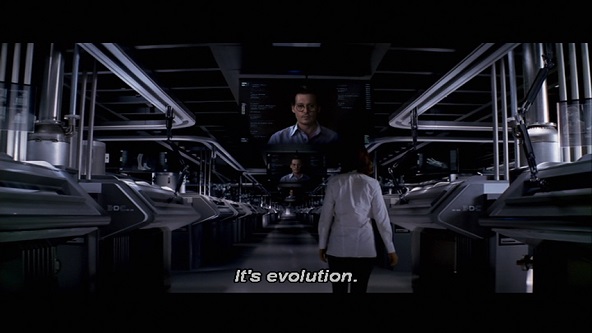
You mean, we’re all going to turn into Johnny Depp? No thanks.

Over at Alex on Film I’ve been watching a bunch of SF movies dealing with the next step in humanity’s evolution. What surprised me the most was how upbeat and apocalyptic the response seemed to be to this. There’s nothing to be frightened of because it will be something truly incredible: the tipping point where we become as gods in the Singularity or digital rapture. I wanted to include my thoughts on Demon Seed just to provide an example of what an earlier generation (my own) thought about the wedding of humanity with our technology. In any event, I once again got more political than I probably should have, but that’s the fun part of having a blog. Here are the films I looked at.

Demon Seed (1977)
Limitless (2011)
Her (2013)
Lucy (2014)
Transcendence (2014)
Morgan (2016)

On not rising to the top

Over at Good Reports I’ve posted my review of Arlie Russell Hochschild’s Strangers In Their Own Land. It’s an excellent work of social reportage that stands alongside Brian Alexander’s Glass House as an attempt to explain and understand what is happening in the United States, and in particular the forces that led to the election of Donald Trump.

What I find interesting is that there was another book on the same general topic that was published at the same time: Hillbilly Elegy by J. D. Vance. To say that Vance’s book received far more coverage and enjoyed better sales than the other two books combined would, I think, be an understatement. And yet of the three I think it’s by far the worst. The cream doesn’t always rise to the top.

Hoodie horror

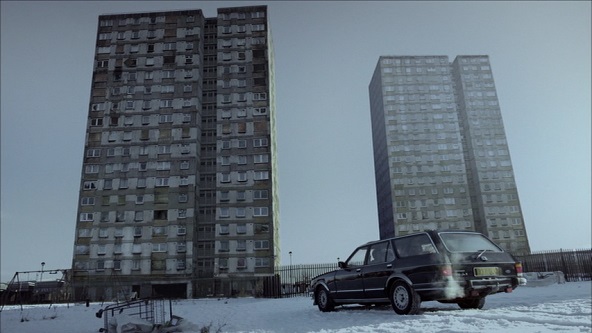
Another neighbourhood gone straight to hell.

Over at Alex on Film I’ve added reviews of a couple of horror movies about youth run wild: Them (2006) and Citadel (2012). Ciarán Foy, the writer-director of Citadel refers to this genre as “hoodie horror,” but this doesn’t seem to be a label that has achieved a lot of traction yet. I suspect it goes back to films like Don’t Look Now and The Brood, though in Don’t Look Now it’s a hooded raincoat and in The Brood the little monsters are wearing hooded snowsuits and pyjamas. Today, the hoodie is a class marker, and the movies are more about juvenile delinquency than the supernatural. The hood is short for a ‘hood full of hoodlums. But either way, the hood retains a power to threaten. Personally, I just hate to see kids driving with their hoods pulled up over their heads. What is this doing to their peripheral vision?

Take, taken, took

This never ends the way you want it to.

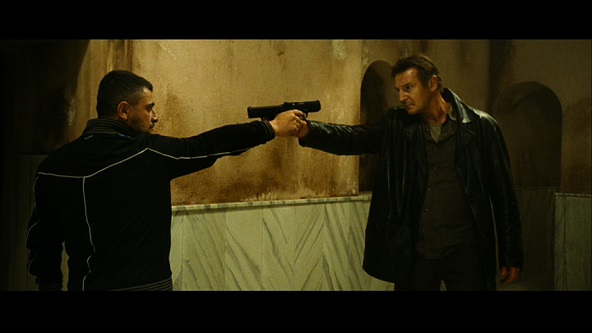
Over at Alex on Film I’ve been watching the Taken trilogy: Taken (2008), Taken 2 (2012), and Taken 3 (2014). This was a surprise franchise hit for which I have no good explanation, since I don’t think any one of them is worth watching. That said, I did think the third was the best, which I believe is a minority critical opinion. Not that I thought the third one was good, just that the first two were both crap.

Just visiting

Somebody took a wrong turn.

You never know what you’re going to see looking out your back window some mornings. When I lived on the farm this wouldn’t have raised an eyebrow, but I live right in the heart of the city now. I hope the little fellow made it home.

Those in wax houses

Melt, motherfucker, melt!

Over at Alex on Film I’ve been watching a bunch of movies dealing with the theme of the mad artist who makes wax sculptures out of his victims. The ball got rolling with Mystery of the Wax Museum (1933), which was a bit of a studio pot-boiler released without any great expectations. The source story had never even been published. With House of Wax (1953), however, the idea received its classic expression. They couldn’t really miss casting Vincent Price as the demented and disfigured sculptor. I then have some notes on a couple of cheap quickies — Nightmare in Wax (1969) and Crucible of Terror (1971) — that are nevertheless of some interest, with Crucible of Terror being well worth checking out just as a curiosity. Finally, I look at House of Wax (2005), probably best known today for being the one with Paris Hilton in it. She gets a pipe driven through her head. Though not a great movie, I was actually pleasantly surprised by this one, especially with the melting museum at the end. Apparently this caused some problems during production, with a big part of the Australian studio burning down and a subsequent lawsuit. That’s unfortunate, but I have to say it looks great.