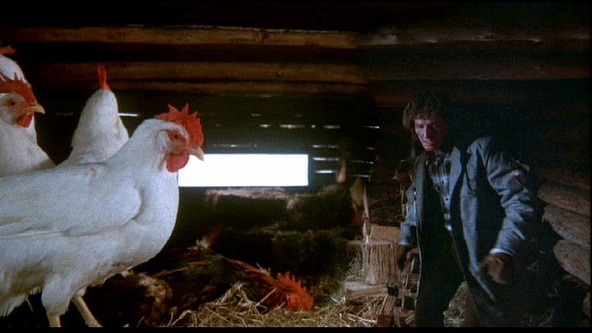
Children at play

But how do you think kids feel about you, Chuck?

Over at Alex on Film I’ve been watching the Child’s Play movies, which are headlined by the murderous doll Chucky. A better-than-average horror franchise that covered a lot of ground over thirty years. Alas, the 2019 reset was a total disaster.

Child’s Play (1988)
Child’s Play 2 (1990)
Child’s Play 3 (1991)
Bride of Chucky (1998)
Seed of Chucky (2004)
Curse of Chucky (2013)
Cult of Chucky (2017)
Child’s Play (2019)

Books of the Year 2019

Well, the end of the year is upon us, which means it’s time for another one of those best-of lists that everyone seems to like so much.

Best fiction: Two books stood out for me this year. I liked Lynn Coady’s Watching You Without Me a lot, and was a little surprised it didn’t get more press coverage. It deals with a couple of important contemporary social issues by way of a well-tuned thriller plot. But I’m giving the top prize to Michael Libling’s Hollywood North, another terrific thriller with a lot more going on than meets the eye. I love books that work on different levels and Hollywood North does that and more.


Best non-fiction: Last year I picked a book on Napoleon here because I was looking for something outside of the avalanche of books on Donald Trump. This year I’ll stick with Trump and pick Tim Alberta’s American Carnage, which presents a pretty thorough accounting of how Trump took over the Republican Party. An important story, and well told.


Best SF: Overall I’d have to rate this a down year in SF. But I have no trouble recommending Tade Thompson’s The Rosewater Redemption, which is the final part of his terrific Wormwood Trilogy. As a columnist, I usually try to stay away from series of novels but I’m glad I gave this one a try.

No future

Twenty years ago I posted an essay online talking about some of the changes that I saw taking place in the production of culture. One such change was the increasing disposability of art, which went along with something I found even more damaging: the loss of belief in any sort of cultural posterity. Here’s part of what I said:

I think the consciousness of disposability is something new. In my opinion it is the most profound change that has taken place in writing in the past century, and cannot be overestimated.

In Shakespeare’s day, even if you weren’t Shakespeare, you might still think that your sonnets would last forever. For Keats the desire to be counted “among the English poets” may have been a dreamy notion, but it was also a perfectly valid goal. It meant that you were intent upon entering a pantheon of immortals. And even in the first half of the twentieth century there was still a firm belief that art was, in some meaningful way, eternal. Ezra Pound could rail against what “the age demanded,” but only because he had confidence that his work would be among what remained. That was part of what being a classic meant.

That has all been lost. Put simply, and without any qualification, no author writing today has any belief that their work will survive. I’m not saying that no literary work will survive: that is a determination hinging on various factors outside of this survey. I don’t even know if the planet is going to survive. What I am saying is that no writer, however noble their intentions or committed their aims, has any belief that what they are creating is going to last.

That was a grim take, I’ll admit, but I was thinking about that essay again this week when I came across a story in the Huffington Post on Republican responses to how they think their defence of President Trump will be judged by history. The takeaway? They’re not concerned at all.

“I don’t care how I’m remembered,” Rep. Jim Jordan (R-Ohio) told HuffPost. “I care that the American people elected this guy president, he’s doing a great job, and [the Democrats] have zero facts on their side to remove this guy from office.”

And if you think Jordan insisting he doesn’t care is just some defense mechanism because he knows it will turn out badly, Jordan will tell you that actually, he hasn’t given any of that “a second’s thought.”

“The first time that even entered my mind was 20 seconds ago when you asked me,” he said.

Jordan’s colleagues expressed much the same indifference (or shamelessness), but at least one went even further:

One of the darkest answers came from Rep. Rob Bishop (R-Utah), a former history teacher himself. Bishop said the idea that history would remember what Republicans do assumes “that we’re going to survive in this country long enough to have a history.”

So much for posterity in politics. It seems the idea of the future has been laid to rest. But Trump’s flunkies are only taking their lead from higher up the food chain. Here, for example, is his Attorney General and Enabler-in-Chief Bill Barr:

Asked by CBS News’ Jan Crawford about concerns over his reputation for defending the president amid ongoing probes into the administration’s alleged ties to the Russian government and claims that Mr. Trump obstructed justice, Barr appeared indifferent.

“I am at the end of my career,” Barr said. “Everyone dies and I am not, you know, I don’t believe in the Homeric idea that you know, immortality comes by, you know, having odes sung about you over the centuries, you know?”

“Everyone dies.” One picks up, again, the odour of a decadent narcissism. Barr isn’t worried about the future because, at the end of his career, he knows he doesn’t have much left. And when he’s dead, why should he care about the judgment of history? In fact, he makes it pretty clear that he doesn’t think there’s going to be any judgment of history. I suspect that, like Rob Bishop, he thinks the whole idea of the U. S. having a history yet to be written a bit of a stretch. And this skepticism goes all the way to the top:

Since the 2016 presidential campaign, Donald Trump’s aides and advisers have tried to convince him of the importance of tackling the national debt.

Sources close to the president say he has repeatedly shrugged it off, implying that he doesn’t have to worry about the money owed to America’s creditors—currently about $21 trillion—because he won’t be around to shoulder the blame when it becomes even more untenable.

The friction came to a head in early 2017 when senior officials offered Trump charts and graphics laying out the numbers and showing a “hockey stick” spike in the national debt in the not-too-distant future. In response, Trump noted that the data suggested the debt would reach a critical mass only after his possible second term in office.

“Yeah, but I won’t be here,” the president bluntly said, according to a source who was in the room when Trump made this comment during discussions on the debt.

I won’t be here. Everyone dies. I really don’t care, do U?

We should all care. As posterity (the “Homeric idea”) is to culture so progress is to politics. Artists have to believe their work is going to have some kind of afterlife, otherwise they’re just making a cash grab. Politicians have to believe that they are trying to improve things, otherwise they become what Matt Taibbi calls (in reference to the Trump administration) a death cult.

I understand where all this is coming from. Humanity faces a lot of challenges that seem insurmountable. But to give up hope in the future is the short road to doom.

Update, May 9 2020:

When Barr’s Justice Department dropped charges in the case against Michael Flynn CBS News’ Cathrine Herridge engaged Barr as follows:

“When history looks back on this decision, how do you think it will be written?” Barr laughed: “Well, history’s written by the winners. So it largely depends on who’s writing the history.”

That laughter tells you a lot.

Update, July 19 2021:

When Chris Christie reproached Rudy Giuliani for the way he was destroying his legacy by putting forward a shambolic legal team to contest the results of the 2020 election the former mayor of New York City is said to have got very hot under the collar.

“F— legacy,” Giuliani reportedly responded. “Legacy is what happens when you’re in the ground. I’m fighting for today.”

No future!

Public language

From Age of Folly (2016) by Lewis H. Lapham:

The familiar story (democracy smothered by oligarchy) has often been told – long ago by Aristotle, more recently in our American context by the Nobel Prize-winning economist Joseph Stiglitz – but it is nowhere better illustrated than by the reversal over the past half century of the meaning within the words “public” and “private.” In the 1950s the word “public” connoted an inherent good (public health, public school, public service, public spirit); “private” was a synonym for selfishness and greed (plutocrats in top hats, pigs at troughs). The connotations traded places in the 1980s. “Private” now implies all things bright and beautiful (private trainer, private school, private plane), “public” becomes a synonym for all things ugly and dangerous (public housing, public welfare, public toilet).

‘Sblood!

Over at Alex on Film I just finished watching the trilogy of Robert Langdon films based on the novels of Dan Brown: The Da Vinci Code (2006), Angels & Demons (2009), and Inferno (2016). Since I can’t tell you what made the books so popular I sure can’t help with the movies. The weird thing is that they don’t even seem like good popcorn entertainment to me. They’re all very dull and talky, and despite throwing in so many highbrow references they’re unbelievably stupid. Is this the sort of nonsense people want to believe in? Yikes.

Blockbusters then and now

Number one with a bullet.

Ranking the highest-grossing films of all time is a tricky business because a lot depends on what you include with the gross. Theatrical revenue only? Domestic and foreign? DVD sales? Television rights? Merchandising deals? Not to mention how you want to adjust the numbers for inflation.

By most rankings, however, Avengers: Endgame is near or at the top of the list. I just finished watching Endgame and Avengers: Infinity War over at Alex on Film, and in my notes I did a bit of musing about what the success of the Marvel Cinematic Universe says about us.

But something else I found interesting when considering the different lists of box office hits was my own drift away from such fare. Gone With the Wind is a movie I’ve seen a number of times, and while I can’t say I really love it, it is a movie I find I can come back to. Same with Star Wars and Jaws. Titanic I can defend, but it’s not a movie I’d want to ever see again. Avatar I couldn’t sit through once. The rest of the comic book nonsense from the past decade that so dominates the “highest-grossing movies of all time” club bounces off me completely.

I’d just say this is because I’ve gotten old, but the thing is, these movies apparently appeal to older audiences as well. And while Star Wars and Jaws were certainly movies that had a big appeal among young people, I don’t find them as downright childish as the formula we get in Avatar or Endgame.

Childish and stupid. Let’s face it, these are dumb movies. They are effects extravaganzas, where you’re supposed to just turn your brain off and have a good time. There was always at least a little more going on in the blockbusters of thirty or forty years ago.

Two questions then. Will history judge us kindly, assuming movies as we know them have a future? And where do we go from here?

Highs and lows

Every year I go to the annual Friends of the Guelph Public Library Giant Used Book Sale. Three years ago I posted some thoughts on the experience where I referred to the sale as “both fun and a bit depressing.” That was my feeling again this year.

The fun part was the same. It really is heartening to see so many people, especially so many young people, lining up to buy books. I know that in the grand scheme of things these crowds don’t add up to much, but they still give one hope.

The depressing bit was something new. For a while now I’d been hearing of cellphone apps that allow you to scan the bar code on a book and pull up prices, either from some online bookseller or price aggregator. This year’s book sale, however, was the first time I’d seen these in action. At the table where I was spending most of my time there were three individuals simply going through everything: pulling a book out, scanning the bar code with their phones, looking quickly at the screen, and then either putting the book in one of their boxes or tossing it back on the table. They worked very quickly, able to do all the scanning and scrolling functions on their phones with one hand while pulling the books with the other.

I get that the used book trade is a business and that this is what apps are for: making things quicker and more convenient. Still, the way these guys worked a table, like the filleters working on the line at a fish processing plant, was depressing. Here was the digital economy moving in, jackal-like, to further cannibalize the remains of our culture. Its foot soldiers were robotic. Quite obviously they didn’t have any interest in the books they were methodically scanning. I’m not sure they could have told you what section of the sale they were working at the time. They were just doing data entry.

But while whatever program they were using to get a quick price check might serve as a rough guide, the fact that they didn’t really know the merchandise meant they were probably missing out on a lot. A couple of years ago I found a book at this same sale that I picked up for a dollar. I later saw it advertised online for over $800. And it wasn’t a copy in as good shape as the one I got! (By the way, it really was just curiosity that led me to check out what it was going for online. I didn’t resell it. I still have it sitting in my “to-read” pile.) The thing is, I found that book on the third day of the sale, after the book scouts and used-book buyers had already been through.

The same thing was happening this year. I thoght the book scanners were missing a lot, whatever their app might have been telling them. This made me think of something David Mason, a veteran used-book seller, had to say in the most recent issue of Canadian Notes & Queries:

Supposedly the great equalizer, the internet is in fact the worst offender against informed judgment . . . An experienced dealer looking at internet entries nowadays often finds five to ten copies of a book offered by dealers they’ve never heard of before they see names they know and credible prices. It takes just one ignorant fool putting a ludicrous price on a book to give other ignorant fools something to copy. They usually price their own copy ten percent or so less, assuming they’re being clever, when what they’re really doing is adding to the general ignorance. The blind lead the blind into the bog of imbecility, all of which makes the internet a dangerous cesspool.

Sadly, I don’t think anyone cares about the internet being a cesspool as long as it’s a profitable cesspool. The question is how well, in a business like this, such an approach really works.

Federal election 2019: After

Back again to comment on the 2019 federal election. A week ago I offered up my thoughts on how things were developing, concluding with the following prediction:

What I think will happen is that the Liberals will hold on with a minority government, perhaps due mainly to an anti-Ford vote in Ontario and stronger support in Quebec. The NDP will be nearly wiped out. The Greens will see a significant increase in their vote, though I doubt it will result in many (if any) seats.

I got some of this right. The Liberals did get back in, this time with a minority. And this was mainly due to their strength in Quebec and Ontario (and more specifically the GTA). Much of Quebec, however, went for the BQ. The NDP weren’t wiped out, but lost a lot of seats. They still tried to put a positive spin on things though by claiming that, while diminished, they will hold a balance of power in the new parliament.

One observation I’d make is that we are becoming a more regionally divided nation, which I see as being a sort of work-around of the archaic first-past-the-post electoral system. The Liberals were crushed in the West, all but disappearing from the map, but it made little difference. The Conservatives actually won the popular vote, but still lost handily. The Greens received 6.5% of the popular vote and ended up with 3 seats. The Bloc Québécois got 7.7% of the vote and 32 seats. This is the FPTP system at work.

As I said in my previous post, I didn’t think the party leaders were an inspiring group. Despite this, it looks as though Elizabeth May will be the only leader stepping aside. Inertia is taking over, as it so often does in Canadian politics. Our leaders have a habit of overstaying their welcome.

Perhaps I’m just old and jaded, but I didn’t see a big difference among the various parties. I studied a primer on their various platforms before voting and was surprised at how ill-defined they were. And what was defined struck me as being largely without meaning. Conservatives complained that a carbon tax would be ineffective, which I’m sure it will be. But at least it’s something. The Conservative position on the environment was a joke, saying they would meet greenhouse gas reduction targets but giving no idea how. But then I’m sure the Liberals will fail at meeting these targets as well.

On most other issues it was the same. A national pharmacare program sounds like a good idea, but the Liberals only said they want to work toward it while the Conservatives dismissed it entirely. The Liberals and NDP were OK with letting deficits grow while the Conservatives promised to reduce them. This is something I’m sure they would not be able to do, but I suspect they would have made at least some of the cuts they promised to government programs.

Immigration was supposed to be a hot-button issue but only the People’s Party tried to run with it. And the People’s Party went nowhere. The other parties were all vague on the matter.

I take it election reform is totally dead. Elizabeth May waited until the day before the election to declare that if the Green party were elected then hers would be the last federal government in Canada chosen by the first-past-the-post system. And where had I heard that before?

Like I say, perhaps this is all just me being jaded. Or something. When I filled in a questionnaire that sought to identify my political preference based on my feelings toward a catalogue of issues I wound up in a quarter of the political spectrum that none of the parties identified with (that is, socially conservative and economically left-wing). But then this position, which I would identify with an “old left,” is one that has increasingly come to feel abandoned.

A final note: For what I believe is the fourth election (federal and provincial) in a row the Green Party were the only party in my riding to do any door-to-door canvassing for votes. And they came by my place twice. So basically the other parties have just given up on this. Are they putting all their resources into social media? I wonder how that’s working out for them.

Looking ahead I don’t see anything to feel good about. Essentially we’re in for more of the same. I don’t see anyone being in a rush to trigger another election and I don’t think the Liberals ran on much of a platform to actually do anything. We didn’t vote for change and we’re not going to get any.

Political punditry potpourri