Holmes: The Crooked Man

When it comes to mystery and detective fiction I’ll confess I subscribe to the “fair play” doctrine. This is the principle, which some authors make expressly, that the reader gets all the same clues as the detective. What this avoids is a situation where the detective just pulls a rabbit out of a hat at the end, explaining the mystery by way of some evidence that we haven’t been told about. Sure you can still have a great mystery that doesn’t play by these rules, but I appreciate it when the author sets a fair challenge.

Sherlock Holmes seems to have felt the same way, as we learn when he upbraids Watson at the beginning of “The Crooked Man.” It’s a point he makes just after remarking on how Watson has had a busy day. Watson doesn’t know how he managed to deduce this and so Holmes explains:

“I have the advantage of knowing your habits, my dear Watson,” said he. “When your round is a short one you walk, and when it is a long one you use a hansom. As I perceive that your boots, although used, are by no means dirty, I cannot doubt that you are at present busy enough to justify the hansom.”

“Excellent!” I cried.

“Elementary,” said he. “It is one of those instances where the reasoner can produce an effect which seems remarkable to his neighbor, because the latter has missed the one little point which is the basis of the deduction. The same may be said, my dear fellow, for the effect of some of these little sketches of yours, which is entirely meretricious, depending as it does upon your retaining in your own hands some factors in the problem which are never imparted to the reader.”

That said, the effect here is again at least mostly meretricious, as Holmes basically just walks back the events of the night Colonel Barclay dies until he comes to their source in the titular crooked man, who quickly spills the beans. There are red herrings, like the footprints made by a small animal, but little in the way of clues. Even the use of the name “David” is an allusion that ties into an exotic backstory that Holmes had no way of knowing anything about until Harry Wood told him what happened back in India during the days of the Mutiny.

As a bonus, Holmes never says “Elementary, my dear Watson” anywhere in the canon. What he says in the passage quoted above is as close as he ever comes to that famous line. That kind of thing happens more than you might think. Bogart, for example, never says “Play it again, Sam” in Casablanca.

Holmes index

Daredevil: Know Fear

Daredevil: Know Fear

This volume is the beginning of a Daredevil story arc written by Chip Zdarsky and illustrated by Marco Checchetto. It’s a bit of a “born again” theme, again, but it’s an odd sort of a launch because Daredevil is coming back to life from a near fatal collision (the “Death of Daredevil”) only to get the crap kicked out of him by nearly every bad guy he meets and then being argued into retirement by Spider-Man

The overall tenor is quite dark. Wilson Fisk is mayor of New York City in this timeline, and you know he’s up to no good. Daredevil himself is a diminished thing. He hasn’t fully recovered from his last near-death experience, has a few days’ worth of stubble growing under his mask, and has trouble even taking out street thugs, much less bona fide supervillains. Even the tough-as-nails Chicago cop Cole North can beat him up in a fist fight. On different occasions he has to be bailed out by superpals like Luke Cage and Iron Fist, or the Punisher (who often pops up at such moments). At one point he’s shot, but (you’ll never guess) it’s only in the shoulder, so he can keep going by taking pain meds. On top of all this he’s starting to wonder if he’s maybe doing more harm than good, especially when he accidentally kills a perp. This leads to lots of tortured reflections and flashbacks to his Catholic upbringing, and his eventual decision to get out of superheroing altogether. He’s not only the man without fear now, but a man without a real purpose in life.

When I say the tenor is dark this is what I mean. It’s Batman dark, and that’s the main feeling I got reading it. Matt Murdock is feeling some Bruce Wayne-level angst, and being the Red Knight is the cross his therapy bears. There isn’t a whole lot of story going on either, as it’s mostly character- and world-building. Which is normally not something I’d go in for, but I thought Zdarsky did a good job with it and I came away wanting to read more. You know DD just has to get back up, dust himself off, and start all over again.

Graphicalex

TCF: Sniper

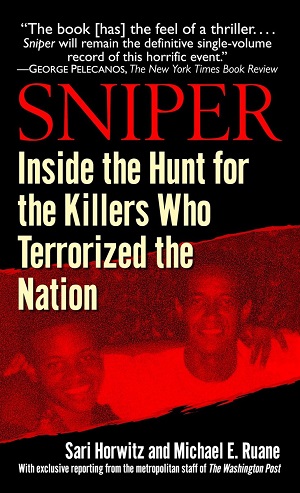
Sniper: Inside the Hunt for the Killers Who Terrorized the Nation
By Sari Horwitz and Michael E. Ruane

The crime:

For a period of three weeks in October 2002 a pair of men – John Allen Muhammad and Lee Boyd Malvo (the latter aged 17 at the time) – terrorized the Washington D.C. metropolitan area by killing 10 people and injuring several more in a series of random sniper attacks. Prior to the sniper outbreak they had committed a number of other deadly attacks across the U.S. After their conviction on multiple counts of murder Muhammad was executed by lethal injection and Malvo sentenced to life in prison.
The book:

I think the word “terrorized” in the title is particularly apt. While it’s hard to think of Muhammad and Malvo as domestic terrorists since they didn’t seem to have any political agenda, they really did scare the hell out of people living around D.C. in these weeks. Sudden death might strike anyone randomly, even out-of-doors in public areas like parking lots and gas stations. Where was anyone safe? Only staying at home with the doors locked and the curtains drawn.

I say this off the top because for all the horror of these crimes, there was also something comic about the snipers’ reign of terror. I even found myself laughing at their failed attempts to take credit for the murders and so get the attention of the media. They were the biggest news story in the country and tried on multiple occasions to open lines of communication to the public and the police but couldn’t get anywhere. No one would believe they were the snipers. Wandering from pay phone to pay phone, they called the tip line, the FBI (four times), and CNN, all in vain. “Frustrated at their inability to be taken seriously,” they felt that the only thing they could do was escalate.

This must have really made them angry. Unlike terrorists looking to draw attention to a cause, Muhammad and Malvo were just into playing God. They even instructed the police to “Call me God.” They liked to exercise absolute control over the lives of others. And they couldn’t get anyone to take their calls!

This desire to play God is all the motive I can come up with. Muhammad was the prototype of the violent, bitter loser whose life had reached a breaking point. Things may have kicked off with his trying to kill his second ex-wife, who he was in a custody battle with, and then spiraled out of control after that. As one ATF agent speculated in the early days of the investigation, “the shooter was one very angry guy, on some kind of personal mission.” For his part, Malvo made some claims to having a larger political agenda and dying for “the revolution,” but this was only after he’d been caught, and much of what he had to say simply didn’t make any sense. For example, declaring that he hated white people but killing people of various races.

Profilers weren’t of much use. Even the ones who took to the airwaves:

The consensus of TV profilers was that the person responsible for these shooting was most likely a white man with a military background, familiarity with firearms, and a grievance. Detectives chuckled that it was the same profile the experts always seemed to produce, no matter what the case. One retired FBI profiler, Gregg McCrary, could see no real motive. “You’re down to the thrill of the kill,” he said. “Playing God. Having the power over these individuals. Life and death. That’s real heady, a real rush. He’s on a high now.”

Does any of this bring us closer to understanding the odd relationship between the two? Muhammad presented Malvo as his son, and friends who saw them together thought their interactions were very much a “father-and-son deal.” In jail Malvo would also insist that he be called John Lee Muhammad and be referred to as Muhammad’s kid. People considered him to be “enchanted” or under a “spell.” Was there more to their relationship than this? At trial, Malvo’s attorney took the line that Malvo had been groomed, even “sissified” by the older man, “just as surely as a potter molds clay.” But while there was speculation about a sexual relationship this was hotly denied (“We Jamaicans don’t play that”) and one could even wonder about how dominant a figure Muhammad was. It’s still unclear, for example, who did the shooting, though I think the common understanding is that Malvo was the usual trigger man as he was a better shot. It’s also the case that Malvo was the one who made the phone calls to the media. Was this a case of folie à deux, or shared psychopathy? Obviously it was to some extent, but I’m still unsure of the actual dynamics. And it’s unlikely we’ll ever know more.

(As an aside, it’s mentioned at one point that the police were having difficulty fitting the killings into one of the “five standard motives for homicide.” I wasn’t aware of these, but they’re listed as greed, power, revenge, hate, and escape. These seem too general to be very helpful to me. I would have thought there’d be quite a bit of overlap, for example, between power, revenge, and hate.)

Adding to the mystery of motive is the fact that this was a very odd murder spree. I can’t think of any other cases quite like it. Subsequently there were a pair of serial sniper attacks in 2003 (in Ohio and West Virginia), but they weren’t really comparable. There had been four victims in total in those two cases, and both times the sniper worked alone. And of course Charles Whitman had killed more than a dozen people when he shot up the University of Texas at Austin in 1966, but that had been a single event. The D.C. snipers were something different.

That uniqueness, and the terror that I started off talking about, is one reason why their rampage is still remembered today. At least I remember it well. Talking to a couple of friends (both older than me) while I was reading this book, however, I was surprised that neither of them had any recollection of the attacks at all. To be sure, many crime stories attract an enormous amount of media attention at the time, and over the course of a trial, only to be completely forgotten a few months, or even weeks later. How many people remember Scott Peterson, Casey Anthony, or Jodi Arias today? Only true crime junkies. But I would have thought this case on another level.

The book itself is adequate, or even better than that, being written by a pair of Washington Post reporters who covered the story. In a just-the-facts manner the bullet path for each killing is described precisely, which is a surprisingly effective approach. The opening killing of James D. Martin sets the tone:

The bullet struck Martin square in the back, slicing through his suit jacket and dress shirt and leaving a tiny hole in his skin one-eighth of an inch wide, smaller than the head of a plastic push pin. It cut through vertebra T7, below his shoulder blades, and severed his spinal cord, instantly paralyzing his lower body. Slowing down, it tore a slightly upward path, perforating his aorta, the main trunk of his cardiovascular system; the pulmonary artery to his lungs; and the pericardium, the membrane surrounding his heart. There was little deflection en route and almost no fragmentation as the bullet burst through his sternum, making a hole three-quarters of an inch by one-half inch shaped like a piece of broken glass. Later, at the autopsy, the medical examiners would find on his neck a tiny shard of gray metal that looked like lead.

Martin began to fall as soon as his spinal cord was cut. The catastrophic drop in blood pressure cause by his other wounds would have then led to swift unconsciousness. The brain carries only about a ten-second reserve of oxygen. A witness heard him moan and saw him crumple onto his left side, losing his glasses. He struck his face on the blacktop, gashing his nose and forehead.

If the keynote for these killings was terror or fear, it’s moments like these that underline their horror. I think it’s explicit without being exploitive, and authenticates the violence in a way that really brings it home.

Noted in passing:

When Muhammad was finally apprehended his wallet contained “a phone card, Muhammad’s Washington State driver’s license, three fake ID cards, and $32 in Canadian money.”

I guess he had the Canadian money because he’d been living for a while close to the Canadian border, but it’s never mentioned in this book if Muhammad ever visited Canada and he certainly hadn’t been there recently. According to Malvo’s testimony the two had planned to escape to Canada at some point so maybe there was a reason for it, though $32 wouldn’t have taken them far.

But why do people keep thinking they can escape to Canada anyway? What do they think Canada is? I mentioned this before in my review of Let’s Kill Mom but the killer kids in that book lived in Texas and weren’t too bright so you could perhaps forgive them for thinking Canada was a sort of Cuba with snow. Muhammad should have known better, and probably did.

Takeaways:

It’s best to ignore attention-seekers, and narcissists in general. But be ready for when they blow up.

True Crime Files

Batman: Reptilian

Batman: Reptilian

I went through a range of responses while reading Reptilian. For example, at first I found myself really grooving to the art by Liam Sharp, which has a thick, painterly atmosphere to it. If that art was dark, well, that’s the Batman universe. And not just any Batman universe, but the DC Black Label Batman universe.

But then I didn’t like how the art stayed so dark, and how the thickness started to just seem muddy. There were action sequences where, even going back to examine them more closely, I honestly couldn’t tell what was going on. There were climactic moments, such as Killer Croc appearing with an external womb like Nola in The Brood, that I couldn’t see at all. I had to take cues from the text to understand what was happening. This was a shame because Sharp really imagines the characters in interesting and original ways but I felt like I was only seeing them through a glass, darkly. Batman himself is all shadow and silhouette, which I guess is apt for the character but also got tiring after a while.

I felt the same mix of good and bad with the writing. Garth Ennis is a writer known for pushing the boundaries of what I’ll call good taste. This title isn’t as crazy as some of his stuff, but then he was writing for an established DC character and they probably had him on some kind of leash. As it is, his Batman is a cold, sarcastic bastard and Killer Croc a sympathetic villain. There’s also a violent plot (though the violence is mostly witnessed in the aftermath) that involves a lot of xenosexual shenanigans. In sum, it wasn’t what I was expecting, but it was something new, which isn’t easy to pull off when we’re talking about a Batman comic. Some of the dialogue felt awkward, and given the aforementioned issues I had with the art the story became hard to follow in places. But on a second reading I did think it all made sense.

So I came away respecting it. I could see a real Batman purist taking offense, but that’s the Black Label brand. The art at least had a lot of interesting design elements, though the monster looked a bit too Giger-ish and as noted it’s all far too dark. And Ennis did come up with a story that I think even his detractors will admit is hard to forget. There aren’t many comics that give us that much.

Graphicalex

Holmes: The Breath of God

The dictionary definition of a pastiche is a work composed in the same style (if not always the same spirit) as the original, but Guy Adams knows that this can be taken too far. “There is a habit amongst writers of new Holmes fiction,” he tells us in an Afterword to The Breath of God, “to concentrate on emulating Conan Doyle’s style. From the word go I decided not to be too slavish about this. Guess what: Conan Doyle didn’t write this, I did.”

Cocky? Sure, but Adams backs it up with a fast-paced supernatural thriller that I enjoyed all the way through. And anyone who acknowledges that Tobe Hooper’s Lifeforce is “one of the finest bad movies ever made” is OK in my book. Though I might even argue with calling Lifeforce a bad movie.

Now if you’re a true Holmesian your ears probably pricked up at my use of the word “supernatural.” The story begins with the “Psychical Doctor” John Silence visiting Holmes and telling him that evil forces are at work looking to bring about a transdimensional apocalypse called the Breath of God. Already various members of the Hermetic Order of the Golden Dawn are meeting mysterious ends. As Holmes and Watson investigate they learn of a power struggle in the Order, with our heroes taking the side of Silence, Aleister Crowley, Thomas Carnacki, and Julian Karswell.

If you’ve read a bit in the weird fiction of the period you’ll recognize the names. Crowley was a real historical figure (“the wickedest man in the world”), while the others were fictional dabblers in the occult. Adams isn’t just borrowing from Conan Doyle but William Hope Hodgson, Algernon Blackwood, and MR James. It’s as much a collage as a pastiche, which is a route Adams would go down again in his next Holmes novel, The Army of Dr. Moreau.

But what’s going on here? Holmes, as “a man thoroughly wedded to a rational view of the world,” is intrigued by Silence’s story, but we may suspect he has some doubts. And sure enough things do get wrapped up in a rational (as well as spectacular) finale. But I thought the novel was a first-rate fantasy even without the Holmes angle. In fact, Holmes has a secondary role throughout most of the proceedings and Watson is the hero as much as he is the narrator. A Watson who can also be quite harsh on his best friend, at one point going so far as to say how much of “a contrary swine he could often be.”

It’s all very cinematic, highlighted by action scenes that have the team of occult ghostbusters battling ectoplasmic demons with magic (or “magick”) spells and artefacts. I also liked that the villains were given interesting motives, and had creative ways of doing in their enemies. There’s no denying Adams does this kind of popcorn-flavoured pulp well, and while such an approach doesn’t have The Breath of God feeling much like a canonical Holmes tale it’s still a good time.

Holmes index

The Superior Spider-Man: Goblin Nation

The Superior Spider-Man: Goblin Nation

As you know from my previous reviews of a couple of the Superior Spider-Man Team-Up collections, I’m a fan of the character. In brief, he’s a version of Spider-Man where Otto Octavius has taken over Peter Parker’s body and thus the identity of Spider-Man, creating a new and improved (“superior”) webslinger. The original Peter Parker had apparently died, but in fact his consciousness is still floating around in the SSM’s head, and in this issue he finally emerges triumphant as Octavius relinquishes control back to him so that he (the real Peter Parker) can save his (Octavius’s) girlfriend.

Did you follow all that? It doesn’t really matter. The main plotline has the Green Goblin (or the Goblin King, who is Norman Osborn having had plastic surgery to look like one of his corporate underlings) and the Goblin Nation (a bunch of characters turned into goblin freaks by the goblin serum) trashing NYC. The Goblin King knows that Spider-Man is now a cosplaying Doc Ock and offers him an alliance (as junior partner) but nobody with a name like Octavius is going to agree to play second fiddle to a little green guy so they end up fighting each other. Meanwhile, Spider-Man 2099 has time-traveled back to help out and J. Jonah Jameson, the mayor of New York, has unleashed his army of robot Spider-Slayers to kill Spidey because you know Jameson just has a hate on for him.

Did you follow that? I’ll admit, I had a hard time with it. And there’s more going on, including a psychomachia in Peter Parker’s head and a battle between the corporate entities Parker Industries and Oscorp/Alchemax. I thought this struggle between the wannabe tech bros to be an angle that had more potential, but as this synopsis has already made clear there’s plenty enough going on.

Probably too much. If you’re not up on this iteration of the Spiderverse then you’re probably going to be lost with regard to all of the supporting characters. I know I was. And I wasn’t impressed with the Goblin King’s ambition to take over all the crime in New York City. Why not just focus on growing Oscorp and take over the world? What would Elon do? OK, probably try to take over NYC. But you know what I mean.

I didn’t like this one as much as I did the other Superior Spider-Man titles I’ve read, but it’s still a better-than-average comic and shouldn’t disappoint the fans who wanted to see Peter Parker come back. I just wasn’t missing him that much.

Graphicalex

Druuna: Creatura

Druuna: Creatura

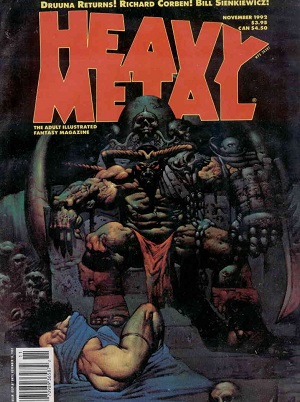
This comic (which I don’t have as a standalone but only as it appeared in the November 1992 Heavy Metal) is a sequel to the Morbus Gravis Druuna books, and there is a sort of continuity, at least insofar as continuity is a thing in the Druuna universe. The spaceship that was the setting for the earlier books has been overgrown by the Evil virus and now constitutes a sort of fleshy asteroid or floating tumor. Another spaceship captained by a man named Will comes across the asteroid, which seems to be communicating psychically with Will by giving him visions of Druuna. An away team lands on the asteroid, indeed enters it in a highly suggestive manner, and as they explore their surroundings reality seems to come undone and it’s not clear how much of what is happening is real and how much is a dream. Druuna’s lover Schastar, for example, appears to have melded into a cyborg creature that is part Schastar and part Lewis. Furthermore, he/it might have died eons ago but for the fact that time no longer has any meaning.

There’s a doctor (he seems to be a psychologist, primarily), who’s based on Serpieri himself, and he shows up to try to explain some of this to Will but I found his theories hard to follow. Otherwise, we’re just lost in the same world as before, consisting of a diseased superstructure built upon a cauldron of id that keeps looping out its tendrils to snag the buxom Druuna or any other nubile creature. The crew-cut Terry giving herself up to something called the Prolet project is another sexual-surrogate stand-in, like Hale in Morbus Gravis. In fact, she might be Hale. I don’t know.

Trying to make sense of all this is impossible. And this despite the fact that Creatura is a lot talkier than the Morbus Gravis comics. I’m just not sure how much of the supposed exposition was meant as a joke, how much was lost in translation, and how much was confused to begin with and then became progressively more complicated. It seems that something is being said about humanity existing in a parlous state between the poles of what I called the id (the Evil virus, carnality, violence, and lust) and a superego (the computer, robots, technology). While Druuna in all her lush voluptuousness would seem to be more closely aligned with the organic, that’s not represented as being an attractive alternative. Sex can be beautiful (especially on the beach), but more often it’s something cruel and degrading. Meanwhile, technology is more closely identified with what we might think of as civilization and a condition of order that we have to fight to preserve.

I won’t try to read anything more into it than that. Most of the pontificating done by the doctor and others strikes me as just a bunch of pretentious bafflegab. And by this point in the story I think it’s clear that there is no linear story being told. “Past, present and future mean nothing here,” Druuna is told by the robot Schastar/Lewis. And so she keeps running in place. There’s no escaping the human condition, even in space!

Graphicalex

Marple: The Case of the Caretaker

An interesting frame to this one, as Miss Marple is recovering from a bout of the flu and to help her recovery her doctor gives her the manuscript of a mystery story that he’s written. Only it’s really more of a true crime story as the only thing he’s done is changed the names. It’s up to Miss Marple to solve it, which she does handily the next time he comes to visit.

It’s a throwaway of a mystery. Miss Marple twigs to what’s going on because the playboy has married a rich heiress who is not his type. That’s putting a lot of weight on a pretty flimsy “clue.” Still, the story was a quick read and I enjoyed the way it was presented. Points also for making me look up what a “dower house” is, using “acidulated” to describe a gossipy spinster, and informing me that a “catapult” is a British slingshot.

Marple index

Simpsons Comics Colossal Compendium: Volume Two

Simpsons Comics Colossal Compendium: Volume Two

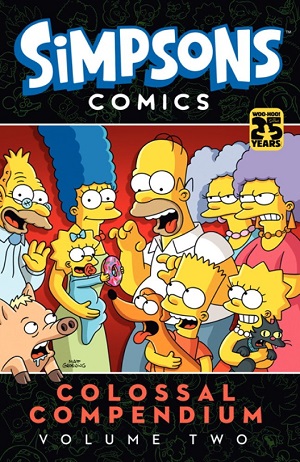
This is more like it. I was a little underwhelmed by the Simpsons Comics Colossal Compendium Volume One, though this was mainly because I judge the writing in these Simpsons comics to a high standard. I know the Simpsons universe well, at least from its earlier years, and I’ve been impressed at how the stories in the comics are still so fresh and funny decades into the franchise now.

There are some good storylines here, including a number of superhero spin-offs. There’s a Bartman story where he meets a supposed Bartman of the future (one guess as to who that is!), another where all three of the Simpsons kids are superheroes (Stretch Dude, Clobber Girl, and Bouncing Battle Baby), a blast from the past courtesy of Comic Book Guy and issue #100 of Radioactive Man, and an adventure where Homer becomes a sort of accidental costumed crimefighter as a way of losing weight.

The best story though is “No Cause for Alarm,” a comic written and illustrated by the legendary Sergio Aragonés. This follows a series of mishaps that arise when Homer gets lazy with the alarm at the nuclear power station. It’s the kind of gag humour Aragonés does well, and the story has a lot of the chaotic crowd scenes he’s famous for, made all the better for the fact that Springfield is so full of easily identifiable characters you can enjoy these pages for a while as you try to locate where your favourite citizens are hiding.

If there’s any negative comment I’d make it’s the inclusion of a couple of short Itchy & Scratchy vignettes. I’ve never understood why they kept with these. Basically they’re an ultraviolent version of Tom & Jerry, with the cat (Scratchy) always being dismembered or destroyed by the sadistic mouse Itchy. I don’t find these comics offensive or shocking, but I don’t think they’re funny either. And they always play out the same, with no twists or surprise endings (unlike Mad’s Spy vs. Spy, for example), so they’re not very interesting in that respect either. But since these only amount to a few pages of filler it’s not a big deal.

Finally, the papercraft Springfield landmark is of Moe’s Tavern.

Graphicalex

The long read

Just a note to let you know that after an eight-month hiatus I’m back posting book reviews at Goodreports.net. This was my first website, launched in 1998 (!) and I’ve operated it continually ever since. Seeing as I post a lot of reviews here, and I’m doing less reviewing in general, Goodreports hasn’t been as active in recent years. But I’ll try to keep things going with weekly updates. Most of the books are non-fiction, with a lot of current events and political matters being discussed. I kick things off with a quick look at Nouriel Roubini’s MegaThreats. Depressing stuff!