
This is so true. Back in the good old days moms could do anything. They were truly superhuman. Baking pies and cookies was the least of it.
This is so true. Back in the good old days moms could do anything. They were truly superhuman. Baking pies and cookies was the least of it.
From Natural Causes: An Epidemic of Wellness, The Certainty of Dying, and Our Illusion of Control (2018) by Barbara Ehrenreich:
In the face of death, secular people often scramble to expand their experiences or memorialize themselves in some lasting form. They may work their way through a “bucket list” of adventures and destinations or struggle to complete a cherished project. Or if they are at all rich or famous, they may dedicate their final years and months to the creation of a “legacy,” such as a charitable foundation, in the same spirit as an emperor might plan his mausoleum. One well-known public figure of my acquaintance devoted some of his last months to planning a celebration of his life featuring adulatory speeches by numerous dignitaries including himself. Sadly, a couple of decades later, his name requires some explanation.
So the self becomes an obstacle to what we might call, in the fullest sense, “successful aging.” I have seen accomplished people consumed in their final years with jockeying for one last promotion or other mark of recognition, or crankily defending their reputation against critics and potential critics. This is all that we in the modern world have learned how to do.
From “Jake Paul beats Mike Tyson in manufactured mismatch as Father Time comes calling,” The Guardian November 16, 2024:
Tyson had already put the result, as well as the protracted and ridiculous hype surrounding the circus, into bleak context the previous night. Dragooned into an interview with Jazlyn Guerra, a 14-year-old social media personality who tags herself as Jazzy’s World TV, Tyson was withering in the way he dismissed the fight and his historical reputation. His words carried a dark meaning which ridiculed his contest with a YouTuber.
Guerra, who appears to be an accomplished teenager, was initially gushing in her enthusiasm for the bout after the weigh-in on Thursday night. She said it would provide “a monumental opportunity for kids my age to see the legend Mike Tyson in the ring for the first time. So after such a successful career what type of legacy would you like to leave behind when it’s all said and done?”
Tyson paused. It wasn’t a terrible question but he was in the mood to dole out a grim truth. “Well, I don’t believe in the word ‘legacy’,” Tyson said. “I think that’s just another word for ‘ego’. Legacy means absolutely nothing to me. I’m just passing through. I’m gonna die and it’s gonna be over. Who cares about legacy after that? We’re nothing. We’re dead. We’re dust.”
Guerra, to her considerable credit, was gracious. “Well, thank you so much for sharing that,” she said. “That’s something I’ve not heard before.”
Tyson wasn’t done. “Can you really imagine someone saying I want my legacy to be this way or that?” he continued bluntly. “You’re dead. What audacity is that – to want people to think about me when I am gone? Who the fuck cares about me?”
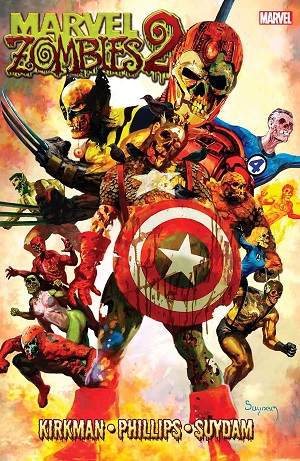 This Marvel Zombies volume doesn’t flow directly from the first run of Marvel Zombies, but constitutes a second miniseries of five issues. Things begin with the zombies suffering the effects of withdrawal after having spent the last forty years eating their way through the whole universe. So they decide to head back to Earth because if they can find a mechanical portal to another dimension there’s a chance they can skip over to another part of the multiverse and eat that too. Which means recovering zombies like Black Panther and Wasp have to try to stop them. And it’s a race against time because the non-zombies are starting to fight among themselves while the zombies are slowly starting to get better on their own after being forced to go cold turkey.
I was disappointed in the first Marvel Zombies series and can’t say I was any more impressed with this one. Robert Kirkman just has too much going on. You’d better know your Marvel universes really well if you’re going to identify the army of different characters, some of them rather obscure, and follow them through the only-confusing-because-it’s-so-lazy plot. I mean, I didn’t recognize the Gladiator at all, or understand what was going on with T’Challa’s son, and I guess I should have. Then everything winds up with the usual conclusion in which nothing is concluded because there’s always that escape hatch to another dimension. The End? Not on your afterlife.
There are things I like about these comics. They do go in some directions I’m not expecting. And overall they hold my interest. But I also find them lacking focus and hard to follow or get involved in. I might like the series more if it took more time introducing and building up the different characters. That’s something that might make the story stronger too.
Over at Good Reports I just posted a quick review of the final part of Jonathan Karl’s trilogy on the (first) Trump presidency: Tired of Winning. (The two previous instalments were Front Row at the Trump Show and Betrayal.)
As I mentioned in my wrap-up post on the 2024 presidential election a few days ago, I read and reviewed a lot of books about American politics in the previous eight years. I don’t have an index to just these reviews, but for a couple of lengthy omnibus essays you can read about the long and short road to Trump here and Trump and the religious right here. I’ve recently been moving these books onto the shelves in my new library and even after tossing out a lot of them out (or donating them to book sales), what’s left still takes up a lot of space. Here’s a couple of shelves.

As I also said in that wrap-up post, I wasn’t sure if I was up to reading about Trump this much again. I really don’t think there’s much new to say. Everyone has known who Trump is for a while now, and what he’s all about. All that’s left is to see how the dance of corruption and appeasement plays out, at least for the next couple of years. And that’s depressing stuff.
I think the best thing to do would be to unplug entirely, but I’m not (quite) ready to do that yet. So I’ve got another shelf set aside for the next chapter in America’s long national nightmare. It’s right next to the fireplace.
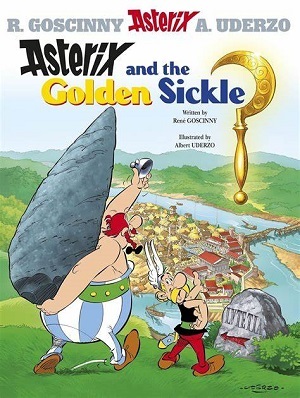 Outside of the central characters and the basic formulas, I only recall bits and pieces of the Asterix comics from when I read them as a kid. But I do remember thinking that Asterix and the Golden Sickle was one of the best. It’s actually a nice little mystery story, with Asterix and Obelix traveling to Lutetia to find Metallurgix, Obelix’s cousin who is also a manufacturer of the golden sickles that druids like Panoramix need to harvest mistletoe. Unfortunately, when they get to Lutetia they find that someone has kidnapped Metallurgix as a way of cornering the market on golden sickles just before the big druid festival.
It’s eventful, fast-moving, and the plot holds interest throughout. The secondary characters are also interesting, from the little guy in the drunk tank who gets a shot of magic potion to the Roman prefect Surplus Dairyprodus, whose appearance was based on that of the actor Charles Laughton. Dairyprodus is a real original, taking up a life of crime and hanging out with lowlifes just because he’s bored of enjoying all the good things in life. He’s even looking forward to rowing in a galley at the end, just for a change of pace.
The only false note came by way of the new “North American” translation, which even has Obelix saying “Cool!” at one point. Not cool!
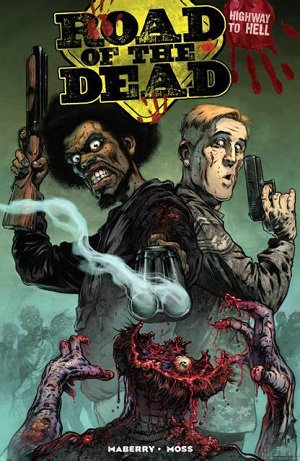 Damn, now that’s a zombie comic cover! Nothing like an eyeball floating in the bowl of a hollowed out skull with a smoking shotgun barrel in the background. Could the comic itself live up to this?
No, it doesn’t. And in fact the cover is by Santíperez while the comic itself is illustrated by Drew Moss. So different artists. There’s a gallery of covers by Santíperez included in the bonus material here though and they all look nearly as cool.
In my review of the movie Zombieland I suggested that 2007 might be taken as the year of “peak zombie.” It just seemed like zombies were everywhere and nothing new was being done with the genre. So this comic, billed as a prequel to Road of the Dead though I’ve never heard of that book, was coming very late to the party (it was published in 2019). In particular, this really feels like a colour version of Kirkman’s The Walking Dead mixed with even older elements borrowed from the Romero films. There are highways jammed with stalled vehicles. There are warrior biker gangs. There’s a pair of pet zombies kept on chain leashes. There’s a guy with a spiked baseball bat. There’s a battle tank that turns out to be surprisingly (and unrealistically) effective in taking out zombies. There’s a story involving the attempt to transport a scientist working on a cure for the zombie virus to a safe haven in . . . you guessed it: Canada!
I don’t think there’s any way writer Jonathan Maberry wasn’t aware of all this. He even kicks things off with a billboard advertising the Monroeville Mall (setting of Romero’s 1978 classic Dawn of the Dead). But it’s hard to draw much of anything from a well that’s already been pumped dry. You can go the route of zombie parody, but even that was getting stale by this time. So there isn’t much to do here but watch the splatter. There’s a slightly more contemporary wrinkle added by the fact that the gang chasing our heroes are members of a sort of conspiracy cult, believing that a cure is being kept from them by government elites. But that’s never developed. And of course the underlying philosophy of the zombie genre is still in play: that the zombie apocalypse only reveals the state of nature as it already exists, a war of all against all with civilization a transparently thin membrane stretched over the abyss. Our lives so routine, meaningless, and devoid of human attachment we might already be dead. As the narration explains:
This is how it is now. Everywhere is a trap. Everyone is an enemy. Each of us is a traitor to the living the second we die.
Ten thousand years of human civilization. Everything we learned, everything we built, all we know about the world and the universe. And now the only thing that defines us is whether we’re predators or prey.
No dignity left. Hope and optimism are getting bitch-slapped. Compassion’s lying dead in a ditch somewhere.
It’s not that I don’t have sympathy for this sort of end-of-days nihilism, but as I say it’s something that’s foundational to the zombie genre and the fact is that Road of the Dead: Highway to Hell doesn’t have a new story to package it in. It’s the sort of comic I’d usually recommend only if you’re a huge fan of zombie stuff, but actually if you’re a huge zombie fan then you might feel let down by how unoriginal it all feels, since I’m sure you’ll have seen it all before. So while it’s an OK comic, it’s kind of hard to recommend to anyone except splatter-action devotees.
While reading John A. Farrell’s biography of Richard Nixon I came across a brief account of Nixon’s soon-to-be wife Pat standing around Hollywood sets but rejecting a career in show business because she “saw through the movieland taradiddles.”
I don’t think I’ve ever come across the word taradiddles before and even in context I wasn’t sure what it meant. The strange thing is, after looking it up I still wasn’t all that clear on it and I can’t even say if Farrell is using it correctly. I might also add here that its etymology is uncertain. It was probably just an arrangement of funny syllables that don’t mean anything.
At the most basic level a taradiddle is a lie. Or perhaps fib would be a better way of putting it. But most dictionaries present it as having two meanings: (1) pretentious nonsense, and (2) a small, petty, or trivial lie. My problem is that these seem like two different things. Or at least two different kinds of lying.
I don’t know what sense Farrell was using it in. Probably pretentious nonsense. Hollywood has some of that. In any event, it was a new word for me but not one that I have any intention of ever using myself just because it’s so long-winded, cutesy, and vague.

The bread man was even more popular than the milk delivery guy in the good old days. He was bringing the good stuff!
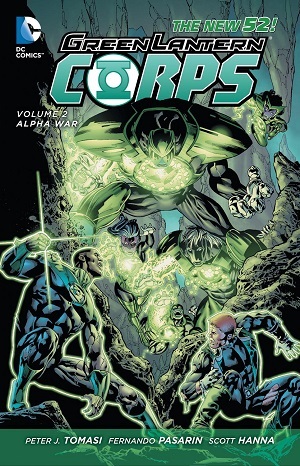 There are actually two different storylines here. The first is the Alpha War one, which has an excessively rigorous bunch of super-Lanterns on the HQ planet of Oa tasked with policing the rest of the Corps. Quis custodiet ipsos custodes? Who will guard the guardians? The Alpha Lanterns, that’s who!
And who is watching over the Alphas? The bobbleheaded Guardians hanging out in their Planetary Citadel. And you wouldn’t want to trust that lot.
Anyway, one of the dark moments in the previous volume had John Stewart kill a fellow Lantern who was being tortured by the Keepers into giving up the pass code they needed to break into Oa. As things kick off here, Stewart is judged by the Alphas and sentenced to death. But then Guy Gardner and some of his buddies break John out of his prison (what they call the “sciencell”), and have a battle royale with the Alphas, who end up being defeated.
I didn’t care for any of this. I couldn’t tell any of the Alphas apart except for the centaur guy and nothing about the plot seemed right to me. To be honest, by the time they wrapped things up I was thinking of giving up on this series.
I’m glad I didn’t, because in the next story line, that only gets introduced here, we learn about some space zombies who are just floating around turning everyone, including any Lanterns who cross their path, into more zombies. These zombies form a “third army” that the Guardians seem to be behind in some way. I told you those bobbleheads can’t be trusted. They’re also up to something when they release Xar from his prison and send him out to stir things up. Meanwhile, Kilowog and Salaak are on to the Guardians but they’re a little slow in piecing things together.
Then John Stewart, who has been sent off on a wild goose chase, meets up with the busty Fatality, and Guy Gardner gets his team of Lanterns wiped out by the space zombies, which results in him getting kicked out of the Corps and sent back home to Earth without any of his Lantern powers.
I don’t know where any of this is going, but I’m interested enough in what Fatality, Xar, the Guardians, and the space zombies are all doing to keep reading for another volume. Power up!

The crime:
Charles Sobhraj was the child of an Indian father and Vietnamese mother born in Saigon in 1944. He took early to a life of petty crime and ran afoul of the law a lot as a juvenile. When his mother moved to France with a new partner Sobhraj went with her and got into trouble there as well. Ingratiating himself with various enablers, he left France and became an itinerant crook involved in a bunch of different scams in South-East Asia. He seems to have mainly been involved in gem and drug smuggling, and would often drug Europeans to rob them and steal their passports. For some reason, and this is the great mystery, Sobhraj’s criminal career took a much darker turn in the mid-1970s as he went on a killing spree while living in Bangkok, mainly targeting European tourists on the so-called “hippie trail.” He killed at least 12 people but perhaps twice that many. He was finally arrested in 1976 and imprisoned in India. He escaped from prison, though perhaps only to be rearrested so that he would not be extradited to Thailand, where he faced the death penalty. After serving his time in India (and with the statute of limitations on his crimes in Thailand having passed) he was set free and enjoyed a life of minor celebrity in France but in 2004 he was re-arrested while visiting Nepal (where he had also murdered a pair of tourists). In 2022 he was released from prison in Nepal on account of his age and good behaviour and now lives in France.
 The book:
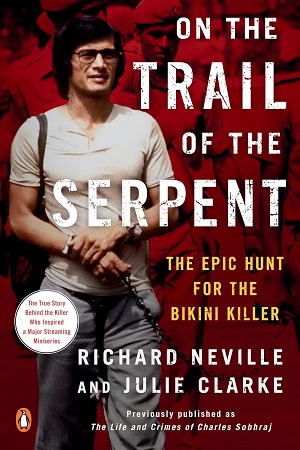
This is a 2021 update of a book that came out in 1979 under the title The Life and Crimes of Charles Sobhraj. That was actually a better, or at least more accurate, title. I don’t recall any mention here of Sobhraj being called “the Serpent,” and the sobriquet “bikini killer” was only something he picked up because that’s what one of his victims was wearing when her body was found.
I suspect the book was reissued (and so retitled) in part to cash in on the spark of interest created by the 8-part BBC series The Serpent that came out in 2021. But an epilogue also brings the case up to date on Sobhraj’s later convictions and imprisonments. Though not totally up to date, since it leaves off with Sobhraj still in a Nepalese prison.
It’s likely to remain the standard work on Sobhraj then, as it’s quite well written by a pair of authors who seem to have really understood the milieu (Neville had authored an early guidebook to the hippie trail) and who had also interviewed Sobhraj extensively. This really helps because it’s a very complicated story that even now remains shady in several places. But Neville’s familiarity with Sobhraj is also problematic, which is something that Clarke (his wife as well as co-author) flags.
The thing is, Sobhraj was an accomplished con and a fraud before he was a killer and he had charm to burn. And he wasn’t just a natural but made a study of it, constantly reading books on psychology and how to influence (read: manipulate) people. So Clarke was right to feel nervous about Neville being played, which is something I think Sobhraj was definitely trying to do. But it’s also something that as readers we have to be on guard against, because so much of the story as we have it comes from Sobhraj himself. His besotted French-Canadian lover Marie-Andrée Leclerc died in 1984. His accomplice Ajay Chowdhury was last seen in 1976, with most people believing that Sobhraj killed him around that time. Add to this the fact that Sobhraj was a fluent and congenital liar, with a great deal to lie about, and parts of the story will likely always remain pretty murky.
The most obvious question, which I flagged earlier, relates to motive. Why did Sobhraj become a prolific murderer so suddenly? Usually in such cases there is a history of slow escalation. But that’s mostly with sexual serial killers and one of the distinguishing features of Sobhraj’s murder spree is that sex was not a driver. He seems to have killed as many men as he did women and I don’t think there was any evidence of sexual assault being involved. Nor does there seem to have been much if anything in the way of a financial motive. Sobhraj was certainly a thief, but seems to have made a good living off of whatever scam he was working or just drugging his victims and tossing their rooms for money, jewelry, and passports. So why did he go through the difficult process of killing so many people and then having to dispose of their bodies?
Sobhraj’s own story was that he was operating on orders given from drug cartels based in Hong Kong, who wanted him to get rid of rogue mules. Or at least that’s how I understand it. I don’t think this makes any sense at all, however, and the accounts Sobhraj gave of several of the killings didn’t match up with what we know, especially with regard to the timelines. I agree with the opinion of Herman Knippenberg, the Dutch diplomat stationed in Thailand who did so much to hunt Sobhraj down, that the hit-man explanation was “pure cant.” I would say the same about Sobhraj’s (much later) claim that he was fighting a kind of anti-colonial struggle against Western exploiters, represented by the young backpackers on the hippie trail. To be sure, he probably did feel some resentment toward Europeans in general, and the book adverts to that.
But this doesn’t explain why he started killing so many people in the mid-1970s, and I think it’s more likely that he just didn’t care for anyone very much, including members of his immediate family. And when I say he didn’t care for them I only mean he thought they were disposable, not objects of obsessive hate. It’s typical of a lot of hardened criminals that they have a near complete lack of empathy, and what’s more disturbing than the passion killers are the ones who would just as soon kill you as look at you. The lives of others, and their suffering, mean nothing to them.
I think Knippenberg gets closer to the truth when he suggests that Sobhraj just couldn’t stand the thought of anyone drifting out of his control. In her epilogue, published after Neville’s death in 2016, Clarke talks about how Sobhraj “ticked every box in the Hare Psychopathy Checklist”:
Glib and superficial charm; grandiose (exaggeratedly high) estimation of self; need for stimulation; pathological lying; cunning and manipulativeness; lack of remorse or guilt; shallow affect (superficial emotional responsiveness); callousness and lack of empathy; parasitic lifestyle; poor behavioral controls; sexual promiscuity; early behavior problems; lack of realistic long-term goals; impulsivity; irresponsibility; failure to accept responsibility for own actions; many short-term marital relationships; juvenile delinquency . . . criminal versatility.
Sobhraj, she concludes, “is the perfect psychopath.” And it’s true he really did cover all of the bases. One thing that’s left out of this checklist, however, is his need to control others. Maybe this is the flipside of the lack of personal control (among his other self-destructive habits, Sobhraj was a compulsive gambler), and maybe it comes with his narcissistic power-tripping. But however you explain it, he seems to have got some psychological satisfaction out of getting people to rely on him, submit to him, and even blindly follow him into some very dark places. I don’t think he ever loved any of the women he seduced, but his ego reveled in how much they adored him. Just before his arrest Marie-Andrée wrote in her diary “I love him so much that I can only make one being with him. I can only exist because of him, I can only breathe because of him. And my love is increasing.” This was well after she realized that she was “just an employee satisfying his whims” and even after when she must have known he was a serial murderer and after he had long been physically abusing her as well. This sort of toxic love, if you can call it that, is a drug, and it’s bad for everyone.
So, to round out the point I raised earlier, Clarke had good reason to suspect Sobhraj was working his charm on Neville while being interviewed. And there were places in the text I could see that happening. Indeed, Sobhraj has continued to cast his spell, as his sickening celebrity has continued even up to this day. It’s a point I’ve made over and over again in these True Crime Files, and elsewhere as well: Wicked people are limited in what they can achieve on their own. They need enablers. Sobhraj’s criminal career highlighted this phenomenon. Like most such operators he had a kind of sixth sense for their weakness, most evident here in the devotion of “Alain Benard” (the pseudonym given Felix d’Escogne) a soft-hearted and soft-headed prison volunteer he charmed while incarcerated as a youth in France. And later he was always surrounded by a gang of flunkies under his spell, without whom he couldn’t have operated. Yes, some of them were victims too, but we can’t let such people off that easy.
Noted in passing:
When escaping from jail in Afghanistan Sobhraj drugged his guards with sleeping pills and had to calculate a dosage based on the fact that “They were big men, more than six feet, like most Afghans.”
This surprised me enough to want to check it out. According to the most recent statistics I could find online the average height of an Afghan male is 5’6”, which ranks them in the bottom quartile of all nations. I’m sure there are regional and tribal differences, but still this is quite a miss.
I’m not sure if it was a lack of feeling that led Sobhraj to keep a pet gibbon monkey named Coco in a cage on the balcony of his Bangkok apartment. It might have been more the custom at the time. It struck me as very sad though, especially as the only time it gets referenced is when a neighbour spies it sitting in its cage “with its head in its hands” just before it is found dead one morning. Marie-Andrée then accuses one of the itinerant residents, who Sobhraj was poisoning, of poisoning the monkey. More likely, Sobhraj was using it as a guinea pig. But keeping a monkey in a cage in your apartment even without testing drugs on it just struck me as terribly cruel.
Takeaways:
You can’t spell charm without harm. If you meet someone you suspect of being charming you should at the very least be on your guard. They’re never up to any good.

