The Empty Man: Manifestation

The Empty Man: Manifestation

Manifestation is the third and final (so far) volume in Cullen Bunn’s Empty Man series, with Jesús Hervás again providing the raw and scratchy artwork and questions still flying every which way as to what’s going on.

We begin with a nod to Kubrick’s 2001 and a caveman finding a pillar or monolith of blood and bone. Where are we? When are we? I suppose this is the dawn of man, and more particularly the dawn of human consciousness, a point at which the Empty Man came into existence. Or so, I think, Agent Langford explains when he shows up back in our dimension, carrying shotguns and with cancerous tumors spilling out of his guts.

Any idea of the meaning of all this is going to have to be found in Langford’s account of his trip to the Empty Man’s world, but I found this just as mystifying as the rest of the story. My own interpretation is that the virus is the physical expression of malignant narcissism, with the Empty Man looking to create peace and unity among all the peoples of the world but only on his/its own terms. Its need to project itself by way of various media platforms is sort of like the amplifier effect of social media. The way people worship it as a god reflects our own cults of celebrity.

Well, that’s a stretch but it’s my story and I’m sticking to it. As I say, it’s left pretty vague. We can’t even be sure if this is the end of the story, as we leave things with the Kerry family (who are relegated to the role of luggage in this volume) locked and loaded, ready to go after the cult in a cosmic horror “holy war.” The apocalypse beckons. But as for what has happened to Jensen, again I have no idea. Apotheosis? And the creepy kids? Are they better now? I guess we’re supposed to stay tuned.

I don’t know how much of the mystery here was deliberate and how much was Bunn just not being sure what it was he was trying to say. But I’m inclined to think it was more the latter, as looking back on the series as a whole it really is a mess. There are some interesting ideas raised, I think, but they’re covered in a whole lot of psycho-spiritual stuff that doesn’t gel. Being left to guess what the point of it was after three books was disappointing.

Graphicalex

Marple: The Moving Finger

In my notes on the first two Miss Marple novels, The Murder at the Vicarage and The Body in the Library, I’ve mentioned how Miss Marple herself remains a secondary figure, knitting in the background and not playing a significant role in the plot or really doing much of anything until the big reveal at the end. Well, that gets doubled-down on here, as The Moving Finger is a 164-page novel in the edition I was reading and Miss Marple doesn’t appear, indeed isn’t mentioned, until page 117. At which point she promptly solves the case, explaining everything in the denouement. She works fast!

But then, as she points out at the beginning of her wrap-up, this was an easy case: “Most crimes, you see, are so absurdly simple. This one was. Quite sane and straightforward – and quite understandable – in an unpleasant way, of course.” There are all the usual distractions – a long list of suspects, a complicated timeline – but what it comes down to, again, is the question of motive. I didn’t figure out exactly how the killer did it, or pick up all the breadcrumbs of clues that Miss Marple did, but I had a strong hunch whodunit that turned out to be correct.

Things kick off with amateur pilot Jerry Burton recovering from a crash in the sleepy country village of Lymstock with his sister Joanna. They’ve rented a house with the too-cozy name of Little Furze and settled in for some quiet convalescence. Unfortunately, as soon as they arrive Lymstock starts suffering from a plague of poison-pen letters, including some addressed to Jerry and Joanna. It seems Lymstock has its very own proto-troll. You know why people write nasty anonymous letters, or insult people on comment threads? It’s because “they’ve got a screw loose. It satisfies some urge, I suppose. If you’ve been snubbed, or ignored, or frustrated, and your life’s pretty drab and empty, I suppose you get a sense of power from stabbing in the dark at people who are happy and enjoying themselves.”

Then one of the addressees dies of an apparent suicide and her serving girl is later murdered in a particularly (for Christie) horrific way: knocked unconscious with a blow to the back of the head and then having a kitchen skewer thrust in the base of her skull. That’s mean! We all know poison is the weapon of choice for cozy killers.

If you were familiar with the plot of The A.B.C. Murders, which came out six years earlier, you’d be able to guess what was going on with the letters, though you’d be no closer to identifying the killer. I won’t add more about that, but only sum up by saying that while the mystery here isn’t first-rate, the book is a good read (and one of Christie’s own favourites) just because the characters are so enjoyable. When Jerry falls for the village tomboy Megan (spunky enough to defend Goneril and Regan against their mean dad, and young enough to almost be Jerry’s daughter) it plays very much like a modern rom-com, especially when he literally whisks her off her feet and takes her to London to dress her up. You can’t help but be reminded of the clichéd scenes in the teen rom-coms where the guy takes the girl’s glasses off and reveals her to be a princess. Even her “freckles are so earnest and Scottish.” I was puzzled, however, at one of the descriptions of Megan in frumpy mode: “She slouched out of the room. She was untidily dressed as usual and there were potatoes in both heels.” Does this mean she actually had potatoes in her shoes, which I’ve heard is a method used to stretch out shoes that are too small or uncomfortably tight, or is it a figure of speech for something else? I suspect I’m missing another archaic Britishism.

In any event, it doesn’t take long for Jerry to fall head-over-heels in love when he realizes that Megan is, indeed, a keeper.

What a nice child she was, I thought. So pleased with everything, so unquestioning, accepting all my suggestions without fuss or bother.

Grab hold of that young woman and don’t let her go, Jerry!

Even a backwater like Lymstock is dominated by certain roles and conventions. It’s assumed, for example, that the letter writer must be a woman of high social position. Don’t ask why. But the one gay man might qualify because he’s “got an abnormally female streak in his character.” Which is as close as Christie is going to come here to calling someone gay. And as for being of high social position, that sort of goes without saying in a world where the lower classes are all but invisible. Jerry at one point is surprised to hear the house servant mention the name of the Daily Woman (capitalized): “For a fortnight now, I had been conscious of a middle-aged woman with wisps of grey hair, usually on her knees retreating crablike from bathroom and stairs and passage when I appeared.” They’d better retreat! What if you were to trip over them?

So Lymstock is a cozy place, aside from the odd skewer to the brain stem. And I’ll confess I find something endearing about relationships based on companionship rather than sexual attraction being presented as the ideal. In fact, you can usually tell who the good people are in a Christie book by the nature of their relationships. Companionship, not far removed from the brother-sister pairings we have a couple of instances of here, is the goal, and spells a happy life. Anything more physical is likely to be dangerous. SA (sex appeal) is always a red flag.

In the best romantic tradition the ending wraps things up with all the good people marrying off, ensuring a future of domestic tranquility, but there is a truly shocking bit at the end I didn’t know what to make of. The old lady that Jerry had been renting Little Furze from says to him on the final page: “I really do think, don’t you, that everything turned out for the best?” (the emphasis on best is in the original). He considers this, and keep in mind that Mrs. Symmington is the woman who was poisoned and Agnes the serving girl who gets her brain skewered:

Just for a fleeting moment I thought of Mrs. Symmington and Agnes Woddell in their graves in the churchyard and wondered if they would agree, and then I remembered that Agnes’s boy hadn’t been very fond of her and that Mrs. Symmington hadn’t been very nice to Megan and, what the hell? we’ve all got to die sometime! And I agree with happy Miss Emily that everything was for the best in the best of possible worlds.

What with the echo of Candide I’m sure the intent here was black comedy, Christie poking fun at the idea of murder mysteries having happy endings. But it was still kind of shocking. The moral of the story seems to be that if you want to live a cozy life there are a lot of bad things you’re just going to have to ignore or at least find your peace with.

Marple index

Simpsons Comics Unchained

Simpsons Comics Unchained

I first read Matt Groening when I was in university in the late 1980s and his strip “Life in Hell” was appearing in one of the alt-entertainment weeklies. It was the only thing worth reading in that rag. Everyone thought it was really funny. It was just after this, however, that The Simpsons took off and Groening became mainstream, the name behind a franchise.

I don’t begrudge him any of his success, as the TV show The Simpsons, at least in the early days, was really very funny. I haven’t seen it in twenty years, but I hope it’s still going strong. And the comics are good too. The question I had reading Unchained is whether Groening himself has anything much to do with them. And the reason I ask is because his name is on every credits page, even though he’s always given a joke title like “Reformed Nerd,” “Cue Card Boy,” or “Lard Lad’s Best Customer.” I had to wonder if there was some legal reason for that. Because he wasn’t writing or drawing or colouring, I think all he’d normally get a credit for is as publisher, or for “characters created by” (just as every Batman comic even today has to credit Bob Kane for creating Batman). So I just don’t know.

In any event, this is a selection of stories taken from the pages of The Simpsons comic, specifically issues #36-#42. There’s not much in the way of connective tissue, though many of the stories deal with members of the family getting in trouble with the law. So that fits with the jailbreak theme of the cover. Overall it’s a typical Simpsons effort, with a gag in nearly every panel, and sometimes several, and with even more hidden in with the fine print (which in one instance I honestly couldn’t read without a magnifying glass because I guess I’m getting too old for this stuff). Some pieces land better than others. I thought the Charlie and the Chocolate Factory spoof got away from them and the Jabberwocky send-up didn’t work. The story where Homer and the Comic Book Guy go to court was one of the better ones, in part because comic nerd-dom has always been close to the heart of the franchise.

I don’t think the line-up here is as good as that found in the Colossal Compendiums or the Treehouse of Horrors comics. I felt these stories were more like B-sides than the best of the best. But it was enjoyable enough while it lasted.

Graphicalex

Jughead: The Hunger Volume One

Jughead: The Hunger Volume One

This title is part of a series published under the Archie Horror imprint, coming after Afterlife with Archie and Chilling Adventures of Sabrina and just before Vampironica. The basic idea is that Jughead is one of a long line of Jones family werewolves, with Betty being the latest werewolf hunter of the Cooper clan.

Volume One contains the one-shot comic that launched the series and then issues 1-3, along with some supplemental material and a teaser for Vampironica. The art is in a more realistic style than the usual Archie stuff, so things like Jughead’s needle nose are played down, though he still has his stupid hat and Archie is easily identified by his cross-hatching at the temples and dusting of freckles. Veronica and Reggie I found unrecognizable: Ronnie for being so skinny (a marker of her affluence?) and Reggie for just looking generic without any of the slick smugness of what I was used to. But otherwise the story leans into the characters as we all know them. Betty as werewolf hunter is the tough and practical girl next door; basically Buffy with bullets, a belly shirt, and torn jeans. Jughead is a reluctant monster, slave to his appetites. Reggie is the consummate schemer. Veronica is corruptible. Archie is the Everyman caught between all these different forces. Victims include the old (Ms. Grundy), the fat (Pop Tate), and the nerdy (Dilton Doiley).

This consistency in character underlines a point made by Archie writer Matthew Rosenberg in his introduction: that horror like this doesn’t subvert Archie’s vision of Americana so much as extend it. Horror is as American as apple pie and Norman Rockwell and the rest of the Riverdale gang anyway.

So everything seems to actually follow quite naturally, and I thought it made for a pretty good story. The only point where I had to complain was when the one werewolf gets shot up by the police and then later heals himself by squeezing all the bullets out of his flesh. Only these clearly aren’t bullets but bullet casings, which are discharged by the gun when the bullet is fired. There’s no way they would have been in the werewolf. I was kind of surprised somebody didn’t catch that, as even for someone who doesn’t work with guns a lot it’s a howler of a mistake.

Graphicalex

Marple: A Christmas Tragedy

Sir Henry is upset that the menfolk are telling all the stories at the group’s get-togethers, so Miss Marple herself has to step up with a mystery that took place at a Hydro. “Do you mean a seaplane?” one of the guests asks, “with wide eyes.” No, not a seaplane. A Hydro is apparently what Brits at the time called a spa, the kind of place where they might take a water cure. Or something like that.

In any event, I didn’t like the mystery here at all. It was ridiculous (or “incredible,” as Dr. Lloyd puts it), involving the usual complicated staging that it’s impossible to credit for a minute. The only interesting element was the way Miss Marple misleads her audience in her telling of the story, leading them to expect one thing, then seeming to deny it, and finally showing that she was actually right in her suspicions all along. It only took her a while to prove it.

A Christmas tragedy? Maybe not. Maybe the victim was lucky. “Perhaps it was better for her to die while life was still happy than it would have been for her to live on, unhappy and disillusioned, in a world that would have seemed suddenly horrible.” Sheesh. I mean, you could probably say that about anybody’s life, at least at some point, but you shouldn’t. It actually reminded me of the end of the novel The Moving Finger, where such sentiments are meant (I’m sure) as a joke. But Miss Marple is no sentimentalist. The killer here ends up being hanged “And a good job to. . . I’ve no patience with modern humanitarian scruples about capital punishment.” Just because they call these cozies doesn’t mean they’re soft-hearted. Order must be maintained.

Marple index

Grass Kings: Volume Three

Grass Kings: Volume Three

The finale of the Grass Kings trilogy, and I think it does a great job wrapping things up. That’s not to say that everything gets wrapped up though. I think Matt Kindt put too much into this series and there wasn’t enough room for all of it. He would have been better to just stick with the serial killer story, which is quite well handled, and not brought in all the stuff about the billionaire with his own private army garrisoned on an island in the lake. Then the way the killer was blackmailing the sheriffs in Cargill just got dropped in without a lot of explanation. And I never understood how such a community was viable “off the grid,” or what its legal status was. When Maria here says that she’s in the Kingdom “illegally” I couldn’t figure out what she was talking about.

The art by Tyler Jenkins was firing on all cylinders. I loved the full-page pic of the sheriffs looking down off the dock to the bound body in the water. I was also impressed at how well Jenkins can draw horses and helicopters. You wouldn’t expect him to do both well. And even the faces seem filled out a little more, allowing a greater range of expressions and emotion.

Well, you want to end a series on a high note and I’d say this is the best of the three volumes so mission accomplished there. The whole concept was bigger and stranger than I think it had to be, but they brought it home in a way I thought was satisfactory.

Graphicalex

Contagion

Contagion

A little disappointing. But I started out with low expectations that were quickly surpassed. I was thinking it would be a kind of Marvel Zombies, which it is, but the story really whips along and throws in what feels like half the Marvel Universe without losing too much focus. The main hero is the ever-lovin’ Thing, who is called into action when zombie-like creatures are found roaming the New York City subway (beneath Yancy Street, even). And yes, C.H.U.D. is referenced, which scored them an extra point.

What’s happened is an ancient evil in the form of a magic fungus (think green mold, not mushrooms) has been raised beneath the ancient city of K’un-Lun. And . . . then it travels to NYC. Don’t ask me how. It has the ability to take people over and absorb their powers, which makes it pretty tough to beat once it’s taken out the rest of the Fantastic Four and then the Avengers. The Thing is immune, as this sort of mold can’t infect his rocky exterior, but he can’t go clobberin’ it either because it just brushes him aside.

But here the story also got pretty hard to follow, since the consciousness of everyone the mold defeats goes into a sort of hive-mind repository within whoever the primary host happens to be. It’s up to Moon Knight to get inside the hive mind and figure out how to beat the mold, but I can’t for the life of me tell you how it’s done.

So it’s a decent idea, and I liked the range of heroes assembled, even if Iron Fist and Luke Cage, one of my favourite teams, had nothing much to do. Generally I felt that things sort of went downhill though, both in terms of the story (written by Ed Brisson) and the art (each of the five issues has a different artist, and I felt they got progressively weaker). The ending, which I’ve said I didn’t understand, was particularly soft, although there’s a nice coda with the Thing back in the ‘hood.

So, it’s a quickie and winds up feeling rushed what with having so many characters involved, but don’t expect too much and you should enjoy it.

Graphicalex

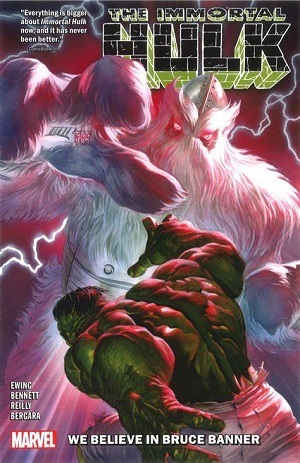
The Immortal Hulk Volume 2: The Green Door

The Immortal Hulk Volume 2: The Green Door

On the plus side, there were some crazy fights here, as the Hulk’s new-found immortality is pushed to the limit and beyond. He’s approaching god-level power and is strong enough take on all of the assembled Avengers. Even if you blow him up with a space laser and then dissect him with adamantium blades his parts keep reassembling, which just leads to another big green can of whoop-ass being opened up. The effects can be grotesque in a truly novel way, and his various pieces coming back together to take out one of his tormentors is well worth the double-page spread. Meanwhile, Skinny Hulk, with his gamma power being drained by Absorbing Man is also freaky, and what happens to poor Absorbing Man is off the charts.

In the negative column . . . just what the hell is going on? The Hulkster is possessed by both a literal and metaphorical demon. The latter being the spirit of his abusive father, who still shows up in visions, and the former being I’m not sure what. Maybe an actual emissary from hell, which is where we end up in the end after going through the eponymous green door (which is, sadly, not an homage to one of the signal films of porn chic).

In sum, this is a really weird take on the Hulk mythos – maybe the weirdest yet, which is saying something since it has gone in a lot of strange directions. I have a hunch that writer Al Ewing was trying to do too much. Even the issue epigraphs rarely seemed on point. That said, I enjoyed this volume a lot more than the first, even if it is a dog’s breakfast of crazy. I still don’t know if there’s anywhere it’s going that’s worth getting to, but the trip is turning into a lot of fun.

Graphicalex

TCF: The Infernal Machine

The Infernal Machine: A True Story of Dynamite, Terror, and the Rise of the Modern Detective
By Steven Johnson

The crimes:

With Alfred Nobel’s invention of dynamite in 1867, criminals and revolutionaries were handed a new weapon in their war on the ruling classes and peace, order, and good government more generally. To fight against a spate of bombings, law enforcement had to up their game and develop the kinds of practices we now associate with modern policing.

The book:

If that summary of what The Infernal Machine is about seems kind of broad, don’t blame me. Steven Johnson specializes in these sorts of popular history grab-bags, and the elements are even more random than usual here. Just for starters I had to shake my head at the subtitle calling this “a true story” – not because any of it is fiction but because there is no story in evidence. The narrative, to give it a fuzzier label, takes us basically from the assassination of Alexander II to the Palmer Raids, with various bombings in-between. Are there threads connecting all of this? Sure. But all too often they struck me as coincidental. I mean, if you stand back far enough, tilt your head, and squint, then I guess everything is connected to everything else on some level. But not really.

I’ll stick to talking about the two main narrative axes that Johnson travels along. The first is political or thematic:

This book . . . is the story of two ideas, ideas that first took root in Europe before arriving on American soil at the end of the nineteenth century, where they locked into an existential struggle that lasted three decades. One idea was the radical vision of a society with no rules – and a new tactic of dynamite-driven terrorism deployed to advance that vision. The other idea – crime fighting as information science – took longer to take shape, and for a good stretch of the early twentieth century, it seemed like it was losing its struggle against the anarchists. But it won out in the end. How did that happen? And could the story have played out differently?

Later, Johnson expresses the terms of this “existential struggle” in slightly different terms, seeing “two rival ideologies” in conflict: “the dream of a stateless society, radically egalitarian, free of the oppressive institutions that had come to define the industrial and imperial age” vs. “the surveillance state, where individual identity is measured, recorded, and archived by vast and often invisible institutions, using the latest science and technology to contain potential subversion.”

This is interesting, but was there really that strong a connection between these two ideas or ideologies? Anarchism never took political root anywhere, but was that because it lost an existential struggle with scientific crime fighting? The surveillance state and modern policing are now ubiquitous facts of life, but did that have anything to do with these early battles against bomb throwers?

I think both developments were, if not inevitable, then at least very likely to have taken place without any engagement with the other. Anarchism suffered the fate of a lot of socialist movements with the outbreak of the First World War, while crime fighting was being driven as much by the advance of technology and the response to other threats like organized crime as it was by dealing with political enemies. And then of course there is the difficulty of defining terms. What is, or was, anarchism anyway? A libertarian movement? A call for class warfare? Were the anarchists who practiced “propaganda of the deed” typical of anarchist thought, or outliers? Is it fair to say that all that survives of the anarchist movement today is terrorist bombings like the 9/11 attacks (“the general tactics of terrorism remain anarchism’s most enduring legacy”)? That seems tenuous to me. Terrorism was a tool used by different ideologies, and it predates the invention of dynamite.

The second narrative axis is built around telling the life stories of a pair of prominent anarchists: Emma Goldman and Alexander Berkman. As a biographical sketch of the two what you get here is fine, but again the connection to “infernal machines” (that is, explosive devices) and modern policing isn’t that strong. They were both anarchists, of a sort. Maybe Berkman was in cahoots with a cell of bomb makers at some point. Goldman probably wasn’t. The police kept thick files on both, though they were prominent public figures and didn’t keep any secrets when it came to their radical beliefs. So again: is there a connection? Yes, but not a strong one. Neither story really depends on the other.

The critics on the back cover rave: “Johnson is a polymath. . . . [It’s] exhilarating to follow his unpredictable trains of thought” (Los Angeles Times); “Johnson’s erudition can be quite gobsmacking” (New York Times Book Review). I think my gob may be harder to smack. To me, The Infernal Machine just seemed like a whole lot of everything and not much of anything in particular. The effect was sort of like reading a bunch of linked Wikipedia articles. Did Johnson really need to kick off a chapter on the Ludlow Massacre with an account of how coal deposits were formed in the Cretaceous period? That’s not erudition, it’s just cheap display of superficial learning.

There are a few perceptive moments. I liked it when the following comparison was drawn between then and now.

Berkman and Goldman were living in a world where one side of the spectrum thought it was appropriate to execute people who objected to a seventy-two-hour week of life-threatening work – while the other side of the spectrum thought that we should abandon both governments and corporations and reinvent society along the lines of Swiss watchmaking collectives. Those were the distant poles of the debate. What we would now call the Overton window – the space of potentially valid political beliefs – was far wider than anything in American politics today.

That’s well observed, and it’s a point that’s expanded on after a description of the public memorial service held for a group of anarchists who had blown themselves up while constructing a bomb meant to avenge Ludlow:

More than a century later, it is not hard to imagine a small band of disaffected New York City residents – in our present moment – spinning themselves into some kind of cyclone of hate and building a dirty bomb or a bioweapon in their basement. What is harder to imagine is five thousand people showing up in Union Square to mourn their deaths as martyrs to a greater cause. We still have people willing to kill for political ends in countries like the United States, though far fewer of them than there were back in 1914. But when those beliefs materialize into actual dead bodies, you don’t conventionally see a great outpouring of public support for those violent acts. There were no rallies for the Unabomber.

This is something work keeping in mind when thinking of how we live in an age of extremes. I still think it’s fair to consider various schools of political thought today as extreme, but they’re extreme in different ways. One of the things that has changed the most is the level of sheer crazy we’ve grown accustomed to.

Noted in passing:

Johnson uses the word “attentat” over a dozen times in this book. It wasn’t familiar to me, though it’s the same word (same meaning, same spelling) in both French and German as in English. The basic meaning is of a violent criminal act, or assassination. It also has a legal meaning in English, but that is considered obsolete. In fact, I found several sources online that give its use as meaning an attack or assassination as obsolete as well. So I can’t blame myself for being surprised to see it. But it’s properly employed, as it correctly describes the bombings and attempted assassinations that are a big part of Johnson’s subject matter, and was used by Goldman herself, though she capitalized it. I suspect reading Goldman is where Johnson might have picked it up. So I did learn something here, though it’s not a word I’m likely to ever use myself.

Takeaways:

There’s no invention or technical advance that can’t be made to serve wicked ends. And given time, almost any invention will end up being so used.

True Crime Files

Alien: Bloodlines

Alien: Bloodlines

In my notes on Aliens: The Original Years I said how much I loved the writing. The way that Mark Verheiden took the story in so many interesting new directions put what happened to the film franchise after James Cameron’s Aliens to shame.

I don’t think what writer Phillip Kennedy Johnson does in this six-issue story arc is on quite the same level as Verheiden’s work, but it’s very good. A tough-as-nails security chief named Gabriel Cruz has to go back to a space station orbiting Earth when his son joins up with an activist group that wants to throw a monkey wrench into what the Weyland-Yutani Corporation is doing up there. Unfortunately, what they’re doing up there is breeding a bunch of Xenomorphs, so of course things get out of hand. It seems that despite all the time spent studying them we’ve never learned how to handle these critters.

Throw in some Bishop-model cyborgs that all look like Lance Henriksen, a super “Alpha” Xenomorph and a mysterious dark queen of the hive, and a strange subplot that has the Xenomorphs forming a psychic bond with Gabriel because he’d survived incubating a facehugger (it was cut out of him before it matured and made its own exit), and I thought there was a lot of interesting stuff going on here, most of which I enjoyed.

What I didn’t like was the art by Salvador Larroca. To give him some credit: the aliens look good and some of the action sequences, like the guy getting his head blown off with a shotgun, are nicely done. But where Larroca really falls down is in his drawing of the human characters, and particularly their faces. Everyone seems made of plastic, or like they’re the product of an AI art-generator, and not a very advanced AI program either. (I also thought the colorist was a program, as the credit is to Guru-eFX, but apparently that’s a real person.) Emotion doesn’t register at all, even when characters are yelling or screaming, and there’s little sense of movement in the way the figures are drawn. From what I’ve been able to gather, there’s a lot of strong opinions on Larocca out there in the comic community and I can only say that while I can see some people liking his style it’s not my thing and it took my grade on this comic down quite a bit.

But if you’re a fan of the franchise I’d definitely recommend this just for the story. You may not like the art any more than I do, but it’s something you’ll be able to put up with.

Graphicalex