TCF: A Murder in Hollywood

A Murder in Hollywood: The Untold Story of Tinseltown’s Most Shocking Crime
By Casey Sherman

The crime:

On April 4, 1958 gangster and gigolo Johnny Stompanato was killed by a single stab wound to his belly in the bedroom of his then girlfriend Lana Turner. There had been a long history of Stompanato being a violent domestic abuser. At the coroner’s inquest it was found that Turner’s 14-year-old daughter, Cheryl Crane, had held the knife, but the jury found it a case of “justifiable homicide” so there was no criminal trial.

The book:

My previous attempt at a Casey Sherman book hadn’t gone well. His account of the serial killer Tony Costa’s rampage on Cape Cod, Hell Town, even made it into my DNF files. It was bad. But I still wanted to give this one a shot, mainly because it’s a case I’d often heard of but didn’t know much about.

As usual with true crime, the title oversells things. Was this really Hollywood’s “most shocking crime”? I’m not sure a woman (or a woman’s daughter or other family member) killing an abusive husband or boyfriend counts as very shocking. I mean, also on the cover there’s a blurb from Ben Mezrich calling it “one of Tinseltown’s darkest moments,” but even that seems like a stretch to me.

Even more questionable though is the subtitle’s assertion that this is an “untold story.” Really? The case was given saturation coverage by the media, for obvious reasons. And the fact is that Sherman’s sources consist mainly of the published memoirs of the main players in the drama, including Turner, Crane, and L.A. crime kingpin Mickey Cohen. Does Sherman add anything new to the mix? I don’t see where he has, and keep in mind that the most recent of these memoirs is over 25 years old. I also didn’t register a single point where he called into question the accounts of events described by Turner, Crane, and Cohen, despite the fact that autobiography is the least trustworthy genre of non-fiction writing there is.

As it is, we’re left with a number of scenes that we just have to take on faith. And not only faith in the memoirist making an honest report, but in their having an accurate recollection of events that may have happened thirty years before they set them down. When I reviewed Hell Town I called Sherman out for his description of events that I didn’t see how he could know so much detail about. Here he at least has a source for most of his stories, but if you don’t trust the source this doesn’t always help very much. Take the following two incidents, which I just flagged at random. The first describes Turner coming home to her husband Lex Barker after learning that he’d been molesting her daughter Cheryl:

While Cheryl remained at Mildred’s [Turner’s mother], Lana drove back to the house she shared with Barker. With rage building inside her, she walked quietly upstairs and into their bedroom. Lana had kept a pistol by her bedside after the foiled kidnap attempt of her daughter. Barker slept soundly while Lana reached for her gun. She stood over her husband with the weapon pointed directly at his head. One shot and he would be dead. Her finger rested on the trigger. She was ready to pull, but she stopped herself. If she murdered Lex Barker in cold blood while he was sleeping in their bed, she would undoubtedly get the gas chamber herself. And what good would she be to Cheryl then? Lana lowered the pistol and left the room. She stayed up for the rest of the night, smoking, crying, and contemplating her next move.

Of course the only possible source for this would be Turner, though the notes only refer to Crane’s memoirs. So I really don’t know how much to credit it. It makes for a very dramatic, even cinematic, moment (the book was immediately optioned for a film deal), but that just makes me more suspicious as to how much of it really happened.

A few pages later another dramatic scene plays out, this time with Frank Sinatra confronting Mickey Cohen. Stompanato had apparently been making a play on Sinatra’s then wife, Ava Gardner.

“Look, I want you to do me a favor,” Sinatra said, staring at Cohen with his famous blue eyes. “I want you to tell your guy Johnny Stompanato to stop seeing Ava Gardner.”

Cohen did not care how famous Sinatra was or what his deep connection to the underworld were. He damn sure wasn’t going to play Mr. Fixit for Sinatra’s love life. Cohen peered out his living room window and noticed the unmarked police car parked across the street.

“You mean to tell me you came all the way out here where they’re recording everybody’s name and number that comes near this house?” he asked rhetorically. “This is what you call important? I don’t get mixed up with no guys and their broads, Frank.”

Sinatra was not accustomed to getting dressed down in this manner. At that point, Cohen took out the proverbial dagger and stuck it in his back.

“Why don’t you go home to Nancy where you belong?” he asked spitefully in reference to Sinatra’s first and long-suffering wife, Nancy Sinatra.

Again, there is only one possible source for this story and that’s Cohen. Did he really “dress down” Sinatra in this fashion? Did he say these exact words? Or is he making himself the hero of his own story?

What makes the dependence on a few far-from-disinterested sources more troubling still is the fact that there is a real mystery at the heart of Stompanato’s murder. Is it true that Cheryl Crane killed him? She always claimed that she did, but many have their doubts, as do I. (If you’re wondering why the defence team would want to pin the rap on her, it’s because as a minor she wasn’t liable for the death penalty in California.) The narrative of what happened on the night in question is pretty shaky (per Sherman: “Lana went black for a moment. All the rage growing inside her had made her blind. Suddenly, there was a frenzy of motion in the bedroom . . .”), and the post-murder behaviour of Turner and her entourage was highly suspicious. In particular I’m talking about the staging of the crime scene. You don’t have to be as cynical as I am to raise an eyebrow skyward at what happened immediately upon the death of Stompanato. Did Turner call the police? No. Instead, she made “four frantic phone calls” to: her mother, a doctor, her ex-husband (Cheryl’s father), and her lawyer, Jerry Giesler. When Giesler arrived he then called “his clean-up man” Fred Otash.

Otash despised Stompanato and was happy to see his lifeless body sprawled out on the carpet of Lana’s pink bedroom. Otash looked around the bedroom and got to work. It took the private investigator two full hours to stage the crime scene to Giesler’s satisfaction. The attorney gathered Lana and Cheryl in the bedroom. . . .

Giesler huddled with Lana and her fourteen-year-old daughter and painstakingly walked them through his plan. Content with the narrative he was about to weave for police and the public, Giesler finally dialed the authorities.

When police officers were summoned to North Bedford Drive more than 120 minutes after Stompanato was stabbed to death, there was something peculiar about the setup in Lana’s bedroom. Investigators were surprised to see that there was little or no blood on the rug, and the bedroom walls were damp and appeared to have been recently scrubbed. Stompanato’s body looked like it had been moved from its original location. Also, the cover had been taken off Lana’s bed and was nowhere to be found. “It looked like a hog had been butchered on it,” Giesler reportedly told friends later on. The murder weapon, the kitchen knife, was located on the sink in the en suite bathroom. The fingerprints on the handle were wiped clean. It also looked like all the bathroom towels were missing from their racks, possibly used to soak up all the blood in the room. Were the bloody linens now stuffed in the trunk of Otash’s car to be burned later?

I don’t know about you, but this doesn’t inspire a lot of confidence in me that the “narrative” Giesler prepared had much relation to what really happened in Turner’s bedroom. It’s certainly something you’d think Sherman would want to look into a little more deeply, making some reference to later accounts of what Turner and others reportedly said about what went down the night of the murder. But he pretty much leaves the finding of the coroner’s inquiry alone, only tossing in suggestive tidbits like Lana dreaming of Johnny: “A long knife appeared in her subconscious, but who was wielding it? Was it her? Or was it Cheryl. It was all a blur to her now.” What are we to make of this? What is Sherman’s source? I couldn’t find any. In any event, for a book selling the “untold story” of Stompanato’s murder not having more to say about it than a sleepy “blur” is leaving a lot on the table.

“To me,” Sherman concludes in an Author’s Note, “Lana was a feminist hero and a pioneer.” Before the #MeToo movement, he writes, “we all must offer thanks to a female star from the golden age of Hollywood who broke a vicious cycle of violence and took her life back.” This is problematic on several counts. First of all, the #MeToo movement mainly had to do with “shitty” industry men preying on women who were trying to make it in the business. Harvey Weinstein was the totemic figure. But Turner sought out inappropriate men who the studio heads, most notably Louis B. Mayer, didn’t want her having anything to do with precisely because they would damage her career.

And in at least some cases she sought them out because they were bad boys. We want to tread lightly here because of the knee-jerk response to calling out a woman’s bad life decisions as victim-blaming. But the fact is that Turner, easily one of the most desirable women in the world at the time, was married 8 times to 7 different men (she re-married Stephen Crane, Cheryl’s father, when she found out she was pregnant). They were a line-up of drunks, losers, abusers, and one pedophile. And this isn’t including Stompanato, who she never married. Everybody is allowed one mulligan for making a bad choice of partner, but it’s only stating the obvious to say that Turner wasn’t just a poor judge of character in the men she dated but was setting herself up for serial disasters. After a while you have to own up to the fact that the problem is you.

Take her mésalliance with Stompanato, who endeared himself to her at one point by climbing a fire escape, breaking into her apartment, and attempting to rape her. “His consuming passion was strangely exciting,” she would later write. “Call it forbidden fruit, or whatever. But his attraction was very deep – maybe something sick within me – and my dangerous captivation [with him] went far beyond lovemaking.” That, at least, shows some self-awareness. But as a feminist “hero” I think Turner is compromised.

In sum, this is a pulpy read but not one that I thought added anything by way of new research or a fresh interpretation of the case. It’s basically just a recitation of what Turner, Cohen, and Crane had already said about it. And I’ll add another of my standard complaints about how the pictures are no good. They’re small, grainy, and mostly credited to Sherman himself, being pictures of locations as they appear now. Which isn’t always how they appeared back in the day. Why even include a recent picture of the famous Hollywood sign when (1) everybody already knows what it looks like, and (2) as the text makes clear, the sign at the time when Turner arrived in town read Hollywoodland (the “land” was only dropped in 1949). For a historical work of true crime like this there must have been a full archive of better pics to draw on. Could the publisher just not get the rights? There are even pics available online of the crime scene and the police looking at Stompanato’s body. You’d expect a photo section in a book like this to be stacked with pictures of Hollywood stars and the murder scene, but you get nothing like that. So in my opinion they would have been better off leaving pictures out entirely. If you’re not going to do it right then you might as well not bother.

Noted in passing:

“Cheryl had lost four pounds while being locked up at Juvenile Hall.” This statement was dropped in out of nowhere and I didn’t know how to take it. Was I supposed to think that losing four pounds in a week, or however long she’d been in for (it isn’t clear), was a lot? Because it isn’t. Even for a tall, skinny kid. I can easily lose four pounds in a couple of days by not eating as much, and I’m not obese. I suppose Cheryl didn’t care for the food in Juvie and wasn’t eating as much, so losing four pounds doesn’t strike me as either surprising or a big deal.

Takeaways:

Some women sure can pick them.

True Crime Files

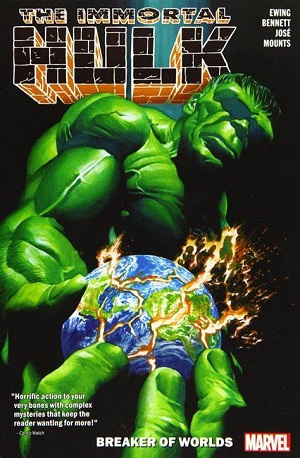
The Immortal Hulk Volume 1: Or is He Both?

The Immortal Hulk Volume 1: Or is He Both?

I don’t know how much credit to give them for saddling this first volume of the Immortal Hulk series with such an obscure title. It’s a bold move that may appeal to die-hard fanboys, but when I was a kid I had a reprint edition of The Incredible Hulk #1 – the cover of which asks “Is He Man or Monster or . . . is He Both?” – and even I didn’t make the connection here.

So much for the “Or is He Both?” part. How about The Immortal Hulk? Well, as things kick off the world thinks Bruce Banner/The Hulk is dead. I’m not sure how or when this happened. There’s a bunch of excerpts from different comics at the end of this volume that are less than informative on the subject, and I didn’t feel like doing any further research (and you can certainly find answers to all these questions, and more, on the Internet).

In any event, as you will have guessed, the Hulk isn’t dead. In fact, he can’t be killed. He can even get a giant hole blown through his chest and it fills back in again. This leaves Bruce Banner to “walk the earth” in a hoodie, righting the odd wrong and filled with existential angst because when he looks in a mirror he sees the big green guy glaring back at him. And before long the cops, the media, and even an old friend are on to him.

I have to say I didn’t care very much for anything going on here. The art didn’t strike me as anything special, even with the way they tried to change things up in issue #3 (different styles for different narrative voices). And the stories weren’t all that good. Instead of being triggered by anger, Banner turns into the Hulk now at night. I don’t know why. In the first issue the Hulk avenges the accidental killing of a girl in a gas station hold-up. Then he encounters a guy who turned himself and his son into glowing green Hulk knock-offs. Then he fights Sasquatch, who is another Hulk-wannabe gone bad. This is a theme that’s played on throughout, as the reporter tracking the Hulk confesses at the end that she wants to be like him too. But of course they don’t understand.

There’s also something going on about Banner’s father, but I couldn’t figure out what that was. I think he abused Bruce when he was a boy. So on top of everything else the Hulk has daddy issues.

I’ll probably give this run some more time to get its feet, but in the first five issues I didn’t get the sense that it was going anywhere, and to be honest I don’t find the Hulk that interesting, so I might not stick with it for long.

Graphicalex

Marple: The Body in the Library

Again Miss Marple remains in the background. At least in the early going, this was a big part of her character and her method. Recall her quietly knitting through the stories of The Tuesday Night Club, or the fact that she isn’t the narrator of The Murder at the Vicarage and indeed isn’t a major presence in that book at all. In The Body in the Library she doesn’t even appear very often. She’s not the sort of detective to lead a very active investigation, looking for clues, or interviewing witnesses. Sure she does a bit of that, but mostly she just notices things. Luckily, the police are willing, if not always happy, to have her along for the ride.

Marple’s process of ratiocination goes from the local to the universal, the incidental to the supremely important. We’re told she “had attained fame by her ability to link up trivial village happenings with graver problems in such a way as to throw light upon the latter.” But to be honest I never see a lot of that happening. We just have to take it on faith, since any village happenings are only slightly alluded to. What seems more on tap here is a literary diversion. “Bodies are always being found in libraries in books. I’ve never known a case in real life,” says gruff Colonel Bantry, just before finding a body in his library. Christie herself introduced the book as having been written out of a desire to play a “Variation on a well-known Theme,” with the theme being the body in the library, recognized to be a cliché of the detective story. This made me wonder how many bodies had been found in libraries before this book (which was first published in 1942). I guess a lot.

Otherwise this seems much the usual puzzle for Jane to solve. The killers hatch an insanely complicated plot, which is made even more difficult to untangle because the innocent guy they attempt to frame behaves in a ridiculous manner. He’s the one who thinks it would be a neat idea to hide the body in the library of Colonel Bantry, just because he doesn’t like the Colonel very much. And I guess he was drunk. Throw in the absurd idea that only one person has to (mis)identify the dead body or else the whole scheme would instantly fall apart and you’ve got something so farfetched I don’t think it’s being fair to the reader. And then you get another of those clues that depends on a bit of specifically British knowledge, like the “banting” and “hundreds and thousands” that I pulled a blank on in “The Tuesday Night Club.” The clue here is a passing reference to Somerset House, which at the time was where the Registry of Births, Marriages and Deaths had its offices. But the Registry moved in 1970 and I don’t think that’s something anyone would be likely to get today. I didn’t understand what its mention meant even after I’d been alerted as to its significance.

Of course there are other Britishisms that I failed to grasp, like “beer and skittles,” but they weren’t as important and only gave the proceedings a bit of period charm.

And finally, since I’m on a roll here, the business with the fingernails is quite obscure.

To be honest, after having re-read the first Miss Marple stories and then the first two novels I’ve come away thinking they’re markedly inferior to Christie’s Poirot mysteries. And I’m not sure I liked them any better when I read them the first time forty or more years ago. As noted, the plots are bonkers, and not in a good way, as much as Miss Marple herself would want to object.

“An intricate plot,” said Colonel Melchett.

“Not more intricate than the steps of a dance,” said Miss Marple.

“I suppose not.”

Of course, the undoing of the intricacy is the point of the exercise, which is why the plot has to be so complex. There’s a nice moment here where it’s suggested that the “explanation of the whole case” may be criminal insanity, but this is immediately dismissed by the police superintendent as being “too easy.” “There are such cases,” he had earlier admitted, “but we’ve no knowledge of anyone of that kind operating in this neighbourhood.” “One does see so much evil in a village,” Miss Marple explains at another point. But not that kind of evil. As I’ve mentioned before, for Christie there are only three motives for crime: sex, greed, and lunacy. And she has no interest in lunacy because it can’t be explained in a clever way. We’re more used to psychopaths in our own time because they get so much media attention. Back in Miss Marple’s day they weren’t as interesting.

Marple index

The Object-Lesson

The Object-Lesson

I love the work of Edward Gorey but you have to take it in small doses. As I go along (if I keep going along) I’ll be revisiting his various Amphigorey collections, but until I get to them this little book will do as an entry point to his dark universe.

Dark because danger and death and loss and mutilation are always lurking around the corner. Some monster is no doubt waiting behind that thick network of wallpaper we’re faced with on the first page. A beast hiding in the mists on the moors. In the trees . . . “a bat, or possibly an umbrella.” You can’t even tell what it is when it flies away. “Something happened to the vicar,” and from the looks of it nothing good. Perhaps a bicycle accident.

The horizontal nature of the book leads you to believe there’s some sort of continuity at work in the way landscapes seem to run from page to page. Your eyes are moving at speed across a sweep of space. But is there a thread that holds it all together? Not an obvious one, but that just means we have to fill in the gaps and make the links ourselves. The text may suggests temporal relations. “Meanwhile, on the tower . . .” And we seem to be moving from morning through day to night. But are there also traps? When the people in the dinghy cry “Heavens, how dashing!” are they talking about the “erstwhile cousin” stepping backwards into the water? They seem to be looking at him, but is that just a coincidence? And is that water the same lake the lordship meets the Throbblefoot Spectre by? And are odd figures who are never identified recurring, or different people? Take the lady in mourning by the edge of the lake (she appears again from a distance, walking either away from or towards the tower), or the lady with the flowerpot.

Surrealism? Yes, or at least the absurd. It’s in the dreamlike symbolism of the landscape mostly. That tower in the middle of nowhere. The ornate gates to the asylum with no adjoining walls. The lonely kiosk. Detached structures that again might be understood as in the same neighbourhood, or be located on different continents and in different eras.

A haunted world, and by what? “The miseries of childhood.” That kid on the second page has seen too much that can never be forgotten. He (or she) will lose much that will never be found.

Graphicalex

The Battle of Cape Matapan remembered

HMS Valiant, in her glory days.

The Battle of Cape Matapan was a naval engagement fought between ships of the British and Australian navies and the Royal Italian Navy from 27 to 29 March 1941 in the Mediterranean Sea. It was a clear victory for the allies, as they sank five Italian ships without losing any of their own, but it didn’t have great strategic importance, mainly serving to limit Italy’s operations in the Eastern Mediterranean for a while. For military historians, however, it is distinguished as “the first big naval battle of World War II” and “the only large fleet action in the war which took place outside the Pacific theater.”

Such, anyway, is the judgment of William Koenig in his chapter on the battle included in a coffee-table book called Two Centuries of Warfare. That book was published in 1978 and it was hanging around the house when I was a kid. At some point, I believe around 1980, in fell into the hands of a family acquaintance who had actually been involved in the battle as a member of the Royal Canadian Naval Volunteer Reserve, serving I believe as a radar operator on the battleship Valiant (the use of radar played an important role in the British victory). He wrote up a note on his own observations in response, and it was kept stuck in the pages of the book. I recently rediscovered it when the book was getting ready to be tossed out in a house-cleaning exercise. I thought I’d post a transcript of it here just because it’s worth holding on to these eyewitness/participant accounts of history before they’re lost entirely. Unfortunately I no longer remember the name of the fellow who wrote the note and I can’t make it out from his signature. But for anyone interested in the battle, here’s what he had to say (I’ve given a literal transcript, with no editing for spelling or grammar).

This is not quite as it happened. The Italian ships Pola, Zara and Fiume were first picked up by Valiant’s radar at about 15 mile range which permitted the British ships Warspite, Valiant and Barham to close the Italian ships. At about 3000 yards range the ships were [?] to starboard in line a head and passed the Italian ships at about 2900 yd. range. Using radar range bearings the search lights were turned on and the battle ships opened fire with the results as indicated in the book. Of interest is the fact that Prince Philip now Duke of Edinburgh a midshipman at the time manned one of the search lights. I was passing range and bearings to him over the ships intercom system.

Xerxes: The Fall of the House of Darius and the Rise of Alexander

Xerxes: The Fall of the House of Darius and the Rise of Alexander

I guess you could call this a sequel to 300, but it came out in 2018, which was 20 years later, and doesn’t have much to do with the events of Thermopylae, which it skips in its race through over 150 years of Persian history. There’s also no real connection to the movie 300: Rise of an Empire, which actually had come out four years earlier.

The treatment of history is weaker than in 300 too. The “House of Darius” would be the Achaeminids, wouldn’t it? Or that’s what Darius I would have claimed. But I would have thought that would be the House of Cyrus, if anyone. The jeweled bodysuits of Xerxes and other Persian emperors was, and remains, mystifying to me. I was rolling my eyes a lot at some of the architecture and statuary, like the colossi on the Athenian acropolis. Aeskylos (Aeschylus) is reimagined as a cross between Darth Maul and a ninja. And Alexander the Great, when he shows up, is basically the reincarnation not of Hercules but Leonidas (because beards are manly). It all seemed a lot sillier than the earlier book. And the art felt lazier too. More full-page splashes (a good word for the splatter effect being used so often), with a few great sequences (the imagined deaths of Xerxes) and some very uninspired and pointless ones (the Ethiopian archers). Given the minimal and disjunctive text, it felt like a bunch of posters with big titles: Marathon! Xerxes Assassinated! Gaugamela! I’ve added the exclamation marks but they feel like they should be there.

300 managed to be an original and quite effective retelling of a particular historical incident. This book covers vastly more ground (both in time and space) and ends up just being a bunch of odd pictures. As I’ve said, some of them are great but most are just more of the same and I came away feeling that none of it added up to much.

Graphicalex

Marple: The Murder at the Vicarage

A characteristic of a lot of detective fiction is that it’s quickly consumed and just as quickly forgotten. We remember the classics – The Hound of the Baskervilles, Murder on the Orient Express – but the others disappear from our minds so quickly that we can read the same book just a year or even months later and be unable to remember the first thing about them. At least this is true for me, as it was for my mother, who always had a mystery novel (or several) by her bedside. When I commented on the fact that she’d read some of them before she’d reply that it didn’t matter because she could no longer remember whodunit.

One reason I think this happens is because a lot of what goes on in a mystery novel is supposed to be quickly forgotten. Important clues are skimmed over in such a way that you’re meant to miss them. Is it any wonder they vanish from our minds when the book is done?

That’s just a theory of mine. But it helps explain how, when I came to write up these notes on The Murder at the Vicarage only a couple of weeks after finishing reading it, I could no longer recall who it was that had been killed at the vicarage, who had done the killing, and why. And this wasn’t a momentary lapse of recall. I tried for hours to think of what had happened in the book and couldn’t come up with anything.

At any rate, the story has it that Colonel Protheroe is shot in the vicar’s study, and there are no end of suspicious characters floating around. The vicar himself is the narrator, and he finds the discovery of a body in his study quite upsetting not just for personal reasons but because “nothing exciting ever happens” in town. “There are had been no murder in St. Mary Mead for at least fifteen years,” and as a result they “are not used to mysteries.” Seeing as this was the first Miss Marple novel, these might be taken as famous last words. But once Jane is on the case he knows things are in good hands. “There is no detective in England equal to a spinster lady of uncertain age with plenty of time on her hands.” Especially when that spinster is “not the type of elderly lady who makes mistakes. She has got the uncanny knack of always being right.”

Miss Marple operates, as usual, in the background. I’ve mentioned how the vicar tells the story and the truth is we don’t get to see the detective spinster doing much. Which isn’t too much of a problem as it also seems natural for the police to invite any respectable citizens to join them in the investigation by sitting in on interviews of suspects and inspecting evidence and the like. Those were the days!

It’s also nice that Miss Marple isn’t as direct a presence because she is a pain in the ass. As Robert Barnard remarked of this novel, “the strong dose of vinegar in this first sketch of Miss Marple is more to modern taste than the touch of syrup in later presentations.” I don’t know. I don’t like the vinegar or the syrup, to be honest. She’s either bitchy or a quietly superior know-it-all with the uncanny knack of always being right? Those aren’t great options.

The plot is pure Christie, and features most of her staple elements. The theatricality of the crime, with its ridiculously complicated staging (the business of faking the gunshot had me rolling my eyes in a loop). The importance of a strict time scheme, which can also be cleverly manipulated. Two or more killers working together to give each other alibis. The simplicity of motive, which always comes down to lust or greed. A third category, of mental disturbance or “queerness,” is never in play. The doctor may have his medical theories to explain crime, but Miss Marple knows better, being a student of that great generality “Human Nature.”

There are also those dated references that a twenty-first century reader may take some time figuring out. One of the girls here is described as having “Lots of S.A.” It took me a while to decide that this must mean sex appeal. (In the story “The Herb of Death” Miss Marple herself had to have it explained.) And here’s another siren who the vicar observes with disapproval: “Her legs, which were encased in particularly shiny pink stockings, were crossed, and I had every opportunity of observing that she wore pink striped silk knickers.” This struck me as shocking until I realized that “knickers” in this context must have been referring to something like a slip.

But in the end I didn’t care for this one very much. It’s a weak mystery, and the explanation confusing, far-fetched, and uninteresting. For a book only too aware of its status as a mystery (there are repeated references to the events being just like a mystery novel), it doesn’t play as very clever or arch. And as I say, as soon as it’s finished it’s forgotten.

Marple index

Bleedout

Bleedout

From the publisher: “Bleedout was created to provide back story for CrimeCraft, a free-to-play online video game in which players create characters, form gangs, and engage in fast-paced shootouts for cash and bragging rights.” The book came out in 2011, and when I checked CrimeCraft is no longer going. So what we have here is the back story for a game that doesn’t exist anymore. At the end of ten short chapters we’re told this is the “End of Book One,” but I don’t think there was ever a Book Two. And I think it’s unlikely there are any plans for one now.

I could leave it at that. Really, this is a nicely produced, hardcover (!) graphic novel that reminded me of the booklets that used to come with video games you bought in a box, giving players some fictional context for the world they were entering. Two things stand out about it. First: Mike Kennedy is the author of all the stories, but each chapter has a different artist. This was kind of neat, and while a few of the artists seemed similar, I thought the art was pretty good overall and there were some different styles on tap (albeit not radically different). Second: There is no dialogue. The story is told entirely through narrative exposition. And there is a lot of back story to get through, and quite a few major characters to be introduced: basically our hero and the various leaders of the different Sun City gangs.

Yes, Sun City. There’s a video game location if ever there was one.

There’s not much more to say. We’re in an urban environment after the collapse of civilization as we know it, due to a bacteria that ate up all the world’s oil reserves (which were quickly diminishing anyway). A bunch of criminal gangs have taken over. A mysterious guy called Pilot, who may be a genetically engineered super-soldier, is out for vengeance against one or all of the gang leaders, for something they did, sometime in the past. I guess all of this was going to be explained in Book Two, but now we may never know. Or maybe you figured out what was going on if you played the game . . . but if so then we may still never know.

It is a nice looking comic and I actually thought the world it created was kind of neat, but as things turned out it’s an orphaned world that nothing was ever done with.

Graphicalex

TCF: Vanished

Vanished: Cold-Blooded Murder in Steeltown
By Jon Wells

The crime:

Acting on a tip that came in on Easter weekend 1999, police found a garbage bag stuffed with body parts on steelworker Sam Pirrera’s front porch. The remains were later identified as belonging to Maggie Karer, a Hamilton sex worker. As police investigated the case it became clear that Pirrera might also have had something to do with the disappearance of his first wife, Beverly Davidson, eight years earlier. Charged with the murder of both women, Pirrera died of a drug overdose, almost certainly suicide, just before his court date.

The book:

While grisly, the crimes here were nothing out of the ordinary for tales of domestic abuse escalating to murder. Pirrera was a violent cocaine addict who spiraled out of control. In fact, the presumed murder of Beverly took place in a manner that I have alerted people to before on several occasions and I can only repeat my earlier takeaways: If the relationship is over, it’s over. You don’t arrange to meet up with your ex for a talk about whatever outstanding issues you may have, especially if there’s not going to be anyone else around. This is part of the value of reading true crime; you can learn something from it.

I suppose killers could learn some lessons as well. One of the chief among these is the disposal problem. Especially given the advances made in forensics, a killer has to be able to make all of the evidence disappear. And I don’t mean just tossing body parts in the garbage, or trying to flush them down the toilet (the latter method being how both Dennis Nilsen and Joachim Kroll were caught when the remains backed up the plumbing). Not even the wood chipper from Fargo is going to do the trick, since that will leave blood splattered all over the inside of the machine. It’s hard to make the evidence of a body disappear entirely. When Dellen Millard used a portable livestock incinerator (known as “The Eliminator”) to get rid of the remains of Tim Bosma there were still some of his bone fragments found in it.

No, if you’re going down this road you have to be able to make a victim literally disappear. When looking for evidence of Pirrera’s having killed his first wife, Beverly, police scoured the house they had lived in together eight years previously, and which had long been occupied by another family, scanning the basement and bathrooms for microscopic traces of blood. They didn’t find anything, but the very idea that they would undertake such a search gives you some idea of what is possible.

Unfortunately for the police, Pirrera is presumed to have disposed of the body of his first wife in a way that was practically foolproof. As noted, he was a steelworker, employed (fitfully, as his issues with cocaine addiction ramped up) at the local Stelco works. (To explain the title to those not familiar with the place: Hamilton, where the crimes took place, is known as “Steeltown” because of its history with that industry) The theory the police had was that he cut the body up and then threw the pieces into a vat of molten steel. That’s making a body disappear. It reminded me of how Robert “Willie” Pickton, the serial killer/pig farmer in British Columbia who killed nearly 50 women, may have got rid of the bodies of his victims by taking them to a rendering plant, feeding them to the pigs, or grinding them up and mixing them with pork he sold to the public. I think the rendering plant theory in particular almost as effective as the vat of molten steel. In any event, what caught Pickton out in terms of physical evidence was the fact that he held on to some personal items belonging to his victims. I think the only body parts they located were a few skulls.

This was a brutal case, with the brutality mostly being the consequence of Pirrera’s drug abuse. That sort of thing rarely ends well, though it doesn’t often blow up as badly as it did here. It’s a tribute to Wells’s ability to tell a story though that he turns these events into such an effective work of true crime reporting. I think two things helped. First, it isn’t a timely book. Karer’s murder took place nearly ten years before Wells wrote about it, which allows for a bit more perspective from all the people involved. Second, the specially commissioned photos by Gary Yokoyama add a lot. I like to complain about true crime books where the photo sections consist of poorly reproduced pictures that sometimes have only a tenuous connection to the story, so it’s nice to be able to give credit to a book that made an extra effort in this regard.

Noted in passing:

The house where Pirrera killed Karer turned into a local site of interest, so that people would even come and knock on the door asking the new owners if they could look at the basement (which had subsequently been refurbished). It got so bad that the owners “asked, and received, city permission to change the number 12 on the façade to a different number for a $130 fee.” Which is nice, but I didn’t understand how that would work. Legally the address would have to be the same for emergency services, so I guess this just meant they put a different number on the door or over the garage. But who would this fool? Anyone motivated enough could just count the numbers of the houses on the street and would notice a jump from 10 to 14, while everyone else would just get confused. How would deliveries work? This seems really strange to me.

Another point I wanted to flag has to do with the book’s preliminary material, being a couple of pages of blurbs of “Praise for Jon Wells.” One of these blurbs comes courtesy of Alex Good in a review of the book Poison that I did for The Record back in 2009. Two things struck me about this. One good: all too often these blurbs are just quoted and then the name of the publication given. It’s nice that I got credited by name. Thank you! Reviews don’t write themselves, you know. One bad: I looked and couldn’t find my review of Poison. I remember reading and reviewing it but I guess I never posted the review at Good Reports and it wasn’t anywhere else I checked. If I want to retrieve it now I’m probably going to have to fire up an old computer and see if it’s somewhere on the hard drive. I sure don’t have a print copy. Nothing lasts forever, people!

Takeaways:

Cocaine is a hell of a drug. Stay away from the stuff.

True Crime Files

Scooby Apocalypse Volume 1

Scooby Apocalypse Volume 1

I’m happy to say this was something I wasn’t expecting. Of course, by this point in history every bit of pop culture has been zombified, and our obsession with end times seems in no danger of letting up (for good reason, I might add), so why not give the Scooby-Doo gang their own apocalyptic saga? I was on board for it. I mean, I wasn’t counting on it being anything special but I was on board.

Well, as things turned out it was kind of special. First off, there aren’t any zombies. Instead, the apocalypse is brought about by those darn scientists with their lab coats and their desire to remake the world, and specifically humanity, into something better. Yeah, we know how that usually works out. We learn about this from Velma, who is the goggle-eyed brainiac in a lumpy orange sweater that we all know and love but who now has a much more complicated backstory. Rounding out the rest of the crew are Daphne and Fred as a pair of crusading “new media” citizen journalists (hey, they have a late-night show on the Knitting Channel) and Shaggy as a dog trainer who is helping out with a new program meant to create special dog soldiers at the same top-secret underground compound where Velma is working on her nanite plague. And the dog program has one washout of a recruit named Scooby-Doo. Rat’s right!

The characters are all easily recognizable, down to their signature lines. A refresher: Daphne says “Jeepers!”, Velma says “Jinkies!”, Scooby says “Zoinks!”, and Scooby says “Ruh-roh!” And they also have the same basic personalities you’ll remember from the classic TV show. Fred is the well-meaning but dense muscleman,  and he’s in love with Daphne. Daphne, in turn, is the professional woman warrior. Velma is the brains. Shaggy is a hipster. And they even get around in a revamped Mystery Machine, which is now a tricked-out war wagon. I’ll mention Scrappy-Doo too, but won’t give any spoilers for how he turns out.

The art is great and the colourful monsters a lot of fun. As I said, they’re not zombies. Velma’s corrupted nanites have turned the world’s human population into a motley assemblage of demons, vampires, and other freaks. How much of this was part of a deliberate plot is left undetermined, as is the extent of Velma’s involvement, but we still feel she’s on the side of the angels. Because who doesn’t have a bit of a nerd fetish for Velma?

If I had one complaint it’s that there’s too much going on. It’s a good story, and the characters are reimagined in a way that’s original but not degrading or overly political (this isn’t Mindy Kaling’s Velma). There’s no agenda to any of it. But there’s a lot of talk here. A lot. This is a comic that takes a long time to read, and I felt a good part of it was unnecessary. We’ve lived with the apocalypse long enough now for us to hit the ground running. We know the drill and it doesn’t take that long for us to be brought up to speed. I also had a hunch that whatever the mysterious Four were up to wasn’t actually that interesting. But that’s a question for the next volume to answer.

Graphicalex