MAD Book of Almost Superheroes

MAD Book of Almost Superheroes
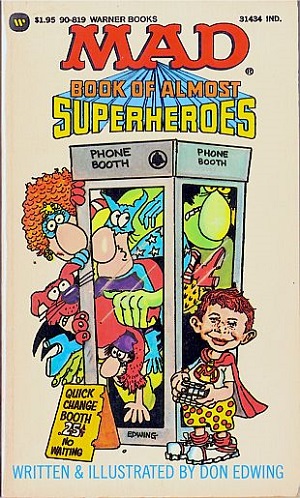
MAD Magazine specialized in satire, or sending up established material. So movies and TV shows. The media, mainly because they loved doing ad parodies. Political figures. That sort of thing.

I’ve previously looked at their take-offs of famous detectives. This book, written and illustrated by Don “Duck” Edwing, does something similar with superheroes. Some of these also-rans are parodies of recognizable heroes – Ms. Wonder Blunder, Fat Bat, The Macho Hunk, Superdud – while others are new inventions. Or at least they seemed like new inventions to me as I couldn’t identify any originals. In this latter camp we get Captain Trivial (“The superhero for the minor annoyances!”), Ragoo of the Jungle (“The gourmet of all comicdom!”), and The Masked Bernard (“Follow the adventures of this wonder dog of the mountain tops in his never-ending search for a fire hydrant!”).

The humour is that of the gag, running for three or four pages with a quick set-up and then a punchline. Aside from the long Ms. Wonder Blunder story, which is also the weakest piece in the book, that’s how everything is presented here. There’s a breathless structure to it, with each new gag being introduced by a quick bit of table-setting: “Meanwhile . . .” “As you remember . . .” “Suddenly . . .” “Later . . .” Different plot lines are adverted to, but they’re left unexplained. The Blue Blowfish is trying to save Buddy and Sue from being turned into jumbo shrimp, or anchovies, or French fries by Doctor Froglips, and I guess he’s successful some of the time, though we never see any of these other characters. It’s always just on to the next gag. You flip through a book like this in a single sitting, and I mean that in a good way. I don’t think I laughed out loud, but I had a goofy smile on my face through all of it.

Graphicalex

Kill or Be Killed: Volume Three

Kill or Be Killed: Volume Three

There’s not much new to report in this review. We begin with our anti-hero Dylan shooting up the brothel run by the Russian mob, which is exactly how Volume One kicked off. And again our narrator is aware of how roundabout he’s been in his duties, leading us to think that “this entire story has been the longest flashback in history.” Some readers, he says, may have “been thinking about that the whole time.” Guilty as charged!

Even so, it’s going to take us nearly another hundred pages before we come back to the brothel and are finally “caught up.” “I know, I know,” he’ll say then, “I’m the worst narrator in history for actually getting to the point” (in history again!) But “it can’t all be action . . . right?” Sometimes there’s a need to fill us in with “some stuff you have to know before the action gets going again.”

So when I say there’s not much new to report here, that’s really a comment on the fact that this story has been spending most of its time running in place and not going anywhere. Which means the things I like are all the things I’ve liked so far, and the things I don’t like are the same as well.

Unfortunately, I wish things had been all action, or at least more action, because Brubaker and Phillips do that well. I really love those star-shaped gun blasts and the way the outbreaks of violence are set up and choreographed. The filler is either dull (Dylan’s love life with Kira) or confusing (the business with the demon).

Still, with only one volume left to go some resolution beckons. Dylan has, singlehandedly, taken out the boss of the Russian mob, an improbability that’s credited to his belief in some wisdom he picked up from the movie The Edge: “What one man can do, another man can do.” Which is absolute bullshit and made me think that getting rid of the demon was actually making the rest of the story even more unlikely. But we shall see how things wrap up before delivering a final judgment.

Graphicalex

Druuna: Morbus Gravis II

Druuna: Morbus Gravis II

In my review of Morbus Gravis I I noted parenthetically how Heavy Metal magazine had just recently ceased print publication. This is a real shame, as it was a terrific mag with high standards for art and storytelling throughout most of its history. What it also means though is that these Druuna books have become collector’s items. For a cover image I actually had to take a snap of my own copy of Morbus Gravis II as I couldn’t find one online (sorry for the glare!). On Amazon a copy in the same condition as mine would set you back at least $250.

So everybody’s favourite (well, at least my favourite) post-apocalyptic babe is back, with her boobs out and her red thong only being replaced, as occasion demands, by some vintage lingerie, or nothing at all. Things begin with romantic sex on the beach, followed by some post-coital posing (“I want to admire your body for one last time . . .”), before our hero wakes up and it’s revealed she’s been having some kind of mind-sex with Lewis, the guy who was running the ship before Delta (the computer system) took over. Now he’s just a head floating in a tank, sharing a telepathic link with Druuna, falling in love with her but also dreaming of finally being allowed to die. The story, such as it is, has Lewis sending Druuna on a mission to destroy the “tower of power” that keeps Delta running.

There’s nothing remotely politically correct about any of this. Not only is Druuna raped, but she likes it. Ditto for the bald-and-busty friend she picks up. Which may be meant as empowering but I doubt it. Not when a dominatrix in a leather skirt, wielding a riding crop, shows up and we’re told her name is Seka (the screen name of an actress known in the 1980s as the Platinum Princess of Porn). We know where Serpieri is coming from, and where he’s going to.

But it’s not just sex and violence that are near allied but love and death, Eros and Thanatos still going at it. I do think this is a comic with something to say. And Druuna isn’t just suffering the misfortunes of virtue in this world. She’s a true goddess. “In these times of hunger and death,” one brutal lover says, “the fact that you exist defies reality.” Only in a comic book I guess.

Graphicalex

Kill or Be Killed: Volume Two

Kill or Be Killed: Volume Two

A mixed bag.

I like how the story is getting thicker, even as I hate all the stuff having to do with Dylan’s improbable love life and I couldn’t understand the way things kept jumping around. Ed Brubaker has to work hard to justify the different points of view while explaining how Dylan, our narrator, knows everything he’s talking about. Dylan’s also still doing that thing where he jumps ahead and then spends the rest of an issue telling us how we got there. And sometimes he’s more than just an issue ahead. At the end of this volume we still aren’t caught up to the gunfight in the brothel where the series began.

Now to be sure a lot of writers do this, and one thing to be said for it is that it shows how much planning went into things. The Chew comics do a lot of this too, for example, and they go even further with the breaking of the fourth wall, albeit with comic intent. But Dylan’s “artistic license” with the storytelling here just confused me. There were more hints dropped in this volume about the demon being Dylan’s imaginary frenemy, his appearance perhaps the result of Dylan going off his meds. But then the demon also seems to know things Dylan can’t, which may be its own version of artistic license.

Otherwise things are escalating nicely, with Dylan’s vigilantism having predictably messy side effects as he keeps skating out onto thinner ice. He’s been lucky so far but the cops and the Russian mafia are closing in, as is the demon. And to be honest, I hope things get worse for him, as I can’t say I like the character at all.

Graphicalex

Kill or Be Killed: Volume One

Kill or Be Killed: Volume One

Something that I’ve found myself responding to a lot in these Graphicalex notes are comics that will have a great premise that fails in the execution. This happens fairly often and it’s not surprising. Between the idea and the reality falls a shadow.

When things are reversed then it’s all the more worth remarking. This is the case with Kill or Be Killed, another pulp/noir collaboration from the team of writer Ed Brubaker and artist Sean Phillips (with Elizabeth Breitweister as colorist). I thought the concept here was sub-grade, neither interesting nor credible. But somehow they managed to make a decent comic out of it.

So first here’s the pitch: Dylan is “just an average, depressed grad student” (this from the back cover) who tries to kill himself by jumping from the roof of his apartment building but is saved after getting hung up in some laundry lines on the way down. This leads to him being visited by a shadowy demon who tells him that his “second chance” comes with a price: Dylan will have to kill “bad people, people who deserve death . . . one each month” as “rent for the life you tried to throw away.” If he doesn’t, then he’ll be the one to die.

As an origin story I thought this just seemed lazy. How would Dylan know who was a bad person? How bad would they have to be to deserve death? Where had Dylan entered into any contract with the demon, and why should he even credit the existence of such a being, or his threats? In order to prove his reality the demon breaks Dylan’s arm, but I didn’t find that very convincing. I assumed the demon was some sort of psychological projection, but born of what? The whole idea just seemed a brainless way of explaining the lame premise, which is a young man adopting a double life by going on a vigilante murder spree.

Having said that, the actual story was effective once it got going. Dylan is in a moral no-man’s land, both in selecting the bad people for execution and for getting involved in a relationship with his roommate’s girlfriend. Suspense arises from wondering which of these poor life choices will blow up on him first. Phillips’s art is suitably grotty and Brubaker does his best to make Dylan at least a semi-relatable narrator-protagonist. I didn’t like all the foreshadowing, something that even Dylan admits is too much, but I could live with it. And I felt hooked enough to stick with things for another volume at least. Now that they had the rough part out of the way I felt like there were some interesting directions they might go in. So we’ll see.

Graphicalex

Alien: Thaw

Alien: Thaw

OK, if you’ve read my notes on titles like Aliens: The Original Years, Bloodlines, Revival, and Icarus then you know how high I rate the storytelling chops on display in the Alien series. Whenever I read these comics I can’t help imagining how they would play as movies, and the answer is invariably “Much better than the actual films in the franchise played out, after Aliens.” I’ve loved reading all of them, despite not being blown away by the art (which I’d usually rate as only competent). In fact, digging into a new Alien comic is something I look forward to more than any other title or character out there.

Alien: Thaw doesn’t disappoint in this regard. And that’s remarkable given that there’s nothing all that special about the story. Talbot Engineering has a trio of employees working on the ice moon LV-695, harvesting the ice to satisfy a universal demand for water. And you’ll never guess what they find frozen in the ice! First just a normal facehugger, but then a whole bunch of adult Xenomorphs. Of course, as soon as they make this discovery the evil Weyland-Yutani corporation shows up, having immediately bought out Talbot Engineering. Things look bad for our plucky ice miners, but then the ice starts to melt and everyone’s in even deeper shit because this means the party is on. When you get a full page of an army of Xenomorphs on the march you have to laughingly start quoting Bill Paxton: “It’s game over, man. Game over!

The story moves quickly. Very quickly. From the start of the franchise there have been questions raised about how the Xenomorph grew to such a massive size so quickly on board the Nostromo. But in this comic there’s one Xenomorph that goes from facehugger to chestburster to full-grown adult in something like an hour. How did that work? Well, because things are moving so fast there’s no time to ask questions like that. Or at least to answer them.

All the franchise touchstones are here. The facehugger glomming on to someone. A chestburster scene. A corporate heel (one of the seemingly endless descendants of Paul Reiser’s Carter Burke). Heavily armed space marines getting their asses handed to them by the Xenomorphs. A last girl. There’s even an android reveal that came as a surprise, which was something I have to give them full credit for because I knew it was coming. On the one hand, it’s pure formula by this point. But this is what an Alien story should be, without the weight of all the later mythology. And I enjoyed every page of it.

A final point: I wonder how much thought writers put into onomatopoeic sound effects in comics. Some of them have become iconic, like the SNIKT! of Wolverine’s claws, or the PAF! of Asterix launching a Roman centurion with a single punch. Of course sometimes you have to go with the classics. Like an explosion being some variation on KABOOM! But now ask yourself: how would you render the sound of a Xenomorph’s tail swishing through the air and decapitating someone? It’s not obvious, is it? But it should be something dramatic. I’ll let you think about it, and provide the answer in the comment thread below.

Graphicalex

Old Man Logan 4: Old Monsters

Old Man Logan 4: Old Monsters

The previous Old Man Logan volume was set in Japan because Logan went there to find Lady Deathstrike. In this one, or at least the first part of it, he’s off to Romania to hunt for Jubilee, who has fallen under the spell of Dracula.

I liked how things kicked off. The art by Filipe Andrade has a suitably gothic flavour to it, with blood flying like mad calligraphy or musical scores turned on their head, and the vampire-hunting Howling Commandos were a lot of fun. I also enjoyed the way they disposed of Dracula at the end. But as I said in my notes on The Last Ronin, if this series is just Logan or “Old Wolverine” (as he hates being called) putting in frequent flyer miles as he jaunts about saving people then it’s not really working for me.

But then in the second part of this volume (back being drawn by Andrea Sorrentino) Logan goes even further afield, finding himself (somehow) in space, visiting an orbiting station that has been taken over by the Brood. “What madness is this?” the back cover asks. I’m not sure. Because Jean Grey is on the space station too and she’s messing with Logan’s mind. In addition, it seems like Logan is caught in some kind of spatial-temporal flux, “stuck between two places”: the station and the wastelands, where he’s confronting Hulk’s grandson, who has grown up (way up) into a green Lord Humungus.

This was all kind of weird, and the sight of Wolverine roaring away in a space suit was, perhaps unintentionally, hilarious. Nevertheless I thought both parts of the story went down well, even if the Dracula adventure was very much a standalone. And the thing is, after The Last Ronin I was pretty much ready to give up on the series but after this I wanted to read a bit more, mainly to see if Jeff Lemire was going to be able to pull all this together.

Graphicalex

The Vault

The Vault

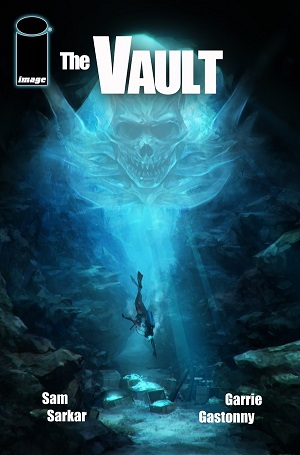
A mix of standard SF-horror tropes. Underwater treasure hunters find a sarcophagus containing the remains of a demon that has been sealed away for centuries, or maybe millennia. They open it up and remove the occult seal from the demon’s corpse, thus reviving it. Carnage follows as the awakened beast goes on a bloody rampage, all while a hurricane strikes.

It’s basically Carpenter’s The Thing (the alien thawing out of the block of ice) meets Alien (the demon is a close cousin to the Xenomorphs). If you want something new, it’s that the action takes place in Nova Scotia (the author, Sam Sarkar, was born in Halifax), with the divers exploring the famed Oak Island “Money Pit.” I appreciated that part, but it doesn’t really add much. I’ve never visited Oak Island, or seen the TV show they made about its treasure-seekers, but I still felt I’d been here before.

It might have worked. I really liked Plunge, another recent horror comic that riffed on 1980s deep-water monster movies. But the plot moves awkwardly, with some abrupt breaks that left me momentarily confused, and the art doesn’t sell the action or suspense. In particular, the different characters are posed like plastic action figures, unmoving over several different panels, and their faces are totally expressionless, even when they’re supposed to be freaking out, delivering lines punctuated with triple exclamation marks!!!

Normally I’d only recommend this to hardcore fans of the genre, but I think they may be the most disappointed by it. It didn’t do anything for me.

Graphicalex

Saga of the Swamp Thing Book One

Saga of the Swamp Thing Book One

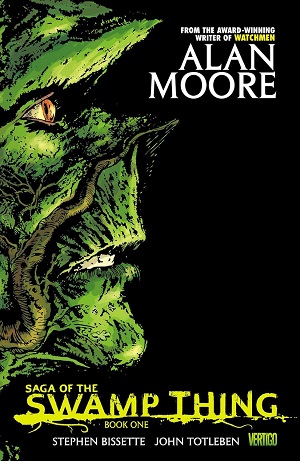
I’d read Alan Moore’s Saga of the Swamp Thing titles years ago, but had remembered them, falsely, as being a standalone series or a reboot of the franchise. That’s not the case. In fact, Moore took over with issue #20, which is a direct continuation of the events that concluded Swampy’s battle with Arcane, and the latter’s death. Or “death.” That was the end of DC’s Swamp Thing: The Bronze Age Volume 3 if you buy the collected editions.

After tying up the “loose ends” (the title of issue #20) to that storyline, Moore was off on his way, not really reinventing the character but subtly redefining him. It’s a new sort of origin story, being one that leaves the original in place. This is explained through the experiments of the Floronic Man on a frozen Swamp Thing in issue #21, which is a great comic and one that works well as a standalone.

Moore’s great theme in all his work is that of a powerful mind becoming unhinged, and he gets to indulge that a lot with the various characters  introduced here (Swamp Thing, the Floronic Man, Matt Cable . . . Jason Blood is already nutty). His writing is also in good form, with “plump, warm summer rain that covers the sidewalk with leopard spots,” and how “clouds like plugs of blooded cotton wool dab ineffectually at the slashed wrists of the sky.” I don’t want to go all in on comic writers being great poets because it’s a different game, but there are levels and Moore was usually operating at a higher one than most who have played it.

The crowded panels of Stephen Bissette and John Totleben’s artwork goes well with melting characters, wavy hair and mossy tendrils. There are also several glorious full-page drawings that are quite effective, especially since page layout is such a big part of the visual delight of the series. Nearly every page here is shattered in an interesting way.

I’m not a fan of all of Moore’s stuff, or even all of his Swamp Thing work, but as things kick off here you can tell why this has been recognized as a comic-book classic. Moore took an already established character and while keeping him very much the same in most important ways also made him his own.

Graphicalex

Daredevil: Dark Art

Daredevil: Dark Art

Dark Art. How dark? Very dark!

Dark Art is superhero title that reads a lot like a horror comic. Daredevil and Blindspot are on the trail of a serial/mass killer who makes grotesque art out of his victims. Like a giant wall mural painted with the blood of over a hundred different people, or a tableau of the bodies of individuals transformed via the Terrigen mist into bastard Inhumans and then into props. These atrocities have been perpetrated by a figure who calls himself the Muse, a clear descendant of the Joker villain tree. (I see he calls himself the Muse. The press has dubbed him Vincent Van Gore.) The Muse walks the walk and talks the talk of a rebel street artist. Meaning he says things like “Do you think the symbolism here is too overt?” and wears combat boots, a knit skullcap, and suspenders without a shirt. Plus he has a very punchable face, even with his bleeding eye sockets.

This series marked the debut of the Muse and though I was left unclear as to the nature of his powers, aside from having really quick reflexes, I was getting into the horror vibe. And the story just kept getting darker, with the climactic issue taking place in the Muse’s atelier, which is decorated with various corpses and body parts (heads, brains, hearts, etc.). Then (spoiler alert, sort of) things end up with the Muse gouging out Blindspot’s eyes! That just ain’t right.

I’d had mixed feelings on Charles Soule’s Back in Black Daredevil run before this. The Chinatown volume was good but I thought Supersonic was a big step back. I’m happy to say that things got back on track here though, as this was a tight story that was creepy and involving, without too many distractions. Among these: Matt Murdock’s new job as a D.A. isn’t going well, making me wonder why he was even bothering. Can’t he make a living doing something else, perhaps making surreptitious use of some of his powers? There’s a trip to New Attilan to try to enlist the help of the Inhumans in tracking down the Muse but that doesn’t go very far, and I can’t say I was too happy with their taking jurisdiction at the end. And finally Ron Garney’s art, while it has its own atmosphere that goes well with this version of DD, isn’t growing on me.

It gives these comics a distinctive look, which I give Garney credit for. The generic Marvel house style drives me crazy. You could replace it now, and probably for the better, with something done by AI. And Garney’s art does fit with the horror angle. But it’s not my thing.

Graphicalex