The Vault

The Vault

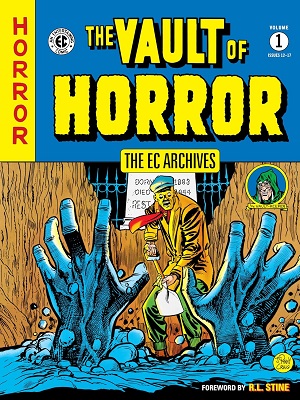
A mix of standard SF-horror tropes. Underwater treasure hunters find a sarcophagus containing the remains of a demon that has been sealed away for centuries, or maybe millennia. They open it up and remove the occult seal from the demon’s corpse, thus reviving it. Carnage follows as the awakened beast goes on a bloody rampage, all while a hurricane strikes.

It’s basically Carpenter’s The Thing (the alien thawing out of the block of ice) meets Alien (the demon is a close cousin to the Xenomorphs). If you want something new, it’s that the action takes place in Nova Scotia (the author, Sam Sarkar, was born in Halifax), with the divers exploring the famed Oak Island “Money Pit.” I appreciated that part, but it doesn’t really add much. I’ve never visited Oak Island, or seen the TV show they made about its treasure-seekers, but I still felt I’d been here before.

It might have worked. I really liked Plunge, another recent horror comic that riffed on 1980s deep-water monster movies. But the plot moves awkwardly, with some abrupt breaks that left me momentarily confused, and the art doesn’t sell the action or suspense. In particular, the different characters are posed like plastic action figures, unmoving over several different panels, and their faces are totally expressionless, even when they’re supposed to be freaking out, delivering lines punctuated with triple exclamation marks!!!

Normally I’d only recommend this to hardcore fans of the genre, but I think they may be the most disappointed by it. It didn’t do anything for me.

Graphicalex

Saga of the Swamp Thing Book One

Saga of the Swamp Thing Book One

I’d read Alan Moore’s Saga of the Swamp Thing titles years ago, but had remembered them, falsely, as being a standalone series or a reboot of the franchise. That’s not the case. In fact, Moore took over with issue #20, which is a direct continuation of the events that concluded Swampy’s battle with Arcane, and the latter’s death. Or “death.” That was the end of DC’s Swamp Thing: The Bronze Age Volume 3 if you buy the collected editions.

After tying up the “loose ends” (the title of issue #20) to that storyline, Moore was off on his way, not really reinventing the character but subtly redefining him. It’s a new sort of origin story, being one that leaves the original in place. This is explained through the experiments of the Floronic Man on a frozen Swamp Thing in issue #21, which is a great comic and one that works well as a standalone.

Moore’s great theme in all his work is that of a powerful mind becoming unhinged, and he gets to indulge that a lot with the various characters  introduced here (Swamp Thing, the Floronic Man, Matt Cable . . . Jason Blood is already nutty). His writing is also in good form, with “plump, warm summer rain that covers the sidewalk with leopard spots,” and how “clouds like plugs of blooded cotton wool dab ineffectually at the slashed wrists of the sky.” I don’t want to go all in on comic writers being great poets because it’s a different game, but there are levels and Moore was usually operating at a higher one than most who have played it.

The crowded panels of Stephen Bissette and John Totleben’s artwork goes well with melting characters, wavy hair and mossy tendrils. There are also several glorious full-page drawings that are quite effective, especially since page layout is such a big part of the visual delight of the series. Nearly every page here is shattered in an interesting way.

I’m not a fan of all of Moore’s stuff, or even all of his Swamp Thing work, but as things kick off here you can tell why this has been recognized as a comic-book classic. Moore took an already established character and while keeping him very much the same in most important ways also made him his own.

Graphicalex

Daredevil: Dark Art

Daredevil: Dark Art

Dark Art. How dark? Very dark!

Dark Art is superhero title that reads a lot like a horror comic. Daredevil and Blindspot are on the trail of a serial/mass killer who makes grotesque art out of his victims. Like a giant wall mural painted with the blood of over a hundred different people, or a tableau of the bodies of individuals transformed via the Terrigen mist into bastard Inhumans and then into props. These atrocities have been perpetrated by a figure who calls himself the Muse, a clear descendant of the Joker villain tree. (I see he calls himself the Muse. The press has dubbed him Vincent Van Gore.) The Muse walks the walk and talks the talk of a rebel street artist. Meaning he says things like “Do you think the symbolism here is too overt?” and wears combat boots, a knit skullcap, and suspenders without a shirt. Plus he has a very punchable face, even with his bleeding eye sockets.

This series marked the debut of the Muse and though I was left unclear as to the nature of his powers, aside from having really quick reflexes, I was getting into the horror vibe. And the story just kept getting darker, with the climactic issue taking place in the Muse’s atelier, which is decorated with various corpses and body parts (heads, brains, hearts, etc.). Then (spoiler alert, sort of) things end up with the Muse gouging out Blindspot’s eyes! That just ain’t right.

I’d had mixed feelings on Charles Soule’s Back in Black Daredevil run before this. The Chinatown volume was good but I thought Supersonic was a big step back. I’m happy to say that things got back on track here though, as this was a tight story that was creepy and involving, without too many distractions. Among these: Matt Murdock’s new job as a D.A. isn’t going well, making me wonder why he was even bothering. Can’t he make a living doing something else, perhaps making surreptitious use of some of his powers? There’s a trip to New Attilan to try to enlist the help of the Inhumans in tracking down the Muse but that doesn’t go very far, and I can’t say I was too happy with their taking jurisdiction at the end. And finally Ron Garney’s art, while it has its own atmosphere that goes well with this version of DD, isn’t growing on me.

It gives these comics a distinctive look, which I give Garney credit for. The generic Marvel house style drives me crazy. You could replace it now, and probably for the better, with something done by AI. And Garney’s art does fit with the horror angle. But it’s not my thing.

Graphicalex

Crime and Punishment

Crime and Punishment

There is a point in updating the classics. Sure we can make the argument, and a good argument too, that Shakespeare is our contemporary. But that isn’t always easy for everyone to grasp, which means there’s nothing wrong with adapting Shakespeare, or any author, into modern forms like film or the graphic novel. It’s not that different from just putting Shakespeare on stage in modern dress.

This is a subtly modernized adaptation of Crime and Punishment. We’re in Putin’s Russia, but we only know that because we can see Putin’s face on TV or in portraits in the police station. And that’s not jarring because Putin sees himself so much as a “new tsar.” Then there are ‘80s-style punks in the street of St. Petersburg and they don’t seem out of place either because if Dostoyevsky was writing at a period when Imperial Russia was in decline you could see that historical moment rhyming with the Soviet Empire’s final days.

Is Raskolnikov our contemporary though? The night before I wrote up these notes I was at dinner with friends and the subject came up as to whether having a conscience was something that was in decline. At one point in the evolution of our species a conscience probably served a purpose, but in more atomized societies like our own, where our most prominent and successful role models (individual and corporate) are psychopaths, it may be that a conscience is the psychological equivalent of a tailbone. Meanwhile, narcissism is seen as a superpower as often as it’s described as a plague.

All of this is sort of by the way though in discussing this graphic novel version of Crime and Punishment because it’s not really interested in Raskolnikov’s tortured conversion. In fact, I wasn’t even sure he had experienced a conversion. He’s flattened out quite a bit here by Alain Korkos, with spiky hair and hollowed-out or whirlpool eyes being made to do a lot of work in representing his madness. Snippets of his theory of the man who has risen above conscience get dropped into the mix, but I don’t think David Zane Mairowitz, who wrote the adaptation, wanted to go into that too deeply either.

Where I think this version of the story is strongest is in the presentation of some of the supporting characters. Raskolnikov’s sister Dunya is a fresh-faced hotty and we can feel there’s something more than a family attachment in some of the drawings. Luzhin is an ‘80s pimp in a three-piece suit, aviator shades, and a cigarette dangling from his lip. Svidrigailov is a cultured sugar daddy. Sonya is a goth pauper-princess. About the only interpretation I didn’t agree with was the police investigator Porfiry, who is a goateed fellow with round sunglasses. He looks threatening, but without any of the depth or humour that readers of the novel will recognize.

Of course reducing a brick of a novel into a 120-page comic necessarily means you’re losing a lot. What’s left is coherent in terms of the story and I think relatively faithful to the original, but it isn’t close to being a substitute or even a summary. Nor, despite the modern setting, does it have much of a new spin to put on things. Was Raskolnikov the equivalent of a punk? The kind of guy to have a Sex Pistols poster hanging in his room? Or was he more intellectual than that? It’s an interesting question to entertain, but it’s also a kind of dead end that I don’t think leads us any further into the sort of ideas Dostoyevsky was digging into. Or maybe we just live in a less serious time.

Graphicalex

Swinging MAD

Swinging MAD

This MAD pocketbook was published in 1977 and I think all of the content is drawn from stuff that had previously appeared in the magazine in the 1970s. So we’re in a world where a mock publication called Occult Magazine looks forward prophetically to 1989, hippies weren’t a long-distant source of fun but a clear and present source of fun, and the tunes of songs like “Bless ‘Em All,” “On Wisconsin!” and “Stouthearted Men” were assumed to be so well known that readers would be able to sing along with parody versions. For the record, I know none of those songs but apparently they were very popular once upon a time. And I suppose “On Wisconsin!” is still familiar to Badgers.

This is a grab-bag collection with no one theme. Instead there’s just a little bit of everything that made MAD what it was. There’s the Don Martin Department. There are funny advertisements. There are two Dave Berg “Lighter Side of . . .” instalments. There’s a Spy vs. Spy cartoon (White Spy wins this one). And it all wraps up with one of MAD’s justly celebrated movie parodies, as drawn by the unforgettable Mort Drucker. What a line-up of talent MAD had during these years. It makes me wonder if a magazine like this would even be possible today. Since MAD itself isn’t possible today (they’ve stopped print publication) I think we know the answer to that. I’m not in love with the ‘70s, but for magazine culture you could look back on it as the end of a golden age.

Graphicalex

Ant-Man/Giant-Man: The Man in the Ant Hill

Ant-Man/Giant-Man: The Man in the Ant Hill

This was a pleasant surprise. Ant-Man, or Giant-Man (a role he grew into, later taking the name Goliath), has never been one of my favourite superheroes and I wasn’t expecting much from this collection of his first appearances in Marvel’s Tales to Astonish. (Most of the early Marvel superheroes didn’t start out with their own comics, so Iron-Man, as he then was, could be found in Tales of Suspense, Thor in Journey into Mystery, Doctor Strange in Strange Tales, etc.) But I had a great time tracking the very silly evolution of the character, and his sidekick “the wonderful Wasp.”

What I mean by silly is the way a hand keeps getting waved at any questions that might be raised as we go along. Explanations are trotted out, but they’re so flimsy you just have to shake your head. Scientist Hank Pym invents a potion, later made into a pill, that allows him to almost instantly shrink to the size of an ant. I mean instantly in that he seems to just disappear. You don’t see him get smaller. I wondered how that worked. But then I wondered about a lot of things. Luckily, the explanations keep coming. How does his costume change sizes along with his physical transformations? An editor’s note: “Clothes composed of unstable molecules are able to stretch and contract as the wearer’s own body does!” How does Ant-Man send and receive messages to all the ants everywhere all over the city? He has antennae on his helmet that can transmit, receive, and “decode” the electronic impulses that all ants use to communicate. And by “communicate” I mean they can even send live video! How does he travel instantly to any place he has to be? He has a catapult that fires him wherever he wants to go, and when he gets there his ant buddies form a cushion to give him a soft landing. How does he fight bad guys when he’s the size of an ant? He keeps the same strength he had as a full-size human even when he shrinks. But then when he learns how to make himself bigger, for some reason he maxes out at 12 feet and after that he gets weaker. I’ve no idea why that happens, but here’s the explanation they give: “It’s like a sculptor rolling the clay figure of a man between his hands until it grows longer and longer! But the longer it grows the weaker it becomes, until it finally snaps!” Uh-huh.

You get the feeling in all of this that they just needed a set of rules for Ant-Man/Giant-Man to operate by, and that they weren’t too concerned that readers would stop to ask too many questions. So when the whole idea of popping a pill to grow or shrink got a bit too awkward they simply had Hank come up with a modification to his helmet that allows him to change size by controlling his “mental energy” in “mentally activated cybernetic impulses.” In other words, he just has to think about getting bigger or smaller! And not only that, he can make the Wasp bigger or smaller with the same helmet (though otherwise he has to still rely on the pills).

This final point underlines what is perhaps the most jarring thing about these comics. Coming out during the height of the Cold War (1962-64), the bad guys are often looped into the Red menace. The commies even apparently killed Hank Pym’s first wife, a story quickly told in flashback. None of that dates the action as much though as the gender roles in the relationship between Hank and Janet van Dyne (who becomes the Wasp in part to avenge her father). Hank is protective of Janet, which is something she rejects in a pseudo-feminist way. “He treats me like a scatterbrained little girl,” she protests to herself, “and I want him to think of me as a full-fledged woman . . . a woman in love!” After all, “He may go for all that adventure jazz, but I go for big, wonderful, dreamy him!” This is awful stuff, and it’s everywhere. Even when Ant-Man and the Wasp discuss matters of international importance with a room full of officials her thought bubble off to the side only reveals “Mmmm, if there’s one thing I like, it’s being in a room full of men!”

There is a lot of this, and it’s representative of a real weak spot in Marvel’s imagining of female characters at the time, which I guess goes back to Stan Lee. Lee’s stories are wonderfully inventive and a lot of fun, but he had trouble with women and imagining real relationships. For all her feistiness, Janet is a throwback to a stereotypical female model. Even after becoming a superhero she revels in a role as fashion icon, and the Wasp with her “dainty wings” and “tiny, delicate antennae” is a modern-day Tinkerbell. The fact that Hank can control her size changes by his helmet, and that she can’t grow big but only smaller, reinforces this. He’s also the brains as well the brawn, and when he gives her an air-compressor weapon that he’s invented so she’ll have a bit more firepower it’s like he’s giving a toy to a child.

So that’s the downside here. What I loved is the way the reduced scale, at least of the early stories, gave us simpler stories that were all the more effective for not being about fighting wildly powerful archvillains. Sure there are some aliens and transdimensional interlopers here, but the guys I enjoyed more are the bitter losers with a grudge against the world, like Egghead (who even retires to a flophouse after first being bested by Ant-Man), the Human Top, Trago (“the man with the magic trumpet”), and the Porcupine. I was curious whatever happened to these guys, and wasn’t too surprised that (at least in these earlier iterations) both Egghead and the Porcupine died in action in later years, while the Human Top turned into Whirlwind. They’re B-listers, after all, but no less fun for all that.

Along with this goon squad we get a lot of low-tech action that’s also the perfect foil for today’s bloated cosmic, multiverse nonsense. On two different occasions first Ant-Man and then the Wasp tie the bad guy’s shoelaces together to make him trip! At another point Ant-Man unstrings a pearl necklace and rolls the pearls across the floor to send the Protector for a tumble. Then, when the Protector sucks Ant-Man up into a vacuum bag, our hero cuts his way free and uses a fan to blow the dust from the bag into the Protector’s face, blinding him and making him sneeze (“My eyes!! I can’t see!! Ah – Ah – Chooo!!!”). That’s good enough to allow the police to capture him and take him away.

Trying to catch Ant-Man leads the not-so-supervillains to some similarly modest stratagems. I just mentioned the vacuum cleaner. Fly paper? Sure. And here’s something really nasty: take away his growth pills and toss him in a half-full bathtub! How is he going to get out of that? Or, most devious of all, how about hunting him down with . . . an anteater! Now that’s playing dirty pool! And even that’s one-upped by the Magician, who has a killer bunny! “Only the Magician could have trained a rabbit to be an obedient beast of prey! Go, my pet . . . catch those two fools for your master!” That’s not quite Monty Python level of funny, but it’s getting close.

I hope that all gives some idea of the highs and lows in this volume. Like I say, it’s silly stuff but for the most part makes a refreshing change of pace from the later excesses of the Marvel multiverse. The 1960s shouldn’t seem so long ago, but much has changed, and in these pages you can really feel some of the distance between then and now.

Graphicalex

Alien: Icarus

Alien: Icarus

All of these Alien comics present self-contained storylines that ran for 5 or 6 issues. There’s a sort-of through line that’s covered in the opening to each, but it’s not necessary to read them in order. For what it’s worth, this volume is a sequel of sorts to Alien: Revival, as the events of that series are briefly mentioned here. But this is a wholly separate adventure. And like all of the Alien comics (at least all the ones I’ve read) it’s another interesting and original story that reimagines the familiar monsters in a new setting.

For reasons not worth getting into a team of super-synth soldiers are sent to a radiated planet overrun by Xenomorphs in order to retrieve a Xenomorph egg that contains an experimental genetic modification that the United Systems (that would be the U.S. government, rivals of the Weyland-Yutani Corp.) believes contains an antidote to radioactivity.

So it’s off to Tobler-9 and it looks like the Xenos actually have an opponent in their own weight class, since the synths are all trained mercenaries who use their plasma rifles, bows and arrows, and samurai swords to go toe-to-toe (or claw, or whatever) with the evil critters. One synth even tears a Xenomorph’s head off with his bare hands. And you don’t have to worry about the synths getting bred in the usual way since the Xenos can’t use them for that. Alas, there are only five synths in the team and as usual an unending supply of Xenomorphs to kill, including a giant Queen and then later an insect-human-Xenomorph hybrid thing.

So that’s something a bit new, though it had been foreshadowed in one of the stories in Aliens: The Original Years. And I thought there was a higher gross-out and gore level here than in previous comics. But like I say, I found the story compelling and original. Writer Phillip Kennedy Johnson also entertains a couple of ideas that I had to think about, even if I ended up rejecting both of them. First there’s the notion that the synths can be more human (meaning, they display more empathy and altruism) than the humans. Would that be the result of their programming? Something to make them a more effective team? Or are they evolving on their own? Then, speaking of evolution, there’s the way the Xenomorphs seem to take biological cues from their hosts, at least under lab circumstances. This is what leads to the insect-human-Xenomorph hybrid. I found myself wondering how much of this was Weyland-Yutani’s efforts to create a new bioweapon and how much was “natural.” Because why would the Xenomorphs evolve when they’re already perfect killing machines?

So great fun for fans, delivering on lots of brutal action and plenty more of what you came for. There’s a simple but effective story with all the usual elements worked in effectively alongside a couple of new wrinkles. There’s been no end of criticism of the Alien film franchise, and for good reason, but readers of the comics have had nothing to complain about.

Graphicalex

Gideon Falls Volume 5: Wicked Worlds

Gideon Falls Volume 5: Wicked Worlds

Sheer chaos. “Please . . . just slow down,” Dr. Xu begs of Danny when he tries to explain. “What does all of this mean? I am . . . I’m so confused.” Join the club, Doc.

Here it is in a nutshell. After the Black Barn got blown up at the end of the previous volume we’re told that it didn’t get destroyed but was instead “set free.” Whatever that means. What it seems to involve is the multiverse collapsing in on its center point, which is Gideon Falls. You see, “for some reason we can never know,” the “heart of it all” (that is, the heart of everything that ever has or ever will exist in space and time) is Gideon Falls. It was all that existed before the fragmentation into an infinite number of timelines, and now after that initial Big Bang reality is experiencing a Big Crunch back to its singular identity. Because of the darkness. Which is where the Laughing Man/Bug God comes in.

If it all sounds fuzzy that’s because it is. In this volume various characters in different parts of the multiverse (a Wild West environment, a dystopic police state) run away from zombie Laughing Men until they can regroup as the “New Ploughmen.” Which is an homage to the original bunch of Black Barn conspiracy nuts. There’s a lot of running around but it feels like running in place since you can’t even say they’re going in circles. We’re just left to understand that someone, somewhere understands what they’re doing and has arranged things to work out the way they’re meant to.

The plot itself doesn’t advance, but lots of things do happen. The main draw here though is again Andrea Sorrentino’s art. He was really off leash with this series and it’s a lot of fun seeing what he comes up with in terms of page design and layout. So enjoy that, because the story in this part is thin gruel and what there is will probably leave you scratching your head.

Graphicalex

Batman/The Shadow: The Murder Geniuses

Batman/The Shadow: The Murder Geniuses

I’ll grant that crossovers can get messy. And crossovers with two writers may get even messier. That said, the idea of having Batman and the Shadow joining forces must have seemed like a good fit, as they’re both dark, mysterious crime-fighters hailing from the same era (both debuted in the 1930s). Unfortunately, it’s hard to think of anything this comic series does right, at least in terms of its storyline.

I found that story impossible to follow. I don’t know the Shadow character very well, but I think even if I did I would have been lost. As far as I can figure out he’s an immortal figure or spirit from another dimension: the fabled city of Shamba-La. What is Shamba-La? Why it’s a “foothold on your plane of existence, anchored by heavy dimensional ballast.” People there live “on a higher thaumic frequency.” Got it?

Anyway, apparently the Shadow has had his eye on Batman for a while and has selected him to be his heir. But then this manga-masked super-villain from Shamba-La named the Stag (because he wears an antler headdress, you see) shows up and starts killing off all the best people in the world. This makes him the reverse Shadow, as the Shadow’s mission is to take out the worst people in the world. So Batman and the Shadow team up to defeat the Stag, who has allied with the Joker. Batman sort of gets killed but then he’s revived by going to Shamba-La and meeting Cthulhu. The Stag is finally beaten and the Shadow is stuck still being the Shadow and Batman stays on as Batman.

I may be getting something wrong in all that. I’m probably getting a lot wrong. I just didn’t know what was going on. The Stag has a backstory but he only speaks a single enigmatic line (“I am an honest signal”) over and over. The Joker is roped into action just because this is a big Batman title and they figured the Joker had to show up and do something. But this is one of his least impressive incarnations. The Shadow looks dramatic in his magic red scarf unrolling like Spawn’s cape, but honestly I didn’t understand what he was going on about most of the time. Harry Vincent and Margo Lane show up too, but just as props. I guess the art isn’t bad, but Batman’s boyish face doesn’t really go with his scarred tank of a physique and the Joker seems like a puppet figure.

I didn’t like this one. The crossover idea had a lot of potential but they needed to keep the script a lot tighter. With all the background mythology I just had the sense that things were getting away from Scott Snyder and Steve Orlando right from the start. It was fairly well received by fans though, which makes me wonder if coherence or intelligibility is something that people even look for anymore in pop entertainment.

Graphicalex

Marvel Comics: Timeless Tales

Marvel Comics: Timeless Tales

Marvel Comics got its start (at least as Marvel Comics) in 1939. This slim volume collects a bunch of all-new genre homages to celebrate their 80th anniversary (in 2019), and is a real treat for fans of the Marvel brand.

We kick off with a spooky psycho-thriller from Crypt of Shadows. Then War is Hell, Journey into Unknown Worlds, Love Romances, Gunhawks, and Ziggy Pig – Silly Seal. I think the titles speak for themselves as to what you can expect, but if you’re wondering, the genres covered are horror, war, SF, romance, Western, and humour.

I thought the first story, written by Al Ewing was the best. I had to go back and read it again to understand what was going on. It’s a complicated narrative involving hypnotic states, but I think in the end it all made sense, which is something I appreciated. Also good were the two stories in Journey into Unknown Worlds. There was nothing fancy about them, but they delivered.

The other genres sampled are ones that haven’t maintained the popularity they once had. War comics and Westerns aren’t so big today, and I think romance titles have mostly disappeared. And I wonder why. Romance novels are still popular, aren’t they? Could romance comics not survive the attention of Roy Lichtenstein?

That’s a point worth dwelling on. Some genres, like SF and horror, can hold up under an ironic gaze. But for war, Westerns, and romance I think it’s harder. Which is why those stories here get cross-genre, ironic treatments. There are twist endings and supernatural elements that I doubt were that common in the originals. One of the romance stories takes place in a steampunk future, and another has a robot falling in love with an alien. The war stories are both strange tales and the Western takes a weird turn at the end as well. Then there’s Ziggy Pig and Silly Seal . . .

I have to admit I don’t know anything about these characters. As I understand it they were the basic comic odd couple, with Ziggy being the smarter one and Silly being the unbeatable goofball. I doubt they were as grown-up as they are here, however, as Silly has become a celebrity while Ziggy is stuck renting prostitutes and throwing up all over his flophouse apartment. Finding out that Silly has put him in his will, Ziggy travels with him to Latveria, home of Doctor Doom, in the hope that the Doctor will kill Silly for being a friend of the Fantastic Four. But that’s not how things work out.

Deadpool has a cameo here and that feels right because the humour is pretty adult and meta. Very Howard the Duck, if you remember that. Again it seems as though this material can’t be done straight today so there have to be layers of irony. At one point the co-writer, Frank Tieri, even puts in an appearance at a back-alley comic-con.

All of this goes down easy, but it’s still worth noting what sort of an homage this is. The genres really aren’t timeless, and these tales are very much of our time.

Graphicalex