Chew Volume Three: Just Desserts

Chew Volume Three: Just Desserts

Alright, we’re rolling again with my go-to comic for a good time. This volume contains issues #11-15, with #15 marking the quarter mark for the team of author John Layman and artist Rob Guillory as they had originally planned a 60-comic run.

I think this gives some idea of the forethought that went into the series and explains the way hints keep getting dropped as we go along to characters and events that didn’t seem all that important at the time, or that we might have thought we were finished with. To be sure, I knew that Gardner-Kvashennaya, the arctic observatory that hosted a vampire bloodbath, was going to play a big part in what was to come. Ditto the “Frog Man” Montero (so-called because he breeds frog-chicken hybrids). But I wasn’t expecting the return of the killer rooster Poyo, or the introduction of new characters like a mysterious food taster, Tony’s sister, and all the rest of his family, including his daughter(!) and one very weird ex.

The other thing about planning so far ahead is that it allows Layman and Guillory to play with the arrangement of the narrative blocks. This happens in almost every issue, as we begin with a scene (often the aftermath of some act of violence) that only gets explained later. They know what they’re doing here, as they even make fun of it in issue #12, which begins with the editorial note “The pages got shuffled out of sequence. This is actually page 18.”

Given all this preparation I feel confident that I’m not going to be disappointed in how things turn out. In the meantime, I’ve enjoyed everything so far, down to all of the little background gags you really have to be on your toes to catch (and a few of which I’ve missed). On to the next course!

Graphicalex

Token MAD

Token MAD

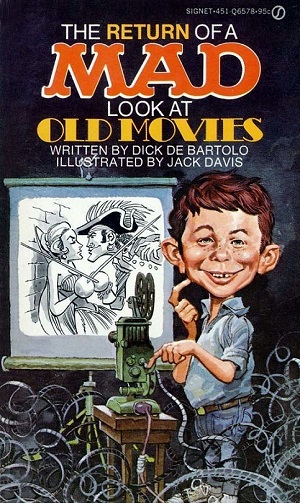
Nope, I don’t think you’d get away with that cover today. But in 1973 (this is a first edition!) you could. It’s meant as a send-up of tokenism (think wokeness, but fifty years ago). The back cover declares: “Is MAD guilty of tokenism? You bet we are! We’ve always offered our readers token humor, token satire, token good taste! And this book is no different . . . just another token attempt at courageous publishing! So even though the price is only a token of what a good book would cost, you’ll be taken . . . with . . . The Token MAD.”

That token price, by the way, was $1.50. Wouldn’t see that on many covers today either.

This is another grab-bag MAD collection, full of bits and pieces mostly from the 1960s. The movie and TV satires, both illustrated by the great Mort Drucker, are for The Professionals (1966) and I Spy (1965-1968) respectively. For years I didn’t know anything about either of these shows, and by the time I finally saw them it was through the lens of the Mad versions that I knew practically by heart. Alongside recurring features like David Berg’s Lighter Side of . . ., the Don Martin Dept., and Spy vs. Spy (they each win one) there are some great one-offs like “Vanishing Human Types and Their Modern Replacements” (do you remember “the inexpensive handyman”? or are you more familiar with “the specialized service technician”?), “Historical Events as Covered by Modern News Feature Writers” (the Battle of Bunker Hill written up by the sports editor) and “Obituaries for Comic Strip Characters.” I got a real laugh out of this last one, and the obit for “noted man about town Donald Duck,” who was killed in a hunting accident after being mistaken for a wild canvasback. I loved this paragraph especially: “A spirited eccentric, Duck was known for his clever wit, all of which was unintelligible. He countered this, however, with savage bursts of temper which accomplished nothing.” That’s our Donald! And that was MAD!

Graphicalex

Old Man Logan: Past Lives

Old Man Logan: Past Lives

This was the final issue of the Old Man Logan series to be written by Jeff Lemire and it has even more of a retrospective feel to it than usual. As things get started Logan has decided he wants to go back in time and to the specific part of the multiverse where the saga began so that he can save Baby Hulk, and maybe his family too. Unfortunately, none of his friends and enemies want to help (he appeals to the Marvel science-and-sorcery brain trusts, from Doctor Strange and Scarlet Witch to Black Panther and Doctor Doom), so as a last resort he springs a devil-worshipper named Asmodeus from supervillain prison. Asmodeus says he’ll send Logan back into his past, but –surprise! – he’s actually going to double-cross Logan. I don’t know why Logan would have expected anything less. That struck me as silly.

Anyway, instead of going straight back to the Wasteland, where it all got started, Logan ends up being unstuck in time, forced to “re-enact [his] greatest hits.” His fight with Hulk. The climax of the Phoenix story. As Patch in the streets of Madripoor. He even gets to re-use his famous tag-line about bad guys taking their best shot but now it’s his turn. But eventually he does get back home, only to have to say good-bye to his wife and kids, knowing that he can’t save them.

(An aside: I was a bit put off by Lemire not knowing the difference between a combine and a tractor. When Logan gets back to his farm he’s shown working on what is referred to as “the combine” but which is really just a tractor. A combine is a combination harvester. From the looks of it, I don’t think they’d have any use for a combine in the Wasteland, which is a Western desert landscape like that of the homestead in The Searchers. And I never could figure out what kind of farming the family was doing in that movie. On further reflection though, I thought this made for a fitting vision of our dystopic future, caring for and repairing old machinery that nobody has any use for now anyway.)

As a way of wrapping Lemire’s part of the series up this sort of thing is fine, but it doesn’t stand out as being a great or essential comic on its own. It has the feel of the last episode of some long-running TV show, like Seinfeld, where you just bring everybody back for a cameo before shutting things down. I like the art by Filipe Andrade (the first couple of issues here) and then Eric Nguyen, the latter feeling influenced by Sorrentino’s earlier modeling of the character while also doing its own thing. And the mechanism for the time-skips, a magic amulet, is at least easy to follow, even if there’s no discernible rhyme or reason to how it works. Of course this wasn’t to be the end of the line, as the series would continue. But there’s still a well-deserved sense of an ending.

Graphicalex

Doctor Strange: A Separate Reality

Doctor Strange: A Separate Reality

This is the third volume in the Epic Collection series of Doctor Strange comics and it kicks off with a character who was still in flux. For one thing, he’s wearing a full black hood/mask and underneath his cloak he’s sporting conventional superhero tights that show off his generic superhero musculature. Thank goodness they realized that look wasn’t working and went back to letting him wear his usual duds. This guy gets his kicks above the neckline, sunshine. And when you have perhaps the most recognizable face in the Marvel pantheon, why pull a bag over it?

There are three main story arcs here. The first is the longest, with the good doctor taking on a series of Lovecraftian demons with names like Dagoth, Sligguth the Abominable, N’Gabthoth the Shambler from the Sea, Ebora the Dark Priestess of Evil, and Kathulos of the Eternal Lives. All of these baddies are defeated on the way to a showdown with Shuma-Gorath. That climactic issue has the title “Finally, Shuma-Gorath!” as though even the writers were getting tired of all the build-up.

This first story arc ends with the Ancient One dying, or more properly becoming one with the universe, leaving Doctor Strange as the Sorcerer Supreme. The next story has him fighting a sorcerer from the future named Sise-Neg, who is traveling through time absorbing all the magic in history so that he can recreate the Big Bang and become God. This is obviously very serious stuff, or as Dr. S. puts it “The power of Sise-Neg is the greatest threat our reality has ever known!” Which is weird because I thought Shuma-Gorath was the greatest threat our reality had ever known. After a while the inflated rhetoric runs out of places to go.

Finally, the third storyline has a villain named Silver Dagger hunting down the Doctor and killing him with his eponymous weapon. Except our hero saves himself by diving into the Orb of Agamotto and facing off with Death. Then he comes back to our world and rescues his girlfriend Clea and puts Silver Dagger in his place.

I went through this breakdown only because it illustrates a point that I think it worth drawing attention to. The thing is, both Shuma-Gorath and Sise-Neg are awesomely powerful multidimensional entities who threaten the existence of the entire universe, or at the very least “our reality” (which contains the universe). The way Doctor Strange engages them in cosmic battle is certainly dramatic and colourful, but neither is very interesting as a villain. Silver Dagger, on the other hand, is a buff old guy dressed in a silly midriff-baring halter top and with a crazy backstory that had him narrowly missing being elected Pope and then digging into the occult section of the Vatican’s library so as to learn how to become a demon hunter. He’s a fundamentalist Catholic and not at all a standard bad guy so much as someone with a monomaniacal thing for using magic to destroy magicians wherever he finds them. He’s a man with a mission, and it’s a mission that’s far more relatable than destroying the universe or becoming God. He’s humanized even to the point where Clea falls asleep listening to him tell his origin story, and he’s taken off stage at one point because he has to go to the bathroom: “Now excuse me. Nature calls.” I can’t think of another time I’ve seen a superhero excuse himself like that, and it made me laugh.

But even Doctor S has his human side here, with a different part of his nature calling when he realizes he’s “neglected” Clea “both as a man and your mentor in the mystic arts.” She can take a hint, and when he offers to instruct her in the way of the Vishanti she tells him she’ll be happy if he tells her about it later. “And with the soft, dancing flames lighting her smile, there is no doubt of her meaning . . .” When next we see Clea she’ll be on the floor “still warmed by the afterglow of love,” happily telling her pet rabbit how her lover is “so much a man . . . so much.” That was pretty risqué for a comic at the time.

Even in the Silver Dagger storyline however the emphasis is on what the back cover here calls “eldritch horrors and psychedelic threats!” Our hero is always getting sucked into different dimensions where he may meet floating skulls or man-eating plants or even a hookah-smoking caterpillar. The art of the dream dimension is “a kaleidoscopic cosmos filled with shifting shapes and colors – beyond even the imaginings of a Freud – a Dali – a Kandinsky!” Those lines come in a full-page spread by Gene Colan, who kicks things off really overloading the reader with large-format artwork. I think he averages four panels per page and has a lot of full-page and even the occasional double-page illustrations. By the end of the volume though we’re into the run of Frank Brunner and a more detailed look. But with either artist the language mirrors the visuals. We hear of how the “awesome eruption of cabalistic conjurations emblazoned the night.” Of how “dire perils” and “frightful abysses of forgotten fears and chasms of primordial horrors gape wide to destroy our world!” Of how “arcane bolts of bedevilment – flaring garishly against the surrounding pitch – leap from rigid fingers!” Nothing is too over the top for the Sorcerer Supreme!

It all makes for a fun series of adventures, with the dread Dormmamu put on hold so that the Doctor can fight new faces of evil with helpful allies (it’s always fun to have Namor pop by for a cameo) and old stand-bys like the Eye of Agamotto, the Vapors of Valtorr, the Shield of the Seraphim, and the Crimson Crystals of Cyttorak. All of these Epic Collections are substantial volumes, running around 450 pages, but I was entertained throughout this one. Even being weird and strange can become stale after a while, but by mixing up writers and artists and looking to grow the Doctor Strange universe with new characters they did a great job in these early days keeping things fresh and creative.

Graphicalex

Daredevil: Identity

Daredevil: Identity

At the end of the previous Daredevil volume, Dark Art, poor Blindspot had been blinded. Specifically, he’d had his eyes gouged out by the mad artist known as the Muse. So now, as if Matt Murdock didn’t have enough good ol’ Catholic guilt already weighing him down (the cover art to issue #15 is an homage to the classic Born Again cover by David Mazzucchelli), he also has to live with blaming himself for what’s happened to his protégé. He’s so down he’s even pursuing a kind of death wish by putting a bounty on his own head as Daredevil.

It all sets up a story arc whose main purpose is to provide the backstory for why everyone in the world forgot that Matt Murdock was Daredevil. This is related by Matt in the confessional to a muscular priest (he’s a member of the Ordo Draconum) who absolves him by sending him on his way to go back to fighting crime. I won’t go into the details of the mass amnesia event, but it involves the Purple Man, who has built a machine that, along with his purple brood of kids, allows him to amplify his powers and control the minds of every human on the planet. Who knew this B-lister baddie would go on to have such an impact?

This plot device was criticized at the time, and fairly so. It’s all ridiculous, even for a superhero comic. And it’s most of what you get here. So the Back in Black series by Charles Soule continues its up-and-down progress. Chinatown good. Supersonic bad. Dark Art good. Identity bad. My hopes are up for the next instalment!

Graphicalex

Alien: The Illustrated Story

Alien: The Illustrated Story

This is, on the face of it, the graphic novel version of Ridley Scott’s 1979 film Alien, but there’s some backstory that has to be added to that.

It was published (after parts of it previewed in Heavy Metal magazine) at the same time as the movie’s release, and the writer (Archie Goodwin) and illustrator (Walter Simonson) hadn’t had a chance to see the film. Goodwin was working from the shooting script while Simonson had seen production stills and a rough cut. This helps explain the sense one has reading it that it’s something the same but different from the movie. The biggest difference I was struck by is the use of colour, which isn’t at all like the palette Scott was using. That giant emerald green spaceship, for example. Or the sickly shade of yellow of the facehugger.

It was a huge hit, becoming the first comic to appear on the New York Times bestseller list, and has gone on to be recognized as a classic in the genre of comic adaptations. I think it’s wonderful. The change-ups made to the paneling in the page layouts particularly stand out, though it’s hard to find fault with anything. Maybe the narrative voice, which they may have felt was necessary to explain things to an audience that didn’t already know the story cold. But that said, I don’t think any movie franchise has been better served, for so long, by its comics. And it all started here.

Graphicalex

Gideon Falls Volume 6: The End

Gideon Falls Volume 6: The End

I began my review of the previous Gideon Falls volume, Wicked Worlds, with the précis “Sheer chaos.” Well, I hadn’t seen anything yet!

In this final part of the story reality comes even more undone, exploding into a barrage of double-page spreads that make you turn the book upside-down to read, or that shatter the page layout or invoke the stairways of Piranesi, or that finally dissolve into ALL WHITE. NOTHING. That latter being the text description from the script for the comic that’s included in this edition as a bonus.

Also included is a visual essay by Andrea Sorrentino on “The Inner Workings of Gideon Falls.” I was hoping this would explain the comic’s multidimensional geography (or “Gideonverse”) a little better, as it even comes with maps that look borrowed from academic editions of Dante’s Comedy, but I ended up being just as confused after looking at them. I doubt there’s any way of explaining what’s going on adequately.

Which means there’s no way I can summarize things here. I’m not sure what happens or why. Our heroes dive into the evil half of the cosmos, confront the Bug God, and destroy the Pentoculus. This action turns out to be of more consequence than blowing up the Black Barn, which can always be rebuilt. And maybe the Pentoculus gets rebuilt too, since we get an inevitable, irritating final panel that suggests there’s no way of putting things right.

I did like this series, mainly as a showcase for Sorrentino’s art. But in The End I thought that art had taken over too much, shoving the story to one side and not bringing things together in a way I found very satisfying. I thought the story as it originally started out had more potential than this. To be honest, it felt like Lemire had checked out by this point and told Sorrentino to just draw anything before turning the lights out when he was done.

Graphicalex

Simpsons Comics Colossal Compendium: Volume One

Simpsons Comics Colossal Compendium: Volume One

I do like the Simpsons’ comics, a lot, and these Colossal Compendiums offer a selection of their best stories so they’re usually quite enjoyable. That said, I didn’t think this volume was all that great. None of the stories were particularly funny and the weird ones were only slightly off-kilter, unlike the really creative (and demented) stuff in the Treehouse of Horrors collections. There are a lot of good ideas here, like the characters transformed into different digital avatars in MMORPGs, a full-length “official movie adaptation” of the Radioactive Man movie, and a trip to a Simpsons Museum in the future that explains how they saved (and then doomed) humanity. But there aren’t a lot of good gags and I didn’t feel the writing was as sharp or as smart as it usually is.

There’s lots of Professor Frink though, if that’s your jam. And only a brief appearance by Ned Flanders, if he isn’t.

As a bonus, each Colossal Compendium comes with a little cut-paper project of a Springfield building that you can fold together. Volume One has The Android’s Dungeon comic and baseball card shop.

Graphicalex

Chew Volume Two: International Flavor

Chew Volume Two: International Flavor

Great stuff. I had my hopes up high after Chew Volume One: Taster’s Choice and International Flavor exceeded all expectations.

There is a self-contained story here sending F.D.A. agent Tony Chu to an island in the Pacific called Yamapalu that grows a kind of fruit (it’s called a gallsaberry, or gallus sapadillo) that tastes like chicken. This is important because, as you’ll remember, chicken is now a black market delicacy after an outbreak of bird flu. While on Yamapalu there is a sort of revolution or civil war that Tony gets caught in the middle of, alongside his partner John Colby (now out of the hospital with his face rebuilt after half of it got hacked off with a cleaver), his brother (invited to the island as a celebrity chef), and his sort-of girlfriend, the food columnist Amelia Mintz.

It’s zany action from start to finish, and introduces a number of new plot points (like an ersatz vampire who’s really an evil cibopath), while dropping hints to storylines that are still being developed (the massacre at the Russian observatory, the missing Mason Savoy, the crime boss Montero and his horny frogs). Meanwhile, Tony’s boss Applebee is still being a jerk and Amelia remains just out of reach.

It’s fun keeping track of all these different threads and characters because nothing is random. Even Yamapalu’s governor had a cameo appearance in Taster’s Choice that you’ll likely remember. Which makes you figure that we probably haven’t seen the last of the corrupt police chief Raymond Kulolo, though I’m afraid the super-sexy U.S.D.A. agent is good and dead.

More good writing from John Layman and great art from Rob Guillory, who delivers “pure aesthetic zing.” I really love what they’ve built here and can’t wait for the next course.

Graphicalex

Titans Vol. 3: A Judas Among Us

Titans Vol. 3: A Judas Among Us

The title of this Titans story arc refers to an insight that Omen gets while interrogating Psimon, who is being held in prison on Rikers Island. It seems one member of the Titans is going to betray the team. So who, we’re left to wonder when this information gets out, is the Judas?

Such a plot hook lets the series once again dwell on how important it is that the Titans are a team of superfriends, whose loyalty to each other is a special bond. Though some of the them are more than ready to take things from being friends to the next level. Garth/Tempest is in love with Lilith/Omen. Roy/Arsenal is in love with Donna Troy, but she may have a crush on Wally/Flash. Karen/Bumblebee needs to get her memory back (it’s been stolen by H.I.V.E. but luckily downloaded onto a flash drive) so that she can remember that she’s in love with Mal/Vox. “My, it’s like a soap opera,” Psimon says to Omen. “You’re not a hero, Lilith. You’re a counselor for a group of maladjusted young adults.” And he’s not wrong.

Anyway, they string things along for a few issues and several possible Judas scenarios, before (spoiler alert) it turns out Donna is the enemy within. But it’s not really Donna, but Donna-from-the-future, where she’s adopted the name Troia and has taken a heel turn. This Troia enters our world through a dimensional portal (yawn) and transforms Psimon, Vox, Gnarrk, the Key, and Mr. Twister into ramped-up villain avatars before taking on the Titans in a battle royale.

I didn’t get into any of this. Perhaps because there were so many different characters. Perhaps because the fighting was so generic, with no interesting strategies or twists. Wally West dies (because of the damage to his heart that he got in the fight against Deathstroke), but is then brought back to life because it turns out he was just frozen in the speed force. Happens to superheroes all the time. And Donna defeats Troia with a double-page punch that launches her right back to whatever dimension she broke out of. No messy clean up! We’re left with the certainty that everybody’s going to be enjoying pizza and pop back at Titans Tower, while holding hands with their new sweethearts and stealing kisses when they’re alone with their crushes.

A pull quote on the cover announces this is “Everything a Titans fan wants and more.” And that may be right. But for a non-fan like me it was less, and I don’t imagine I’ll be coming back this way again.

Graphicalex