Simpsons Comics Colossal Compendium: Volume Two

Simpsons Comics Colossal Compendium: Volume Two

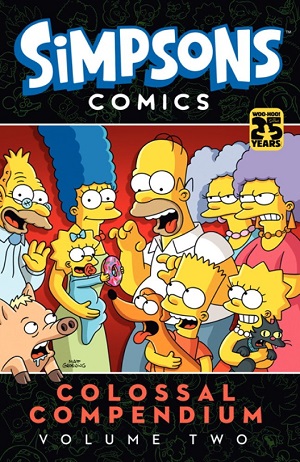
This is more like it. I was a little underwhelmed by the Simpsons Comics Colossal Compendium Volume One, though this was mainly because I judge the writing in these Simpsons comics to a high standard. I know the Simpsons universe well, at least from its earlier years, and I’ve been impressed at how the stories in the comics are still so fresh and funny decades into the franchise now.

There are some good storylines here, including a number of superhero spin-offs. There’s a Bartman story where he meets a supposed Bartman of the future (one guess as to who that is!), another where all three of the Simpsons kids are superheroes (Stretch Dude, Clobber Girl, and Bouncing Battle Baby), a blast from the past courtesy of Comic Book Guy and issue #100 of Radioactive Man, and an adventure where Homer becomes a sort of accidental costumed crimefighter as a way of losing weight.

The best story though is “No Cause for Alarm,” a comic written and illustrated by the legendary Sergio Aragonés. This follows a series of mishaps that arise when Homer gets lazy with the alarm at the nuclear power station. It’s the kind of gag humour Aragonés does well, and the story has a lot of the chaotic crowd scenes he’s famous for, made all the better for the fact that Springfield is so full of easily identifiable characters you can enjoy these pages for a while as you try to locate where your favourite citizens are hiding.

If there’s any negative comment I’d make it’s the inclusion of a couple of short Itchy & Scratchy vignettes. I’ve never understood why they kept with these. Basically they’re an ultraviolent version of Tom & Jerry, with the cat (Scratchy) always being dismembered or destroyed by the sadistic mouse Itchy. I don’t find these comics offensive or shocking, but I don’t think they’re funny either. And they always play out the same, with no twists or surprise endings (unlike Mad’s Spy vs. Spy, for example), so they’re not very interesting in that respect either. But since these only amount to a few pages of filler it’s not a big deal.

Finally, the papercraft Springfield landmark is of Moe’s Tavern.

Graphicalex

Malignant Man

Malignant Man

It’s likely the main initial selling point for Malignant Man is that, as the back cover tells us, it was “written by Saw director James Wan.” But even this needs some unpacking.

In the first place, on the title page inside James Wan is credited with “Created and story by.” The comic itself was “Written by” Michael Alan Nelson. This put me in mind of the way the BRZRKR comics were credited as co-written by Keanu Reeves. I expressed some doubt as to how much writing Reeves actually did on those comics, but since (to be fair, after getting off to a decent start) they were terrible, and his co-writer Matt Kindt was a capable hand, it’s possible he was at least somewhat involved.

The other thing to note is that Wan did go on to produce and direct a 2021 horror film with the title Malignant, but that movie has nothing at all to do with this comic (which came out in 2011). There was apparently a deal in place to make a movie out of Malignant Man, with Wan originally slated to direct, but it never got off the ground. At least I’ve never heard of it.

On to this comic. Our hero is one Alan Gates, a fellow who has been diagnosed as dying of brain cancer. But don’t worry, he’s not going to turn into the Jigsaw Killer. Instead, after being shot in the head by some punk who he tries to stop from stealing a woman’s purse, he’s taken in for surgery where the doctors find out that his brain tumour is actually an alien parasite called a malignant that gives him super powers.

Just as an aside, I think that’s supposed to be him on the cover, but that person doesn’t look anything like the guy in the comic. Which seems like the kind of thing someone should have flagged.

Unfortunately for Alan, there are other malignants out there. Actually there are two secret societies of them, one good and the other bad. The bad ones, who look like the Agent Smith clones from The Matrix, start sending hit squads after Alan. Along with a malignant buddy named Sarah Alan kills them all, utilizing his glowing malignant blade and prosthetic shotgun.

I didn’t think there was anything special or very new about this idea, and for a short run of four comics they tried to put too much mythology into the mix. For example, we never do figure out what the malignants are up to. Maybe if the series had gone on some of that would have been explained, but this seems to have been the end of the line.

Graphicalex

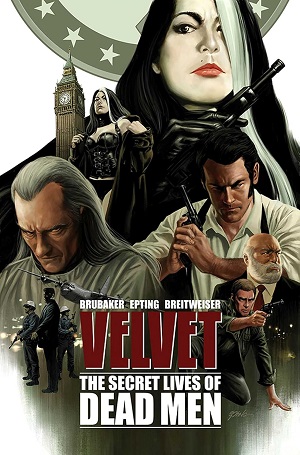
Velvet Volume 2: The Secret Lives of Dead Men

Velvet Volume 2: The Secret Lives of Dead Men

I’m happy I stuck with this series. I thought Before the Living End was generic and uninteresting spy stuff, but The Secret Lives of Dead Men drew me in. It’s still terribly generic, but I found myself genuinely curious as to what the game behind the game was and who was being played. Even though the answer to that latter question seems to be everyone.

So sexy superspy Velvet Templeton, clad in her skin-tight prototype stealth suit (bullet proof, and with wings for gliding off of tall buildings) is running around Europe with stolen passports trying to find out who framed her for the murder of secret agent X-14. Apparently it all goes back to some shit that was going down in the 1950s (the story is set in 1973) and Velvet’s husband, codenamed Mockingbird.

Don’t think you’re going to get any answers here! Just a lot more questions. But I enjoyed all of it, and was even glued to long stretches of dialogue that take place between two people sitting in a bar or together on a train. You know these conversations are games as well, but it’s fun to watch Velvet playing them as she follows the bread crumbs to whatever final twist Ed Brubaker has up his sleeve.

Graphicalex

Aliens: Dust to Dust

Aliens: Dust to Dust

In my thoughts on Aliens: Dead Orbit I offered up the opinion that sometimes with comics where one person does double duty as artist and writer you end up wishing they’d split the labour with someone else. In that case I loved the art by James Stokoe but had trouble following the story. Dust to Dust reverses this, as I thought Gabriel Hardman’s story was solid, if pretty basic, while his art wasn’t to my liking.

First the story. In his Introduction Hardman expresses his (in my opinion, correct) understanding of the mission. “You have to bring in different ideas while still fitting the tone of the Aliens universe or you’ll end up with a stagnant pool of a franchise.” This is what I meant when I said of the Aliens: The Original Years Volume 2 omnibus that the stories have to deliver fan service but also “just enough stuff that’s new that every story has its own character.” And in fact this is the challenge faced by every genre writer.

So in most respects Hardman presents us with a classic Aliens story here. On a planet that’s been undergoing an only partially successful terraforming program there is a Xenomorph outbreak. And, as is the nature of these things, pretty soon the nasty creatures have overrun the human colonies, leaving everyone scrambling to get on the last escape shuttle out. Two such people are 12-year-old Maxon and his mom, the latter having recently had an intimate encounter with a facehugger. So yeah, she’s expecting. After Maxon and mom get on a shuttle, mom gives birth in the usual way, and within a couple of minutes the chestburster is a full-grown adult Xenomorph. How do these things grow so fast?

Anyway, the shuttle has to crash land back on the planet, which is an inhospitable environment riven by dust storms. The passengers all survive the crash, but so does the Xenomorph, minus an arm. This is significant because it brings in the “different idea” that jazzes the story up. You see, as one character puts it, “everybody says the Xenomorphs take on the traits of their hosts.” And since this particular Xenomorph was born of Maxon’s mother that means there’s still a kind of shared bond. She (the one-armed Xenomorph) may kill everyone around Maxon, but she’ll leave him alone. Or even protect him, as needs be.

The idea that Xenomorphs borrow something from their hosts had, I think, been suggested in the Aliens mythology before this, but the step taken here goes quite a bit further. These aliens even take on the personality of their hosts. That’s new, and it’s an interesting twist in what turns out to be, as promised on the back cover, a story “equal parts the horror of Alien, and the action of Aliens!”

But then there’s the art. It’s very much the sketchy style of drawing (and lettering) that I’m not a fan of. The work of Jesús Hervás and Vanessa R. Del Rey on The Empty Man series being a good example. I like the art here better than in that title, but it suffers from the same drawbacks of being hard to read at times. There’s one fight with the Xenomorph, for example, where it gets knocked off its feet when attacking Maxon. How? I can’t make it out. I think a giant robotic arm is swung at it, but I had to wonder how that would work. It’s just not clear.

Now to be fair I do like an individual artistic style, and I’d rather see a comic drawn this way than in the plastic visuals of the mainstream Marvel manner. Also, the scratchy quality of the images goes with the fact that a lot of the time the characters are caught out on the surface in a raging dust storm. But still, it’s not my thing.

Graphicalex

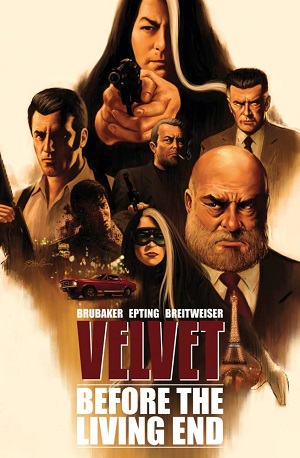
Velvet Volume 1: Before the Living End

Velvet Volume 1: Before the Living End

It’s fine. Just nothing special.

A vintage spy story, set in 1973 but in James Bond’s Europe, so definitely not the disco era. There’s a spy organization known as ARC-7 that only a graphic in the corner of one of the cover pages tells us stands for the Allied Reconnaissance Commission. So sort of like the Five Eyes? I don’t know. Their headquarters is in London. James Bond again.

One of the ARC-7 superspies is gunned down in the streets of Paris, which sets off alarms back at HQ. It seems they have a mole. The chief suspect is one Victoria Templeton, a mid-40s beauty with a shock of white hair who works as the personal secretary of the Director. Ms. Templeton is, however, a lot more than a secretary, being a super-spy herself. And now she’s on the run.

Exotic settings. Luxury acccomodations. Gunfights. Martial arts. Car chases. Victoria in lingerie and swimsuits. Like I say, it’s fine. But really generic and just not that interesting. Maybe the next volume will throw in some change-ups, because that’s what I think it really needs.

Graphicalex

Batman Arkham: Hugo Strange

Batman Arkham: Hugo Strange

I like these DC Arkham volumes (and Marvel does something similar with their MCU tie-in books) because they show the evolution of a villain through time. And when I say through time I mean a lot of time. The character of Hugo Strange first showed up in 1940 and the last comic collected here is from 2016. So it’s been a slow evolution.

In Dr. Strange’s debut Batman describes him as “the most dangerous man in the world! Scientist, philosopher and a criminal genius . . . little is known of him, yet this man is undoubtedly the greatest organizer of crime in the world.” This makes him sound a bit like a DC version of Professor Moriarty, which may have been the original idea. As things went on, however, he turned into something a little more specific. I assume he’s still a great mind and polymath, but in his later iterations he seems more specifically to be a psychiatrist or psychologist. His appearance also became more distinct: coke-bottle glasses or goggles, bald and with a beard, and a grin that flashes both top and bottom rows of teeth. It’s also revealed that he’s quite buff, to the point where he can fill out a Batman suit well enough to pass as the caped crusader, only hairier. Or even go toe-to-toe with the champ in fisticuffs, if need be.

This made the data page provided as a bonus at the end of this volume all the more surprising when it gave his personal stats as 5’10 ½” and 170 pounds. Do you know anyone else who is 5’10 ½” and 170 pounds? Yes you do! The fellow writing this review! And I can tell you, I don’t have a superhero’s build.

Another quick aside: Why is he Professor Hugo Strange? I assume he has a Ph.D. from somewhere, and so could be called Dr. Strange (albeit not of the mystic arts), but the title of professor usually means someone who has a teaching position somewhere. I don’t see any evidence of that in these comics, and I’m not sure how it would work for Hugo, given his criminal record.

In any event, like a lot of shrinks (and yes, I’ve known a few), this Dr. Strange has lots of his own mental issues to work through. The chief being an obsession not just with defeating Batman but becoming Batman himself. Hence the way he keeps dressing himself up as Batman, which seems almost like a kink. When Robin asks him why he’s so into cosplay we get this explanation: “Batman is more than a person, child. Batman is a force, a power of archetypal potency! The Bat is in all of us! I am the Bat! He has no right to keep the mask to himself! No right!”

I don’t know if that makes any sense. It probably does to him, but as Robin realizes, he’s not someone who knows himself very well. I mentioned, for example, his thing for dressing up as Batman being a sort of kink, and there were a few points in these comics that reinforced that notion. In his debut for example, when Professor Strange captures Batman he ties him up and starts whipping him. Or, in his words, giving him “a taste of the lash!” This struck me as kind of weird. Then in a later comic there’s a two-page wrestling match between a totally nude Bruce Wayne (fresh out of the shower, you see) and a “mandroid” version of Robin. This made me think of Saturday Night Live’s Ambiguously Gay Duo. Is there some homoerotic fascination then that Strange has for Batman/Bruce Wayne? (For years Strange was the only villain that knew Batman’s real identity, which he discovered by the simple expedient of taking off his mask when he captured him.) As for his dating preferences, his data page gives his marital status as single and whatever else he envies about Bruce Wayne’s lifestyle, it’s not having hot girlfriends like Silver St. Cloud, who he finds to be a nuisance.

Leaving all that aside and just focusing on the comics, I thought the two-parter from 1977, and 1986’s “Down to the Bone” (that reads a lot like Frank Miller’s Daredevil: Born Again storyline, which came out the same year) were both very good. Do you know what elite status markers were in 1986? Yachts and . . . VCRs! Alas, “money is not just yachts and VCRs,” we’re also told. So I guess I wasn’t that rich after all. Moving along, the four-part “Transference” story from Gotham Knights though struck me as poor and the final story, the climax of the “Night of the Monster Men” arc, wasn’t worth including. In other words, the storytelling hit a peak in the ‘70s and ‘80s and has been in a trough since. That’s not really an issue with the evolution of the character of Hugo Strange though, but says more about the declining quality of writing everywhere.

Graphicalex
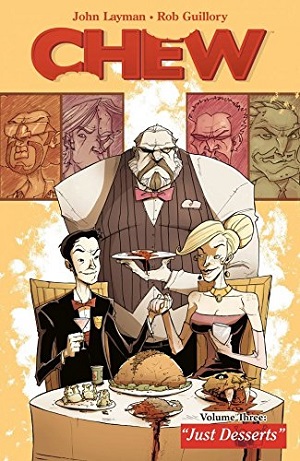
Chew Volume Three: Just Desserts

Chew Volume Three: Just Desserts

Alright, we’re rolling again with my go-to comic for a good time. This volume contains issues #11-15, with #15 marking the quarter mark for the team of author John Layman and artist Rob Guillory as they had originally planned a 60-comic run.

I think this gives some idea of the forethought that went into the series and explains the way hints keep getting dropped as we go along to characters and events that didn’t seem all that important at the time, or that we might have thought we were finished with. To be sure, I knew that Gardner-Kvashennaya, the arctic observatory that hosted a vampire bloodbath, was going to play a big part in what was to come. Ditto the “Frog Man” Montero (so-called because he breeds frog-chicken hybrids). But I wasn’t expecting the return of the killer rooster Poyo, or the introduction of new characters like a mysterious food taster, Tony’s sister, and all the rest of his family, including his daughter(!) and one very weird ex.

The other thing about planning so far ahead is that it allows Layman and Guillory to play with the arrangement of the narrative blocks. This happens in almost every issue, as we begin with a scene (often the aftermath of some act of violence) that only gets explained later. They know what they’re doing here, as they even make fun of it in issue #12, which begins with the editorial note “The pages got shuffled out of sequence. This is actually page 18.”

Given all this preparation I feel confident that I’m not going to be disappointed in how things turn out. In the meantime, I’ve enjoyed everything so far, down to all of the little background gags you really have to be on your toes to catch (and a few of which I’ve missed). On to the next course!

Graphicalex

Token MAD

Token MAD

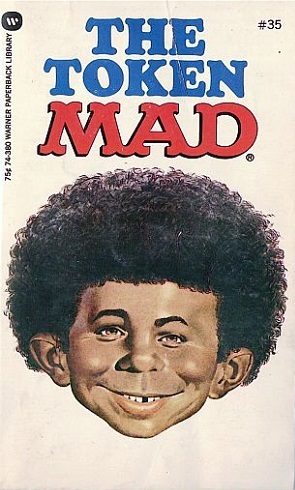
Nope, I don’t think you’d get away with that cover today. But in 1973 (this is a first edition!) you could. It’s meant as a send-up of tokenism (think wokeness, but fifty years ago). The back cover declares: “Is MAD guilty of tokenism? You bet we are! We’ve always offered our readers token humor, token satire, token good taste! And this book is no different . . . just another token attempt at courageous publishing! So even though the price is only a token of what a good book would cost, you’ll be taken . . . with . . . The Token MAD.”

That token price, by the way, was $1.50. Wouldn’t see that on many covers today either.

This is another grab-bag MAD collection, full of bits and pieces mostly from the 1960s. The movie and TV satires, both illustrated by the great Mort Drucker, are for The Professionals (1966) and I Spy (1965-1968) respectively. For years I didn’t know anything about either of these shows, and by the time I finally saw them it was through the lens of the Mad versions that I knew practically by heart. Alongside recurring features like David Berg’s Lighter Side of . . ., the Don Martin Dept., and Spy vs. Spy (they each win one) there are some great one-offs like “Vanishing Human Types and Their Modern Replacements” (do you remember “the inexpensive handyman”? or are you more familiar with “the specialized service technician”?), “Historical Events as Covered by Modern News Feature Writers” (the Battle of Bunker Hill written up by the sports editor) and “Obituaries for Comic Strip Characters.” I got a real laugh out of this last one, and the obit for “noted man about town Donald Duck,” who was killed in a hunting accident after being mistaken for a wild canvasback. I loved this paragraph especially: “A spirited eccentric, Duck was known for his clever wit, all of which was unintelligible. He countered this, however, with savage bursts of temper which accomplished nothing.” That’s our Donald! And that was MAD!

Graphicalex

Old Man Logan: Past Lives

Old Man Logan: Past Lives

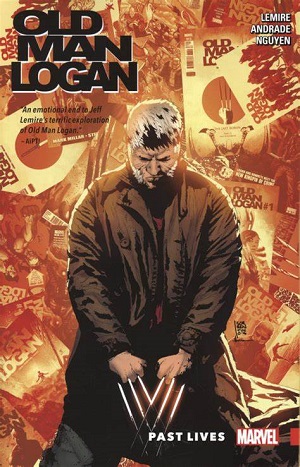
This was the final issue of the Old Man Logan series to be written by Jeff Lemire and it has even more of a retrospective feel to it than usual. As things get started Logan has decided he wants to go back in time and to the specific part of the multiverse where the saga began so that he can save Baby Hulk, and maybe his family too. Unfortunately, none of his friends and enemies want to help (he appeals to the Marvel science-and-sorcery brain trusts, from Doctor Strange and Scarlet Witch to Black Panther and Doctor Doom), so as a last resort he springs a devil-worshipper named Asmodeus from supervillain prison. Asmodeus says he’ll send Logan back into his past, but –surprise! – he’s actually going to double-cross Logan. I don’t know why Logan would have expected anything less. That struck me as silly.

Anyway, instead of going straight back to the Wasteland, where it all got started, Logan ends up being unstuck in time, forced to “re-enact [his] greatest hits.” His fight with Hulk. The climax of the Phoenix story. As Patch in the streets of Madripoor. He even gets to re-use his famous tag-line about bad guys taking their best shot but now it’s his turn. But eventually he does get back home, only to have to say good-bye to his wife and kids, knowing that he can’t save them.

(An aside: I was a bit put off by Lemire not knowing the difference between a combine and a tractor. When Logan gets back to his farm he’s shown working on what is referred to as “the combine” but which is really just a tractor. A combine is a combination harvester. From the looks of it, I don’t think they’d have any use for a combine in the Wasteland, which is a Western desert landscape like that of the homestead in The Searchers. And I never could figure out what kind of farming the family was doing in that movie. On further reflection though, I thought this made for a fitting vision of our dystopic future, caring for and repairing old machinery that nobody has any use for now anyway.)

As a way of wrapping Lemire’s part of the series up this sort of thing is fine, but it doesn’t stand out as being a great or essential comic on its own. It has the feel of the last episode of some long-running TV show, like Seinfeld, where you just bring everybody back for a cameo before shutting things down. I like the art by Filipe Andrade (the first couple of issues here) and then Eric Nguyen, the latter feeling influenced by Sorrentino’s earlier modeling of the character while also doing its own thing. And the mechanism for the time-skips, a magic amulet, is at least easy to follow, even if there’s no discernible rhyme or reason to how it works. Of course this wasn’t to be the end of the line, as the series would continue. But there’s still a well-deserved sense of an ending.

Graphicalex

Doctor Strange: A Separate Reality

Doctor Strange: A Separate Reality

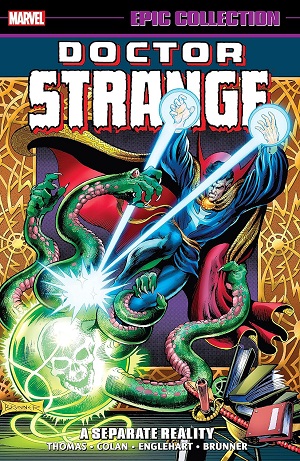
This is the third volume in the Epic Collection series of Doctor Strange comics and it kicks off with a character who was still in flux. For one thing, he’s wearing a full black hood/mask and underneath his cloak he’s sporting conventional superhero tights that show off his generic superhero musculature. Thank goodness they realized that look wasn’t working and went back to letting him wear his usual duds. This guy gets his kicks above the neckline, sunshine. And when you have perhaps the most recognizable face in the Marvel pantheon, why pull a bag over it?

There are three main story arcs here. The first is the longest, with the good doctor taking on a series of Lovecraftian demons with names like Dagoth, Sligguth the Abominable, N’Gabthoth the Shambler from the Sea, Ebora the Dark Priestess of Evil, and Kathulos of the Eternal Lives. All of these baddies are defeated on the way to a showdown with Shuma-Gorath. That climactic issue has the title “Finally, Shuma-Gorath!” as though even the writers were getting tired of all the build-up.

This first story arc ends with the Ancient One dying, or more properly becoming one with the universe, leaving Doctor Strange as the Sorcerer Supreme. The next story has him fighting a sorcerer from the future named Sise-Neg, who is traveling through time absorbing all the magic in history so that he can recreate the Big Bang and become God. This is obviously very serious stuff, or as Dr. S. puts it “The power of Sise-Neg is the greatest threat our reality has ever known!” Which is weird because I thought Shuma-Gorath was the greatest threat our reality had ever known. After a while the inflated rhetoric runs out of places to go.

Finally, the third storyline has a villain named Silver Dagger hunting down the Doctor and killing him with his eponymous weapon. Except our hero saves himself by diving into the Orb of Agamotto and facing off with Death. Then he comes back to our world and rescues his girlfriend Clea and puts Silver Dagger in his place.

I went through this breakdown only because it illustrates a point that I think it worth drawing attention to. The thing is, both Shuma-Gorath and Sise-Neg are awesomely powerful multidimensional entities who threaten the existence of the entire universe, or at the very least “our reality” (which contains the universe). The way Doctor Strange engages them in cosmic battle is certainly dramatic and colourful, but neither is very interesting as a villain. Silver Dagger, on the other hand, is a buff old guy dressed in a silly midriff-baring halter top and with a crazy backstory that had him narrowly missing being elected Pope and then digging into the occult section of the Vatican’s library so as to learn how to become a demon hunter. He’s a fundamentalist Catholic and not at all a standard bad guy so much as someone with a monomaniacal thing for using magic to destroy magicians wherever he finds them. He’s a man with a mission, and it’s a mission that’s far more relatable than destroying the universe or becoming God. He’s humanized even to the point where Clea falls asleep listening to him tell his origin story, and he’s taken off stage at one point because he has to go to the bathroom: “Now excuse me. Nature calls.” I can’t think of another time I’ve seen a superhero excuse himself like that, and it made me laugh.

But even Doctor S has his human side here, with a different part of his nature calling when he realizes he’s “neglected” Clea “both as a man and your mentor in the mystic arts.” She can take a hint, and when he offers to instruct her in the way of the Vishanti she tells him she’ll be happy if he tells her about it later. “And with the soft, dancing flames lighting her smile, there is no doubt of her meaning . . .” When next we see Clea she’ll be on the floor “still warmed by the afterglow of love,” happily telling her pet rabbit how her lover is “so much a man . . . so much.” That was pretty risqué for a comic at the time.

Even in the Silver Dagger storyline however the emphasis is on what the back cover here calls “eldritch horrors and psychedelic threats!” Our hero is always getting sucked into different dimensions where he may meet floating skulls or man-eating plants or even a hookah-smoking caterpillar. The art of the dream dimension is “a kaleidoscopic cosmos filled with shifting shapes and colors – beyond even the imaginings of a Freud – a Dali – a Kandinsky!” Those lines come in a full-page spread by Gene Colan, who kicks things off really overloading the reader with large-format artwork. I think he averages four panels per page and has a lot of full-page and even the occasional double-page illustrations. By the end of the volume though we’re into the run of Frank Brunner and a more detailed look. But with either artist the language mirrors the visuals. We hear of how the “awesome eruption of cabalistic conjurations emblazoned the night.” Of how “dire perils” and “frightful abysses of forgotten fears and chasms of primordial horrors gape wide to destroy our world!” Of how “arcane bolts of bedevilment – flaring garishly against the surrounding pitch – leap from rigid fingers!” Nothing is too over the top for the Sorcerer Supreme!

It all makes for a fun series of adventures, with the dread Dormmamu put on hold so that the Doctor can fight new faces of evil with helpful allies (it’s always fun to have Namor pop by for a cameo) and old stand-bys like the Eye of Agamotto, the Vapors of Valtorr, the Shield of the Seraphim, and the Crimson Crystals of Cyttorak. All of these Epic Collections are substantial volumes, running around 450 pages, but I was entertained throughout this one. Even being weird and strange can become stale after a while, but by mixing up writers and artists and looking to grow the Doctor Strange universe with new characters they did a great job in these early days keeping things fresh and creative.

Graphicalex