Jughead: The Hunger Volume One

Jughead: The Hunger Volume One
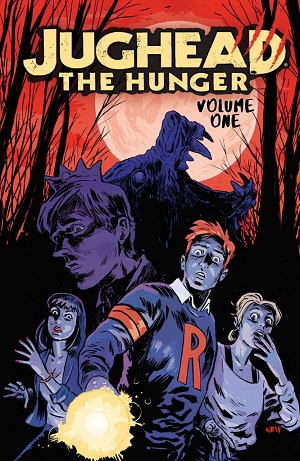
This title is part of a series published under the Archie Horror imprint, coming after Afterlife with Archie and Chilling Adventures of Sabrina and just before Vampironica. The basic idea is that Jughead is one of a long line of Jones family werewolves, with Betty being the latest werewolf hunter of the Cooper clan.

Volume One contains the one-shot comic that launched the series and then issues 1-3, along with some supplemental material and a teaser for Vampironica. The art is in a more realistic style than the usual Archie stuff, so things like Jughead’s needle nose are played down, though he still has his stupid hat and Archie is easily identified by his cross-hatching at the temples and dusting of freckles. Veronica and Reggie I found unrecognizable: Ronnie for being so skinny (a marker of her affluence?) and Reggie for just looking generic without any of the slick smugness of what I was used to. But otherwise the story leans into the characters as we all know them. Betty as werewolf hunter is the tough and practical girl next door; basically Buffy with bullets, a belly shirt, and torn jeans. Jughead is a reluctant monster, slave to his appetites. Reggie is the consummate schemer. Veronica is corruptible. Archie is the Everyman caught between all these different forces. Victims include the old (Ms. Grundy), the fat (Pop Tate), and the nerdy (Dilton Doiley).

This consistency in character underlines a point made by Archie writer Matthew Rosenberg in his introduction: that horror like this doesn’t subvert Archie’s vision of Americana so much as extend it. Horror is as American as apple pie and Norman Rockwell and the rest of the Riverdale gang anyway.

So everything seems to actually follow quite naturally, and I thought it made for a pretty good story. The only point where I had to complain was when the one werewolf gets shot up by the police and then later heals himself by squeezing all the bullets out of his flesh. Only these clearly aren’t bullets but bullet casings, which are discharged by the gun when the bullet is fired. There’s no way they would have been in the werewolf. I was kind of surprised somebody didn’t catch that, as even for someone who doesn’t work with guns a lot it’s a howler of a mistake.

Graphicalex

Grass Kings: Volume Three

Grass Kings: Volume Three

The finale of the Grass Kings trilogy, and I think it does a great job wrapping things up. That’s not to say that everything gets wrapped up though. I think Matt Kindt put too much into this series and there wasn’t enough room for all of it. He would have been better to just stick with the serial killer story, which is quite well handled, and not brought in all the stuff about the billionaire with his own private army garrisoned on an island in the lake. Then the way the killer was blackmailing the sheriffs in Cargill just got dropped in without a lot of explanation. And I never understood how such a community was viable “off the grid,” or what its legal status was. When Maria here says that she’s in the Kingdom “illegally” I couldn’t figure out what she was talking about.

The art by Tyler Jenkins was firing on all cylinders. I loved the full-page pic of the sheriffs looking down off the dock to the bound body in the water. I was also impressed at how well Jenkins can draw horses and helicopters. You wouldn’t expect him to do both well. And even the faces seem filled out a little more, allowing a greater range of expressions and emotion.

Well, you want to end a series on a high note and I’d say this is the best of the three volumes so mission accomplished there. The whole concept was bigger and stranger than I think it had to be, but they brought it home in a way I thought was satisfactory.

Graphicalex

Contagion

Contagion

A little disappointing. But I started out with low expectations that were quickly surpassed. I was thinking it would be a kind of Marvel Zombies, which it is, but the story really whips along and throws in what feels like half the Marvel Universe without losing too much focus. The main hero is the ever-lovin’ Thing, who is called into action when zombie-like creatures are found roaming the New York City subway (beneath Yancy Street, even). And yes, C.H.U.D. is referenced, which scored them an extra point.

What’s happened is an ancient evil in the form of a magic fungus (think green mold, not mushrooms) has been raised beneath the ancient city of K’un-Lun. And . . . then it travels to NYC. Don’t ask me how. It has the ability to take people over and absorb their powers, which makes it pretty tough to beat once it’s taken out the rest of the Fantastic Four and then the Avengers. The Thing is immune, as this sort of mold can’t infect his rocky exterior, but he can’t go clobberin’ it either because it just brushes him aside.

But here the story also got pretty hard to follow, since the consciousness of everyone the mold defeats goes into a sort of hive-mind repository within whoever the primary host happens to be. It’s up to Moon Knight to get inside the hive mind and figure out how to beat the mold, but I can’t for the life of me tell you how it’s done.

So it’s a decent idea, and I liked the range of heroes assembled, even if Iron Fist and Luke Cage, one of my favourite teams, had nothing much to do. Generally I felt that things sort of went downhill though, both in terms of the story (written by Ed Brisson) and the art (each of the five issues has a different artist, and I felt they got progressively weaker). The ending, which I’ve said I didn’t understand, was particularly soft, although there’s a nice coda with the Thing back in the ‘hood.

So, it’s a quickie and winds up feeling rushed what with having so many characters involved, but don’t expect too much and you should enjoy it.

Graphicalex

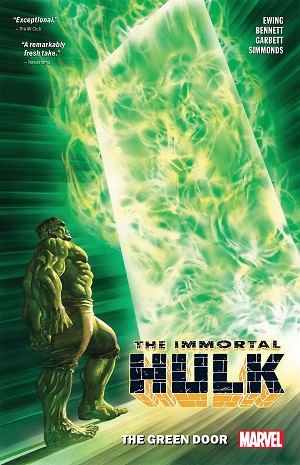
The Immortal Hulk Volume 2: The Green Door

The Immortal Hulk Volume 2: The Green Door

On the plus side, there were some crazy fights here, as the Hulk’s new-found immortality is pushed to the limit and beyond. He’s approaching god-level power and is strong enough take on all of the assembled Avengers. Even if you blow him up with a space laser and then dissect him with adamantium blades his parts keep reassembling, which just leads to another big green can of whoop-ass being opened up. The effects can be grotesque in a truly novel way, and his various pieces coming back together to take out one of his tormentors is well worth the double-page spread. Meanwhile, Skinny Hulk, with his gamma power being drained by Absorbing Man is also freaky, and what happens to poor Absorbing Man is off the charts.

In the negative column . . . just what the hell is going on? The Hulkster is possessed by both a literal and metaphorical demon. The latter being the spirit of his abusive father, who still shows up in visions, and the former being I’m not sure what. Maybe an actual emissary from hell, which is where we end up in the end after going through the eponymous green door (which is, sadly, not an homage to one of the signal films of porn chic).

In sum, this is a really weird take on the Hulk mythos – maybe the weirdest yet, which is saying something since it has gone in a lot of strange directions. I have a hunch that writer Al Ewing was trying to do too much. Even the issue epigraphs rarely seemed on point. That said, I enjoyed this volume a lot more than the first, even if it is a dog’s breakfast of crazy. I still don’t know if there’s anywhere it’s going that’s worth getting to, but the trip is turning into a lot of fun.

Graphicalex

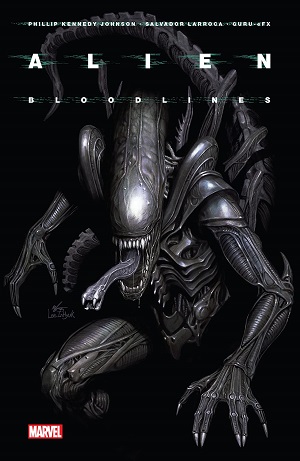
Alien: Bloodlines

Alien: Bloodlines

In my notes on Aliens: The Original Years I said how much I loved the writing. The way that Mark Verheiden took the story in so many interesting new directions put what happened to the film franchise after James Cameron’s Aliens to shame.

I don’t think what writer Phillip Kennedy Johnson does in this six-issue story arc is on quite the same level as Verheiden’s work, but it’s very good. A tough-as-nails security chief named Gabriel Cruz has to go back to a space station orbiting Earth when his son joins up with an activist group that wants to throw a monkey wrench into what the Weyland-Yutani Corporation is doing up there. Unfortunately, what they’re doing up there is breeding a bunch of Xenomorphs, so of course things get out of hand. It seems that despite all the time spent studying them we’ve never learned how to handle these critters.

Throw in some Bishop-model cyborgs that all look like Lance Henriksen, a super “Alpha” Xenomorph and a mysterious dark queen of the hive, and a strange subplot that has the Xenomorphs forming a psychic bond with Gabriel because he’d survived incubating a facehugger (it was cut out of him before it matured and made its own exit), and I thought there was a lot of interesting stuff going on here, most of which I enjoyed.

What I didn’t like was the art by Salvador Larroca. To give him some credit: the aliens look good and some of the action sequences, like the guy getting his head blown off with a shotgun, are nicely done. But where Larroca really falls down is in his drawing of the human characters, and particularly their faces. Everyone seems made of plastic, or like they’re the product of an AI art-generator, and not a very advanced AI program either. (I also thought the colorist was a program, as the credit is to Guru-eFX, but apparently that’s a real person.) Emotion doesn’t register at all, even when characters are yelling or screaming, and there’s little sense of movement in the way the figures are drawn. From what I’ve been able to gather, there’s a lot of strong opinions on Larocca out there in the comic community and I can only say that while I can see some people liking his style it’s not my thing and it took my grade on this comic down quite a bit.

But if you’re a fan of the franchise I’d definitely recommend this just for the story. You may not like the art any more than I do, but it’s something you’ll be able to put up with.

Graphicalex

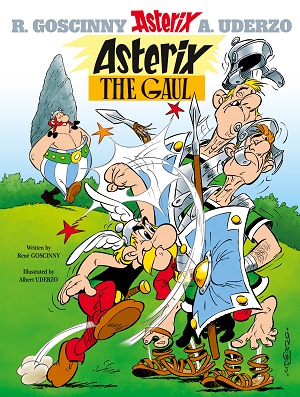
Asterix the Gaul

Asterix the Gaul

This is the first of the Asterix comic books written by René Goscinny and illustrated by Albert Uderzo, and was published in 1961. I grew up reading these in English translations, but this time I wasn’t reading the English version I remembered, as it was an “all-new more American translation” done in 1999. Back when I read the comics the village druid was named Getafix, but here he’s Panoramix, which is actually his name in the original French even though I don’t like it as much. And I wondered if, when Panoramix says he can make soup in various flavours, including “bacon cheeseburger,” this was a literal translation or something more “American.” Did they have bacon cheeseburgers in France in 1961?

For being the first in the series they hit the ground running with Asterix the Gaul, as the series was basically born full grown with everything in place. Except maybe for Dogmatix. I might have missed Obelix’s little dog but I don’t think he was here. And they even let Cacofonix sing at the final feast, which wasn’t going to happen again very often.

The story has a nice a mix of goofiness (the Romans playing musical chairs to see who will be the secret agent sent to the Gauls’ village), wordplay, and basic moral instruction. When Panoramix explains to Asterix that he doesn’t need the magic potion to beat the Romans but only has to use his native wit, it’s a point that a lot of superhero comics like to make.

The real star though is Uderzo’s art. It’s what impressed me the most when I was a kid and it still does today. And it’s all the more impressive because I can’t think of any comic artist who has created anything quite like it in all the years since. One panel here that really stood out has a Roman troop marching beneath a tree, with Asterix and Obelix perched in silhouette on a branch overhead. There’s so much action and information put into that one drawing, not to mention just how beautiful it is to look at. There aren’t many books you can return to after so many years that hold up so well.

Graphicalex

Bone Parish: Volume Three

Bone Parish: Volume Three

The last volume – or is it just the season one finale? – of the Bone Parish saga. And up to the final issue I was wondering how they were going to manage to wrap everything up in the few pages remaining. Well, much to my surprise Cullen Bunn managed to pull it off. It’s a quick ending, and feels a bit rushed, but it’s satisfactory and does manage to tie up most of the loose ends while holding out the promise of the story continuing. Colour me impressed. I didn’t think it was going to work.

There were no big twists or revelations, while the action seemed bloodier than usual even though the regular gang violence was toned down and the mutants created by the bad batch of Ash weren’t back. I was getting used to Jonas Scharf’s art, and while he has a real weak spot for faces, especially in profiles that he tends to just repeat, he does some good action scenes here, including a couple of nice fights and one great explosion drawing.

So that’s a wrap, with most of the Winters family now deceased and bottled up. But what might be going on in the land of the dead is left a little vague. Is there a voodoo king of the underworld, or is it all just hallucinations? Maybe if the series is continued things like this will be explained, but I’m fine if they just leave it the way they did. Solid work all around.

Graphicalex

Batman: Damned

Batman: Damned

Batman: Damned is a sequel of sorts to the Joker comic put out by the same writer and artist ten years earlier but it was also the first comic to be published under the imprint of DC’s Black Label, which was targeted at mature audiences. The first printing of Damned even included a picture of a nude Bruce Wayne with his dick hanging out, and there are few things as adult as Batman’s dick. So . . . it was something old and something new. But what I really found it to be was overblown and confusing.

The blame, in my opinion, falls on Brian Azzarello. I really didn’t like the writing on any level. Most of it is woefully ungrammatical, no matter who is speaking. The Enchantress I could give a pass too since she’s a demon zombie witch or something so I figure she can say “I be fate written. Die cast. Why you no remember?” But why are Batman’s “diaries” full of stuff like “what don’ kill us eats us alive”? Why are the rapper’s rhymes so weak? Why does the homeless guy say things like “seen him with my own too [sic] eyes”? Why would the mandarin Waynes say things like “Don’t be here when I do get back”? Were these typos? In a prestige publication like this? Or did they have some meaning I was missing? Hell, I even hated the lettering. This was all terrible.

Then there was the plot, which was another take on the idea of the journey of the soul after death. The aim was to do a sort of horror comic, but I was too confused to find any of it very scary or unnerving. So as usual it just turned out dark. There were cameos from figures I didn’t know well (John Constantine, the Spectre) or barely at all (the Enchantress). And there’s an uncomfortable appearance by Harley Quinn, who nearly rapes Batman at one point because . . . she hates him. I didn’t need any of this. But then Swamp Thing shows up and I always like to see Swampy so that was a plus.

It looks fantastic. Lee Bermejo’s art is on point with the noir-horror vibe throughout, making me almost wish DC had done the book as one of those comics without words. I might have followed the story just as well. I’ve really liked some of Azzarello’s stuff, but this struck me as a poorly developed idea that tried to make up for its deficiencies with lots of heavy breathing and broken English. And that’s a shame because I did have the sense it could have been something great.

Graphicalex

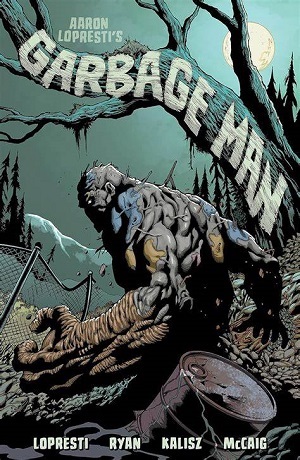
Garbage Man

Garbage Man

There’s a bit at the beginning of Aaron Lopresti’s Garbage Man comic (which is not the sequel to Derf Backderf’s Trashed) where the hero, now an animated pile of toxic sludge complete with bits of rebar sticking out of him, has flashbacks as to how he got that way. As things turn out, he was a corporate lawyer named Richard Morse investigating the goings-on at Titan Chemicals. Titan had been given a government contract to create super-soldiers by injecting test subjects with an HGH (Human Growth Hormone) derivative, combined with a bit of creative gene splicing. The mad doctor in charge at Titan, figuring Morse knew too much, had made him into one of the project’s guinea pigs, and in a lab explosion Morse was propelled into a nearby swamp, from which he then arose as Garbage Man.

When the mad doctor is letting Morse know what he’s going to do to him he says “Stop me if you’ve heard this one before.” Which is Lopresti’s way of letting you know that, yeah, we’ve all heard this one before. Basically Garbage Man is a cross between Swamp Thing and the Toxic Avenger, with Hellboy’s granite hand thrown in for good measure. He actually looks a lot like Swamp Thing too, so much so that when another experiment gone bad appears that looks even more like Swampy it seems redundant (this latter figure is called Mossy Man).

I liked the art and colours here, but the story really is pretty basic stuff, and the not-so-basic stuff (like the guy who dreams dinosaurs into life) is a mess. Garbage Man slowly remembers, in fits and starts, what happened to him and so he goes after the people responsible. Along the way he’s helped by a preacher who lives among the homeless in the city’s sewers, and an old flame who, remarkably, isn’t too freaked out by his appearance. There’s also a trio of superhero types called the Night Club that play an ambiguous role. Maybe if the series continues we’ll find out more about them. But as far as I know this is all the Garbage Man we’ve got.

The individual comics/chapters are only ten pages long so things move really quickly. And it’s fun. But at the same time it didn’t really strike me as anything special and the story itself is very worn. Good as a diversion then, but not a comic I’m likely to remember very long or want to bother re-reading anytime soon.

Graphicalex

Man-Bat

Man-Bat

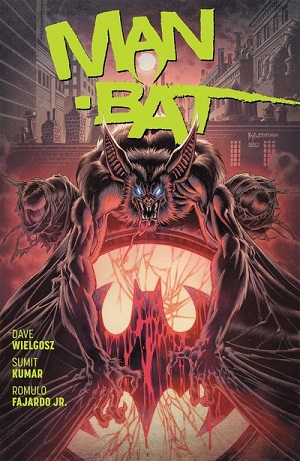
A straightforward, self-contained five-issue story arc by Dave Wielgosz that has Batman sort of fighting and sort of teaming up with Man-Bat (Dr. Kirk Langstrom) to take on Scarecrow.

I don’t really know much about Man-Bat but he struck me as a very similar character to Marvel’s Lizard: another doctor with a monstrous alter ego he keeps trying to find a cure for. But then I guess you could take the same model further back to Dr. Bruce Banner and the Hulk, and before that to Dr. Jekyll and Mr. Hyde. There’s some truth, maybe a lot of truth, to the idea that there are only a handful of stories and characters that we keep recycling. This one expresses the notion that we all have a dark side or primal id that we try to control but that keeps erupting in violent and dangerous ways.

The Freudian model or myth (which can be taken as another version of the same story) is useful here because Langstrom/Man-Bat is literally put on the couch by Harley Quinn (a trained psychologist, she reminds us), and subliminally conditioned by Scarecrow (Dr. Jonathan Crane being another doctor of psychology). Is Langstrom barking up the wrong tree in trying to find a cure for his Man-Bat condition in a lab? Maybe all he needs is therapy. Then again, therapy doesn’t seem to have rid Batman of any of his demons, which are released here by a sonic gun Scarecrow invented that unleashes the basest instincts of all the citizens of Gotham.

It’s not a ground-breaking comic in any way, but I found it quick and entertaining. Sumit Kumar’s art has a bit of a manga flavour to it, and the covers by Kyle Hotz and Alejandro Sánchez are great. I even had to laugh at the cover for issue #1, which clearly has the silhouette of the Bat Signal looking like Man-Bat’s balls hanging down from his crotch. I don’t think that was an accident. They knew what they were doing!

Graphicalex