Kill Shakespeare: A Sea of Troubles

Kill Shakespeare: A Sea of Troubles
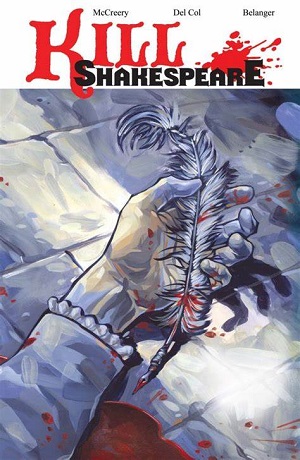
This is something very different from what I was expecting. Which is a good thing, because I wasn’t expecting much more than a comic version of some tales from Shakespeare, maybe done up with a bit of postmodern fillips.

Kill Shakespeare is a lot more ambitious than that. This is a wholly new story that kicks off with Hamlet being sent on a presumably one-way trip to England. That part’s in Shakespeare, but after being shipwrecked things go off the rails. The kingdom Hamlet finds himself in is run by wicked King Richard III, allied with Lady Macbeth, who is in turn carrying on an affair with Iago. This Injustice League of Shakespearean baddies is looking for the magic quill of Will, an artefact with the power to control the world. Opposing them are a team of good guys including Falstaff, Othello, and a kick-ass Juliet. Hamlet initially falls in with Richard, who’s hoping Hamlet is the “Shadow King” who will be able to find and kill Will (Shakespeare). But then the not-so-much melancholy as just confused Prince of Denmark joins up with the oppressed freedom fighters of the woodlands. Meanwhile, the duplicitous Iago is playing all sides, as you’d expect.

It’s quite a bold re-imagining of things, and I give creators Anthony Del Col and Conor McCreery high marks for coming up with the concept. But while the idea is great, I thought the writing itself pretty rough. There’s an attempt to have people talk in a sort of faux-Shakespearean fustian that never sounds right, and there’s way too much talk in the first place. There’s just no need for stuff like this: “Hamlet, do not think that I mean to intrude into your destiny – nothing would be further from the truth. But it seems to me that this maelstrom of events has left your brain heavy and your spirit distracted. Trust in your own abilities. I beg you to take a moment to rest your mind, your heart, your soul. Within you lies a great power to pierce Shakespeare’s veil of deceit, to find this monster. The fates would not lie.”

The art by Andy Belanger had the same effect on me. Some of it is quite well conceived, like poor Macbeth getting Fortunatoed by his wife, a scene that is genuinely horrifying. But most of the rest of the time it has a basic, generic look that made me think of some of the less inspired Classics Illustrated. The various characters have little personality in the way they’re drawn, and could be hard to distinguish at times. Hamlet and Juliet look dropped in from a rom-com, and Othello is the stereotypical hulking Black man, with a shaved head and a build like a defensive lineman.

The actual story itself felt like it was something simple that was being dragged out too much. Nothing seems to happen in this first volume, and it mostly just feels like we’re being introduced to the characters as they run around. This also made me wonder just what the target audience was. I suppose most high school kids will have some idea of who Hamlet, Othello, Richard III, and Lady Macbeth are. But . . . maybe not. Even believing (hoping) that some Shakespeare is still taught in high school, I think very few people will recognize the names of Don John (from Much Ado About Nothing) or Parolles (from All’s Well That Ends Well). Not that it matters much.

So it’s something different, and if you’re familiar with Shakespeare it makes for a cute diversion. But the execution of the various ideas in play didn’t strike me as all that great and I came away feeling that they, somewhat surprisingly, didn’t have enough here to make a whole series out of. I’m not sure when or if I’ll continue with it.
Graphicalex

Chilling Adventures of Sabrina: The Crucible

Chilling Adventures of Sabrina: The Crucible

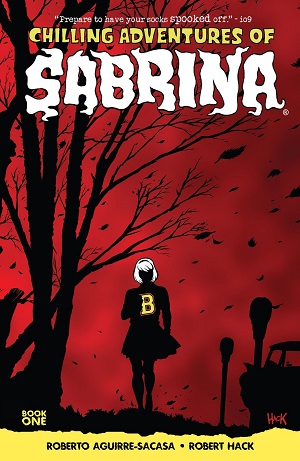
This is another title, the second in the Archie Horror series, by author Robert Aguirre-Sacasa (who kicked the imprint off with Afterlife with Archie) and artist Robert Hack. I think it’s really well done, though I can’t say I enjoyed it as much as Afterlife. Why not? Because it’s so dark.

I don’t mean the art is dark. Hack has a sketchy style, but it’s not heavily shadowed or murky. What I mean by dark is that there is very little humour, quite a bit of unpleasant violence, and a whole lot of devil worship. The comic is rated as Teen + for “Violence and Mature Content” but I could almost see them putting some kind of “upsetting to those with religious beliefs” warning on it as well as they really lean on that angle pretty hard. The witches we meet aren’t nature-loving Wiccans but are instead the blood-thirsty servants of the Dark Lord himself. There’s some of the same vibe going on with witches as there was with the zombies, as we find out that the good citizens of Greendale/Riverdale are, beneath the surface, possessed by the same evil passions as those of Salem in Nathaniel Hawthorne’s story “Young Goodman Brown.” Rip off the polite façade of Norman Rockwell Americana and you’ll find flesh-eating monsters and devil-worshippers holding black masses in the woods.

Or you could look to the inspiration for Afterlife and compare it to that of Chilling Adventures of Sabrina. Thanks to Romero, zombies have always had something a bit comic about them. But as Aguirre-Sacasa puts it in his Introduction, the models they were looking to here were films like Rosemary’s Baby, The Exorcist, and The Omen, with a bit of Arthur Miller’s The Crucible thrown in (though that seems to have mainly just given the comic its otherwise obscure subtitle).

The story has it that amateur witches Betty and Veronica raise Madame Satan, a nightmarish figure with mini-skulls for eyeballs torn from the yellowing pages of Pep Comics in 1941 (one of which is included here as a fun bonus). It seems Mrs. S. got jilted by Sabrina’s warlock father years ago and then got sent to hell. And hell hath no fury like a woman burning in hell who’s there because she was scorned. Since Sabrina’s dad is imprisoned in a tree and her mom locked up in an asylum, Madame Satan decides to go after Sabrina herself for revenge. Sabrina, meanwhile, is living with her two witchy aunts and is about to give herself over to the Devil on her sixteenth birthday. But Madame Satan has other plans.

It’s a good story, and Madame Satan is a great villain, but I felt like it really needed to have some lighter moments. It seems very cynically grown-up, even down to drawing the thirteen-year-old Sabrina with a full figure and adult features. Then it ends with more of a cliffhanger than the rest of these collections. I’m sure I’ll read the rest of it because I’m curious how things play out, but it’s not really my thing. At least I can’t think of any other way of saying that I thought it was excellent but not something I liked very much.

Graphicalex

Tag

Tag

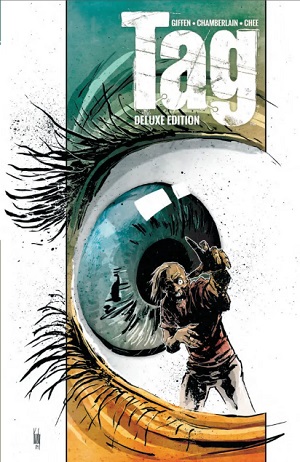
This Deluxe Edition of Tag is actually two comics that don’t have much to do with each other aside from both being written by Keith Giffen. The first is the three-part Tag story, which has a young man named Mitch being “tagged” with a curse that kills him but turns him into a zombie, rotting on his feet until he tags another victim. The only wrinkle is that the next person to be tagged has been pre-selected by fate or karma because of something they did to the tagged person, perhaps many years before.

It’s all a bit awkward, and Mitch actually has to go online and find someone’s blog explaining how it works. There are also clues to the identity to the next person in the zombie chain coming by way of visions that are sparked when tagged. I had the sense it would make an interesting Blumhouse horror flick, as it plays a bit like It Follows, Truth or Dare, or similar viral horrors. And to give it credit, it’s also a bit unorthodox in that Mitch, despite his predicament, isn’t a very sympathetic character most of the time and things end on a down note. I also thought the art kind of grim, with a lot of shadow and a really limited palette.

That’s it for the first comic. What follows is the Dead Meat trilogy (Dead, Deader, Deadest), which follows the post-apocalyptic adventures of a zombie mercenary. I don’t think the story has anything at all to do with Tag, and the comics are so slight as not to amount to much anyway. In the final part I thought there was some potential with the merc’s frying brain pan resulting in a kind of creeping dementia, and again things end on a bit of an odd note, but I can’t say it was anything special.

So two comics in one here, but while both had potential that they showed signs of developing I didn’t think either was very good. I wouldn’t say either was bad though, and they add a bit to the now very mature tradition of zombie literature, especially in the use of the first-person (or first-zombie) perspective and the analogy drawn between zombification and aging.

Graphicalex

The Metamorphosis

The Metamorphosis

In his notes on Franz Kafka’s The Metamorphosis, a work he rated very highly, the Russian-born author Vladimir Nabokov sketched the layout of the Samsa family’s apartment, which is the sort of thing you want to do after reading the story because Kafka is careful to describe the placement of the different doors leading out of Gregor’s bedroom and then the furnishings of the apartment.

I thought of this when I opened Peter Kuper’s adaptation, which begins with a full-page spread of Gregor’s bedroom and Gregor lying on his back, transformed into a giant bug. It’s very cluttered in that late-nineteenth century way, with the rug and the wallpaper and the dresser and the alarm clock and the case full of samples (Gregor is a traveling salesman for a textile concern), and that odd fetish picture that Gregor later mounts and that I was surprised Kuper didn’t make more out of. Shouldn’t the woman in the picture have been the troll-haired cleaning lady, who will later appear as Gregor’s dominatrix? In any event, we also identify the window and one of the doors, which will both play important roles. It’s a bit of domestic scene-setting that makes Samsabeetle (as David Cronenberg called him) almost disappear amidst all the bric-a-brac.

Kuper’s introduction notes the connection between Kafka’s nightmare and Winsor McCay’s (earlier) comic-strip “Dream of the Rarebit Fiend,” but I was feeling the more obvious inspiration here was Robert Crumb, who had himself done a comic biography of Kafka that included adaptations of Kafka’s works, including The Metamorphosis. Crumb certainly had a fellow feeling with the theme of the Untermensch and that’s picked up again here with the emotional radiation coming out of people’s heads and the use of perspective to make Gregor seem even more threatened and smaller (a scaling that we’re shown has begun even before his transformation). All of these things are related.

That said, this book is Kuper’s own thing and I think he did a great job capturing both the story’s realism and the way that reality is strained and distorted through an expressionistic lens. The depiction of the bug with a human head is representative of this pull in both directions, as is the typeface lettering. I think a lot of the classics I see illustrated are hit and miss (including Kuper’s own take on Heart of Darkness), but here everything works really well in an adaptation that manages to be both faithful to the source and something new.

Graphicalex

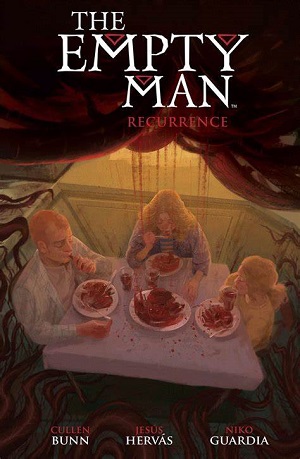
The Empty Man: Recurrence

The Empty Man: Recurrence

In my review of The Empty Man I said I came away from it with mixed feelings. Well, I felt the same way here, though the needle was pointing a little more to the positive.

The Empty Man virus is still in full swing, though no one has figured it out yet. A doctor is shown on TV explaining a bit about its different stages, but at the end of the day (meaning the end of this comic) we’re no clearer as to what’s going on. It seems like humanity is caught in someone’s nightmare, a nightmare that has taken on a life or physical form of its own and is now being projected around the globe. The virus makes its victims act out in spectacularly violent ways, so it doesn’t seem like a very nice thing, though its message is that it only wants to bring people together and create a kind of paradise on earth. There’s a cult of crazies who worship it, but they don’t seem like they’re up to anything good. The “manifestations” or “sacred visitations” of the virus look like a cross between Marvel’s Carnage and a giant shrimp. So that’s all to the bad.

The murkiness that I complained about in the first book is still with us. And things like the peroration here, where it’s said that the virus is a response to humanity taking our free will too far, just added to my confusion. But having said all that, this is a more focused story, with agent Walter Langford having moved off-stage and Monica Jensen (formerly FBI) and Owen Marsh (formerly CDC) being the main protagonists. They’re freelancing now, trying to protect a suburban family home from cultists without and the Empty Man within, as the mother is possessed. Jensen herself has the virus too, but she’s keeping it under control with meds. I don’t know how much longer that’s going to work though.

The art by Jesús Hervás also struck me as a step up from Vanessa R. Del Rey’s, though it shares a very sketchy texture that makes faces seem almost semi-sculpted out of clay, melting or otherwise ill-formed. But at least I could see what was going on.

I don’t know why I liked The Empty Man, but I did. And I had the same response to Recurrence. On the face of it, I shouldn’t have liked it at all. The story is muddled and, from what I could make of it, not very good. The art is rough. And yet it has a vintage X-Files sort of flavour to it and I found myself interested in what was going on. Unfortunately the story, as basic as it is, isn’t resolved, leaving us with a couple of cliffhangers. Oh well. Onward, then.

Graphicalex

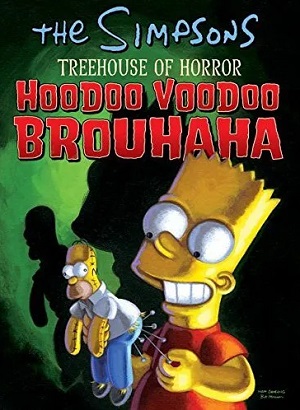
The Simpsons Treehouse of Horror: Hoodoo Voodoo Brouhaha

The Simpsons Treehouse of Horror: Hoodoo Voodoo Brouhaha

This instalment of the popular Simpsons Halloween special is introduced by Comic Book Guy, someone who knows something about a wasted life. He’s prepared a list of things that scare him most – “A slobbering child in the vicinity of a near mint-condition Golden Age comic book,” “What may lurk beneath my beard” – and concludes it with this observation:

But what scares me the most? Poorly executed comic books. Every piece of awful graphic literature that I’ve read cannot be unread. The hours spent cannot be added back to my lifespan. And since much of what I read is awful, said mediocrity has eaten up approximately 17.4 years of my allotted time on Earth. Sooner or later, the days I have left to live will be in deficit to the amount of times I have spent reading paper drive classics like “David Niven Adventures” or “Radioactive Man Vs. The New York Times Crossword Puzzle.” This realization chills me to the bone.

This is the same sort of accounting that I think gives every dedicated reader pause. It may not chill us to the bone, but it does force us to reflect and do a bit of mental accounting. And then we soldier on . . .

I’m a big fan of the Simpsons comics. For all their being a glossy corporate media product, they’ve somehow managed to stay inventive and fun. In particular, the Treehouse of Horrors – a flagship event for the TV show – really lets them go all out with a variety of different stories and art. There are quick pieces like Comic Book Guy’s Best Costumes Ever and Professor Frink’s Hyper-Science Halloween Hi-Jinx and Party Pranks, and parody movie posters (Planet of the Apus, Night of the Living Ned, Teacher from the Black Lagoon). And then there are longer stories, often riffing on established properties like “Krustina” (a haunted clown car that’s a take-off of Christine), “From Hell and Back” (a parody of the Alan Moore comic From Hell and the movie they made out of it), and “The Cask of Amontilla-D’oh” (Poe’s famous tale recast with Moe taking out his frustrations over Homer’s unpaid bar bills). There’s even one story that’s told entirely in the form of limericks, “The Power Plant of Pain.” Though it’s the art that’s the best part of that one.

If I had a knock against this particular book it’s that the stories, while always clever and amusing, weren’t that funny. It’s a handsome production (being a big-media publication has its advantages!), the ideas they came up with were great, and the art is first-rate all the way through, but there were few laughs. It’s not the best Simpsons volume then, or even their best Treehouse of Horrors, but I still enjoyed every bit of it.

Graphicalex

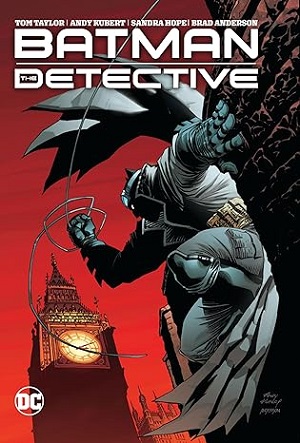
Batman: The Detective

Batman: The Detective

The biggest story in the development of movies in the twenty-first century, at least the first quarter of it, was the domination of comic-book action films. Not just the MCU, but almost any action movie started seeming more and more like a comic book through the heavy use of CGI and generic comic-book tropes.

It wouldn’t be unreasonable though to think that some influence went the other way. That’s certainly the feeling I had reading Batman: The Detective, which plays very much like the graphic-novel version of a Hollywood movie of the period, from the storyboard flavour of the action sequences to the iconic European locations.

Of course one of those comic-book tropes I mentioned as bleeding into film is that of the deathless hero. Despite all the scars on Batman’s tank-like frame (he’s huge in this comic), he just keeps going along. I mean, how does he crack a rib and dislocate his shoulder and keep on fighting when he crashes out of the hospital window and falls to the street? And even more to the point, how do the mooks he falls on keep going? And how does Beryl Hutchinson (Knight) survive falling from a plane and then being shot at point-blank range by Equilibrium? It’s not like Equilibrium wants to spare her, as Hutchinson must have been on the kill list and we know Equilibrium is a homicidal maniac. But the next time we see here she’s sitting up in a hospital bed, and by the time we get to the end of the series she’s ready for action again. I feel like I was missing something there.

Still, this is a really good comic that kept me interested all the way through. The action is great, and the writing moves us along quickly, even though I thought the plot was ridiculous. Equilibrium’s motivation seemed sketchy to me, but she was a strong villain, enforcing some kind of amoral order against Batman as agent of chaos. I thought of her as the anti-Joker in this regard.

I just don’t know why it was called The Detective since Batman doesn’t do much detecting here aside from plugging into his continental network (the European Alliance of the Bat) and getting status updates. I was also wondering when Batman started wearing goggles. I’m not enough of a Batman stan to know that bit of trivia.

One minor point: the use of @#$%$@# for cuss words seems out of place in a contemporary comic. Either don’t use bad language (there’s no need for it here) or spell it out. This isn’t Asterix.

Graphicalex

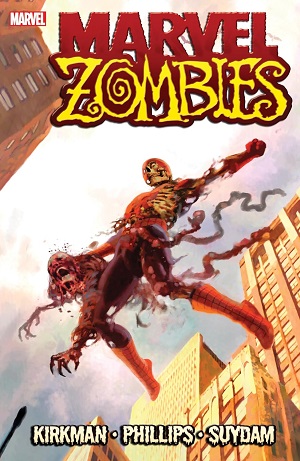
Marvel Zombies Volume 1

Marvel Zombies Volume 1

Disappointing.

2005 was near the point of peak zombie, a genre fad that writer Robert (he’ll let you call him “the zombie guy”) Kirkman had ridden to huge success with his Walking Dead comics. I liked The Walking Dead, and indeed you could say I’m a big zombie fan, so I was definitely on board for seeing how zombification would go with the Marvel universe.

The answer? Meh.

The idea for Marvel Zombies took its start from a storyline in the Ultimate Fantastic Four, and as things kick off here the zombie apocalypse/virus has actually run its course. We’re in the ruins of a depopulated city with only superheroes left. Zombie superheroes, that is. I assume they’ve eaten everyone else.

These aren’t your usual zombies though, and not just because they still have their super powers. It’s not clear what the cause of the zombie outbreak was but the effect is somewhat similar to the classic Romero strain: those infected have a hunger for human flesh, and whoever they bite suffers the same fate (that is, if they aren’t fully consumed). What’s different is that though dead they have their minds entire. They know what’s happened to them, it’s just that they can’t control their appetite for flesh. After a good feast of flesh they’re able to function somewhat normally, but then the hunger begins to grow again . . .

They are, in other words, junkies.

I think more than anything else this is what gives Marvel Zombies its depressing air. To be sure, zombies have been used from the beginning as a kind of metaphor. They started life (after death) as slave labour in the cane fields of Haiti and went on to be identified with the lumpenproletariat, the underclass, or simply the masses. On a planet with too many mouths to feed and an economy without enough decent jobs for everyone, the zombie apocalypse was just what the name suggests: not a vision of the future but a revelation of our own class divisions and environmental crisis. Throw in the generic landscape of bombed-out, urban decay and everything about the premise here just feels grim. And then it gets grimmer.

I appreciated how Kirkman took things in a different direction here, and how dark it all was, but I can’t say I enjoyed it very much. It’s not that it’s too bleak or depressing, but more that the story, at least in the early going, doesn’t have much to do. What we get are fights between the zombies and the usual ascending order of level bad guys (who are now sort-of good guys). They kill Magneto and eat him. Then they kill the Silver Surfer and eat him. And finally they kill Galactus (!) and eat him. In this they are helped along by what I thought was a stupid plot device of having the heroes who eat the Silver Surfer absorbing some of his “cosmic powers” along with his flesh (or whatever it is the Surfer is made of). They need such an energy boost because their rotting bodies keep getting torn apart in their various battles. Captain America has the top of his skull sheared off. Spidey loses a leg. Iron Man loses his entire bottom half. Wolverine and Luke Cage both lose an arm. But they can keep going without losing a step because of the “cosmic powers” (or Power Cosmic) of the Surfer. I thought this was stupid. Given Kirkman had the whole Marvel line-up to play with I thought he should have had more of the heroes being destroyed completely.

The art by Sean Phillips is fine. The zombies are identified clearly by pupil-less eyes and the way lips and gums have disappeared from their mouths, which foregrounds shiny grills of teeth. For whatever reason the sun has gone missing so everything is equally dark, inside and out. Again: depressing. Arthur Suydam reimagines classic Marvel covers with zombie makeovers, even though these have nothing to do with the action inside.

The human story has it that Black Panther (who zombie Giant-Man had been keeping alive to munch on) has teamed up with Magneto’s Acolytes to maybe find some kind of cure. That part seemed kind of vague, but they manage to salvage the head of zombie Wasp so maybe they’ll be able to learn something from that. Meanwhile, the zombies who ate Galactus are hungry again and we’re left with them invading another planet. I can’t say this left me all that interested to see what was going to happen next, but maybe interested enough to carry on a bit more.

Graphicalex

All-New X-Men: Here to Stay

All-New X-Men: Here to Stay

Well, as the title indicates the classic X-Men are here to stay in our own time, where they will have to deal with the Scott Summers/Cyclops-led evil X-Men. Meanwhile, Jean Grey continues to come to grips with her growing psychic powers, people start to question Hank McCoy’s messing with the space-time continuum, Kitty Pryde gets exasperated trying to bring the teenage X-Men up to speed, Angel meets a new friend, Mystique assembles her own gang of supervillains, and Wolverine is angry all the time.

I had a feeling that they were sort of marking time here, especially given that there are two big fight scenes, one a battle with Hydra that feels like a simulation in the Danger Room and the other being a fight against Sentinels that is a simulation in the Danger Room. Neither amounts to much. But overall Brian Michael Bendis keeps the different balls in the air pretty well and the writing is better than average. I particularly like the way Bendis spices up dialogue scenes in interesting ways. In the previous volume it was the two Hank McCoys talking to each other via psychic link-up. In this one we get a heated conversation between Beast and Captain America as filtered through Iceman and Kitty Pride. I thought that was neat.

Unfortunately, I really didn’t like the art from David Marquez (issues #6-8). It felt very generic and crude, with a blandness that seems almost AI generated, and there’s not a lot going on in the individual cells, either in the background or expressed on faces. It’s similar to Stuart Immonen’s work (who did issues #9-10 here), but more cartoonish, if I can make a distinction between a cartoon and a comic style. I can see some people liking it, but it’s not my thing.

Not a great instalment then, but the story interests me and I’ll stick with it for a while. I may not be here to stay, but I’ll hang around for a bit longer.

Graphicalex

Swamp Thing: The Bronze Age Volume 2

Swamp Thing: The Bronze Age Volume 2

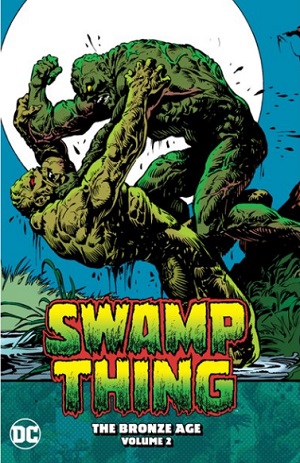
We sort of swing from the good to the bad here. First up we have the back half of the initial run of Swamp Thing comics, issues #14-24. This has lots of the usual nuttiness, including Swampy fighting demons, robots, and even a clone of himself that grew out of the arm that was cut off in an earlier story (this gives us the awesome Swamp Thing vs. Swamp Thing cover for issue #20 that also fronts this omnibus edition). I especially loved the Dr. Seuss-inspired Ultra-Cerebralociter, a machine that has the power to turn the brains of all the world’s leaders into “mush.” It even comes with a DANGER: HIGH VOLTAGE warning label on it. You’ve gotta love this stuff. Then of course there’s the purple writing that was the house style of the time, with Swamp Thing being described so often as a “mockery” (as in a “muck-draped mockery” of a man, or a mockery of life itself) that I was wondering if there was something in the style guide that said the word mockery had to be used a certain number of times every issue.

Unfortunately, sales were really poor so the series was discontinued. Issue #24 was the last, though the script and draft pencils and inks for the never-published issue #25 are included as an appendix with this edition, which is a really nice bonus.

The rest of the book has Swampy (along with Deadman) teaming up with the Challengers of the Unknown, a team of heroes who are now as unknown as their challenges. Who were the Challengers, you ask?

Ace Morgan: Former test pilot – now leader of the Challengers!

Rocky Davis: Onetime champion heavyweight wrestler!

Red Ryan: Electronics expert and world renowned mountain explorer!

Professor Haley: Scientific genius and deep diver into – the unknown!

Oh, and just in case you think this is a boys only club:

June Robbins: honorary Challenger and research physicist.

June is the buxom blonde who Rocky and Red have a falling out over. Yes, it’s that hokey.

Anyway, there are two main Challengers of the Unknown storylines. The first has them going back to the charmingly named town of Perdition to fight the reawakened spirit of the Lovecraft-demon M’Nagalah in a surprisingly yucky bit of horror, and the second has them jumping forward 12 million years to fight a bunch of solar tyrants who are offloading their excess monsters onto twentieth-century Earth. Beginning, alas, with Toronto: “an orderly city. A city of peaceful and pleasant people. A city with one of the lowest crime rates on the continent.” These stories are plenty crazy enough, but Swampy is just an extra, albeit more competent at smashing bad guys than the Challengers. His fight with the Persuader is the highlight.

Also included are a couple of Brave and the Bold team-ups with Batman and a frankly kind of lame crossover that has him fighting alongside Solomon Grundy against Superman (it’s complicated, but Swampy is still a good guy).

I think there are interesting storylines here, some of which had to be left as dead ends when this run was canceled. We never hear anything more about Alec Holland’s brother Edward, for example, a guy who seemed to have a pretty justifiable grudge against his brother. Like his arm restoring itself, however, cutting the series off wasn’t going to be the end of the “mossy man-brute.” He’d be back!

Graphicalex