Federal election 2015: After

Well, in my post a week earlier I said my predictions almost always turn out wrong, so I wasn’t surprised, or terribly disappointed, by the election results. For the record, I predicted a Conservative minority. In the final week the polls indicated a strong Liberal swing to the vote and this turned out to be an accurate reading. Overall, I thought the Conservatives ran a dreadful campaign, while the other parties just waited for the tide to come in. In the event, I didn’t vote Liberal myself, but I’m glad to see the end of Stephen Harper.

I’m sure more will be added to the already large literature about Harper in the years to come. I’m still not sure why someone who was by most accounts aware of his deep personal unpopularity insisted on re-branding the federal Conservative party as the “Harper government” (and the “Harper party” in the words of the Globe and Mail this morning). In the words of John Ibbotson, “No prime minister in history and no political party have been loathed as intensely as Stephen Harper and the Conservative party.” But the two didn’t have to go together.

It’s one thing to want to rule as an autocrat, as a “party of one” in the phrase of Michael Harris, but to be so in-your-face about it is another. Perhaps it was all part of Harper’s divisive game plan, to pander to his base while repelling everyone else. If so, it was a strategy that backfired. As I said in my earlier post, Harper’s base politics can only work given certain conditions, like a divided opposition in a first-past-the-post system. He enjoyed that for his entire tenure, but the Anybody But Harper vote undid him this time (as well as undoing the fortunes of the NDP). This leaves the federal Conservative party vulnerable. As Jeffrey Simpson commented just a few days before the election:

Conservatives have their voters – their core – and that’s it. Their core isn’t large enough to win again. . . . When Rob Ford and his brother Doug are organizing a late rally for the party in Toronto, and the federal party thinks this is just fine, the message is clear: The party is down to its hard core.

It didn’t have to be this way. Canada is, in many ways, a conservative (small “c”) country. But the party’s leadership has been hijacked in the twenty-first century by angry freaks. Stephen Harper like Tim Hudak in Ontario, or even Rob Ford in Toronto could have been a more successful, effective political leader if he’d just been moderately reasonable. But being reasonable isn’t what any of these guys signed on for. They preferred to play ideologues and idiots (or actually were ideologues and idiots). Not one of them could be considered, and this is an important quality for a politician, normal. As I also indicated in my earlier post, the same thing can be said of the current Republican field in the United States. The right has spent years pandering to its base. That base now holds it hostage.

As far as the election around here went, the Liberal candidate won handily. One thing that surprises me, looking back on the last two elections, is the end of canvassing. In the last provincial election the only party that sent people door-to-door was the Green party (and that wasn’t the candidate himself but a volunteer from out of town). This year none of the candidates, or representatives from their party, came through my neighbourhood to knock on doors. None! And I only received two telephone calls in the lead up to the election. Do candidates no longer have the resources to do this kind of thing? What else are they doing with their time?

Moving forward, I’m not confident that the Liberals will provide much in the way of new ideas or leadership. One hopes for competence at best. Still, I’m interested in how a couple of issues that came up during the campaign will be handled. First, the Liberals declared that they were against the first-past-the-post election system. Now that they have a majority, will they backtrack on that? Second, the Liberals have also said that they want to “reform” the Senate (I’m all on board). This will be harder to effect, but I think would be a popular move. That said, I don’t expect any meaningful changes to be made to the current system.

I guess another way of saying this is that while Justin Trudeau’s governing style will likely be much different from Harper’s, I question how far apart he will be on substance. This isn’t being cynical, but is more just a reflection on modern politics, where it is very hard to effect real change. This is a problem, because in at least some ways this country should be looking to change direction. In ways that count, I don’t think it will.

Political punditry potpourri

Federal election 2015: Before

We are now a week away from a federal election.

What I’ve been wondering about over the course of the campaign is what has happened to conservatism.

This summer the Republican primaries in the United States have been dominated by Donald Trump, a candidate that almost no one takes seriously. His success thus far has been attributed to causes such as the anger felt by most Americans at the political system (as a non-politician Trump can market himself as an outsider) and the public’s fascination with celebrity, which keeps everything Trump says and does at the top of the news cycle.

Another reason for his success may be the weakness of the rest of the very large Republican field. At one point there were seventeen declared candidates, and taken as a group they are an unattractive, uninspiring lot. Perhaps what’s most surprising is that only a few of them seem capable of speaking convincingly on any subject (a talent that eludes Trump as well). I thought giving speeches was the one thing politicians had to know how to do. Someone forgot to tell Jeb Bush.

But the bigger problem with the Republicans may be that a particular historical strand of American conservatism has played itself out. In terms of cultural conservatism it seems as though the “culture wars” are, if not over, at least moving into a new, yet-to-be-determined phase. The right to an abortion is now settled, and the fight over gay marriage mostly is too. Human-driven climate change is a fact accepted by everyone who is not a complete idiot. The idea that the U.S. can build a wall separating itself from Mexico (or Canada), and somehow round up all its illegal immigrants and send them back to their countries of origin is laughable. And yet all of this can be found in the platforms of leading Republican candidates.

When it comes to economic or fiscal conservatism the picture is just as bleak for right-wing politicians. In a nutshell: what advantage do they offer over the center or center-left? Economic inequality has continued to grow unabated under Democratic presidents, and it seems very unlikely that Hillary Clinton will do anything to stop these trends. If you’re a member of the 1%, or 0.1%, or the 0.01%, you have nothing to worry about: the Dems have your back. If you want to say that neoliberalism won the battle for ideas I don’t think that would be far from the mark (leaving aside the question of what such a victory means). And that being so, what is there to mobilize right-wing voters who are fiscal conservatives?

In short, the conservative movement has found itself left behind on almost every issue. This doesn’t mean they’re doomed to irrelevancy, far from it, but it does mean that either they or the world will need to change course in some dramatic way for them to regain power. And I am inclined to think it’s the world that is more likely to change first.

Where does this leave conservatives? Primarily as an anti-government party. This is a ridiculous position for any national political party to take, but in at least one sense it may have some traction. I sense a growing divide between public (unionized) and private sector workers both in Canada and the U.S. that could make for a coming split between a party of the state and a party of everyone else. If there is a future for the right it may be here.

In Canada the Conservative Party, or as it insists upon branding itself, the Harper government, is similarly bankrupt of ideas. The most depressing aspect (thus far) of the campaign has been the attention given over to the “issue” of the niqab. This is pure dog-whistle politics, a waving of the bloody shirt (or veil) that apparently came from Lynton Crosby, a political guru who specializes in this kind of thing. It’s not even a minor issue. It’s a non-issue. It literally affects no one. And yet voters, particularly in Quebec, have seemed to respond.

Nevertheless, it seems to me that Harper still has two big advantages going in to the election.

In the first place there is the first-past-the-post election system. This archaic and undemocratic form of politics explains the Conservative campaign philosophy, which goes by different names but is usually referred to as Roveism (after Karl Rove) or “base politics.” Given the way the vote on the nominal left is split among several different parties the Conservatives can, in theory, not only win but win a majority with less than 30% of the popular vote. All they have to do is appeal to a hard core of support, which they can do by waving the bloody shirt and complaining that anything they’ve done wrong (the F-35s, the Senate scandals, the Robocalls) is all just a smokescreen of lies being sent up by the liberal media.

Such a strategy would be disastrous in a system of proportional representation, turning that hard core of support into a fringe movement. But we’re not playing by those rules.

The second advantage the Conservatives have is the fact that they are the party out of power in most of the provinces. In particular, their traditional stronghold in Alberta recently elected a premier from the NDP and the key province of Ontario is led by the deeply unpopular government of liberal Kathleen Wynne, who won the last provincial election, and a majority government, due only to the sheer incompetence of the Conservative candidate, Tim Hudak. I think voters like for there to be some conflict between their provincial and federal governments as a way of providing checks and balances, so this is something that I think works in Harper’s favour.

I voted in an advance poll. There were seven candidates in my riding: the four major parties, plus a Communist, a Libertarian, and one of the few candidates nation-wide for the Radical Marijuana Party. Waiting in line to vote (reports of long waiting times at the polls turned out to be accurate, as I was standing and sitting in line for nearly an hour), I spoke to the people standing directly in front of and behind me. One was a tech worker and the other a retired military man. Both had been Conservatives in the past but despised Harper and had specifically come out to vote against him, mainly on the grounds of his managerial incompetence. The riding has a long history of being Liberal, though the sitting MP is not running again in this election. I would say the Liberal is a shoo-in to win, but a popular liberal mayor was recently defeated by a hard-right candidate in our last municipal election so I wouldn’t be too sure.

So here’s my prediction on the federal election, offered up with that caveat that I’ve nearly always been wrong in the past and will probably be wrong this time as well:

Despite polls showing the Liberals clearly in the lead and gaining momentum, and much talk about “strategic voting,” I think the Anybody But Harper vote is so fragmented the Conservatives will be able to get re-elected with a minority, but won’t be able to govern, that task falling to a coalition of the Liberals and NDP.

In another week I’ll be back with some thoughts on what happened.

Political punditry potpourri

Her mother’s son

Here we go again.

It’s been a week now since the Umpqua Community College shootings, when 26-year-old Christopher Harper-Mercer, a student at the college, fatally shot nine people and injured nine others on the campus before killing himself when the police arrived.

His mother, Laurel Harper, was a proud gun afficionado and bragged of keeping loaded handguns and assault rifles in the house (guns that Christopher would take with him to school on the fateful day).

Here’s an excerpt from a Los Angeles Times story describing their relationship:

Reina Webb, 19, recalls how closely his mother would keep an eye on him, which to her, “was kind of weird, because he seemed like a grown man.”

She remembers how his mom had to calm him the day he found that someone had slashed the tires on his bike. “He had a fit almost,” Webb said. “Almost like a tantrum, like a kid. . . . He was upset, crying and doing all that stuff because of the tires on his bike.”

Other times, neighbors could hear him in the family’s apartment yelling at his mother as she tried to calm him down. “He would get mad if things weren’t his way,” Webb said. “But she always had him in control.”

Although she never interacted with Harper-Mercer, Webb remembers his mother as a “really nice lady.” “She’d always talk to everybody, say hello and be super nice and always try and watch her son,” Webb said. “She always tried to take care of him.”

Does this scenario sound familiar? It should. Yes, Harper-Mercer was yet another bitter loser, unable to get a girlfriend and with a hate-on for the entire world. But he’s also an example of the boy in the basement, a type I have already written about.

Laurel Harper, in turn, fits the stereotype of the enabling mom perfectly. You can check the items off the list: a single mom (widow or divorced), focusing all of her life on her (adult) baby boy; someone with a background as a professional caregiver (Laurel Harper is employed as a nurse); someone who gave in completely to the idea that her son was suffering from some kind of vague mental/psychological/social/emotional disability (here apparently Asperger’s Syndrome, though I don’t know what evidence there was for that).

Just as the report into the Sandy Hook killings concluded, it all led to a pattern of appeasement, enablement, and accommodation. As it did with Nancy Lanza. As it did with Wenche Behring (another divorced nurse looking after her adult son). Here’s how I concluded my review of One of Us: Anders Behring Breivik and the Massacre in Norway:

Living such an isolated life, Breivik needed very little assistance. He received it, again as so often is the case, from his unhappy, damaged mother. And this is probably the only takeaway. If we’re to recognize the warning signs and draw lines around such people, that’s a process that has to start at home.

It doesn’t take an advanced degree in psychology to see where these situations are heading. As I said at the end of my earlier post: know the signs and keep your distance.

Why does Canada have a Senate?

Why does Canada have a Senate?

Not to operate as a chamber of “sober second thought,” in John D. MacDonald’s deathless words. Senators have almost no legislative or political function, which, I would like to emphasize, is as it should be. They are an unelected body of party hacks who have been placed in comfortable public sinecures, and as such should not be allowed to meddle in the political process. The Senate is a body modeled after the British House of Lords, which itself has no place in a modern democracy.

In all fairness, I think most senators realize this. And they do a good job of doing nothing. Claire Hoy’s Nice Work exposed their uselessness years ago.

Even if you do see the Senate as having a function, the idea that the dirty rabble of democracy needs to be guided over by a wealthy and paternalistic Establishment was a fossilized notion already in 1867. The United States Constitution originally had senators elected by state legislatures — which, while indirect, was at least a notionally democratic process — up until 1913, when the Seventeenth Amendment provided for their direct election by the people. In other words, the American system was always more progressive than the one our own Constitution provided for (drafted over 70 years later), and was still considered politically out of date before the outbreak of the First World War. Meanwhile, we’ve thought it best to keep with the old ways.

So why does Canada have a Senate?

Not because anyone wants there to be a Senate. Stephen Harper has attempted to either abolish or reform it, only to be slapped down by the Supreme Court. An embarrassed Justin Trudeau removed Liberal senators from that party’s caucus (they now call themselves Senate Liberals instead of Liberal Senators). Abolishment of the Senate is a longstanding part of the NDP platform. The Greens want to make it an elected body based on proportional representation. Nobody wants to keep it in its current form. Except, I guess, the senators themselves.

But reform is a dead letter. Every attempt to reform the Senate since the 1970s, and there have been many, has failed. Change is never going to come.

This does not upset me. I would not like to see an elected, more effective, or otherwise reformed Senate. What purpose would a reformed Senate have? It would either be redundant or lead to gridlock, and would certainly be more expensive to maintain (and lead to even more electioneering). Who thinks Canada needs more politicians? What problems does Canada currently face for which more politicians will provide the answer?

If reform is a dead letter, abolition is a pipe dream. According to the Supreme Court abolition could only happen with the unanimous consent of the provinces and the Senate itself. In short, they’d have to vote themselves out of existence. It’s even questionable whether the house can be allowed to simply grow old and die of natural causes. The Constitution may require we maintain it.

Why does Canada have a Senate? Because we were saddled with this house of shame by a bunch of wannabe aristos in the nineteenth century and now it can’t be gotten rid of. Ever.

And so, as the Senate continues to wallow in scandal, we the people are left to follow the trials and tribulations of figures like Mike Duffy and Pamela Wallin on TV and in the newspapers. Excess and entitlement for the Establishment. For the plebs it’s broken crackers, cold camembert, and circuses.

Universal decline

Universities are odd institutions. They come in many different shapes and sizes, from local community colleges to huge multinational corporations. They can be state-run or private, highly specialized or more general in scope. They can even exist wholly online. They began in the middle ages, but today bear almost no relation to their earliest incarnations. And if signs are any indication, their evolution will continue to take them in strange new directions.

The last several years have seen a great deal of soul-searching within the halls of academe. One of the sparks was the claim made by a hedge fund manager and venture capitalist that universities were an economic “bubble,” selling a product at an unreasonable and unsustainable price through the assistance of government loans. Such a charge led to a flood of books attempting to explain what had gone wrong. In Canada the sociologists James E. Côté and Anton L. Allahar (authors of Ivory Tower Blues and Lowering Higher Education) are two of the more popular commentators.

Various villains have been identified. Some, like Camille Paglia, continue to blame trends like post-structuralism and cultural relativism for having hollowed out the core mission of higher education. Others blame the “massification” of higher ed, the explosive post-World War 2 growth of universities to the point where they now admit far too many unqualified and uninterested students. Some accuse the government of cutting funding. Still others point the finger at the swelling ranks and salaries of a non-teaching administrative class within the universities. And then there are those who blame the adoption of a neo-liberal, market-oriented philosophy by institutions that (they feel) must stand outside such a framework.

I’ve followed much of the debate, and it saddens me. The humanities are, frankly, losing, and they aren’t even putting up a good fight. I tried to address some of the points being made in my joint review of Marjorie Garber’s The Use and Abuse of Literature and John Carey’s What Good Are the Arts? The depressing takeaway from Carey’s book is that the arts aren’t good for much at all. The usual platitudes are trotted out: how the humanities encourage independent, critical thinking and make us more empathic and active citizens, but this just isn’t true. I can’t help thinking that if humanities professors, trained in disciplines like history, philosophy and rhetoric, can’t put forward better arguments for what we might call higher education’s traditional mission, then perhaps it’s time to give up. In a recent piece appearing in the Guardian, one pro-humanities spokesperson, Sarah Churchwell, had this to say:

“What has changed radically in the last 10 years is that they’re trying to turn everything into a for-profit business,” said Churchwell. “And that’s bullshit. Universities are not for profit. We are charitable institutions. What they’re now doing is saying to academics: ‘You have to be the fundraisers, the managers, the producers, you have to generate the incomes that will keep your institutions afloat.’ Is that really what society wants – for everything to become a marketplace, for everything to become a commodity? Maybe I’m just out of step with the world, but what some of us are fighting for is the principle that not everything that is valuable can or should be monetised. That universities are one of the custodians of centuries of knowledge, curiosity, inspiration. That education is not a commodity, it’s a qualitative transformation. You can’t sell it. You can’t simply transfer it.”

Churchwell went on to talk about what would be lost if we didn’t stand in the way of this systematic destruction of the traditional liberal education. “Virtually every cabinet minister has a humanities degree,” she said. “And I think there’s something quite sinister about it: they get their leadership positions after studying the humanities and then they tell us that what we need is a nation of technocrats. If you look at the vast majority of world leaders, you’ll find that they’ve got humanities degrees. Angela Merkel is the only one who’s a scientist. The ruling elite have humanities degrees because they can do critical thinking, they can test premises, they can think outside the box, they can problem-solve, they can communicate, they don’t have linear, one-solution models with which to approach the world. You won’t solve the problems of religious fundamentalism with a science experiment.”

This is entirely unconvincing. Critical thinking certainly isn’t the preserve of the humanities. Indeed, I sometimes wonder if today’s arts departments even encourage it. And while I’m as dejected as Churchwell at the thought of people wanting “everything to become a marketplace, for everything to become a commodity,” I don’t think it’s realistic to see such giant corporations (which is what universities are) as standing outside the larger economy. As recent strikes at York University and the University of Toronto have highlighted, universities can be seen as a microcosm of that dysfunctional larger economy, with its widening split between a privileged elite at the top (enjoying high pay, job security, benefits and pension) and a growing underclass whose sub-minimum wage labour supports the whole enterprise.

It’s very common now to decry the “corporatization” of universities and emphasize their “charity” status (at least for state-funded schools), but how honest are such claims? This past week saw the release of Ontario’s “Sunshine List” of public sector workers making over $100,000 a year. Perhaps the most common defense of such high salaries — after the remarkable claim, made by many, that because of inflation a $100,000 annual salary, which doesn’t include benefits, “isn’t very much” — is that they have to be “competitive” with the private sector. I suppose this makes sense in some fields (though surely not for professors in the humanities), but one has to ask to what extent a public sector in competition with the private sector is still truly public. At the very least it smacks of having one’s cake and eating it too.

Meanwhile, the real crisis facing higher education, as I see it, is the constriction of the middle class: their falling (real) wages and stagnant standards of living. A university education used to be a step on the ladder of upward mobility, but while that’s still true in some cases, more and more it’s a step on a ladder to nowhere, and it comes at a staggering cost. When I was at university nearly thirty years ago it was not hard to find an easy summer job that would pay tuition, school supplies, rent, and groceries. That’s no longer the case for young people today, who are graduating with incredible amounts of debt. And the old certainty that even if you didn’t walk into your dream job you at least were sure of finding some kind of meaningful work when you graduated has gone as well, most dramatically in the case of humanities graduates because the cultural economy has been gutted by the Internet.

But the problem isn’t one faced by humanities graduates alone. The advice to study the so-called STEM disciplines (science, technology, engineering, and math) is no guarantee of finding a good career. Even “learning a trade” is little help. I know a lot of un- and underemployed contractors. The problem is one affecting young people generally, and faced with such a challenge there’s little wonder they’re becoming wary of higher education. Enrollments are indeed kept inflated thanks to the willingness of this generational cohort to take on high levels of debt, and because there is nowhere else for young people to go and nothing for them to do. That’s a terrible defense of higher education, but it’s the bottom line.

Ignoring the obvious

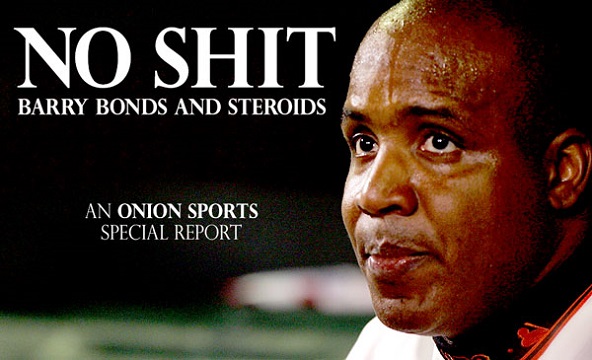
'Nuff said. (The Onion)

‘Nuff said. (The Onion)

In a recent comeback fight in the UFC, Anderson “Spider” Silva, considered by many to be one of the greatest MMA fighters of all time, tested positive for performance enhancing drugs. The news has been met with expressions of shock. Silva himself has denied any doping. And maybe, just perhaps . . . But when are we going to stop being surprised by stories like this? Barry Bonds, Lance Armstrong . . . and these are only to name a couple of titans. Rumours have circulated for years about other major figures, even in sports like golf. But of course little has been proven. The reason for this is simple. Aside from the fact that people don’t really want to know (hey, some people insist that professional wrestling is “real to them”), doping is almost impossible to prove. Testing is expensive and easy to beat. The legal process is even more expensive, ultimately less conclusive, and interminable (the long-drawn out Roger Clemens story being one example). Armstrong often roared that he was “the most tested man in sports,” which was probably true. And he was doping all the time. It’s common knowledge that you have to screw up or be really stupid to get caught, which is why Armstrong could lie about it so loudly and for so long. Or why UFC president Dana White could berate journalists only a year ago for suggesting that any of the organization’s fighters were juicing. From Kevin Iole’s report:

Nearly two dozen reporters sat silently around a long conference table as Dana White challenged them. Give me a name of any fighter you think is on steroids, the UFC president spat, and I’ll have them drug tested today.

He held his flip phone open in the palm of his hand, ready to dial.

No one said a word as White shot hard glances at the reporters staring at him.

Give me a name, he demanded, and I’ll test them today, or don’t ever say it to me again. He was yelling, his face reddened, the fury evident. He sounded more like he was looking for a fight than trying to promote one.

“Give me one [expletive] name right now, I’ll get them on the phone, and somebody will drive to their [expletive] house today and will test them,” White said. “Say it. Say it.”

After pausing for a second to silence, he resumed.

“Then don’t ever [expletive] say it to me again,” he said, defiantly. “You guys like to play these [expletive] games. Let’s do it. I’m ready. I’m down. Let’s do this right now. Give me one name. Give me 10 names. Give me all the names you want; I’ll test all these [expletives] right now.”

The reporters remained silent. It’s not a reporter’s job to make news; it’s to report the news. But White was gunning for a fight.

He raved on, often shouting loudly, as he defended his fighters against claims their ranks are full of performance-enhancing drug users and his company against allegations that it turns a blind eye to their usage.

The best defence is a good offence, as they say. Given this state of affairs, it’s only reasonable to be sceptical. As a general guide, here are the big three tip-offs that someone is doping:

(1) The eye test: Much derided as unscientific, in fact it’s a pretty good diagnostic. You know what an impossible physique looks like. Just think of a professional bodybuilder. Forget about good genetics, a healthy diet, or a non-stop training regimen — the usual excuses that are trotted out. That’s all smoke.

(2) The fountain of youth: Physically, an athlete is in his prime in his late 20s. Sometime after 30 you start to go into a decline that gradually picks up speed, with no reversals. Drugs can arrest this inevitable effect of aging. So when you hear about a sports star who is experiencing a career “resurgence” or who is described as “ageless” and is still competing at an elite level against people ten or even twenty years younger than he is . . . that’s probably the drugs talking.

(3) Quick recovery: Has an athlete come back at spectacular speed from a gruesome/catastrophic/(supposedly) career-ending injury? Have they come back even stronger? No doubt that’s all due to their superstar doctors, or X-men mutant healing powers! Or maybe not. Perhaps it was the drugs. All of which is pretty obvious. But then, we only believe what we want to believe.

What we talk about when we talk about conflict of interest

Why is the concept of conflict of interest so hard to understand? True, like any misdemeanour that has certain penalties attached to it, there is some room for debate when assessing culpability. But the thing is, we know it when we see it. And it’s precisely because we know it when we see it that we can say when it exists.

I say “exists” because conflict of interest is not a specific action or event. It doesn’t “occur.” One doesn’t have to actually do anything at all. Conflict of interest is a state of being. You are in a position where there is a conflict of interest or you are not.

This makes all the confusion over Amanda Lang’s “potential” conflict(s) of interest very strange. In brief, Lang, who is the chief financial correspondent for CBC news, has been hauled onto the carpet for supposedly trying to kill a story critical of the Royal Bank of Canada. Lang has accepted paid speaking engagements from the Royal Bank, went on to write an op-ed piece for the Globe and Mail on the subject (taking the bank’s side), and was in a relationship with an officer of the bank at the time.

A position of conflict? Of course. Writing in Britain’s Guardian newspaper, columnist George Monbiot even expressed amazement that “she remains employed by CBC, which has so far done nothing but bluster and berate its critics.”

This is probably a reference to a note from Jennifer McGuire, CBC’s general manager, seeking to “set the record straight.” If that was McGuire’s intention then she failed entirely. As did Lang herself, who had a remarkably tone-deaf piece in yesterday’s Globe and Mail.

Lang writes that “it is painful to me that public perceptions of my integrity may have been compromised because I have been accused of acting improperly by allowing myself to be seen to have been in a conflict of interest.” This is a mind-wrenching circumlocution. Apparently her crime was not that of being in a conflict of interest. Instead, her improper action was to allow herself to be seen in such a conflict. Is Lang saying it’s only a crime if you get caught?

This may sound like nit-picking, but one suspects this is a piece that went through many, many drafts, every word of which was carefully parsed before submitting it for publication.

Nevertheless, Lang may have twisted herself into the truth, which is that in cases of conflict of interest, perception is everything. What I think confuses the matter is the use of terminology like “apparent,” “perceived,” and “potential” conflict of interest. These words shouldn’t apply. As I began by pointing out, conflict of interest isn’t an act, it’s a position one finds oneself in. And it is all a matter of perception: perceived conflict of interest (by an objective observer) is conflict of interest. When Lang responds to “exact allegations” of improper behaviour she’s changing the subject.

Lang goes on to say: “It did not occur to me that others would question my motivation. That they would raise doubts about my integrity. That they would believe my perspective on this story was affected, for example, either by a relationship or by the fact that I have spoken for pay at events organized by business groups and companies.”

So what? That Lang thought (and apparently still thinks) there was nothing wrong with what she was doing only tells us that she possesses a typically Canadian attitude about what it means to hold a position of power within any group or establishment (media, financial, or both, as the case may be): that it entitles you to do whatever you want without being questioned or criticized.

Those who say I acted improperly seem not to care that they, in effect, are alleging deeply unethical behaviour, or worse. I’m not sure how to convince people that my principles, integrity and career are fundamentally important to me, that I have no trouble understanding right from wrong and reporting honestly and independently. Unfortunately, it appears that I can assert that as long as I wish and still not overcome suspicions that originate from unshakeable and, in my view, utterly unwarranted presumptions of venal behaviour.

But the problem is not an allegation of any unethical behaviour. You certainly can question that in the present case, but it’s not necessary to do so. The problem is simply being in the position of a conflict of interest, not exercising that position in any unethical way. And the reason for having such a hard rule is simple: because in most cases proving any wrongdoing or quid pro quo is impossible. The accused can then simply respond with a blank denial and that’s the end of it.

As Monbiot registers, it’s easy to be cynical about the “impartial media” having become “mouthpieces for the elite.” And the fact that in Lang’s case this is happening with regard to public broadcasting makes it even worse. The public has, with some justification, little faith in the news media in general, but Caesar’s wife (the CBC) must be above suspicion. What makes the Lang story remarkable, at least to my eyes, is the obliviousness on the part of the CBC and Lang to there being anything wrong with what happened. As I’ve suggested, they may simply be taking for granted the culturally ingrained deference toward authority in this country: that our betters know better than we do what’s right and wrong. Or perhaps they’re taking the matter to the next level with a sort of “everybody does it because that’s the way the system operates” argument. Which may be true as well, but doesn’t help build trust.

Update, January 23 2015:

Media critic John Doyle, writing in the Globe and Mail, has this to say: “It’s always bracing when outsiders look at Canada, its cronyism and system of privilege. Monbiot is correct – it is grotesque. ”

Update, March 6 2015:

An internal review by the CBC has found that Lang’s reporting “met CBC’s journalistic standards.” The review did however find problems with the CBC’s conflict of interest policies, concluding that they were too open to interpretation. “Going forward, CBC News will ensure that all of our staff adhere to the most rigorous interpretation of this standard.” This sounds good, but I’m curious as to what this rigorous interpretation will be.

Update, August 27, 2016:

The issue reared its head again during the 2016 U.S. presidential campaign.

Some strings attached

The whole story?

The whole story?

One of the most interesting sidelines to the outbreak of rape allegations that have been brought against Bill Cosby has been the spotlight thrown on Mark Whitaker, the author of a hefty (544-page) biography of “the Cos” that was published just a couple of months ago. In his attempt at a definitive biography, for which he was given “by far the most access [Cosby] has given any prospective biographer,” Whitaker makes no reference to any of the allegations of sexual abuse and rape that had been made against Cosby, or the civil suit that was settled out of court.

In an essay appearing on the Salon website Erin Keane calls the bio a “false narrative”:

Certainly, journalists should be commended for confirming what they are told in interviews, especially in a myth-making enterprise like biography, as the author prepares work that could become a major historical record of a public figure’s life. That assumed rigor is one thing that distinguishes a comprehensive biography from the whims of memoir. But at some point, it becomes irresponsible not to mention multiple accusations of violence and sexual abuse, especially when they contrast so starkly with the image the bulk of the biography presents.

Whitaker’s immediate reaction was to say that he would probably need to amend or update his book, perhaps sooner rather than later. After being called out on Twitter he announced he was wrong not to deal with the sexual charges and pursue them more aggressively.

So was his book a lie? Not quite. As V. S. Naipaul once remarked of imperial powers, “they don’t lie, they elide.” Leaving information out can be quite as effective as telling a deliberate untruth. In 2005, for example, Cosby testified under oath that he made a deal with the National Enquirer giving them an exclusive interview in exchange for their spiking a story of another woman coming forward with an accusation of sexual assault. Access = Silence.

There is nothing conspiratorial about any of this. It’s how the system works, how it’s supposed to work. Mary Elizabeth Williams, also writing in Salon, spoke to this point:

Man, it’s a great week for bullying journalists. But as many writers who have ever been granted an audience with a prominent person can attest, it’s always a pretty great week for bullying journalists. That AP reporter’s placating assertion to Cosby that “We haven’t written about this at all in the past two months” is not an unfamiliar exchange for celebrity journalists. You want access? In return, you have to play by the subject’s rules. That’s the way the dance generally goes.

Just two weeks ago, when that AP interview was conducted, Bill Cosby could still command a degree of deference. Now, as more women are coming forward with accusations, that is rapidly changing. The AP release of the footage clearly indicates an editorial decision that Cosby no longer has the power in this scenario — that even its staff’s own kid gloves-wielding behavior in the clip is trumped by Cosby’s arrogance. . . . God knows plenty of journalists are more than capable of throwing ethics out the door. But take a look at what their subjects, when feeling cornered and confronted with questions and criticism, are capable of. It can involve threats and intimidation and flat out playing dirty, on the part of very powerful people. This is the sausage-making process in action, folks. It’s not pretty, is it? And that’s exactly why you need to see it.

It’s an important lesson. Access always comes with strings attached (playing “by the subject’s rules”). It’s something the U.S. military learned in Vietnam, when reporters were allowed to run around talking to anyone and taking pictures of everything. The lesson was: Never again. By the time of the Gulf Wars reporters would be officially “embedded” with the military, their news broadcasts and sound bites all provided for them.

One can’t emphasize enough that this is something everybody does. Any “official” biography or history is compromised. It doesn’t have to involve any explicit quid pro quo, just a recognition and acceptance between the parties that these are the rules of the game. Then, when it’s done, you thank your subject for his or her generous assistance and have done.

Several years ago a Canadian academic wrote an essay on Alice Munro while working toward a book on the author. Her conclusions were far from controversial, and certainly not scandalous or personal, but Munro apparently disagreed with them. Munro and a pair of her editors then revoked the permission they had extended to the academic to quote from any of their correspondence.

Alice Munro! We’re not talking about the military-industrial complex here, or a celebrity powerhouse who has been accused, fairly or not, of being a serial rapist. But it doesn’t matter. Whatever or whoever the subject, the same rules of the dance apply and the “sausage-making process” does its job. There’s nothing sinister or even wrong with that, but you have to always keep it in mind any time you’re getting access to a source that has a clear interest in spinning a story a particular way. Which is to say, any source. The story you’re hearing is the one they want you to hear. It may be true, but that’s beside the point.

Update, December 20 2014:

As the Jian Ghomeshi saga continues, the Toronto Star has reported on a story with some similarities to Cosby’s. From a piece by Kevin Donovan headlined “How Ghomeshi’s publicist worked to shut down Toronto Life story.”

Former Q star Jian Ghomeshi was “incredibly disappointed” with attempts by a Toronto magazine to contact former girlfriends of his in the summer of 2013 for a future article. So disappointed that his publicity team asked the magazine to stop its attempts and offered the publication access to Ghomeshi for a full profile.

“We feel this is a really unfair and absurd piece,” said Ghomeshi’s then-publicist Debra Goldblatt-Sadowski in an August 2013 email to a Toronto Life writer.

Behind the scenes, according to one of now 15 women who have made allegations against Ghomeshi, the radio host was very “nervous” that someone would be digging into his personal life.

In the publicist’s email, she writes:

“Surely we could work with Toronto Life on a more interesting story in the future (with our co-operation) vs. going behind an incredibly established and well-respected public broadcaster’s back looking for anonymous sources for women he has taken out.”

According to emails to both Kohls [assigned author of the original piece] and Toronto Life editor Sarah Fulford, Ghomeshi and his publicity team were not pleased.

In an interview by email (she would not talk to the Star on the telephone or in person because the case is a “criminal matter” and she wants a record of her communications), Goldblatt-Sadowski told the Star she was just doing “my job” as a public relations specialist.

She first complained to Toronto Life on Aug. 22, 2013, in an email to [Toronto Life editor] Fulford: “It has come to my attention that Toronto Life is planning a piece focusing on Jian Ghomeshi and his personal life, highlighting women he has dated over the past few years.”

The publicist said “Jian is upset by the idea of this type of a story. Not only would it not be an (sic) inappropriate representation of his personal life, but would also be unfair to those included in the story.” She asked Fulford to provide more information.

Four days later, on Aug. 26, the publicist again wrote Fulford and Kohls, the reporter: “A few people have already alerted me regarding this piece and I spoke to Sarah about it last week,” Goldblatt-Sadowski began. “I’d like to see these emails stopped.”

In the body of her email, the publicist said Ghomeshi is “extremely disappointed” in how the story is being approached. She suggested that Ghomeshi and his publicity team would co-operate with Toronto Life on a “more interesting story in the future.”

The Star asked Goldblatt-Sadowski if her intention was to get the piece about ex-girlfriends killed in exchange for offering access for a profile piece. Goldblatt-Sadowski replied by email:

“Yes — and what’s your point? I did my job. As I’ve now said numerous times, I worked with them on a much larger piece.

“My former client didn’t like them doing a piece by going to women they thought he may have dated — the women didn’t appreciate it — that’s why I asked them to stop. But we were more than happy to co-operate with them.”

Update, March 25 2021:

The publication of Blake Bailey’s monumental, and authorized, biography of Philip Roth has raised some of these same issues again. A review of Bailey’s book by Laura Marsh in the The New Republic talks about how Roth spent years trying to find a suitably pliant biographer who would settle some scores, albeit posthumously. Control of one’s legacy being something such people take seriously, however quixotic an enterprise it may be. (Who can control their legacy? Such efforts strike me as on the level with wealthy medieval merchants leaving bequests to have chapels built in their honour and masses said for their souls.) One candidate for the job, Ross Miller, was canned when Roth “didn’t like the way Miller was conducting interviews, and found his interpretations intrusive.” For his part, Miller thought that Roth was “surrounded by sycophants.” The falling-out gives us another glimpse at the sausage-making process:

The parts of Bailey’s book that trace the unraveling of Ross Miller’s Roth biography are among its most revealing. Not long after signing the book deal, Miller came to suspect Roth of interference: Roth was actively involved in setting up interviews with friends, family, and collaborators, and was even drafting the questions that Miller was to ask them. In one case, he was directing Miller to ask a dying friend to yield up old gossip. Miller was also editing the Library of America edition of Roth’s works, and Roth had inserted himself there, too. As the editor, Miller was meant to provide a 10,000-word chronology of Roth’s life, but Roth wrote it himself and signed Miller’s name to it; he also wrote all the jacket copy himself, claiming he could do a better job.

And Miller was not the only would-be chronicler who got on Roth’s bad side. In 2011, Roth took exception to an essay by Ira Nadel in The Critical Companion to Philip Roth that drew on Claire Bloom’s book [Bloom had been Roth’s wife]. He spent over $60,000 in legal fees to get the offending passage changed. When Roth found out that the same writer was contracted to write a biography of him with Oxford University Press, he had his agent tell Nadel that he would not have permission to quote from his works in the book.

It’s been a while since I’ve updated this post, so I skipped over the downfall of Harvey Weinstein. The relevant issue there was why Peter Biskind, who had written a book on Weinstein and his company Miramax, had failed to address any of the rumours about Weinstein’s predatory behaviour. While admitting he knew about these rumours Biskind never raised them with Weinstein, saying “I never asked him about it because . . . I didn’t feel it was relevant to what I was doing.” Despite this, Weinstein had caught wind that Biskind might be digging up some dirt and apparently tried to buy him off with a more lucrative book deal. This Biskind turned down, but he didn’t look any deeper into the reports. Nevertheless, Weinstein was still upset at his portrayal in the book and used surrogates to attack Biskind for writing a hatchet job. Zero tolerance for bad press works for some people, until it doesn’t.

As I said in my initial post, access always comes with strings attached. And it has always been thus. So why would anyone read an authorized biography of a celebrity who had given the author special access and think that they were getting anything close to the truth? I know people find me cynical for asking questions like this, but . . . come on.
The boys in the basement

Adam Lanza. (AP -- Western Connecticut State University)

Adam Lanza. (AP — Western Connecticut State University)

There is an understandable tendency to view murderers, and psychopaths in general, as coming from broken homes or dysfunctional and underprivileged families. Nature and nurture combine to create killers, but in so far as the “nurture” or environmental side of the equation goes, the assumption is that these individuals entered adult society as damaged goods. They were victims of bullying at home or at school, products of a childhood marked by abuse.

The opposite may be just as true. The murderer next door could have been spoiled his entire life, or “enabled” in the language of codependency. I recently reviewed Girl in the Cellar by Allan Hall and Michael Leidig, a quickie true crime book about the Natascha Kampusch story. Kampusch was the Austrian girl who was kidnapped and kept locked in a basement for eight years by Wolfgang Priklopil. This is what I had to say:

Academia may not have a record of a criminal with Priklopil’s profile (as the authors here assert), but we know him well. He was a spoiled only son who couldn’t wait for his father to die so that he could inherit all his money, and his wife in the bargain. Upon that blessed day Mommy duly proceeded to dote on her adult baby and new life partner, cooking his meals, doing his laundry, cleaning his house. “Wolfgang is my everything,” is something she apparently “always said.” Naturally enough, Wolfi grew up thinking that all girls were sluts. His own choice of a helpmeet would be cut from more traditional cloth. In his own words: “I want a partner who will underestand when I want to be alone, who can cook well, is happy to be only a housewife, who looks good but does not consider looks important. I want a woman who will simply support me in everything I do.” Natascha could never measure up. Though she had cleaning duties, after every visit by Mrs. Priklopil she was released from her dungeon to find the house “spotless.” When Priklopil let Natascha wash his car (he was lazy as well as a miser) she decided it was time to run away. Abandoned, and realizing that even after eight years of captivity he hadn’t managed to train Natascha to the level of submission freely volunteered by his mom (who was old now, and depreciating as an asset), Wolfi decided to sulk away from life and throw himself in front of a train. Goodbye, cruel world! And good riddance to another psychopathic man baby, the boomer bane of the bourgeoisie.

The girl in the cellar is the revenge of the boy in the basement, made possible in Priklopil’s case by family money and his mother’s enabling. It was a subject I returned to when I wrote a brief comment on Newtown: An American Tragedy by Matthew Lysiak:

Heaven knows the subtitle is perhaps the most overused in the entire history of publishing, but the heartbreaking mass killings at Sandy Hook Elementary were tragic indeed. It was an event so extreme it even seemed for a moment as if it might effect some change in America’s gun laws. That didn’t happen, and blame was instead spread around, a lot of it attaching to Nancy Lanza. And I think she’s what makes the story one of continued relevance and public fascination. Was she culpable in some way, or just another victim? I tilt toward the former position, seeing a classic case of codependency that resulted in a criminal act of enablement. The warning signals were there, and if someone like Nancy Lanza didn’t have the resources to cope with the situation then nobody has. I don’t know who else can throw on the brakes.

Yesterday my hunch received some support from the official state report on the Sandy Hook killings. Parents and educators were criticized for “accommodating – and not confronting” Adam Lanza’s manifest difficulties. I’ll quote here from the AP story filed by Pat Eaton-Robb and Michael Melia:

In exploring what could have been done differently, the new report honed in on his mother, Nancy Lanza, who backed her son’s resistance to medication and from the 10th grade on kept him at home, where he was surrounded by an arsenal of firearms and spent long hours playing violent video games.

“Mrs. Lanza’s approach to try and help him was to actually shelter him and protect him and pull him further away from the world, and that in turn turned out to be a very tragic mistake,” said Julian Ford, one of the report’s authors, at a news conference.

“Records indicate that the school system cared about AL’s [Adam Lanza’s] success but also unwittingly enabled Mrs. Lanza’s preference to accommodate and appease AL through the educational plan’s lack of attention to social-emotional support, failure to provide related services, and agreement to AL’s plan of independent study and early graduation at age 17,” wrote the report’s authors.

The report also provocatively asks whether a family that was not white or as affluent as the Lanzas would have been given the same leeway to manage treatment for their troubled child.

“Is the community more reluctant to intervene and more likely to provide deference to the parental judgment and decision-making of white, affluent parents than those caregivers who are poor or minority?” the report said.

Appeasement. Enablement. Accommodation. No doubt Adam Lanza was a sick person, but he was also that same familiar type I mentioned when discussing Priklopil: the spoiled man baby, withdrawn from the world and being cared for by his mother (Lanza was twenty years old when he snapped, not a child). As the report indicates, his becoming a monster wasn’t the result of abuse or deprivation. The aggravating circumstance was special privilege.

The boys in the basement are everywhere. Rip the roofs off of any suburban development and you’ll find them down there, running from the light. A couple of months ago an old woman on my street was found murdered. It was a big news story given the low crime rate in the area. Later the same day the woman’s adult son was picked up as a person of probable interest. He had been living at home with his mother and was said to have been suffering from mental illness. Nothing further has been reported.

This form of codependency is a widespread phenomenon now, and has various causes. Some of it is due to economic distress, the “lost generation” of un- and underemployed young people who can’t afford to live on their own. Some of it is the result of mental illness, though here there is a lot of wiggle room for excuse-making by maternal enablers. There are at least four basement boys that I know of living within a few minutes walk of my house, only one of whom is actually ill. The rest are perfectly healthy and financially well off. But they are angry.

To be sure, there are many individuals with mental disorders who find it next to impossible to function in the real world. But the majority of basement boys are simply antisocial jerks who don’t like other people. There’s a difference.

In any event, none of them should be living at home. They are not getting better. Fueled by a mother’s “unconditional love” (which is to say, a love that extends even to accommodating an evil that poses a clear and present threat to the enabler’s personal safety), their rage knows no bounds.

Know the signs and keep your distance.

Update, October 8 2015:

My notes on the Umpqua Community College shooting are a follow up to this.

You know you’re out of touch when . . .

Oxford Dictionaries has declared “vape,” a verb meaning “to inhale and exhale the vapour produced by an electronic cigarette or similar device,” to be the 2014 word of the year.

The Oxford word of the year is usually some neologism that has  become so widespread it can’t be ignored. Last year it was “selfie,” which I was familiar with even though I’ve never taken one and indeed don’t even own a cellphone or any other device that would enable me to take one.

This year, however, I pulled a complete blank. I can honestly say I’ve never heard or seen the word “vape” used before, and had no idea what it meant. What’s worse, I don’t even know what an electronic cigarette or e-cigarette is.

And it gets even worse! I’d never heard of any of the words on this year’s shortlist! Here they are:

bae n. used as a term of endearment for one’s romantic partner. [I pulled a complete blank on this one.]

budtender n. a person whose job is to serve customers in a cannabis dispensary or shop. [I would have guessed this was something like a male friend who also worked a bartender. Sort of like a brotender? I would have been wrong.]

contactless adj. relating to or involving technologies that allow a smart card, mobile phone, etc. to contact wirelessly to an electronic reader, typically in order to make a payment. [This doesn’t seem like a wholly new word to me. I’m not familiar with the technology anyway.]

indyref, n. an abbreviation of ‘independence referendum’, in reference to the referendum on Scottish independence, held in Scotland on 18 September 2014, in which voters were asked to answer yes or no to the question ‘Should Scotland be an independent country?’ [I wouldn’t have thought of this. I would have guessed it had something to do with liking independent music on social media. Or something.]

normcore n. a trend in which ordinary, unfashionable clothing is worn as a deliberate fashion statement. [Vanilla, hetero pornography?]

slacktivism, n., informal actions performed via the Internet in support of a political or social cause but regarded as requiring little time or involvement, e.g. signing an online petition or joining a campaign group on a social media website; a blend of slacker and activism. [I would have come closest to getting this one right, because it’s  pretty much what the name suggests. I don’t think it counts as a word though. It’s too cute.]

Obviously I’m way out of touch.