Some strings attached

The whole story?

The whole story?

One of the most interesting sidelines to the outbreak of rape allegations that have been brought against Bill Cosby has been the spotlight thrown on Mark Whitaker, the author of a hefty (544-page) biography of “the Cos” that was published just a couple of months ago. In his attempt at a definitive biography, for which he was given “by far the most access [Cosby] has given any prospective biographer,” Whitaker makes no reference to any of the allegations of sexual abuse and rape that had been made against Cosby, or the civil suit that was settled out of court.

In an essay appearing on the Salon website Erin Keane calls the bio a “false narrative”:

Certainly, journalists should be commended for confirming what they are told in interviews, especially in a myth-making enterprise like biography, as the author prepares work that could become a major historical record of a public figure’s life. That assumed rigor is one thing that distinguishes a comprehensive biography from the whims of memoir. But at some point, it becomes irresponsible not to mention multiple accusations of violence and sexual abuse, especially when they contrast so starkly with the image the bulk of the biography presents.

Whitaker’s immediate reaction was to say that he would probably need to amend or update his book, perhaps sooner rather than later. After being called out on Twitter he announced he was wrong not to deal with the sexual charges and pursue them more aggressively.

So was his book a lie? Not quite. As V. S. Naipaul once remarked of imperial powers, “they don’t lie, they elide.” Leaving information out can be quite as effective as telling a deliberate untruth. In 2005, for example, Cosby testified under oath that he made a deal with the National Enquirer giving them an exclusive interview in exchange for their spiking a story of another woman coming forward with an accusation of sexual assault. Access = Silence.

There is nothing conspiratorial about any of this. It’s how the system works, how it’s supposed to work. Mary Elizabeth Williams, also writing in Salon, spoke to this point:

Man, it’s a great week for bullying journalists. But as many writers who have ever been granted an audience with a prominent person can attest, it’s always a pretty great week for bullying journalists. That AP reporter’s placating assertion to Cosby that “We haven’t written about this at all in the past two months” is not an unfamiliar exchange for celebrity journalists. You want access? In return, you have to play by the subject’s rules. That’s the way the dance generally goes.

Just two weeks ago, when that AP interview was conducted, Bill Cosby could still command a degree of deference. Now, as more women are coming forward with accusations, that is rapidly changing. The AP release of the footage clearly indicates an editorial decision that Cosby no longer has the power in this scenario — that even its staff’s own kid gloves-wielding behavior in the clip is trumped by Cosby’s arrogance. . . . God knows plenty of journalists are more than capable of throwing ethics out the door. But take a look at what their subjects, when feeling cornered and confronted with questions and criticism, are capable of. It can involve threats and intimidation and flat out playing dirty, on the part of very powerful people. This is the sausage-making process in action, folks. It’s not pretty, is it? And that’s exactly why you need to see it.

It’s an important lesson. Access always comes with strings attached (playing “by the subject’s rules”). It’s something the U.S. military learned in Vietnam, when reporters were allowed to run around talking to anyone and taking pictures of everything. The lesson was: Never again. By the time of the Gulf Wars reporters would be officially “embedded” with the military, their news broadcasts and sound bites all provided for them.

One can’t emphasize enough that this is something everybody does. Any “official” biography or history is compromised. It doesn’t have to involve any explicit quid pro quo, just a recognition and acceptance between the parties that these are the rules of the game. Then, when it’s done, you thank your subject for his or her generous assistance and have done.

Several years ago a Canadian academic wrote an essay on Alice Munro while working toward a book on the author. Her conclusions were far from controversial, and certainly not scandalous or personal, but Munro apparently disagreed with them. Munro and a pair of her editors then revoked the permission they had extended to the academic to quote from any of their correspondence.

Alice Munro! We’re not talking about the military-industrial complex here, or a celebrity powerhouse who has been accused, fairly or not, of being a serial rapist. But it doesn’t matter. Whatever or whoever the subject, the same rules of the dance apply and the “sausage-making process” does its job. There’s nothing sinister or even wrong with that, but you have to always keep it in mind any time you’re getting access to a source that has a clear interest in spinning a story a particular way. Which is to say, any source. The story you’re hearing is the one they want you to hear. It may be true, but that’s beside the point.

Update, December 20 2014:

As the Jian Ghomeshi saga continues, the Toronto Star has reported on a story with some similarities to Cosby’s. From a piece by Kevin Donovan headlined “How Ghomeshi’s publicist worked to shut down Toronto Life story.”

Former Q star Jian Ghomeshi was “incredibly disappointed” with attempts by a Toronto magazine to contact former girlfriends of his in the summer of 2013 for a future article. So disappointed that his publicity team asked the magazine to stop its attempts and offered the publication access to Ghomeshi for a full profile.

“We feel this is a really unfair and absurd piece,” said Ghomeshi’s then-publicist Debra Goldblatt-Sadowski in an August 2013 email to a Toronto Life writer.

Behind the scenes, according to one of now 15 women who have made allegations against Ghomeshi, the radio host was very “nervous” that someone would be digging into his personal life.

In the publicist’s email, she writes:

“Surely we could work with Toronto Life on a more interesting story in the future (with our co-operation) vs. going behind an incredibly established and well-respected public broadcaster’s back looking for anonymous sources for women he has taken out.”

According to emails to both Kohls [assigned author of the original piece] and Toronto Life editor Sarah Fulford, Ghomeshi and his publicity team were not pleased.

In an interview by email (she would not talk to the Star on the telephone or in person because the case is a “criminal matter” and she wants a record of her communications), Goldblatt-Sadowski told the Star she was just doing “my job” as a public relations specialist.

She first complained to Toronto Life on Aug. 22, 2013, in an email to [Toronto Life editor] Fulford: “It has come to my attention that Toronto Life is planning a piece focusing on Jian Ghomeshi and his personal life, highlighting women he has dated over the past few years.”

The publicist said “Jian is upset by the idea of this type of a story. Not only would it not be an (sic) inappropriate representation of his personal life, but would also be unfair to those included in the story.” She asked Fulford to provide more information.

Four days later, on Aug. 26, the publicist again wrote Fulford and Kohls, the reporter: “A few people have already alerted me regarding this piece and I spoke to Sarah about it last week,” Goldblatt-Sadowski began. “I’d like to see these emails stopped.”

In the body of her email, the publicist said Ghomeshi is “extremely disappointed” in how the story is being approached. She suggested that Ghomeshi and his publicity team would co-operate with Toronto Life on a “more interesting story in the future.”

The Star asked Goldblatt-Sadowski if her intention was to get the piece about ex-girlfriends killed in exchange for offering access for a profile piece. Goldblatt-Sadowski replied by email:

“Yes — and what’s your point? I did my job. As I’ve now said numerous times, I worked with them on a much larger piece.

“My former client didn’t like them doing a piece by going to women they thought he may have dated — the women didn’t appreciate it — that’s why I asked them to stop. But we were more than happy to co-operate with them.”

Update, March 25 2021:

The publication of Blake Bailey’s monumental, and authorized, biography of Philip Roth has raised some of these same issues again. A review of Bailey’s book by Laura Marsh in the The New Republic talks about how Roth spent years trying to find a suitably pliant biographer who would settle some scores, albeit posthumously. Control of one’s legacy being something such people take seriously, however quixotic an enterprise it may be. (Who can control their legacy? Such efforts strike me as on the level with wealthy medieval merchants leaving bequests to have chapels built in their honour and masses said for their souls.) One candidate for the job, Ross Miller, was canned when Roth “didn’t like the way Miller was conducting interviews, and found his interpretations intrusive.” For his part, Miller thought that Roth was “surrounded by sycophants.” The falling-out gives us another glimpse at the sausage-making process:

The parts of Bailey’s book that trace the unraveling of Ross Miller’s Roth biography are among its most revealing. Not long after signing the book deal, Miller came to suspect Roth of interference: Roth was actively involved in setting up interviews with friends, family, and collaborators, and was even drafting the questions that Miller was to ask them. In one case, he was directing Miller to ask a dying friend to yield up old gossip. Miller was also editing the Library of America edition of Roth’s works, and Roth had inserted himself there, too. As the editor, Miller was meant to provide a 10,000-word chronology of Roth’s life, but Roth wrote it himself and signed Miller’s name to it; he also wrote all the jacket copy himself, claiming he could do a better job.

And Miller was not the only would-be chronicler who got on Roth’s bad side. In 2011, Roth took exception to an essay by Ira Nadel in The Critical Companion to Philip Roth that drew on Claire Bloom’s book [Bloom had been Roth’s wife]. He spent over $60,000 in legal fees to get the offending passage changed. When Roth found out that the same writer was contracted to write a biography of him with Oxford University Press, he had his agent tell Nadel that he would not have permission to quote from his works in the book.

It’s been a while since I’ve updated this post, so I skipped over the downfall of Harvey Weinstein. The relevant issue there was why Peter Biskind, who had written a book on Weinstein and his company Miramax, had failed to address any of the rumours about Weinstein’s predatory behaviour. While admitting he knew about these rumours Biskind never raised them with Weinstein, saying “I never asked him about it because . . . I didn’t feel it was relevant to what I was doing.” Despite this, Weinstein had caught wind that Biskind might be digging up some dirt and apparently tried to buy him off with a more lucrative book deal. This Biskind turned down, but he didn’t look any deeper into the reports. Nevertheless, Weinstein was still upset at his portrayal in the book and used surrogates to attack Biskind for writing a hatchet job. Zero tolerance for bad press works for some people, until it doesn’t.

As I said in my initial post, access always comes with strings attached. And it has always been thus. So why would anyone read an authorized biography of a celebrity who had given the author special access and think that they were getting anything close to the truth? I know people find me cynical for asking questions like this, but . . . come on.

The boys in the basement

Adam Lanza. (AP -- Western Connecticut State University)

Adam Lanza. (AP — Western Connecticut State University)

There is an understandable tendency to view murderers, and psychopaths in general, as coming from broken homes or dysfunctional and underprivileged families. Nature and nurture combine to create killers, but in so far as the “nurture” or environmental side of the equation goes, the assumption is that these individuals entered adult society as damaged goods. They were victims of bullying at home or at school, products of a childhood marked by abuse.

The opposite may be just as true. The murderer next door could have been spoiled his entire life, or “enabled” in the language of codependency. I recently reviewed Girl in the Cellar by Allan Hall and Michael Leidig, a quickie true crime book about the Natascha Kampusch story. Kampusch was the Austrian girl who was kidnapped and kept locked in a basement for eight years by Wolfgang Priklopil. This is what I had to say:

Academia may not have a record of a criminal with Priklopil’s profile (as the authors here assert), but we know him well. He was a spoiled only son who couldn’t wait for his father to die so that he could inherit all his money, and his wife in the bargain. Upon that blessed day Mommy duly proceeded to dote on her adult baby and new life partner, cooking his meals, doing his laundry, cleaning his house. “Wolfgang is my everything,” is something she apparently “always said.” Naturally enough, Wolfi grew up thinking that all girls were sluts. His own choice of a helpmeet would be cut from more traditional cloth. In his own words: “I want a partner who will underestand when I want to be alone, who can cook well, is happy to be only a housewife, who looks good but does not consider looks important. I want a woman who will simply support me in everything I do.” Natascha could never measure up. Though she had cleaning duties, after every visit by Mrs. Priklopil she was released from her dungeon to find the house “spotless.” When Priklopil let Natascha wash his car (he was lazy as well as a miser) she decided it was time to run away. Abandoned, and realizing that even after eight years of captivity he hadn’t managed to train Natascha to the level of submission freely volunteered by his mom (who was old now, and depreciating as an asset), Wolfi decided to sulk away from life and throw himself in front of a train. Goodbye, cruel world! And good riddance to another psychopathic man baby, the boomer bane of the bourgeoisie.

The girl in the cellar is the revenge of the boy in the basement, made possible in Priklopil’s case by family money and his mother’s enabling. It was a subject I returned to when I wrote a brief comment on Newtown: An American Tragedy by Matthew Lysiak:

Heaven knows the subtitle is perhaps the most overused in the entire history of publishing, but the heartbreaking mass killings at Sandy Hook Elementary were tragic indeed. It was an event so extreme it even seemed for a moment as if it might effect some change in America’s gun laws. That didn’t happen, and blame was instead spread around, a lot of it attaching to Nancy Lanza. And I think she’s what makes the story one of continued relevance and public fascination. Was she culpable in some way, or just another victim? I tilt toward the former position, seeing a classic case of codependency that resulted in a criminal act of enablement. The warning signals were there, and if someone like Nancy Lanza didn’t have the resources to cope with the situation then nobody has. I don’t know who else can throw on the brakes.

Yesterday my hunch received some support from the official state report on the Sandy Hook killings. Parents and educators were criticized for “accommodating – and not confronting” Adam Lanza’s manifest difficulties. I’ll quote here from the AP story filed by Pat Eaton-Robb and Michael Melia:

In exploring what could have been done differently, the new report honed in on his mother, Nancy Lanza, who backed her son’s resistance to medication and from the 10th grade on kept him at home, where he was surrounded by an arsenal of firearms and spent long hours playing violent video games.

“Mrs. Lanza’s approach to try and help him was to actually shelter him and protect him and pull him further away from the world, and that in turn turned out to be a very tragic mistake,” said Julian Ford, one of the report’s authors, at a news conference.

“Records indicate that the school system cared about AL’s [Adam Lanza’s] success but also unwittingly enabled Mrs. Lanza’s preference to accommodate and appease AL through the educational plan’s lack of attention to social-emotional support, failure to provide related services, and agreement to AL’s plan of independent study and early graduation at age 17,” wrote the report’s authors.

The report also provocatively asks whether a family that was not white or as affluent as the Lanzas would have been given the same leeway to manage treatment for their troubled child.

“Is the community more reluctant to intervene and more likely to provide deference to the parental judgment and decision-making of white, affluent parents than those caregivers who are poor or minority?” the report said.

Appeasement. Enablement. Accommodation. No doubt Adam Lanza was a sick person, but he was also that same familiar type I mentioned when discussing Priklopil: the spoiled man baby, withdrawn from the world and being cared for by his mother (Lanza was twenty years old when he snapped, not a child). As the report indicates, his becoming a monster wasn’t the result of abuse or deprivation. The aggravating circumstance was special privilege.

The boys in the basement are everywhere. Rip the roofs off of any suburban development and you’ll find them down there, running from the light. A couple of months ago an old woman on my street was found murdered. It was a big news story given the low crime rate in the area. Later the same day the woman’s adult son was picked up as a person of probable interest. He had been living at home with his mother and was said to have been suffering from mental illness. Nothing further has been reported.

This form of codependency is a widespread phenomenon now, and has various causes. Some of it is due to economic distress, the “lost generation” of un- and underemployed young people who can’t afford to live on their own. Some of it is the result of mental illness, though here there is a lot of wiggle room for excuse-making by maternal enablers. There are at least four basement boys that I know of living within a few minutes walk of my house, only one of whom is actually ill. The rest are perfectly healthy and financially well off. But they are angry.

To be sure, there are many individuals with mental disorders who find it next to impossible to function in the real world. But the majority of basement boys are simply antisocial jerks who don’t like other people. There’s a difference.

In any event, none of them should be living at home. They are not getting better. Fueled by a mother’s “unconditional love” (which is to say, a love that extends even to accommodating an evil that poses a clear and present threat to the enabler’s personal safety), their rage knows no bounds.

Know the signs and keep your distance.

Update, October 8 2015:

My notes on the Umpqua Community College shooting are a follow up to this.

You know you’re out of touch when . . .

Oxford Dictionaries has declared “vape,” a verb meaning “to inhale and exhale the vapour produced by an electronic cigarette or similar device,” to be the 2014 word of the year.

The Oxford word of the year is usually some neologism that has  become so widespread it can’t be ignored. Last year it was “selfie,” which I was familiar with even though I’ve never taken one and indeed don’t even own a cellphone or any other device that would enable me to take one.

This year, however, I pulled a complete blank. I can honestly say I’ve never heard or seen the word “vape” used before, and had no idea what it meant. What’s worse, I don’t even know what an electronic cigarette or e-cigarette is.

And it gets even worse! I’d never heard of any of the words on this year’s shortlist! Here they are:

bae n. used as a term of endearment for one’s romantic partner. [I pulled a complete blank on this one.]

budtender n. a person whose job is to serve customers in a cannabis dispensary or shop. [I would have guessed this was something like a male friend who also worked a bartender. Sort of like a brotender? I would have been wrong.]

contactless adj. relating to or involving technologies that allow a smart card, mobile phone, etc. to contact wirelessly to an electronic reader, typically in order to make a payment. [This doesn’t seem like a wholly new word to me. I’m not familiar with the technology anyway.]

indyref, n. an abbreviation of ‘independence referendum’, in reference to the referendum on Scottish independence, held in Scotland on 18 September 2014, in which voters were asked to answer yes or no to the question ‘Should Scotland be an independent country?’ [I wouldn’t have thought of this. I would have guessed it had something to do with liking independent music on social media. Or something.]

normcore n. a trend in which ordinary, unfashionable clothing is worn as a deliberate fashion statement. [Vanilla, hetero pornography?]

slacktivism, n., informal actions performed via the Internet in support of a political or social cause but regarded as requiring little time or involvement, e.g. signing an online petition or joining a campaign group on a social media website; a blend of slacker and activism. [I would have come closest to getting this one right, because it’s  pretty much what the name suggests. I don’t think it counts as a word though. It’s too cute.]

Obviously I’m way out of touch.


I hadn’t thought of it before in quite those terms

In a recent opinion piece appearing in the Washington Post, Andrew J. Bacevich points out that Syria is the fourteenth country in the Greater Middle East that the United States has “invaded or occupied or bombed, and in which American soldiers have killed or been killed” just since 1980.

Bacevich thinks this latest intervention is only likely to bring about more of the kind of political instability that has led to so much Islamic militancy in the first place. Once these things get started it’s very hard to get out without leaving a mess behind. As General Sir Philip Chetwode remarked in 1921, referring to British imperial policy in what was then Persia, “the habit of interfering with other people’s business and making what is euphoniously called ‘peace’ is like buggery; once you take to it, you cannot stop.”

After the party

Perhaps not the Sean Michaels you were thinking of? (CBC -- David Donnelly)

Perhaps not the Sean Michaels you were thinking of? (CBC — David Donnelly)

Did you watch the Gillers last night? Me neither.

It’s a bit discouraging. Last year I wrote a 20,000-word essay on the Gillers that required me to read the entire long list (thirteen books). This year I was just a spectator, and without that incentive I read only one of the twelve books on the long list, and that because I had been paid to review it. (The book was Rivka Galchen’s American Innovations, by the way. It was pretty good, but didn’t make the shortlist.)

The biggest news, really the only “news” surrounding this year’s award, was extra-literary. The scheduled host, Jian Ghomeshi, had been relieved of duty (more on his downfall here), to be replaced by Rick Mercer. In addition, the prize purse had been doubled to $100,000.

I’m not impressed by the big pile of cash. It strikes me as desperation. The only thing the Giller people can do to attract attention to their award is to throw more money at it. But how many eyeballs did it buy? This has to have been one of the most under-the-radar Gillers ever. Clearly it is now a fading brand. I didn’t even recognize the names of any of the “celebrity presenters.”

Of course, Scotiabank has no end of money to put into events like this. Banks, as we all know after 2008, are the masters of our universe. Whether today’s banks are effective cultural custodians, however, is another matter. The prize money here is more than most of these authors can ever expect to make from selling their books. Is that a good thing? Meanwhile, Scotiabank announced 1,000 Canadian job cuts just last week, despite making billions in profits. The few-big-winners/lots-of-losers economy continues apace.

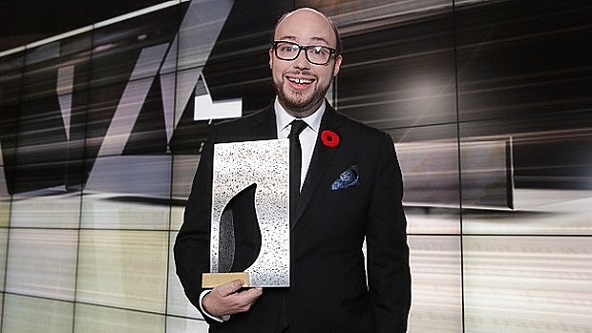
Congratulations to Sean Michaels, author of Us Conductors, who walked away with the prize. He was given the longest odds, and in a poll conducted by the Globe and Mail not one of the “experts” picked him to win (the only author on the shortlist so undistinguished). In the lead-up to last night’s gala All My Puny Sorrows by Miriam Toews was reported to be the clear bestseller on the shortlist, with David Bezmogis’s The Betrayers in second place. I confess that before the announcement of the long list I hadn’t heard of Us Conductors, despite it being published by a major press. Indeed, the only “Sean Michaels” I knew of was a porn actor from the 1990s.

Michaels is the third debut novelist to win the award, following Vincent Lam (OK, his debut was a linked short story collection) and Johanna Skibsrud, a pair of authors who did not set the world on fire as sophomores (bonus points if you can name their follow-up efforts). This makes one wonder how accurate a predictor the Giller is of future success, or whether winning Canada’s most prestigious and richest literary prize, which began as something of a lifetime achievement award, is good for younger authors.

We’ll find out after the party.

This is the way we rise and fall

Haters gonna hate? (Sarah Zucca)

Haters gonna hate? (Sarah Zucca)

Every now and then a story crosses the digital wire that seems to be about something more. They stick in your head with resonant factlets, or are representative of some larger meaning. Past examples that I have filed away include the announcement that the videogame industry has become larger than the film business, and the effect that social media has had on porn usage (Facebook taking over as the preferred mode of self-gratification).

Here’s the latest: Taylor Swift’s most recent album, 1989, accounted for one in every five American record sales (physical or digital editions) last week. As reported in the New York Times, the 24-year-old sold more copies of her No 1 album than the combined sales of singles at No 2 to No 107 in the Billboard chart. At Slate.com, Chris Molanphy tried to explain just how striking this was:

Basically, in the postmillennial, digital-first music business, you can divide artists into a small handful of elite megablockbuster acts and the 99 percent. And this is fundamentally different from the music world of the ’80s and ’90s. The Michael Jackson of Thriller may have been in a league of his own, but the ’80s acts just a half-tier below him—Bruce Springsteen, Madonna, Prince, Whitney Houston, Michael’s sister Janet, George Michael—were minting tens of millions in sales, and medium-tier acts like REO Speedwagon or Mötley Crüe did fine. In the ’90s, the album chart was dominated overall by Garth Brooks and Mariah Carey, but dozens of other artists were genuinely competing with them, dropping 5- and 10-million-sellers, from Pearl Jam to TLC to the Spice Girls. What we have now, on the other hand, is an extreme case of haves and have-nots. Swift may be quite a bit bigger than Lil Wayne, Justin Timberlake, and Lady Gaga. But really, when it comes to chart performance, this small handful of artists (plus consistent chart-toppers like Jay-Z and Beyoncé) is hobnobbing together in a very exclusive luxury box behind home plate while every other act is squinting from the bleachers.

Or if you don’t like baseball metaphors, consider football—and television. DVRs and online streaming have decimated TV ratings for the last decade; top-rated series of today like Modern Family and The Big Bang Theory wouldn’t even make the Top 50 in the age of Seinfeld and ER. And yet somehow the NFL keeps commanding ever-larger TV audiences for its live games. This year’s Super Bowl ranked as the most watched television program in U.S. history. It beat the ratings record set two years earlier by … the Super Bowl. And that 2012 game was the third time in three years it topped itself for the all-time record. The gap between live events, like the Super Bowl and the Oscars, and everything else on television is too large to even consider them the same kind of televisual entertainment at this point. In TV ratings as in music, it isn’t just winner-take-all. It’s winner-moves-to-a-private-island-and-secedes.

There’s nothing new about the trends at work. The growing gulf between the one-percenters and the rest of us, between the haves and have nots, is common knowledge. We also know that this is something that has been happening in all sectors of the economy and not just finance or industry. In her book Plutocrats, Chrystia Freeland even describes how it works in the music business. The world only needs one “world’s greatest cellist,” and so Yo-Yo Ma is rich and famous and all the other cellists in the world . . . well, they still have their music. Culture has become a zero-sum game, with great rewards for the winner and oblivion for the rest.

When it comes to culture, I can think of two possible outcomes that might have redeemed the digital revolution. In the first, the tearing down of any barriers to distribution might have led to a new cultural economy, one that had some big winners but which also raised all boats. Alas, trickle-down economics always was voodoo. As the Taylor Swift story indicates, it’s not just that Swift is doing so well, it’s that the rest of the field is collapsing. The same thing has happened in publishing, as a story that appeared in the Guardian several months ago explained:

Earlier this week, the Authors’ Licensing & Collecting Society released a survey of almost 2,500 writers which found that the median income of a professional author last year was £11,000, down 29% since 2005 – a period in which median earnings for UK employees have fallen by 8%. By this year, according to the survey, just 11.5% of professional authors said they earned their income from writing alone, compared with 40% in 2005.

I note in passing the full title of Chrystia Freeland’s book: Plutocrats: The Rise of the New Global Super-Rich and the Fall of Everyone Else.

But there was another avenue open for the new cultural economy to redeem itself. Perhaps not everyone would succeed, but those who did would be the best of the best, the most innovative and creative, the strongest competitors in an increasingly hostile environment. If 99% of everything is junk anyway, then only the efforts of the vital 1% deserve to exist. The market has spoken. If you can’t sell your books or music then you should be doing something else with your time.

Has that happened? Has the Internet led to a cultural renaissance?

I don’t see it. The rags-to-riches stories of self-publishing on the Internet have mainly been of formulaic, mass market fiction. Indeed, I’m unaware of any experimental or “literary” author who has found success taking this route. Instead, the one-percenters have been names like E. L. James, author of the Fifty Shades of Grey series. Generic fiction rules. A global monoculture spreads its kudzu-like vines everywhere, squeezing out the rest of the literary ecosystem.

And as for music, there is Taylor Swift.

I’m not “hating” Taylor Swift at all. You can look for her on YouTube and judge her talent for yourself. But for me the news of her rise and everyone else’s fall is depressing. You have to look at the trends that are developing and be concerned about where they are taking us.

Must we burn Jian Ghomeshi?

Hic est locus Marini Faletro decapitati pro criminibus. (CP -- Chris Young)

Hic est locus Marini Faletro decapitati pro criminibus. (CP — Chris Young)

I don’t know Jian Ghomeshi, have never met or corresponded with him, and the only time I ever listened to his Q Radio Show was when I was writing commentary on the Canada Reads program. I knew of him, but he wasn’t really on my radar. Since his firing from the CBC, however, his celebrity star has gone supernova, attracting daily headlines in the national news media for over a week.

From poster boy of the new CBC to whipping boy of “rape culture,” it’s been quite a fall, of the kind that celebrity-watchers delight in. His humiliation has been exquisite. We’ve learned about his Big Ears Teddy, and the foulness of his body odour (that he apparently tried to conceal beneath baths in cologne that stank up the Ceeb’s elevators). We’ve put him on the couch, analysed his “pathological narcissism” (Michael Smyth, writing in The Province), and been told of how he represents an entire culture’s “narcissistic male rage” (Gabor Maté in the Toronto Star). On Salon.com Andrew O’Hehir even came up with “Ghomeshi syndrome,” a label for “delusional creeps” with an inflated sense of alpha-male entitlement. Finally, by the end of his week from hell, another media station of the cross was reached when a male friend made the claim that Ghomeshi had fondled his junk in an elevator. The man has become a cliché as well as a pariah.

All of which is fair enough. The charges are serious, and celebrity is cruel. (That Ghomeshi even counted as a celebrity tells you something about Canadian culture today.) This is a point I brought up in my review of Paula Todd’s book on Internet bullying, Extreme Mean:

Rebecca Black is Todd’s poster child for [the use of YouTube as a public pillory for prospective celebrities], but despite becoming “the most hated person on the Internet” at the tender age of thirteen when her music video “Friday” was cybermobbed, she is not a sympathetic case. Black was a celebrity wannabe following a script that, after all, had made a global star out of Justin Beiber. But fame is a harsh game — as many a talent-show contestant taken from the stage in tears can testify – and this is as it should be. Our attention comes at a price.

When you play the fame game in the digital age you’d better have a skin of steel or a very well-developed case of narcissism, the kind that makes you totally oblivious to what anyone else thinks. The state has no place in the bedrooms of the nation (Ghomeshi’s initial defence, on Facebook), but celebrity isn’t politics, it’s pop culture. Ghomeshi was a personality, of the kind that has taken over much of the radio dial. That personality was, in turn, a brand. When you become a brand, everything is in play. You’re selling yourself, and the public feels entitled to inspect the goods.

All of the coverage has led to some unseemly piling on (it appears no one really liked Jian very much), as well as unfortunate collateral damage. One can’t be surprised any more by the haters who post on YouTube threads (just ask Rebecca Black), but Moxy Fruvous weren’t a bad band. Come on, people: they wrote silly, satirical pop songs, a couple of which have managed to stay in my head. Of course they look and sound stupid now, but making fun of them is anti-Jian overkill.

More serious collateral damage will be felt by the CBC. The scandal hits them at a bad time (not that any time would be very good). But the impact may be even broader, what with the “rape culture” debate getting re-energized as media gasoline is tossed on the flames. After Ghomeshi’s original Facebook post there was a flood of support for his pro-kinky sex stand. Now the kinksters are running scared. Under Canadian law, we are told, there is no such thing as consent to harm. An investigation has begun into who knew what at the CBC, and when they knew it. Early reports don’t look good. Heads may roll. Carl Wilson, writing for Slate, suggests that because a lot of people in the Toronto scene knew Ghomeshi was a creepy perv, they were “complicit in his abuse.” That is, “you didn’t know, of course. But you knew. There was doublethink, a split consciousness” (Wilson’s piece is written in the second person). Is that a defence that will hold up in court?

Ours is a society terrified of personal responsibility, and for good reason. Responsibility means liability, and you really, really don’t want to go there. Ghomeshi’s case has made a lot of people anxious, and for that alone he’ll probably have to burn.