Maigret: Maigret is Afraid

Though a boy from the provinces (his father was a rural estate manager), Maigret is as closely identified with Paris as you can imagine, even if he also gets around quite a bit: traveling to the U.S. in Maigret in New York and Maigret at the Coroner’s and England in Maigret’s Revolver. That said, the books I like the best are the more village-cozy ones where he finds himself in some small provincial town having to investigate a crime involving the corrupt or degenerate local big-wigs. Which is where Maigret is Afraid lands us.

Maigret isn’t really afraid. At least he isn’t afraid for himself. His fear is more like concern for the welfare of some particularly vulnerable individuals. He arrives in Fontenay to visit an old friend and immediately finds himself investigating a series of murders. The town, which is understandably on edge, is also deeply polarized along class lines (“Maigret had rarely experienced such cliqueyness”) and the proles have turned against the family living in the grand old manor house that dominates the high street.

That family is, in turn, an extreme example of decadence, their gentility now submerged in shabbiness and possibly insanity. Even the hired help have turned against them, which is less of a surprise given that they (the help) aren’t getting paid.

Speaking of the help, I always like the little nods in books like these to the social protocols of the time. It’s like when you see servants tucking in their upper class masters at bedtime in the novels of Agatha Christie and P. G. Wodehouse. Of course most of this is gone now, and for good reason. For example, why would you even want someone else to run your bath for you, as the hotel chambermaid does here for Maigret? How would they know what temperature you wanted it?

Though it’s a classic set-up, the plot here is a bit nutty, and stays off-focus as Maigret is more concerned with his friend the town magistrate than he is with what’s going on with the slayings. The magistrate’s problem? Madame Maigret thinks it’s the fact that he never married. Is her judgment apt, or is the magistrate just another illustration of men not being able to live with women or without them? The book seems to suggest that you’re damned either way.

Maigret index

One night in Dubai

Not going anywhere for a while.

Magnus Carlsen has defeated Ian Nepomniachtchi at the World Chess Championship, held this year in Dubai. This is Carlsen’s fifth championship and gives him some claim to be the greatest chess player of all time.

I followed the match intermittently, mostly through recaps. I didn’t have the patience, or the understanding, to watch any of the games live. The sixth game, which was the turning point in this contest, was the longest in the history of the WCC, clocking in at nearly 8 hours (136 moves). A great game, but hard to follow for the casual fan.

To my inexpert eye the early games were kind of interesting. They were all draws, and indeed Game 3 was rated the most accurate game ever played, as judged by the computer engines. Of course it was a draw. At the highest levels chess is sort of like a staring match. At one of the early press conferences Nepomniachtchi remarked that the only way to have decisions was if someone made a mistake. In the later games he would prove himself correct by making a number of bad ones. After Game 6 he really didn’t seem that interested any more. So not a great event, and one that just seemed kind of sad at the end.

Chess played online has enjoyed an explosion of popularity in the last couple of years, with many of the top players and Internet personalities becoming stars. But there’s also a trend toward faster formats like Rapid and Blitz that will likely continue, while classical chess will remain more of a prestige event. What I do like about all of this is the fact that even though computers are better at chess than humans now, we still want to watch humans compete.

Maigret: Maigret and the Man on the Bench

I wonder how relieved Maigret feels that he didn’t have kids. He does mention here that he had a daughter who didn’t survive, which I’m sure is a source of regret, but in so many of the cases he investigates kids are what get people into trouble.

The reference to his daughter, by the way, comes during a courtroom scene where Maigret is being interrogated by a defence lawyer about having struck the accused after taking him into custody. “At one point I boxed his ears, as I might have done my own son,” he admits. There’s a bit that hasn’t worn well.

I like the story though. Louis Thouret is found dead, stabbed in the back in an alley. How did he get there? As Maigret pieces together the last few years of Thouret’s life he discovers that he had led a dual life, along the lines of the Michael Douglas character in the movie Falling Down or John Lanchester’s novel Mr. Phillips. It all comes from having to keep up appearances, which is something Louis’ wife nagged him about. These are the sort of people Maigret is most drawn to in the Parisian crowd:

In former days what had struck, you might even say romantically inspired, him about this crowd in perpetual movement were those people who, discouraged, defeated and resigned, had given up on life and been swept along by the flow.

Since then he had come to know them, and they were no longer the ones who made the biggest impression on him; rather, those who did were on the rung above, the decent, honest, inconspicuous types who struggled day in, day out to stay afloat, or to foster the illusion, the belief, that they really existed and that life was worth living.

Maigret and the Man on the Bench is also one of those books where the action is driven by predatory and cruel women, and the men who try to appease them. In our own time the bathrobe has come to seem like the uniform of the man on the make; in Maigret novels it’s more often a woman in a dressing gown with a breast falling out. I should have kept count at the start of this series of how many times this happens. It’s usually just a depressing attempt at seduction by some vamp who doesn’t realize that Maigret can’t be tempted in that sort of way (they’d do better by offering him a drink). In fact, he is usually repelled by boobs, as here when visiting a woman of a certain age and noticing how “one of her breasts – always the same one, soft and wobbly like bread dough – had a tendency to slip free of her dressing gown.”

I wonder how critical a comment that is meant to be. I think a breast like bread dough would be pretty firm for a woman over 50.

This was a good one, though the ending is presented as a sort of afterthought. I think the lesson learned is not to flash your cash around, especially in certain neighbourhoods. Also don’t have kids unless you’re prepared to slap them about to keep them in line.

Maigret index

Maigret: Maigret’s Revolver

When you’re as famous a detective as J.-J. Maigret (that’s Jules-Joseph) you don’t have to go looking for trouble; it comes to your door. In this case it takes the form of a disturbed young man who drops in at his apartment and is entertained by Madame Maigret for a while but who leaves before the Detective Chief Inspector arrives, taking with him Maigret’s revolver.

I have to say, Maigret doesn’t come away from this initial bit of business that’s used to get the plot rolling looking very good. Why doesn’t he rush home when his wife calls him? Why does he stop on his way at a brasserie to have a few pastis with a colleague? Later he will apologize – to the young man! – for not getting back more quickly. Meanwhile, it is Madame Maigret who wants to apologize for not keeping the young man at the apartment, while she’s having to cook Maigret’s lunch at the same time.

I guess it’s a minor point, but like I say, it doesn’t show our hero in a good light. Or later when the couple are walking to a friend’s place for dinner and she has to tell him “Don’t walk so fast,” because “He always walked too quickly for her.” Always? How long have they been married? Wouldn’t he know this by now and slow his pace when out with his wife?

All of this is by the way, but it is something I tripped over in the opening pages. Once the story gets going here it has Maigret pursuing the young man, and his revolver, to London, where Maigret meets up with cross-Channel colleague Inspector Pyke of Scotland Yard, who we remember from My Friend Maigret. But as usual any attempt at establishing a Maigret chronology is frustrated by the offhand remark that “they had not seen each other for some time.” How long a time? Don’t know.

In my notes on Maigret and the Old Lady I speculated on whether or not Maigret could be considered an alcoholic. That’s a thought I had again here, especially when he’s stuck staking out the lobby of the Savoy Hotel, with the bar closed. Then when the bar opens he can’t get to it! This, this is torture:

His throat was swollen with thirst and from where he stood he could see the bar full of customers, the pale martinis, which from a distance looked so cool in their clouded glasses, and the whiskies that the men standing at the bar were holding in their hands.

You can bet this is a thirst that water isn’t going to relieve. And in fact when he later has dinner with the young man he’s been hunting and the young man only orders water Maigret looks down on him as a child. Grown-ups order a bottle with their meals, and if the young man doesn’t want any then that just means more for Maigret.

A quick read with a silly plot that wraps up without much of a conclusion. Alas, as Maigret has to concede, he is not God the Father but only head of the Crime Squad. A mere mortal who needs to stop off on his way home for a few drinks and who gets parched standing in a hotel lobby.

Maigret index

Now you’re cooking with gas . . . in space

They even put it on buttons.

The expression “Now you’re cooking with gas!”, which has the meaning of “Now you’re doing it right/making progress/on the right track,” had its origins at the end of the 1930s, when it was used on radio shows as a way of promoting the home use of natural gas. Some have attributed it to Bob Hope (or one of his writers) and it apparently does get used by him in Road to Zanzibar (1941), a movie I haven’t seen.

My father liked to use the expression. I heard it a fair bit growing up. I never heard anyone else say it. Whenever I’ve used it I’ve only gotten confused looks. I think it may have been the equivalent then of “Where’s the beef?” for my father’s generation. That’s an ad line that found it’s way into a movie too.

You can imagine my surprise then on reading Miles Cameron’s Artifact Space, which is space-opera SF set sometime in the distant future on board a giant “greatship” that is sailing through the cosmos. When the crew of a hydrogen harvester are unloading their cargo of fuel the captain tells the rookie “Now we’re cooking with gas.” This provokes a questioning response, “We are?”

“It’s an expression,” he said. “Apparently, once upon a time cooking with gas was very . . .” His eyes met hers. “Honestly, I don’t know. Half our jargon is from the old United States Navy and the other half is from the ancient British Royal Navy, and there’s a bunch from early spaceflight operations and some even from Old Terran trucking. Navies are the most conservative linguists anywhere — we preserve even the meaningless terms for hundreds of years.”

I don’t know why the connection is made here to navies, since it’s an advertising catch phrase that started out on radio directed at people using gas ovens in their kitchens. In any event, this may be the first time I’ve ever seen the expression in print, and what a strange place to finally find it!

Top of the world

Going up.

Just over 24 years ago I started what turned into a surprisingly long stint as a freelance book reviewer with a review of Jon Krakauer’s Into Thin Air. I think it was the second review I had published, outside of student newspapers and academic journals. Alas, it appeared in a paper that hasn’t had a books page now for over a decade.

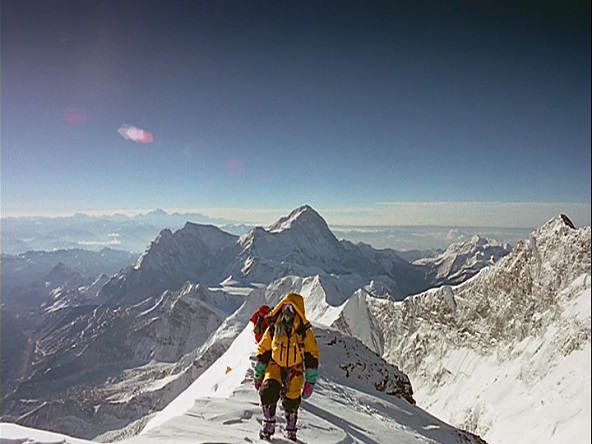
I absolutely loved Krakauer’s book, and a couple of months later did a double review for the same paper of a pair of similarly-themed mountaineering books: Dark Shadows Falling by Joe Simpson and Everest: Mountain without Mercy by Broughton Coburn. The latter was a companion book to an IMAX expedition that was on Everest the same time as Krakauer’s team. Apparently I liked the pictures but thought the text “virtually unreadable.” I recently re-read it though, so I can say that judgment was maybe a little harsh. Still, the main draw are the pictures.

I don’t think I saw the IMAX film Everest at the time, but I recently watched it — on DVD, alas, and a small screen — and posted my thoughts over at Alex on Film. I guess after nearly a quarter century this closes that particular circle.

In case you’re wondering, I’m not a mountain climber. Or rock climber. Not at all. Though I do like hiking. You couldn’t pay me enough to get me to go up Everest, though I wouldn’t mind visiting Nepal. The dangerous stuff should probably be left for the professionals.

Maigret: Maigret, Lognon and the Gangsters

The Maigret novels aren’t without their moments of humour, but I wouldn’t call any that I’ve read thus far comic. Maigret, Lognon and the Gangsters comes the closest, beginning with the sad sack Lognon himself, who I don’t recall appearing before Maigret at Picratt’s. Lognon goes by the nickname Inspector Hard-Done-By and is described as “the most lugubrious individual in the entire Parisian police force, a man whose bad luck was so proverbial some people claimed he was cursed.” Very much a comic figure then, and the book begins with his going missing and Maigret having to make a visit to his wife, a scene which plays out as farce.

There is, however, a dangerous subtext. Another potentially comic character Maigret meets is the café owner Pozzo (this book was published in 1952 and Waiting for Godot premiered in 1953, so Simenon wasn’t writing under the influence). Pozzo initially seems to be acting the clown and even later will look like “one of those old comic actors whose faces have become rubbery from all their contortions.” But beneath that rubbery face, and despite his costume of baggy pants and red slippers, he is a figure of threat, with eyes that remain hard and watchful. The same might be said of some of the gangsters, Americans who come with snappy names like Sweet Bill and Sloppy Joe. And the final gunfight, which is underscored by funny moments like Maigret having a pullet pass through his hat and a tiny French policeman trying to physically constrain a giant American woman.

So maybe this is a comic novel. I don’t even think anyone gets killed, though quite a few are shot and beaten up (including poor Lognon, who is removed from “his” case pretty quickly). The plot involves a bunch of gangsters arriving in Paris and behaving as very poor guests. Maigret takes their presence as a challenge – we know he loves a challenge – and makes their capture a point of national pride. I don’t have to tell you how that works out. He shows them all . . . Absolutely!

Maigret index

The final chapter?

Over at Goodreports I’ve posted a review of three of the books that came out on the last days of Trump: Landslide by Michael Wolff, I Alone Can Fix It by Carol Leonnig and Philip Rucker, and Peril by Bob Woodward and Robert Costa. Could this be the final chapter of the Trump saga? Trump remains the undisputed leader of the Republican Party but my own sense is that his health isn’t going to hold up well enough to run again. That said, I guess anything can happen. There may be Four. More. Years!

Maigret: Maigret and the Tall Woman

Something about wicked women seems to have got Simenon’s creative juices flowing. Looking back on the books I’ve read in the series, it’s the bad girls who stand out the most. Madame Le Cloagulen in Signed, Picpus was probably the worst, but Madame Serre gives her a run for the money here. Related to this fascination with such women is an instinctive loathing of men who are excessively mothered.  The Flemish House and My Friend Maigret are the best examples. I wonder if there was some psychological projection going on here, as Maigret himself is waited on hand and foot by his wife.

In any event, Maigret and the Tall Woman combines both of these elements into one of the chief inspector’s most enjoyable cases. Enjoyable in part because Maigret himself is having so much fun. Guillaume Serre is actually bigger than Maigret is, which makes taking him down into a special challenge. This will be a heavyweight match-up for the ages!

Had it become a personal matter between him and Guillaume Serre? More precisely, would events have played out in the same manner, would Maigret have come to the same decision, at the same moment, if the man from Rue de la Ferme hadn’t been a heavyweight like him, both physically and psychologically?

From the start he seemed intent to test himself against him.

Alas, that’s not quite how things work out. But the sting in the tail of this one, a doctor’s stoppage almost, is even more satisfying than a knockout.

Maigret index

Hitting the books, again

After a brief hiatus I’m back posting book reviews on Goodreports.net, kicking things off with a review of Michael Sandel’s The Tyranny of Merit.

I started Goodreports in 1998, so I’ve been at it for a while now. In recent years, however, I haven’t been updating it as much. This is not, however, because I’ve been spending all my time watching movies. I still read as much as ever, about 100-120 books a year. But my reading has changed.

Most of my reading these days is non-fiction. This is either history or current political events (for the last few years that latter category could be relabeled “books about Trump”). I’ve also spent a lot of time re-reading the classics — fiction, drama, and poetry. Currently I’m working my way through a lot of Milton and Joyce. I haven’t read either author in years and I’m having a great time. But I’m not going to review them!

What I’m not reading, at least in any great quantity, is new fiction. I still cover a bit of SF, but, aside from that, in the past year I haven’t read many new novels or story collections.

I don’t think this is because of anything I’ve got against new fiction. It’s probably more a result of aging. If you only have time for a certain number of books left, why not spend it with the masters? But also, as I get older I find that works by new (that is young) writers have less to say to me. Again, this isn’t a unique feeling. I’ve heard other (old) people express the same feelings.

I’m not giving up, however, and plan on making a commitment to reading more new fiction moving forward. I just need to find some more hours in the day to make it happen.