A book-movie double bill today, with notes on Where Eagles Dare up at Alex on Film and a brief review of Geoff Dyer’s commentary on it, “Broadsword Calling Danny Boy,” at Goodreports. Both well worth checking out. They made me wonder though how much of the interest in Where Eagles Dare today is driven by nostalgia. Not for the Second World War, but its place in the cultural imagination, particularly of boys in the 1960s and ’70s. And whether that’s a kind of popularity likely to last. If so, I think it will have to change into something else.
Author: Alex Good
Maigret: Maigret and the Headless Corpse
Right near the start of Maigret and the Headless Corpse a canal-side scene is drawn wherein “everything seemed as bright and clear as a painting by Utrillo.” I’m not the best-informed fellow when it comes to art history and pulled a blank on this name. I looked it up and Utrillo is Maurice Utrillo, who actually died in 1955, the year this book was first published. I don’t know if Simenon slipped his name in as an homage. I looked at some of Utrillo’s paintings online and while there were a number of cityscapes the sky always seemed slightly overcast.
I wonder how many people reading this book at the time it came out would have known what sort of an image was being drawn. Were readers of Maigret novels the same people as would be familiar with Utrillo paintings? I don’t know. Is it a connection Maigret himself would have been likely to make? Probably not. This is part of what made me think it could have been meant as an homage.
The whole first chapter here is brilliant, taking us through the discovery of the headless corpse in a manner that underlines the automatic nature of the process, with the one out-of-the-ordinary fact of the case (it’s a man’s arm) being flagged by everyone along the way. Simenon’s usual economy is perfectly employed. I was smiling with the turn of every page.
The rest of the book is almost as good. After the clutter of Maigret and the Minister Simenon seems to have wanted to pare everything down to the bare essentials this time. Just a corpse (they never do find the head) and a few suspects. One of these is the bistro owner Aline Calas, who is Maigret’s chief antagonist. “They were evenly matched,” we are told at one point, and soon it becomes clear that this is “less a police investigation to discover a culprit than a personal matter between Maigret and this woman.” It’s on!
Even though there’s not much detective work, and Maigret, as so often, just has to wait to have the solution provided to him, I still thought this one of the best I’ve read in the series for a while. Once again there’s the slow revelation of a perverse character type, which also allows for observations such as this:
Maigret had often tried to get other people, including men of experience, to admit that those who fall, especially those who have a morbid determination to descend ever lower and take pleasure in disgracing themselves, are almost always idealists.
Self-destructiveness is fueled, in other words, by a profound disappointment or even disgust with the world. I’d never thought of it quite that way, but I think the Detective Chief Inspector has a point.
End of the road?
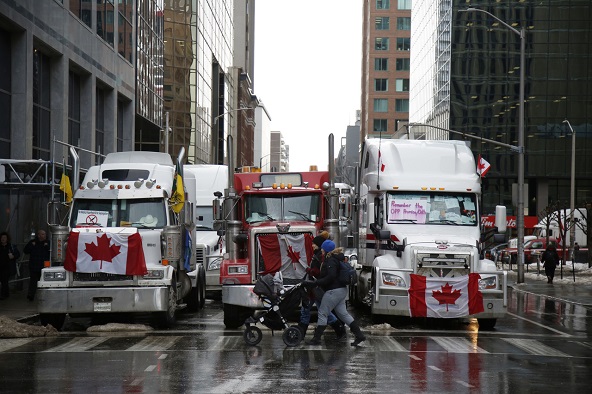
Well, it looks like the Freedom Convoy is over now. They’re just clearing the last of it away. What, if anything, did it all mean?
(1) It was great political theatre. This was a story that got major media play not just in Canada but in the U.S. and Europe too. I can’t think of the last time that happened with a Canadian news story.
(2) It didn’t make a lot of sense. Indeed, I said when it started that it was born of a certain lack of seriousness. The ostensible point was to protest vaccine mandates which required Canadian truckers to show proof of vaccination to enter back into Canada from the U.S. Without such proof they were required to quarantine for two weeks. Since they already had to show proof of vaccination to enter the U.S. from Canada this seemed like reciprocity. Also, apparently 85% of truckers were vaccinated. But then they were against all vaccine mandates (passports) and perhaps even more against Justin Trudeau. And it’s still an open question as to how many of the protesters were even truckers.
(3) If they’d stuck to just having a quick demonstration I think they could have called it a huge success. But they kept hanging around in Ottawa and Windsor, with no clear idea what for, and that started to irritate people. Rule for protests: Don’t be too annoying! Though given how Ottawa is a Liberal stronghold they probably figured they had nothing to lose there.
(4) As it is, the whole thing might still be considered a success by those involved in that it provoked the government into an overreaction with their invoking the Emergencies Act to clamp down. I don’t think this was necessary, and the business of going after funding, most of which was domestic, strikes me as particularly problematic. This was not “Canada’s January 6,” or anything even close, though both sides were certainly channeling the energy and iconography from that event.
(5) That said, it might also have been successful in firing up an American-style culture war, one that had both sides calling the other Nazis. (An aside: Will we ever be free of this tired and misleading rhetoric? The threat of authoritarianism in our time isn’t Nazism, or Communism, but something new.) Who gains the most from this polarization? The results will probably take a while to tally, but I’m inclined to think Trudeau was one of the losers, as he came across as both weak and sanctimonious, qualities that have become his most readily distinguishable and least admirable trademarks. On the other hand, the convoy was pushing the Conservatives further than I think many of them wanted to go. What began as farce might still end as tragedy.
Maigret: Maigret and the Minister
Maigret and the Minister is a bit of a change-up, being more of a political novel than the other books in the series. Maigret doesn’t care much for politics, or politicians, so when he gets called in by a government minister to investigate the theft of a politically explosive document he doesn’t relish the assignment one bit. He’d rather be dealing with the usual criminal types, feeling at one point “almost fond of the petty thieves maniacs, swindlers, and offenders of all kinds that he usually had to deal with.”
Making matters worse is the role of a press baron in all of this. Because if there’s one group of people that, then as now, people tend to like even less than politicians it’s the media. Who will win this race to the bottom?
Fitting the broader, more public scope of the proceedings there’s also a larger cast, with lots of incidental characters. This is compounded by what Maigret sees as the almost comic competition between Maigret’s team – the Police Judiciaire, headquartered at Quai des Orfèvres – and the Sûreté on Rue des Saussaies. I’m afraid I’m not clear on the distinction between these two organizations. I think Maigret is in a division of the Paris police and the other investigators are federal, but that might be the wrong way around.
Once everything gets unwrapped, however, things settle down into the usual round of Maigret and his deputies wearing out some shoe leather following people about and interviewing suspects until the solution just sort of comes to the Chief Inspector. It’s one of those things where he only needs to be reminded of something that’s been sitting at the back of his mind all along.
Also as usual, the chief villain will have to wait to get their full comeuppance. As for Maigret, he’s happy to wash the stink of politics off his hands and get back to his liars, murderers, and thieves.
And now some words from our sponsors
Wow, the Super Bowl ads really sucked.
They’ve probably been bad for a while now, but to be honest I haven’t been paying any attention. This year I managed to check a bunch of them out. And they were . . . terrible.
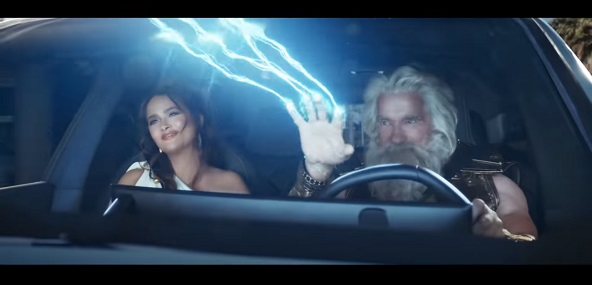
I’m honestly surprised they were this bad. No intelligence or creativity at all. They just seemed like they were throwing around lots of money, big stars, and brand IP, and then hoping for the best. What was funny about Arnold Schwarzenegger and Selma Hayek playing retired Olympians (Zeus and Hera) who get an electric car? Do you think they might have written them actual jokes? What was funny about Mike Myers reprising his role as Dr. Evil to hawk an SUV (in an ad The Athletic rated the pick of this year’s crop)? What was funny about Ryan Reynolds recycling an old Mint ad upside-down? What was funny about Lindsay Lohan reinventing herself by going to the gym, along with a bunch of weird celeb cameos (Dennis Rodman, Danny Trejo, William Shatner)? There was nothing clever, noteworthy, or memorable about any of this. It was all trash.
Is ad culture now as exhausted for new ideas as Hollywood has long been? Because that’s what these ads felt like. Blockbuster commercials with A-list talent and no brains. Were these the ads we were supposed to be talking about the next day around the water cooler? Or is that itself an antiquated notion now?
Or perhaps I’m just being a curmudgeon. Writing in Slate, Justin Peters declared this year’s Super Bowl ads to be “by and large, pretty good.” So I watched all of the ads he ranked as the best. I was even more disappointed. The Chevy Silverado ad just mined The Sopranos for . . . what? That’s the ad? Meadow and AJ hugging after she drives through the opening credit sequence? It was only a minute long and I honestly had to skim through it to make it to the end. And I loved The Sopranos!
Next Peter had an ad for something called ClickUp, with the joke being that the signers of the Declaration of Independence were using a tablet and cloud computing. No laughs, not even a smile, and the whole idea is played out by now.
Then there was an Expedia ad which was sort of meta, poking fun at previous Super Bowl ads and ad culture in general. Another yawn.
A Lay’s Potato Chips ad which had Sexiest-Man-in-the-World Paul Rudd teamed up with Seth Rogen, as they reminisced over movies they’d been in together while sharing some Lay’s. Peters found this “very funny.” Huh?
Nissan “Thrill Driver.” Eugene Levy is funny in just about anything, but this is more of the blockbuster syndrome I was talking about. Big effects, big star cameos, and nothing else.
I sort of gave up at this point. Among the rest, Jim Carrey was back as the Cable Guy. I actually thought this was a little better than Mike Myers returning as Dr. Evil, though not much. Apparently there were a lot of not-good commercials trying to sell us on crypto. One of these just had a QR code bouncing around the screen. Larry David shilled for another, but his ad was way too long, dragging out a single joke to the point where it lost its edge before the hook at the end. LeBron James also pitched crypto, with the same FOMO message. As Matt Schimkowitz writing for Yahoo put it, “The [crypto] ads, disturbing and boring in their own ways, were met with derision online for basically the same reason: They suck because the thing they’re advertising sucks.” Yep.
Anyway, the only ad I sort of enjoyed was the Uber Eats one, which was weirdly riffing on “can you believe how stupid the people are who order Uber Eats?” You could say it fell into the category of so-dumb-it-was-kind-of-good, and Gwyneth Paltrow’s cameo was definitely off-putting. In a field of disposable formula and conspicuous waste, it’s the only moment that stood out.
The football news
The days leading up to the Super Bowl (this would be LVI) haven’t been full of good news for the National Football League. In particular, a lawsuit filed by former Miami Dolphins Brian Flores coach alleged all sorts of misconduct by various teams. But it was a couple of other NFL-related news stories that caught my eye this past week.
The first story had to do with a documentary on the Tuck Rule, a controversial call made in a playoff game in 2001 involving the now newly-retired quarterback Tom Brady. Jay Busbee, writing for Yahoo Sports, introduces us to it:
Farewell, Tom Brady the football player. Hello, Tom Brady the Image Builder.
This weekend, ESPN will debut “The Tuck Rule,” a “documentary” in the sense that it’s a series of real people discussing, dissecting and squabbling over a real historical event — the fateful play in a 2001 season AFC divisional round game between the New England Patriots and then-Oakland Raiders.
In a more accurate sense, though, “The Tuck Rule” is the first step in the construction of the post-NFL Tom Brady. Co-produced by 199 Productions — which just happens to be the production company of one Tom Brady — it’s a carefully curated version of the truth, one that just happens to break Brady’s way at every turn.
Busbee is right to be suspicious. What’s happening here is something I’ve written about several times before, most recently with regard to the dust-up over tennis star Naomi Osaka’s picking and choosing what media she would do. Osaka was lionized in the press, but I had my doubts about the way she was being allowed to play the reporters whose job it was to cover the story:
I want to express my concern at the way a widespread anger at and distrust of the media has become cover for those in positions of wealth and power who want to take control of the way they’re presented. To ask the obvious question: Who wouldn’t “much rather tell their own stories than let reporters do it for them”? How brave is Osaka in ditching press conferences for social media platforms where, as Jones puts it, “she can control the conversation without risk to herself”?
Everyone wants that kind of control. But who has that privilege? Only the most powerful. Billionaires. Those with “massive social-media followings.” Celebrities who own their own media companies.
Celebrities who own their own media companies. Would that be Tom Brady? Why, yes it would. And to these alternative-reality bubble-blowers we might add celebrities with leverage over mainstream media companies. Like Michael Jordan, who was given editorial control over the 10-part ESPN documentary The Last Dance, which wasn’t exactly a warts-and-all portrait of the superstar basketball player. Or we might think of LeBron James, whose Space Jam 2: A New Legacy was nothing if not an exercise in personal-corporate branding. These athletes are immensely talented in their field, but also smart enough to know how much money can be made as a brand. They are Image Builders, in Busbee’s phrase.
I wrote about this in a post several years ago that I’ve since updated a few times. But it’s worth repeating: a celebrity, or really any individual in a position of wealth and power, will manage their public profile very carefully. Which means that representations of these people, whether in the form of interviews, documentaries, official/authorized biographies, or anything else like that, are pretty much worthless. They are only advertisements for a brand.
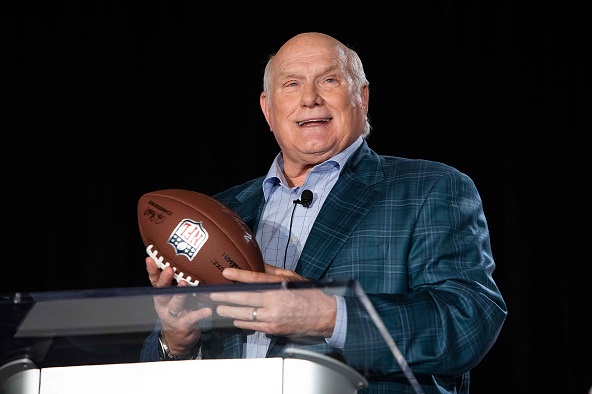
Of course the chief reason they do this is to make money. But it’s not all about the money. This was brought home to me in the second bit of NFL news I wanted to talk about. In an interview for ESPN former Pittsburgh Steeler quarterback and long-time Fox Sports commentator Terry Bradshaw was asked about any regrets he might have looking back on his career. His response was surprising:
“If there’s one thing in my life I do wish I had . . . I wish I was loved and respected. . . . And I understand, I know I don’t deserve this, I just wish I had it. Like [Tom] Brady, and like Peyton [Manning], Roger Staubach . . . ”
At least it was surprising for a moment. But then I thought of Brett Favre, the quarterback of the Green Bay Packers who left that team under something of a cloud, apparently because he didn’t like the fact that the organization was moving on without him (his successor would find himself in a similar position a decade later). It was even reported that Favre might have talked to the manager of an opposing team to give them some inside scoop on the Packers out of spite. It’s hard to tell if this was really what was going on, but it sounded right. I mean, in more recent NFL news the quarterback Tom Brady retired and made a lengthy statement that didn’t even mention the team he’d played on for twenty years and that he only left at the end of his career in order to make another Super Bowl run.
It would be easy to write Favre and Brady off as just a pair of divas. But as Bradshaw’s interview suggests I think it goes deeper than that. All three of these quarterbacks were idolized not just in their home markets but nationwide. They achieved the most that anyone could achieve in their sport: Super Bowl rings and entry into the Hall of Fame (not yet for Brady, but a foregone conclusion for the player many consider to be the greatest of all time). They of course became fabulously rich, and in the case of Bradshaw and Favre went on to become film and television figures who could also cash in on how well liked they were. Indeed, according to Wikipedia: “Among U.S. consumers, Bradshaw remains one of pro football’s most popular retired players. As of September 2007, Bradshaw was the top-ranked former pro football player in the Davie-Brown Index (DBI), which surveys consumers to determine a celebrity’s appeal and trust levels.”
This is the guy whose greatest regret is that he wished he received more love and respect.
To have done so much, gained so much fame and recognition, to be worshipped as gods, and yet . . . to take away from it that it wasn’t enough. They wanted more. More respect. More love. They had been treated so unfairly.
In my earlier post on Osaka I mentioned how her media strategy was taken straight out of the Trump playbook: grievance used as an excuse to tightly manage and control one’s coverage. Unsurprisingly, Trump would also become a bubble blower with his own media company, the Trump Media & Technology Group. I suppose it’s just a coincidence that Favre and Brady are both big Trump supporters (and golf buddies), since Bradshaw was a critic, at least when Trump was in office. But it’s interesting to look at the psychology in play here through the lens of Mary Trump’s profile of her uncle in Too Much and Never Enough. In that book she saw Trump’s narcissism as at least partially being a way of acting out a need for love he didn’t receive from his father.
Are today’s celebrities damaged in the same way? Will too much ever be enough to satisfy their craving for more? More money, more attention, more respect, more love? And how accommodating will supposedly objective media have to become in order to placate these needs?
Isolating in style
As the super-rich continue to rake in the pandemic bucks (billionaires in the U.S. have seen their wealth grow by over 44% during the COVID-19 crisis) they have gone on a buying spree of superyachts. According to a VesselsValue report there were a record 887 superyachts sold last year, which is up 77% from 2020. One of the newest has been built for Jeff Bezos (whose wealth increased by $24 billion just in the past two years) and it’s been in the news recently because it will apparently require the temporary dismantling of a historic bridge in Rotterdam to get it out into open water.
What caught my eye reading one report about the growth of the superyacht industry was a quote from Sam Tucker (of VesselsValue) who said that the spike in sales can be attributed to “the increased need for privacy and private isolation” that superyachts provide.
Really? This is a need? Billionaires can’t safely self-isolate within their gated estates? Small armies of security details can’t ensure privacy anywhere but on a yacht? How much privacy are we talking about? How much isolation?
This sounds like camouflage for what is basically just more conspicuous consumption by the ultra-rich. As long ago as April 2020 CNN ran a story on the practicality of riding the pandemic out on a yacht:
Rumble Romagnoli, CEO of Relevance, a luxury digital marketing company headquartered in iconic yachting destination Monaco, is skeptical of the notion, pointing out that the practicalities involved make it an unfeasible choice for most.
“I think it’s a bit unrealistic to think people are going to swan off, get on board a yacht and just sit in the middle of the sea,” he says.
He also stresses that being stuck in the middle of the sea for weeks on end would prove tedious for most, even if they have lavish amenities at their disposal — “Rising Sun” has a wine cellar and a basketball court onboard.
“These billionaires and multi-millionaires don’t just stay on a yacht for two to three months. It’s not that pleasurable,” he adds.
“They fly over, get on a yacht, go to a restaurant, get off the yacht for lunch, go to a nightclub, get a helicopter somewhere else.
“It’s not like a villa. It can be quite claustrophobic.”
Also, with a full crew on board, as well as passengers, the risk of possible infection cannot be ignored.
The CNN story came out partially as a response to the Instagram post by David Geffen, where the billionaire mogul captioned a picture of his superyacht with the message “Isolated in the Grenadines.” That didn’t go down well (the post was later deleted), and it adds to my suspicion that what the billionaires really want to isolate from is bad press. But how do you quarantine from that? Can a media bubble be blown big enough to go around the world?
Maigret: Maigret and the Dead Girl
A Jane Doe is found dead on the streets of Paris. It’s on Lognon’s beat but Maigret takes an interest. The Eeyore of the Paris police can never catch a break.
Not one of the better Maigret novels. The victim’s back story is unnecessarily exotic and the resolution is abrupt and kind of ridiculous. I did like the introduction of a leitmotif of old ladies looking for young female companionship in the middle section, even though nothing much is done with it. I remember when I was a kid there would still be older women advertising for female companions to take with them to Europe and other destinations. I’m not sure that sort of thing still happens anymore. It seems like something out of the world of Agatha Christie. In this book it comes across as decadent and almost predatory behaviour. But then the same sort of power imbalance is reflected in the dead girl’s one Paris friendship as well. Before she even got to the mean streets of the big city she was already a victim several times over. There are few things as sad as a life that’s caught in a rut. They never end well.
Tilt! Tilt!
Erin O’Toole is out as leader of the Conservative Party.
This came as a bit of a surprise, if only because I wasn’t aware they were even having a vote to remove him. In the event, 73 out of 118 MPs voted for his ouster, which is pretty emphatic.
O’Toole was not an inspiring leader, though the Conservatives did win the popular vote in the 2021 federal election (as they did in 2019). Apparently the main complaint against him was that he was too much of a centrist on issues like abortion, a carbon tax, balancing the budget, and firearms. In the way they speak of these things, this made him more of a Red than a Blue Tory.
What his removal seems to signal is a tilting of the Conservatives toward right-wing populism. Personally, I think there is some sense in dumping O’Toole if only for his lack of charisma and inability to be the party’s standard-bearer. But I don’t see how running further to the right, even if only on culture-war issues, is going to help the Tories. And if the switch was driven by an unhappiness among the grass-roots about mask mandates and cancel culture, we may be entering into a period of deeply unserious politics. This is too bad, because I think Justin Trudeau has shown himself to be a corrupt and ineffective prime minister. The country can do better, but I’m afraid better is not going to be a choice moving forward.
Pandemic lite
A convoy of truckers, dubbed by some the Freedom Rally, is driving to Ottawa to protest vaccine mandates. Thousands of protesters and counter-protesters are expected to welcome them this weekend.
Commentators often express surprise at how the COVID-19 pandemic became so political. I think it’s been a combination of two things. In the first place, the various lockdowns have had a huge negative impact on a lot of people’s lives. As I’ve said before, the fallout from this is going to be profound, and will be felt for years.
Then there’s the problem, if I can call it that, of COVID not being deadly enough. Make no mistake: we were lucky, given the poor response countries around the world had to its outbreak, that it was so mild. If you are under the age of 65 with no underlying medical conditions the infection fatality rate is 0.5% or less. The last time I checked, two-thirds of Canada’s deaths due to COVID were of people over the age of 80. The average life expectancy of a Canadian male is 80.
But it’s because the disease itself has been so mild that people have been given license not to take it seriously and turn it into political theatre (or just plain theatre). When Trump got back from his hospital stay after contracting COVID he originally wanted to stand outside the White House and take his jacket off to reveal a Superman shirt. That’s not being serious. Boris Johnson having parties in violation of his own restrictions on such gatherings is not being serious.
But why should we be serious when COVID was no big deal? Professional athletes like Novak Djokovic and Aaron Rodgers could afford to blow off any rules and regulations on reporting their status and condition both because they’re fabulously wealthy and because even after testing positive for COVID they were still able to physically perform at the highest level.
Look, if COVID had been a particularly lethal disease none of this would be happening. Everyone would be getting vaccinated. But because the stats are what they are people don’t feel personally at risk. Sure they might get sick for a few days, but otherwise what are the consequences?
And there’s the rub. A year ago I said that one of the good things to come out of the pandemic would be what we learned from the experience. Unfortunately, that can cut both ways. We’re lucky that COVID-19 turned out to be so (relatively) harmless. It wasn’t the Black Death, the Spanish Flu of 1918, or even SARS 2003. But given how mild it was I’m afraid that the next time, and there will be a next time, when we may have to deal with something a lot more serious, our immediate response is going to be influenced by our experience with COVID-19 and our skepticism of how the government handled it. A resistance to vaccines will be dug in. This may turn out to be one of the most damaging results of the pandemic.