Alien: Black, White & Blood

Alien: Black, White & Blood

This oversized volume is part of Marvel’s Black, White & Blood series, which is distinguished by its use of a mostly black-and-white format with coloured accents in red to show blood (with a bit of green mixed in for Xenomorph blood here). You may think of the sort of thing that was done with colour (and its absence) in Frank Miller’s Sin City comics, and I think that’s a good analogy for both the level of violence on display as well as the noir sensibility. Noir referring both to the heavy and dramatic shadow as well as a lack of traditional good guys in an amoral universe.

The Alien run consisted of four issues, each with a part of a long story, “Utopia,” as well as two short pieces. They all have different writers and artists, but the same letterer (Clayton Cowles), which actually provides a lot more of a sense of continuity than you’d expect. I would have even appreciated cover pages for each of the individual stories because it’s easy to miss where one ends and another is getting started.

The large format makes covers and full-page spreads into poster-size art that you just want to enjoy. I’ve commented before on the cheaper reprints in the Marvel Masterworks and DC compact comics lines and how hard they can be to read, and it’s a real treat to read a big book like this that looks so good throughout. I especially liked the chonky stylized turn that Claire Roe gives her story, with illustrations that look almost like woodcuts.

If you want one word to describe the general sensibility I’d say it’s bleak. And that’s saying something considering these are Alien comics. There are no happy endings, and most of the stories are very unhappy in brutal and ironic ways. Even “Utopia,” about a ship full of socialists looking to colonize a new planet as a worker’s paradise, took a dark turn I found surprising. Mankind is clearly something to be surpassed. The final line in the book is “Any chance to eradicate humanity’s ugliness is beautiful.” That gives you some idea of where you’re going.

Graphicalex

Holmes: Sherlock Holmes and the Christmas Demon

If you’re fan of pastiche Holmes then you probably know the name of James Lovegrove for his Cthulhu Casebooks, a series of novels pitting Holmes against Lovecraftian monsters.

Sherlock Holmes and the Christmas Demon is something a little more mainstream. At first blush it might seem like we’re still in supernatural territory though. A damsel in distress named Eve Allerthorpe comes to London to see if Holmes can help her solve the mystery of an evil spirit of Yorkshire folklore known as the Black Thurrick (don’t bother looking the name up, it’s Lovegrove’s invention). This Black Thurrick creature has a reputation for stealing children at Christmas from families who don’t offer him the traditional offering of milk and cookies, leaving a bundle of birch twigs behind.

Intrigued, Holmes and Watson set out for the Allerthorpe family castle, a spooky place with the delightful name of Fellscar Keep that sits out in the middle of a lake. There they meet the extended Allerthorpe family as well as some of the household staff, and have some Scooby-Doo adventures involving possible ghosts and things that go bump or even scream in the night. Holmes isn’t buying the legend of the Black Thurrick for a minute though (he even dismisses Christmas itself as “fatuous and tawdry”), and is more interested in the fact that Eve is due to come into a significant inheritance on Christmas Day, but only if she is found to be of sound mind.

(As an aside, and still on the matter of sound minds, the novel is set in 1890 and at one point Eve refers to her deceased mother as having been “anxious and neurotic.” The term “neurotic” was popularized only in the 1940s, and according to what I could find online its first use in English, at least to describe an individual, was in 1896.)

As with a lot of contemporary Holmes pastiches the action and setting here are highly cinematic, as is the story’s structure. The mystery is also resolved in a manner that doesn’t play fair with the reader (Holmes, as he often does, disappears to do his own investigations when necessary), while the conclusion, with everyone gathered in the drawing room to hear Holmes’s explanation, includes a truly ridiculous character turn. That said, there’s fun to be had and we’re sent off with a Watson family Christmas vignette that indulges a bit of that holiday spirit. Holmes isn’t such a Grinch after all.

Holmes index

Druuna: Carnivora

Druuna: Carnivora

Another part of the Druuna saga, a story cycle that runs in place, never really going anywhere because time and place have no meaning in the Druunaverse. We’re told that Druuna’s boyfriend Shastar has become pure energy and his mind integrated with the ship’s computer, within which he is joined with the ship’s captain, Lewis. But they can both still make themselves manifest either through dreams or virtual reality. Meanwhile the monsters are proliferating and creating “replicants” of the crew members: exact doubles who don’t even seem to know that they are replicants. Well, some of the time they do, but most of the time they don’t. So Druuna doesn’t even know if she’s a replicant. In her human form she’s something special, not quite a sub- or ur-human “prolet,” but also something different from the more civilized crew members. More civilized, I think, mainly because they wear more clothes. Druuna doesn’t like wearing clothes. Or maybe she does but just often finds herself without any.

There’s sex. And violence. And sexual violence. And various attempts, all futile, to explain what’s going on. I love how Shastar actually tries to draw a diagram to show Druuna what’s happening . . . and it’s of no use at all. As near as I can figure it, there are two dimensions, one good the other evil, and the ship has come up to the boundary between them and the monsters are spilling over from the evil dimension and contaminating our own. At the end the character of Doc figures out some way to go back in time and avoid all this. Or maybe he doesn’t and it’s a dream and they’re all replicants now. I couldn’t tell you.

You just have to learn to let go with Druuna. It’s not meant to make sense. Judged against the other books in the series I’d probably rate Carnivora near the bottom because there’s more talk and less coherence than usual. Even the minimal structure of the hero’s journey is dropped, as it’s not clear if Druuna is actually on her way anywhere or has any particular mission. I barked out a laugh when, after talking to Shastar (or his avatar) she says she has to return to the ship’s crew to pass on the message that they’re in danger. As if they hadn’t figured that out! Most of them have already been killed and eaten! But if you’re a fan then none of this really matters. Nor, I would argue, is the sex all that important. You’re just here for the crazy.

Postscript: My hardcover edition of this book is basically in mint condition. When I last checked there was only one for sale, used, on Amazon for $545. If I just hold on to mine for another thirty years I’ll be rich.

Graphicalex

#@*&%!

This is not a grawlix. It’s a grawlix emoji.

You probably can’t pronounce the title of this post, but you know what it means. What you may not know is that it has a name. It’s called a grawlix.

The word grawlix was coined by the late cartoonist Mort Walker, who created the comic strip Beetle Bailey. Walker invented a lot of terms relating to comics (like “briffit” for a cloud of dust to show a character’s sudden movement, or “plewds” for drops of sweat shed from someone who is stressing out), but I think grawlix is the only one that’s stuck.

The use of grawlixes long preceded Walker’s giving it a name though. It’s generally regarded that the first example came in the comic strip Lady Bountiful in 1901. It looked like this:

The definition of grawlix is the use of typographical symbols to replace profanity. Hence it is sometimes also referred to as an “obscenicon.” I got that definition from Wikipedia but I could have taken something similar from a dictionary since as of 2018 Merriam-Webster added grawlix to their lexicon and in 2022 it made it into The Official Scrabble Players Dictionary. Which must have pleased Scrabble players because it’s always nice to have another “X” word to play.

Words, words, words

Big Trouble in Little China (Legacy Edition Book Two)

Big Trouble in Little China (Legacy Edition Book Two)

I enjoyed the first volume of this series so much that two years later I had no trouble remembering where it left off: with Jack Burton being transported into the twenty-first century as a roadside attraction. Usually two years is more than long enough for me to forget plot lines entirely.

This collection contains three main storylines. In the first, after being brought out of suspended animation in the year 2015, Jack meets up with some of his old pals (and their children), and gets involved in a plot to take down a billionaire who collects pop culture artefacts from the 1980s. One such artefact being Jack’s rig the Pork Chop Express.

We’re introduced here to the girl who will become Jack’s new sidekick, his buddy Wang’s daughter Winona. Though of course Winona thinks of herself as more than a sidekick, and it’s her skill in martial arts that saves Jack’s bacon more often than he saves her. She’s also helpful in explaining the changes that have taken place in America since the Reagan years, which is the source of lots of the usual kinds of jokes stemming from Jack and Winona speaking what amount to different languages.

The second story has Jack and Winona and the rest of the gang heading off to Macao to take part in a poker tournament and rescue Margo Litzenberger from Koschei the Deathless. Here they are reunited with Egg Shen, who inadvertently sends Jack and Winona back to 1906 San Francisco, just before the earthquake is about to hit. This marks the beginning of the third story. In San Francisco Jack and Winona meet a younger Egg Shen and also get the origin story for the evil wizard Lo Pan before sorting out their respective timelines.

I liked this just as much as the first volume. The period gags are all on point, from the A-Team spin-off in the first story, to the Harry Potter kid in Macao, to Jack’s ongoing hunt for a payphone. And plot-wise it keeps spinning off in all kinds of crazy directions, including a crossover event revisiting scenes from the movie. The only place it dragged for me was in the primer on the rules of Texas hold’em, as presented by the Three Storms. And I guess the land developer/casino operator who becomes a nativist politician in San Francisco was a bit unnecessary. It’s interesting to note how often this character kept popping up in comics around this time.

Graphicalex

Marple: Miss Marple’s Christmas

“And what put you on to the Dashwoods?” Sir Henry Clithering asks Miss Marple, “mystified” at how she solved the mystery of the missing pearls. The answer is pretty simple: they were the only non-recurring characters at the “real old-fashioned Christmas” party hosted by the Bantrys. We know Arthur and Dolly didn’t take the pearls. Or Jane Marple. Or her nephew Raymond and his wife Joan. Which leaves the Dashwoods. I mean, a suspicious eye is rolled in the direction of the new under-gardener but we never so much as see him. So it will have to be the Dashwoods.

Knowing the literary background is also a help. A big clue is provided by the fact that Ronald Dashwood is reading Dorothy Sayers’s Hangman’s Holiday. Or just the name Dashwood itself, which is borrowed from Austen’s Sense and Sensibility. And of course the fact that Dolly just doesn’t like them very much. Once you factor all of this in, the stuff having to do with pins and mistletoe is almost beside the point. I wasn’t even sure what was going on there, but at the end I didn’t need to be.

What Ruth Ware assumes you’re not to be alerted by is the age difference between Major Dashwood, retired, and his wife, said to be in her “early thirties.” That’s just the way it was, back in the day. I did sort of scratch my head a bit though at Mrs. Bantry excusing Ronald, who appears to be a student, for his feeling bored at being “cooped up in the country with a lot of middle-aged people.” Who is middle-aged? I think Raymond and Joan are a young couple (she is revealed to be pregnant at the end). As noted, Mrs. Dashwood is in her early thirties. Major Dashwood and Colonel Bantry are both retired. Miss Marple is simply ancient. I suppose Mrs. Bantry is middle-aged, and maybe she’s just projecting onto the others.

Marple index

The last days of cute pet videos on the Internet

This never happened.

For decades now (has it been that long? it has) it’s been remarked that funny/cute pet videos are what drive the Internet. Cats behaving badly. Dogs being lovable. Such moments were what short-form videos seemed made for even before TikTok and Instagram.

Because people were spending so much time filming their pets there was no end to this content: pets interacting with toddlers, pets being shamed for destroying apartments, pets defending their owners from real and imagined threats, pets giving their owners the side eye, pets upset at going to the vet, or pets just soaking up the love and making goofy faces when people say their favourite word. And to this list we could add animal videos in general, because animals are great and there seems to be a nearly inexhaustible supply of such content.

But today an inexhaustible supply is no longer enough. The algorithm demands even more cute pet videos, and that they be even cuter. What to do?

Well, never fear because AI has come to the rescue. And yes I mean that ironically. About a week ago I noticed that a number of short pet/animal videos were showing up in my feeds that didn’t seem quite right. And a few that were not right at all. A pair of dogs stopping a grizzly bear from mauling a woman on her front porch? A gorilla defending a zookeeper from a jaguar? How was that even possible?

It isn’t, and it never happened. Just after I started noticing this as a trend a friend of mine who knows how fond I am of Newfoundland dogs sent me a cute YouTube short that had a little girl scolding a Newf for eating her cookies. It was even tagged as a “Heartwarming & Cute Moment!” But while it looked pretty realistic I figured it wasn’t real from a couple of tells. And that was before seeing that the “creator” was something called “Infinity Viral 7.”

The floodgates have truly opened for such AI slop, which isn’t surprising. Our content is being scraped and fed into the AI harvester in order to train it, but what’s even more disturbing is the way the algorithms are training us. It knows what we want to see and so it gives it to us, only in an exaggerated, more sugary form that will give us an even bigger dopamine hit and leave us clicking for more.

As for authentic cute-pet videos, I’m sorry but they’re not going to be able to compete.

To which you might say: so what? The Internet is a firehose of misinformation and we’re all just swimming in it now. But even acknowledging that I still find these animal and pet videos upsetting. Moments that are truly magical and unique, that meant something to people, are just being turned into chum that deadens us to what is natural and real. What these slop videos are doing is taking what is a healthy human response and using it to jerk us around. I find it sad, and more than sad, to read the comments on obviously fake “Heartwarming & Cute!” videos from people saying how moved they were by them. How damaging is it to them to realize that they haven’t been moved but been used?

But then, how many of those comments were written by bots? Just as AI now writes college papers and marks them too, AI makes YouTube videos and writes its own comment threads.

Of course AI has an even worse social impact when it takes the form of political slop and porn slop, but the psychological effect of the end of authentic cute cat videos might actually be something worse. And please don’t be one of those people who think you can’t be manipulated by this trash. I assure you, you can. You can and you are. We all are. Even when the videos are marked as being generated by AI we’re still clicking on them. They’re still pushing our buttons. They’re still training us, and leading us into a deeper epistemological crisis. What will happen when what’s authentic is no longer “real” enough to warm our hearts?

Saga of the Swamp Thing Book Four

Saga of the Swamp Thing Book Four

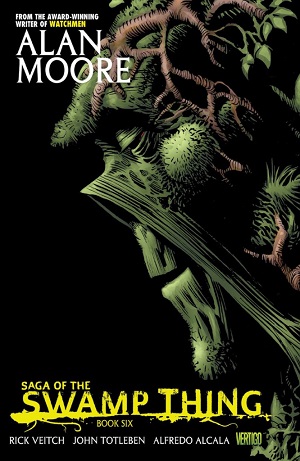
In my notes on Saga of the Swamp Thing Book Three I talked about how I preferred the back-to-basics Swamp Thing stories that played like X-Files “monster of the week” episodes to the epic storylines involving some grand cosmic battle between good and evil. I felt that way again here, as I really enjoyed the introductory stories about the druggies eating some sweet potato that has fallen off Swampy’s back and going on hallucinatory trips, and “Ghost Dance,” about the legacy of a gun manufacturer playing out in a haunted house (a story that was a personal favourite of Alan Moore’s). But once we get back into the preparation for a final battle between a newly awakened power of evil and the forces of light, I thought things weakened. Sticking with the comparison to the X-Files, you spend all this time building up the main storyline or “mytharc” about Fox’s missing sister and alien abductions and black oil, but when you finally go on board the mothership you know you’re going to be disappointed. I mean, where do you go from a build-up like what we get here: “This is ultimate dark, ultimate light. The forces and the stakes here are fundamental and absolute . . . and whichever side meets its final destruction this day, everything will be changed.”

That said, I thought the final battle was well choreographed. A host of characters are assembled. John Constantine is holding a completely useless séance with a group Neil Gaiman describes as “the detritus, the flotsam and jetsam of the DC occult universe.” Swampy is in hell (or thereabouts) and is joined by Deadman, Phantom Stranger, the rhyming demon Etrigan, and the Spectre. They’re trying to stop the aforementioned evil. Or maybe it isn’t evil. Maybe it’s just misunderstood. In any event, the glowing hand of God descends from heaven and the world just continues on its merry way. “Nothing has happened. Everything has happened.” Good and evil are necessarily linked, you see. Can’t have one without the other. According to Gaiman’s introduction, Moore thought this had something to do with the Manichaeism of American culture, and what happens is an answer to Swamp Thing’s questioning if there is “some truth . . . that may be divined . . . from the entrails of America.”

Well, colour me unimpressed with these flabby conclusions. Getting to them was a lot of fun though, even if Swampy himself remains a remarkably passive as well as ponderous figure throughout. I think maybe Moore came up with the character of John Constantine just to liven things up. I do like what Moore did with this series, but at the same time I don’t think he was ever as interested in Swamp Thing as he was in doing his own thing.

Graphicalex