Captain America: Winter Soldier

Captain America: Winter Soldier

I actually hadn’t read this comic, which came out in 2005-2006, before seeing the 2014 movie they made of the same name that was loosely based on it. I remember liking the movie but honestly can’t remember a thing about it now except for the return of Bucky Barnes as a Russian killing machine with a cyborg arm. Which was all it really took from the comic, as it turns out.

Apparently bringing Bucky back from the dead was a big deal, as writer Ed Brubaker tells us in an afterword to this collected edition that recounts how Winter Soldier came to be. “There are several constant truths in Marvel Comics, or unwritten rules, if you will. And one of them was, no matter what else you did, Uncle Ben, Gwen Stacy . . . and Bucky Barnes all stayed dead.” So, leaving aside the long, phantasmagoric afterlife of Gwen Stacy, coming up with a storyline where Bucky didn’t die in that midair explosion but fell into the sea and was flash frozen, to be picked up by the Russians and turned into a super Cold Warrior, was pretty radical.

And it works. I thought Brubaker crafted a detailed and complex story with plenty of moving pieces and WW2 flashbacks. It really sucked me in. Indeed, the only problem I had with it is that it wrapped up too quickly, with the aid of that laziest of all plot devices the Cosmic Cube. Otherwise I was on board with all of it, which I wasn’t expecting given that Bucky Barnes was one of those teenage superhero sidekicks I dislike so much. Robin. Rick Jones. Bucky Barnes. I can’t stand them.

But Bucky, who was Brubaker’s “favorite character” as a comic-loving kid, is all grown up here and he’s quite the bad-ass. The thing is though, he’s not really that important a character in this story arc. He’s mostly kept in the shadows until the end, and the main story line has to do with Cap trying to figure out what’s going on with the Russian general and the Cosmic Cube. I found all of this quite engaging though, both in terms of the plot and the characters. The art wasn’t quite my thing aside from the somber palette, but overall I think this is a comic that deserves its high reputation in the Captain American canon.

Graphicalex

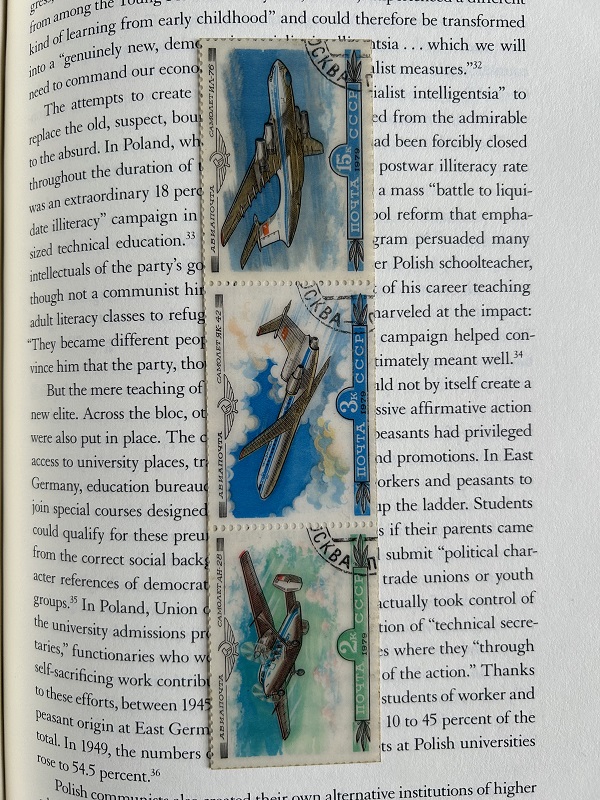
Bookmarked! #159: Upper Canada Village

Upper Canada was what Ontario was known as in the olde days. Upper because it was further up the St. Lawrence, as opposed to Quebec, which was Lower Canada. Upper Canada Village is a “living history” tourist destination located in Morrisburg, a town on the St. Lawrence. I think I may have gone there once as a kid, but I don’t remember. If I did, I’m sure I didn’t get this bookmark on that visit so somebody must have got it for me later.

Book: Nature and Selected Essays by Ralph Waldo Emerson

Bookmarked Bookmarks

Holmes: The Rape of the Sherlock

In his introduction to this squib in The Big Book of Sherlock Holmes Stories, editor Otto Penzler says that “To describe it as trivial overpraises it. It is included here as a curiosity – nothing more.”

Small praise indeed! But understandable, given how slight a story it is. Its main claim to fame is that it was written by Winnie the Pooh author A. A. Milne, who was also a mystery writer himself. It was first published in October 1903, making it contemporary with Doyle’s “The Adventure of the Empty House,” which was the story that brought Holmes back from the dead. So here we have Holmes appearing to Watson like a ghost and explaining that he’d been in hiding since apparently falling from the Reichenbach Falls. The title has no relation to anything, not even Pope’s poem. As for Moriarty, “There is no such man. It is merely the name of a soup.”

That’s not much of a punchline, and it’s not much of a story. I include it here only as a curiosity.

Holmes index

Criminal 1: Coward

Criminal 1: Coward

Coward is the first volume in the Criminal series of semi-standalone neo-noir crime stories by Ed Brubaker and Sean Phillips. I say semi-standalone because each can be read independently but they’re set in the same fictional “universe” (as we have to call these things nowadays) and they share recurring characters and themes.

The coward of the title is a thief named Leo Patterson, though his reputation as yellow is partly a disguise. It leads people to underestimate him, and the fact is he isn’t so much cowardly as careful, always thinking of the ways a job can go wrong and planning in advance. His caution keeps him out of jail and makes him a survivor.

There is a plot here involving some crooked cops enlisting Leo to help them with a heist, but the way it works out is pretty much just the regular sort of thing, with double-crosses and fallings out. What I thought set Coward apart was the character of Leo, who feels authentic and well-rounded. He grew up in the trade, and now cares for his elderly uncle Ivan, who is both a junky and suffering from Alzheimer’s. Though despite this Ivan is still mostly functional, or functional enough to be a problem.

We’re very much in Sin City-style territory here, and if I had a gripe about Coward it’s that the ending is so clichéd and predictable. But it’s still better than most contemporary crime comics, thanks to Brubaker’s writing and Sean Phillips’s thick lines, shadowed faces, and signature starburst gun flares. I’m sure the rest of the series will be more of the same, but I’m down for it anyway.

Graphicalex

Curb appeal

Hats off to the people living in this house, which I often walk by on my way to the bank. All of these flowers are planted outside their backyard fence, so they can be enjoyed by pedestrians. That just makes the world a nicer, brighter place. (You can click on the pic to make it bigger.)

Hulk: Gray

Hulk: Gray

This was a six-issue miniseries by the all-star team of writer Jeph Loeb and artist Tim Sale that was first published in 2003-2004. It’s an oversize comic, on the scale of Marvel’s Grand Design series, though I believe it came out before that series started.

I loved seeing Sale’s art blown-up to this size, though I could have lived without the wide side borders on every page. The full-page and double-page spreads are like movie posters and they’re used really effectively throughout. The Hulk is a big dude and he can fill a page any size. Sale has a great sense of space and he can move from epic vistas looking like Monument Valley to close-ups of the Hulk’s mouth full of rocky teeth. You can tell Sale had a lot of fun with those teeth.

As great as it is to look at, I’ll admit that after a while I was just turning pages without reading it very closely. I thought Loeb, whose The Long Halloween is probably my favourite Batman comic, really mailed this one in. It’s a tired story that basically retells the Hulk’s origins, covering the 24 hours after Dr. Bruce Banner was caught in the explosion of the Gamma Bomb. The Hulk steals away into the desert with Betty Ross, and first Iron Man (in his vintage yellow “tin can” suit) and then General “Thunderbolt” Ross (Betty’s father) chase after him. The whole thing takes the form of a flashback, with Bruce relating these events to the superhero shrink Dr. Leonard Samson. It’s a narrative device that didn’t serve any real purpose, as their back-and-forth didn’t add anything and the ending was the flabbiest part. I guess it’s a breakthrough for Bruce to realize that Betty Ross really loved him as both monster and man? I don’t know. It all seemed pointless to me.

So a great comic to look at, with nice lettering too by Richard Starkings, but the effect is almost like a coffee-table book that you just want to pick up and flip through. I ended up doing that a lot. But I wasn’t into reading it.

Graphicalex

Montalbano: The Snack Thief

I didn’t much care for The Snack Thief. There are actually a couple of different mysteries in it, hinging on the character of a Tunisian woman named Karima. The first mystery has to do with the murder of a merchant whose stabbed body is found in the elevator of an apartment building. It turns out that Karima was his mistress. The second mystery involves the killing of a terrorist, who happens to be Karima’s brother. Now the first mystery was the kind of thing I’d put more in the Maigret vein, involving different fraught family relations and a murder that was half an accident. The apartment building setting also put me in mind of Maigret. I thought this was interesting. The second mystery, however, was a complicated business involving Italy’s secret police and international intrigue. It all takes some time to explain in the end when Montalbano has a sit down with the nasty little guy who was behind the operation, and I didn’t like any part of it.

Now the two plotlines are connected, which is what confuses Montalbano, but whenever you have two stories like this and, as a reader, you find one is a lot more interesting than the other, you have a book with a problem. But I had other issue as well. As in The Terra-Cotta Dog Montalbano’s big crack in the case comes about entirely by circumstance, in a manner that reminded me of the boy seeing the photo of the police in the movie Witness. Then we have Montalbano’s character further developed through his relationship with Livia and (something new) his dying father, and though Camilleri does this to make him a very human and even relatable figure what this also means is that he comes across as a jerk a lot of the time. He’s nasty and mean (“ornery as hell” as one of his lieutenants buts it), vain, jealous of Augello, self-righteous, anti-social (a gourmand, he hates talking to anyone when he’s eating), and in the end not that interested in his job, which a perceptive old man tells him is his escape from reality. He likes to solve cases without any practical result, you see. Except, in this case, for himself.

Now you can say that a lot of famous fictional detectives are difficult types. Holmes. Poirot. Wolfe. But in all those cases the reader has a friend who is more likeable (Watson, Hastings, and Goodwin). In the Montalbano novels we’re stuck in closest proximity to Montalbano himself. This makes a difference and can be pretty uncomfortable.

So not the book I wanted it to be. I wanted the focus to be on the dead man in the elevator and got the terrorist plot instead. I wanted more about Montalbano’s relationship with his father and less about Livia adopting Karima’s son. I wanted to see Montalbano actually solving a mystery instead of getting lucky with clues being dropped in his lap. But having said all that, I still thought this was a decent story that did a lot to fill out Montalbano’s world and it kept me on the hook for what would come next.

Montalbano index