American election update: No change

In an earlier post I talked a bit about how the current American presidential election cycle may be marking the end of the conservative road.

A point I brought up was that in the U.S., as in Canada, there is “systemic resistance to change” in the political system that is leading to a desire among a significant number of voters to blow it all up. In Canada, for example, if you’re outraged or disgusted by the Senate or the first-past-the-post election system, both of which the Liberals promised to reform (or end), you should be aware by now that absolutely nothing is going to be done about either. Ever. As I said in that earlier post:

The resulting feelings of frustrated impotence just drive greater anger toward party establishments on all points of the political compass. Perhaps aware of the disappointing results from the “hope and change” presidency of Barack Obama, the Democratic Party this time around is offering none of either. The very best you can expect is more of the same.

Politicians understand this, and so we have Hillary Clinton — the most establishment, status quo politician one can imagine; someone who has explicitly stated her desire for only “incremental” change — being branded at her convention nomination as “the best darn change-maker I’ve ever met in my whole life” (in the judgment of husband Bill). Meanwhile, the (political) outsider Donald Trump’s economic platform consists of nothing but tried-and-true Republican planks (lower taxes, especially for the rich) that are now rotten with age.

I’m afraid this has been the lesson of the presidential election thus far. Bernie Sanders, who clearly never had any reasonable chance of winning the Democratic nomination (the party was working against him), got to play the part of everyone’s nutty granddad. Though popular among some voters, the media as well as his opponents successfully made him out to be “Crazy Bernie,” a flaky socialist and somewhat comic figure. Donald Trump, meanwhile, was a madman on the other side, a ranting demagogue who has become another object of fun and mockery: a stock comedy figure channeling the resentment of the rubes, the bubbas, the losers, and the flakes in the Tea Party.

The fairness of any of this aside, the larger structural message of all this is clear. In troubling times we need to accept the safety of things as they are. Don’t rock the boat. Any thought of real reform is dangerous. Change is bad. As Christian Lorentzen, watching the Democratic convention for the London Review of Books concludes, “the young and the left will have to trade in their revolution for the prospect of some mildly ameliorative technocratic reforms.” And even that they may not get.

It’s clear that the Republican party feels that Trump is a nightmare they’re just going to have to endure before they can get back to business as usual. The Democrats, meanwhile, should walk to victory with a candidate who represents . . . business as usual. I think that while this will be far from the worst of all possible outcomes, it will still be a disaster. So much of the present system is in need of radical reform, especially with regard to environmental and economic issues. But the meaning and message of this election thus far has been to reinforce the notion that any thought of change is impractical folly. As Margaret Wente writes in the Globe and Mail, “the greatest danger in [Trump’s] defeat would be if both Republicans and Democrats decide they were right all along, and don’t need to change. Because if they don’t, another Trump will come along. And the next one might not be crazy.” To this I would only say that if things don’t change then another Trump will have to come along. We can only hope he or she will be a force for good, but I suspect we’ll be past that point by then. We can effect change or have change happen to us. The latter course is going to be ugly.

Bava-rama

But which do you enjoy more, Christopher?

But which do you enjoy more, Christopher?

Over at Alex on Film I’ve been watching a bunch of movies directed by Mario Bava. Bava made a great deal of trash, but some classic trash as well, which is a status I don’t disparage.

Black Sunday (1961)
Hercules in the Haunted World (1961)
The Whip and the Body (1963)
Blood and Black Lace (1964)
Planet of the Vampires (1965)
Kill, Baby . . . Kill! (1966)
Hatchet for the Honeymoon (1970)
Five Dolls for an August Moon (1970)
A Bay of Blood (1971)

Dangerous Dining with Alex #9

Bellaberry Cherry Cheescake

Overview: Wow. And I don’t mean that in a good way.

Label: I did say “Wow!”, aloud, when I saw this in the freezer section of the grocery store. People even stared at me.

To be more exact, I said “Wow!” when I looked at the label. This is not a big treat — and I call it a treat and not a dessert. It comes in a little plastic tapered cup that is only 3 and a half inches at the top. It weighs a mere 100 g and yet it contains 51 % of your daily saturated fat (and 0.4 g of trans fat)! It’s basically a double Snickers bar! It also comes with 290 mg of sodium. That’s the real kicker. I mean, two Cadbury’s Caramilk bars (100 g) will give you 72 % of you daily saturated fat, so the fat isn’t out of line (for junk food). But I don’t know where that sodium is coming from. And keep in mind, these little snacks are tiny. You don’t eat just one, at least if you’re like me.

As an aside, it’s almost comical to also find on the label the fact that this dessert is certified as both kosher and halal. How can something so bad for you be permitted, even endorsed, by a just and loving God?

Review: I love cheesecake. It’s probably my favourite dessert. So when I saw these little guys on sale for a dollar each I had to try them out. But that label was sticker shock. There’s just no exaggerating how much concentrated awfulness they’ve put in here. I mentioned how it equates pretty much to a chocolate bar in terms of junk-to-total mass, which makes me wonder if there is some golden ratio for this. Is there a limit to how bad, nutritionally, food (or “food”) can get, short of being totally inedible (or poison)? I’m sure scientists must be looking into it.

But the big disappointment here is that it doesn’t taste great. The mouth feel is alright, but there’s a bitter after-taste that doesn’t wait long to register and that sticks around for hours. Apparently it’s made with real cream cheese but the texture seems off. It certainly doesn’t feel anything like a real, baked cheesecake (not that I was expecting much in that regard). There are various flavours, but they hardly register. Overall, this one just didn’t make me feel good.

Price: $1 on sale.

Score: 3 / 10

Dangerous Dining

Se7enty Times Se7en, and the First of the Se7enty-First

There has to be a clue here somewhere . . . but what is it?

There has to be a clue here somewhere . . .

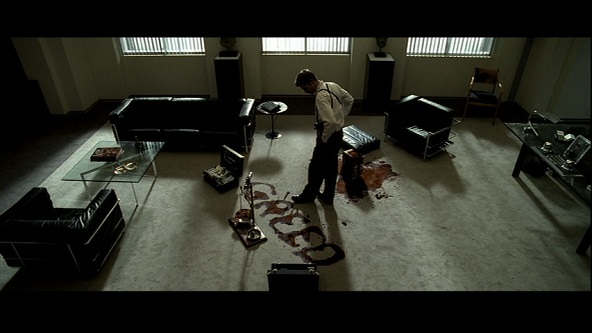
Over at Alex on Film I’ve added my notes on Se7en (1995). I’m not as big a fan of this movie as most people seem to be, and in my write-up I try to explain why. Chances are you’ll disagree.

I’m a little concerned at how extensive these film commentaries are getting. My original plan was to just write a few quick thoughts for each, but I find they’re often ending up running over 1,000 words (and my notes on Se7en are twice that). I have to start cutting back.

Psycho women from hell!

playmisty2

Over at Alex on Film I’ve been watching a bunch of movies about crazy ladies. Dangerous crazy ladies. Most of them fell into one of two categories: the brief-lived hagsploitation genre beginning with What Ever Happened to Baby Jane? and the sexual predator, probably most famously represented in Fatal Attraction. There are, however, outliers, and of course no two psychos are perfectly alike.

What Ever Happened to Baby Jane? (1962)
Hush . . . Hush, Sweet Charlotte (1964)
Pretty Poison (1968)
What’s the Matter With Helen? (1971)
Play Misty for Me (1971)
Whoever Slew Auntie Roo? (1972)
Fatal Attraction (1987)
Misery (1990)
Single White Female (1992)
Disclosure (1994)
To Die For (1995)
Gone Girl (2014)
The Babadook (2014)

Wikipedia: Our gate of horn or ivory?

The gates of horn and ivory always gave me trouble as a student. In part this was because of my own mental laziness. True dreams passed through one, false dreams the other, but which was which? And what, I wondered, was the difference between horn and ivory anyway? Of course ivory comes from elephant tusks, and tusks are teeth, while horns are bones with a layer of keratin, but if you saw a gate of horn set beside a gate of ivory would you be able to tell them apart? And what’s the connection between the material the gate is made of and whether the dreams that pass through them are true or false?

The myth goes back to Book 19 of Homer’s Odyssey, where (in the Robert Fagles translation) Penelope explains the difference:

Two gates there are for our evanescent dreams,
One is made of ivory, the other made of horn.
Those that pass through the ivory cleanly carved
Are will-o’-the wisps, their message bears no fruit.
The dreams that pass through the gates of polished horn
Are fraught with truth, for the dreamer who can see them.

In the notes to the Fagles translation provided by Bernard Knox we get this: “Why the ivory gate should be the exit for false dreams and the gate of horn for true has never been satisfactorily explained.”

Later epic poets would pick up on the twin gates, including Virgil in the Aeneid (where their use has been much debated, specifically why Aeneas has to leave the underworld by way of the ivory gate). What gave me trouble, however, as a student, was their appearance in Edmund Spender’s The Faerie Queene, where they are described in Canto One as guarding the House of Morpheus:

Whose double gates he findeth locked fast,
The one faire fram’d of burnisht Yuory,
The other all with siluer overcast

Silver? That’s not part of the original pairing. Where did it come from? Why does Spenser cast the gate of horn, the gate of true dreams, in silver? The notes to the Penguin edition offer no assistance. The notes to the Variorum Spenser are downright misleading:

The gates of horn may be imagined to send forth true dreams, from its transparency and simplicity; the gates of ivory, silver, etc. from its gaudy appearance, to send fallacious dreams.

But the gate of silver is the gate of horn. The estimable Longman edition of The Faerie Queene does the same thing, not mentioning Homer at all but saying that the use of silver “may be suggested by Virgil’s description of the ivory gate.”

I haven’t had much occasion to think about these matters since leaving school, but recently I came across a note in the introduction to the Arden edition of Much Ado About Nothing that sheds a different light on the subject. Claire McEachern points the reader to Rabelais’s Gargantua and Pantagruel, where the gate of ivory is described as misshapen and impenetrable “exactly the way you can’t see through ivory,” while the gate of horn is transparent: “so diaphanous, so shining . . . you can see them [the true dreams] perfectly.” This ties in to a point McEachern is making about the lucid nature of a cuckold’s horns, with horn being used at the time as material for windows and lanterns as well as hornbooks.

I found all of this very interesting, and wondered if it helped explain where the distinction originally came from. I was quite surprised, then, to find on Wikipedia that the difference was first explained in 1919 by Arthur T. Murray in his translation of the Odyssey for the Loeb Classical Library. In a note, he writes:

The play upon the words κέρας, “horn”, and κραίνω, “fulfil”, and upon ἐλέφας, “ivory”, and ἐλεφαίρομαι, “deceive”, cannot be preserved in English.

Recourse to etymology would seem to settle the matter. But if so, why have so many other distinguished editors made such a hash of it, and/or made no mention of this basic point? It’s easy to make fun of students relying on Wikipedia as the source of all knowledge in the age of the Internet, but the editors seem to have done a pretty good job on this one. Good enough to make me wish we’d had Wikipedia when I was a kid.

We who are about to die . . .

Let the games begin.

Let the games begin.

Over at Alex on Film I’ve been checking out a number of f not-quite classic films dealing with the spectacle of violent entertainment in a dystopian future. First up are a couple of titles from the mid-’70s: Death Race 2000 and Rollerball. Next there’s a trashy Italian flick from Lucio Fulci: Warriors of the Year 2072. Then we have the Arnold Schwarzenegger vehicle The Running Man, and finally Battle Royale and Battle Royale II: Requiem. The first Battle Royale is considered a cult classic in some circles, but there’s a pretty strong consensus that Requiem is one of the worst sequels ever made.

An interesting question: With the ratings provided by sites like IMDb and Rotten Tomatoes I wonder if it could be determined with some polling accuracy what the worst sequel ever made was. Would you judge based on the score of the sequel, or the gap in score between the first film and the second? Troll 2, for example, is often considered one of the worst films (or “best worst films”) ever made, and at IMDb it has a score of 2.7. However, Troll (I’m taking this as the first Troll film even though Troll 2 really isn’t a “sequel”) only has a score of 4.3, for a gap of 1.6. Battle Royale, meanwhile, has a score of 7.7 and Requiem a score of 4.7, for a gap of 3.0. So is Requiem a worse sequel?

In any event, it’s an interesting theme that’s often been dealt with in speculative fiction: taking sports competition to what seems the logical next level. If sports are a proxy for the struggle for survival, why not cut out all pretense and embrace blood sports as our new bread and circuses? Most of these films are clearly forms of satire, pushing recognizable games and events that extra bit over the top. What over-the-top means, in each case, is murder. Because really, that’s the only place there is left to go.

Unaccountable

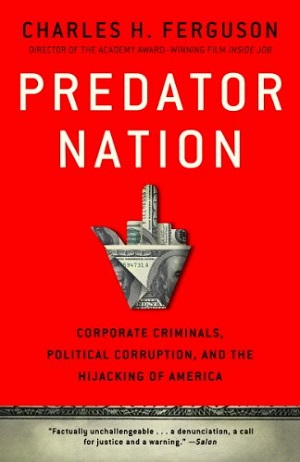
predatornationFrom Predator Nation (2012) by Charles H. Ferguson:

Many books have already been written about the financial crisis, but there are two reasons why I decided that it was still important to write this one.

The first reason is that the bad guys got away with it, and there has been stunningly little public debate about this fact. When I received the Oscar for best documentary in 2011, I said: “Three years aftera horrific financial crisis caused by massive fraud, not a single financial executive has gone to jail. And that’s wrong.” When asked afterward about the absence of prosecution, senior Obama administration officials gave evasive nonanswers, suggesting that nothing illegal occurred, or that investigations were continuing. None of the major Republican presidential candidates have raised the issue at all.

As of early 2012 there has still not been a single criminal prosecution of a senior financial executive related to the financial crisis. Nor has there been any serious attempt by the federal government to use civil suits, asset seizures, or restraining orders to extract fines or restitution from the people responsible for plunging the world economy into recession. This is not because we have no evidence of criminal behavior. Since the release of my film, a large amount of new material has emerged, especially from private lawsuits, that reveals, through e-mail trails and other evidence, that many bankers, including senior management, knew exactly what was going on, and that it was highly fraudulent.

americaswarFrom America’s War for the Greater Middle East (2016) by Andrew J. Bacevich:

In the performance of their most fundamental mission — defending the homeland — the Bush administration and the world’s largest and ostensibly most sophisticated national security apparatus failed utterly. Yet curiously, in the wake of that failure, not one U.S. official of any rank lost his or her job. No one was reprimanded or demoted. Rallying around the flag and getting on with the business at hand too precedence over fixing accountability.

Was it fair after December 1941 to single out Admiral Husband Kimmel and Lieutenant General Walter Short as personally responsible for the disaster at Pearl Harbor? Probably not. Yet firing these two senior officers and reducing them in rank served at least to acknowledge that an unacceptable failure of leadership had occurred. From the outset of America’s War for the Greater Middle East, the cabinet secretaries and four-star military officers charged with formulating and implementing national security policy had remained largely exempt from accountability — the arbitrary firing of defense secretary Aspin after Mogadishu being the exception that proved the rule. Remarkably, that practice survived the events of 9/11. So those who failed to anticipate or prevent the worst ever direct attack on American soil stayed on the job, if anything accruing even greater authority as the officials to whom the public now turned to “keep America safe.”

See here for Unaccountable, Part two, and here for Unaccountable, Part three.