Over at Alex on Film I just posted my notes on The Beach. This is a mess of a film based on Alex Garland’s novel of the same name, which was actually pretty good. I think they needed to take it either a lot more or a lot less seriously.
Author: Alex Good
Poltergeists
Over at Alex on Film I’ve posted my notes on Poltergeist (1982) and its 2015 remake.
In general, these twenty-first century remakes of horror classics from the ’70s and ’80s have been terrible. The 2015 version of Poltergeist is pretty bad too, but . . . it’s better than the original. I’m honestly shocked at how many people still think the Tobe Hooper/Steven Speilberg version was any good. I didn’t like it much when it first came out, and re-watching it (for what I think was the first time in thirty-plus years) I thought it was even worse. It’s downright laughably bad.
Is it just that people remember it as being good and are holding on to some vision of it that imprinted on them when they were children? That happens a lot, not just with movies we’ve seen but books that we’ve read decades ago and never returned to. In the case of Poltergeist, I’d advise anyone with fond memories of the original not to go back.
Conflict of interest, again
A while back, commenting on a story involving a CBC reporter, I had occasion to say something about conflict of interest. Here is how my post began
Why is the concept of conflict of interest so hard to understand? True, like any misdemeanour that has certain penalties attached to it, there is some room for debate when assessing culpability. But the thing is, we know it when we see it. And it’s precisely because we know it when we see it that we can say when it exists.
I say “exists” because conflict of interest is not a specific action or event. It doesn’t “occur.” One doesn’t have to actually do anything at all. Conflict of interest is a state of being. You are in a position where there is a conflict of interest or you are not.
I couldn’t help but think of this while watching the cotton-candy accrual of controversy surrounding presidential candidate Hillary Clinton’s tenure as secretary of state and the State Department’s relation to the family’s Clinton Foundation. The same issue is again front and center. While acknowledging an unseemly “appearance of impropriety,” Clinton’s defenders point to the fact that there has been no finding of criminality (and that through no lack of investigation). Indeed, Clinton herself has said — in her defence! — that “I know there’s a lot of smoke and there’s no fire.”
Again I am wondering why the nature of the problem is so hard to understand, or if Clinton is being deliberately obtuse. The smoke is the smoking gun. Charles Krauthammer’s column (and this is a commentator I rarely find myself in agreement with), puts it this way
The Associated Press found that more than half the private interests who were granted phone or personal contact with secretary Clinton — 85 of 154 — were donors to the foundation. Total contributions? As much as $156 million.
Current Clinton response? There was no quid pro quo.
What a long way we’ve come. This is the very last line of defence. Yes, it’s obvious that access and influence were sold. But no one has demonstrated definitively that the donors received something tangible of value — a pipeline, a permit, a waiver, a favourable regulatory ruling — in exchange.
It’s hard to believe the Clinton folks would be stupid enough to commit something so blatant to writing. Nonetheless, there might be an email allusion to some such conversation. With thousands more emails to come, who knows what lies beneath.
On the face of it, it’s rather odd that a visible quid pro quo is the bright line for malfeasance. Anything short of that — the country is awash with political money that buys access — is deemed acceptable. As Donald Trump says of his own donation-giving days, “when I need something from them . . . I call them, they are there for me.” This is considered routine and unremarkable.
It’s not until a Rolex shows up on your wrist that you get indicted. Or you are found to have dangled a Senate appointment for cash. Then, like former Illinois governor Rod Blagojevich, you go to jail. (He got 14 years.)
Yet we are hardly bothered by the routine practice of presidents rewarding big donors with cushy ambassadorships, appointments to portentous boards or invitations to state dinners.
The bright line seems to be outright bribery. Anything short of that is considered — not just for the Clintons, for everyone — acceptable corruption.
It’s a sorry standard. And right now it is Hillary Clinton’s saving grace.
As I said in my earlier post, conflict of interest isn’t an act, it’s a position one finds oneself in. And it is all a matter of perception: perceived conflict of interest (by an objective observer) is conflict of interest. To argue over “exact allegations” of improper behaviour is changing the subject. That may sound harsh, but the reason for having such a hard rule is simple: because in most cases proving any wrongdoing is impossible. The accused can simply respond with a blank denial and that’s the end of it. Short of concrete evidence of “outright bribery” anything goes. And outright bribery isn’t the way corruption works, except at the very lowest level.
Look, everyone in a position of power sells access. When you buy access you get something in return, as the worst-presidential-candidate-in-history Donald Trump testifies. I don’t think anyone is under any illusions about how the system works, which means this is just another one of those things that everybody takes for granted but that can never be admitted publicly. The only danger is in assuming that people are too stupid not to know what’s going on.
Update, June 6 2023:
I couldn’t help but return to this earlier post after watching the testimony of former Governor General and long-time Trudeau family friend David Johnston before a committee looking into the appropriateness of his being appointed (by Justin Trudeau) “special rapporteur” investigating foreign interference in Canadian politics.
From John Ivison’s reporting:
Johnston views himself, his counsel Sheila Block and former Supreme Court justice Frank Iacobucci as thoughtful, impartial people of the highest integrity.
Yet, Johnston’s ties to Trudeau personally and his family’s foundation are unabashed and have persuaded a majority of Canadians that he should step aside (a Léger poll last week suggested only 27 per cent believe he is credible and impartial).
When he was asked at committee about how he would define the appearance of conflict of interest, he said that would occur “when a reasonable person, in possession of all the true facts, concludes that a person would not be able to provide unbiased judgment on a particular matter.”
In his mind, there is no question of his impartiality.
“To suggest I’m part of a Liberal clique is just wrong,” he said.
But the facts suggest a far cozier relationship than is becoming.
I actually like Johnston’s definition of conflict of interest (keeping in mind, as I’ve said before, that “appearance of conflict of interest” is conflict of interest), but have to shake my head (again) at the inability of insiders and members of an establishment to recognize how their privilege and power is seen by others (a large majority of others, in Johnston’s case). Or is it just an unwillingness to acknowledge that privilege? Would doing so somehow diminish their reputation, even if only in their own eyes, for being “impartial people of the highest integrity”?
I tend to roll my eyes at the constant carping about out-of-touch “elites” that we mainly hear coming from the political right, but there’s something in the operation of the Clinton and Trudeau Foundations that just adds fuel to the fire.
Burgess on page and screen
Over at Alex on Film I’ve posted my notes on the 2014 film Hellmouth, which was written by the lyric-surrealist horror maestro Tony Burgess. I thought Hellmouth looked great, but it wasn’t a strong story (and had nothing to do with The Hellmouths of Bewdley, Burgess’s first story collection).
Over the years I’ve reviewed a bunch of Burgess’s stuff, most of which I like a lot. I think he’s one of a handful of writers whose reputation will last, mainly on the basis of books like Pontypool Changes Everything (loosely adapted into the film Pontypool), People Live Still at Cashtown Corners, and Ravenna Gets. Also under review is the bizarre YA meta-novel Idaho Winter, a Burgessian vision of the apocalypse in The n-Body Problem, and the Civil War zombie flick Exit Humanity (included because Burgess has a cameo).
American election update: No change
In an earlier post I talked a bit about how the current American presidential election cycle may be marking the end of the conservative road.
A point I brought up was that in the U.S., as in Canada, there is “systemic resistance to change” in the political system that is leading to a desire among a significant number of voters to blow it all up. In Canada, for example, if you’re outraged or disgusted by the Senate or the first-past-the-post election system, both of which the Liberals promised to reform (or end), you should be aware by now that absolutely nothing is going to be done about either. Ever. As I said in that earlier post:
The resulting feelings of frustrated impotence just drive greater anger toward party establishments on all points of the political compass. Perhaps aware of the disappointing results from the “hope and change” presidency of Barack Obama, the Democratic Party this time around is offering none of either. The very best you can expect is more of the same.
Politicians understand this, and so we have Hillary Clinton — the most establishment, status quo politician one can imagine; someone who has explicitly stated her desire for only “incremental” change — being branded at her convention nomination as “the best darn change-maker I’ve ever met in my whole life” (in the judgment of husband Bill). Meanwhile, the (political) outsider Donald Trump’s economic platform consists of nothing but tried-and-true Republican planks (lower taxes, especially for the rich) that are now rotten with age.
I’m afraid this has been the lesson of the presidential election thus far. Bernie Sanders, who clearly never had any reasonable chance of winning the Democratic nomination (the party was working against him), got to play the part of everyone’s nutty granddad. Though popular among some voters, the media as well as his opponents successfully made him out to be “Crazy Bernie,” a flaky socialist and somewhat comic figure. Donald Trump, meanwhile, was a madman on the other side, a ranting demagogue who has become another object of fun and mockery: a stock comedy figure channeling the resentment of the rubes, the bubbas, the losers, and the flakes in the Tea Party.
The fairness of any of this aside, the larger structural message of all this is clear. In troubling times we need to accept the safety of things as they are. Don’t rock the boat. Any thought of real reform is dangerous. Change is bad. As Christian Lorentzen, watching the Democratic convention for the London Review of Books concludes, “the young and the left will have to trade in their revolution for the prospect of some mildly ameliorative technocratic reforms.” And even that they may not get.
It’s clear that the Republican party feels that Trump is a nightmare they’re just going to have to endure before they can get back to business as usual. The Democrats, meanwhile, should walk to victory with a candidate who represents . . . business as usual. I think that while this will be far from the worst of all possible outcomes, it will still be a disaster. So much of the present system is in need of radical reform, especially with regard to environmental and economic issues. But the meaning and message of this election thus far has been to reinforce the notion that any thought of change is impractical folly. As Margaret Wente writes in the Globe and Mail, “the greatest danger in [Trump’s] defeat would be if both Republicans and Democrats decide they were right all along, and don’t need to change. Because if they don’t, another Trump will come along. And the next one might not be crazy.” To this I would only say that if things don’t change then another Trump will have to come along. We can only hope he or she will be a force for good, but I suspect we’ll be past that point by then. We can effect change or have change happen to us. The latter course is going to be ugly.
Bava-rama

But which do you enjoy more, Christopher?
Over at Alex on Film I’ve been watching a bunch of movies directed by Mario Bava. Bava made a great deal of trash, but some classic trash as well, which is a status I don’t disparage.
Black Sunday (1961)
Hercules in the Haunted World (1961)
The Whip and the Body (1963)
Blood and Black Lace (1964)
Planet of the Vampires (1965)
Kill, Baby . . . Kill! (1966)
Hatchet for the Honeymoon (1970)
Five Dolls for an August Moon (1970)
A Bay of Blood (1971)
Dangerous Dining with Alex #9
Bellaberry Cherry Cheescake
Overview: Wow. And I don’t mean that in a good way.
Label: I did say “Wow!”, aloud, when I saw this in the freezer section of the grocery store. People even stared at me.
To be more exact, I said “Wow!” when I looked at the label. This is not a big treat — and I call it a treat and not a dessert. It comes in a little plastic tapered cup that is only 3 and a half inches at the top. It weighs a mere 100 g and yet it contains 51 % of your daily saturated fat (and 0.4 g of trans fat)! It’s basically a double Snickers bar! It also comes with 290 mg of sodium. That’s the real kicker. I mean, two Cadbury’s Caramilk bars (100 g) will give you 72 % of you daily saturated fat, so the fat isn’t out of line (for junk food). But I don’t know where that sodium is coming from. And keep in mind, these little snacks are tiny. You don’t eat just one, at least if you’re like me.
As an aside, it’s almost comical to also find on the label the fact that this dessert is certified as both kosher and halal. How can something so bad for you be permitted, even endorsed, by a just and loving God?
Review: I love cheesecake. It’s probably my favourite dessert. So when I saw these little guys on sale for a dollar each I had to try them out. But that label was sticker shock. There’s just no exaggerating how much concentrated awfulness they’ve put in here. I mentioned how it equates pretty much to a chocolate bar in terms of junk-to-total mass, which makes me wonder if there is some golden ratio for this. Is there a limit to how bad, nutritionally, food (or “food”) can get, short of being totally inedible (or poison)? I’m sure scientists must be looking into it.
But the big disappointment here is that it doesn’t taste great. The mouth feel is alright, but there’s a bitter after-taste that doesn’t wait long to register and that sticks around for hours. Apparently it’s made with real cream cheese but the texture seems off. It certainly doesn’t feel anything like a real, baked cheesecake (not that I was expecting much in that regard). There are various flavours, but they hardly register. Overall, this one just didn’t make me feel good.
Price: $1 on sale.
Score: 3 / 10
Se7enty Times Se7en, and the First of the Se7enty-First
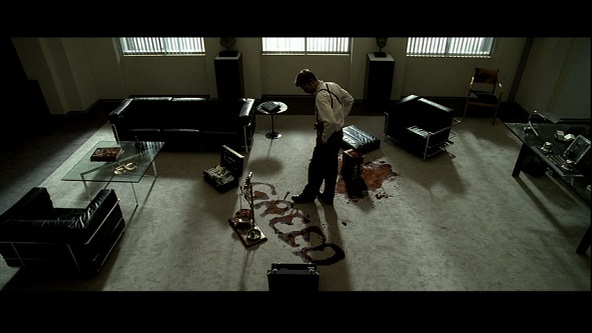
There has to be a clue here somewhere . . .
Over at Alex on Film I’ve added my notes on Se7en (1995). I’m not as big a fan of this movie as most people seem to be, and in my write-up I try to explain why. Chances are you’ll disagree.
I’m a little concerned at how extensive these film commentaries are getting. My original plan was to just write a few quick thoughts for each, but I find they’re often ending up running over 1,000 words (and my notes on Se7en are twice that). I have to start cutting back.
Psycho women from hell!

Over at Alex on Film I’ve been watching a bunch of movies about crazy ladies. Dangerous crazy ladies. Most of them fell into one of two categories: the brief-lived hagsploitation genre beginning with What Ever Happened to Baby Jane? and the sexual predator, probably most famously represented in Fatal Attraction. There are, however, outliers, and of course no two psychos are perfectly alike.
What Ever Happened to Baby Jane? (1962)
Hush . . . Hush, Sweet Charlotte (1964)
Pretty Poison (1968)
What’s the Matter With Helen? (1971)
Play Misty for Me (1971)
Whoever Slew Auntie Roo? (1972)
Fatal Attraction (1987)
Misery (1990)
Single White Female (1992)
Disclosure (1994)
To Die For (1995)
Gone Girl (2014)
The Babadook (2014)
Alex on anthologies
If you’re interested in such things, my review of Anthologizing Canadian Literature: Theoretical and Cultural Perspectives (ed. Robert Lecker) is up at the Canadian Notes & Queries website.

