The return, revenge, and curse of Michael Myers

Him again.

Over at Alex on Film I’ve finished up working though the Halloween franchise (I had an earlier post after watching the original series and then the Rob Zombie flicks here). The only ones I skipped were Halloween: The Curse of Michael Myers (1994) and Halloween: Resurrection (2002). Maybe I’ll get around to writing notes on them someday.

It’s a weird series. There’s no through narrative, even of the most strained, supernatural kind like in the Friday the 13th franchise. In fact, there’s not much to the whole Halloween mythos aside from the (literally) tortured relationship between Michael and Laurie. And the movies, with the exception of the first, are not every good. Aside from exploiting the brand it’s hard to see how or why they’ve hung around for nearly half a century.

Halloween (1978)
Halloween II (1981)
Halloween III: Season of the Witch (1982)
Halloween 4: The Return of Michael Myers (1988)
Halloween 5: The Revenge of Michael Myers (1989)
Halloween H20: Twenty Years Later (1998)
Halloween (2007)
Halloween II (2009)
Halloween (2018)
Halloween Kills (2021)
Halloween Ends (2022)

Price signals worth

I first noticed something disturbing about fifteen years ago. I was lending books out and not getting them back. What made this disturbing was not discovering that I had friends who would take advantage of my generosity, but that they were surprised I wanted them returned. “You mean you want it back?” one of them gasped in disbelief.

I’ve since stopped lending out books (and DVDs too). I’m afraid that one day I’ll be informed that the borrower no longer has it in their possession, having thrown it out. This loss of status is something I talked about in Revolutions, and a lot of other commentators have addressed it as well. Here is what I said then:

What will be the consequences, not just for us but for our cultural inheritance? What will happen when people come to see Pride and Prejudice no longer as a novel, or even a book, but only as a worthless file to be diced, sliced, mashed-up, manipulated, and (mostly) ignored? . . .

There is something more to this transformation than the shedding of a Benjaminian “aura.” Not just the integrity of the text, but our sense that text can have any value or meaning at all is being lost.

I was thinking of all this again recently while reading William Deresiewicz’s The Death of the Artist. There’s nothing new in what he’s saying, but it’s a message that is still worth heeding. At least it helps explain why I wasn’t getting those books back.

Perhaps the most insidious aspect of free content, as well as the most demoralizing, is the extent to which it devalues art in the eyes of the audience. Price is a signal of worth. We tend to value more what we have paid more for or worked harder to get; what we have gotten for free with a click we tend to value not at all. With Facebook, Instagram, YouTube, and the like, music, text, and images are now akin to tap water, accessed with a turn of the spigot and supplied in an endless, homogenous stream. . . . We used to take pride in the books, albums, and movies that we kept on our shelves, personal touchstones as well as permanent companions. Now that we don’t even store anything on our hard drives, art is here one minute, gone the next.

Nor is this devaluation purely psychological. The creation of art cannot be automated, nor can technology make the process more efficient. Quality, therefore, will sink to meet price. Artists who are paid less, all else being equal, will be forced to spend less time on making any given thing. Kim Deal, the indie rocker, remembers how, at a certain point, music came to be “considered not only just free but trash, a bother to have to wade” through. We still put a tremendous amount of value on the arts in general, but less and less on any given work.

The forest through the trees

I had an earlier post where I mentioned Len Deighton’s use of the word “azoic” (lifeless) in The Ipcress File. I’ve been revisiting Deighton’s spy novels for a viewing of ’60s spy movies I’m preparing for Alex on Film, and recently turned up a passage in Funeral in Berlin where the hero is driving past a timber plantation where saplings are planted in rows and he looks out to where “the graticule of trees glowed with fiery foliage.”

A graticule is the grid of lines, typically of longitude and latitude, on which a map is drawn. I didn’t know that. Thanks again, Len!

Words, words, words

More thoughts (in isolation)

As pandemic life continues I thought I’d offer up some more random thoughts on how things are going.

Much as I disliked it the first time, shouldn’t Ontario be in lockdown again? Our numbers are as bad as they were when this took off, and experts say they’re only likely to climb as the cold weather hits. So why are gyms still open?

Is there some rationale behind rendering it COVID-19 instead of Covid-19? I see both used, but I’m not sure what the principle is. The “CO” stands for corona, “VI” for virus and “D” for disease, so it should be CoViD-19 or CoviD-19 (“Coronavirus Disease”). This is the way the virus that causes the disease is written (SARS-CoV-2).

Face masks have become our new plastic bags. You see them everywhere now. Even hanging from trees. I don’t imagine they’re very environmentally friendly either.

When we first entered lockdown it seemed like Amazon was one of the big winners. I’m sure they still are, but I think I’ve only ordered from them once since this started. Their prices for everything are higher and their delivery times (unless you’re on Prime) are slow and unreliable. I don’t even bother with them anymore. But then Costco is no fun either since they stopped giving out samples. The golden age of retail may be over.

So many small local businesses are going under. And where are these people going to go? Time for a Universal Basic Income, whether we like it or not.

Is every “milestone” a “grim” milestone? It seems no other adjective works, at least when it comes to the death count in a pandemic.

Why do so many people drive around with their masks on? People alone, in their cars. I’m all for wearing masks, but only when I go into some public place. Driving with a mask on seems overkill.

Schoolkids are getting screwed. I’ve been talking to a lot of teachers over the last several months. Public school and high school students aren’t even getting a second-rate education. I guess if the kids are really motivated they can still be doing the work and learning something, but I strongly suspect that many of them are basically taking the year off while still picking up their credits. In university I’ve heard that small classes work, since you can run them as Zoom seminars. But again I suspect a lot of students in larger, introductory classes are just floating along and not learning much. In programs involving lab work the amount of lab time is getting cut back. Again, it’s a second-rate sort of education.

And I think it’s even worse than that. With more emphasis being put on online learning we’re pushing young people into taking on even more screen time as a substitute for direct human interaction. Kids in Grade 2 are having to learn to navigate their school’s class portals. Which is a useful skill, I suppose, but I feel like we’re embarking on a giant social psychology experiment whose results we already know are going to be disastrous. Things have come to a sad pass when you start feeling sorry for young people, but I really do.

Departures, no arrivals

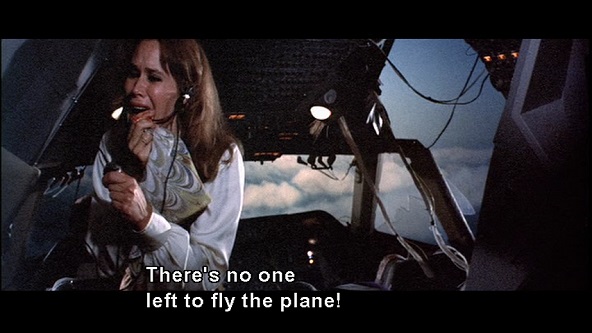
Hang in there, Karen. You still have House of 1000 Corpses to get through.

Over at Alex on Film I’ve been watching the Airport tetralogy: Airport (1970), Airport 1975 (1974), Airport ’77 (1977), and The Concorde . . . Airport ’79 (1979). I was surprised at how much I enjoyed them. Yes they’re trash, but it’s trash that has aged well, and each film has its own silly identity. I actually went to see The Concorde on its initial release, so many years ago now. Of course, after this it was on to Airplane! and other send-ups, since there was no place left to go. And Airplane! is still very funny today too. But don’t sleep on the originals.

Rage on

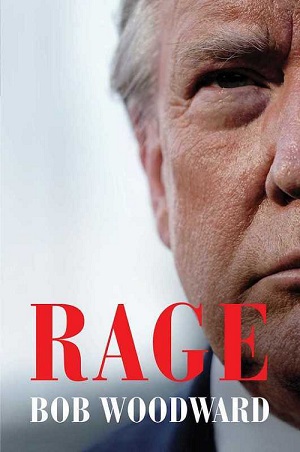
rageI recently reviewed Bob Woodward’s Rage, his second book on the Trump presidency (the first was Fear). It’s not a flattering portrait, though I thought he did his best to cast his subject in the best possible light, including excerpts from over a dozen lengthy interviews. What it made me think about though was what an official biography of Trump, when we get it, will look like. You’d have to think it will be flattering, but since no amount of flattery can satisfy a narcissist Trump will still object to it. Putting lipstick on the pig of this presidency, however, will be no easy task. Who will say anything good about Trump’s handling of the job? Not people like Rex Tillerson or John Kelly or James Mattis, who all held high positions in his administration but were cashiered or resigned in (quiet) protest, only to be insulted by their boss on the way out. I anticipate a truly Herculean feat of apologetics.

If certain tendencies proceed unchecked

From The Modern Century (1967) by Northrop Frye:

If certain tendencies within our civilization were to proceed unchecked, they would rapidly take us towards a society which, like that of a prison, would be both completely introverted and completely without privacy. The last stand of privacy has always been, traditionally, the inner mind. It is quite possible however for communications media, especially the newer electronic ones, to break down the associative structures of the inner mind and replace them by the prefabricated structures of the media. A society entirely controlled by their slogans and exhortations would be introverted because nobody would be saying  anything: there would only be echo, and Echo was the mistress of Narcissus. It would also be without privacy, because it would frustrate the effort of the healthy mind to develop a view of the world which is private but not introverted, accommodating itself to opposing views. The triumph of communication is the death of communication: where communication forms a total environment, there is nothing to be communicated.