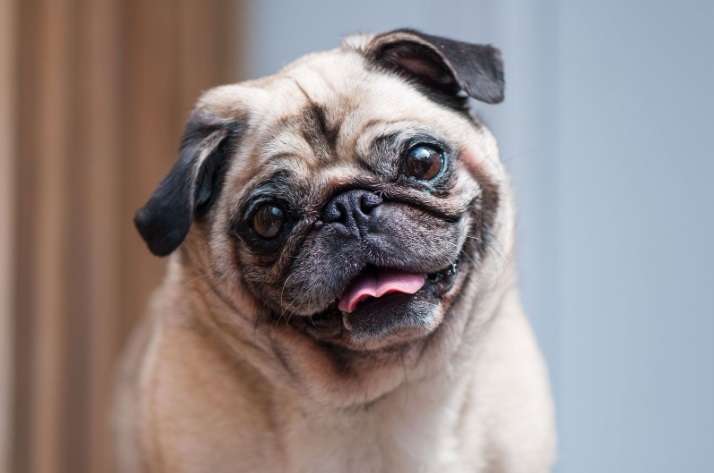
Not that sort of pug nose.
In the Kingsley Amis story “The Mystery of Darkwater Hall” (it’s a Sherlock Holmes pastiche), the villain, a local ruffian named Black Ralph, is described as having a “simous and ape-like appearance.” I pulled a blank on “simous.” Most dictionaries now label it as obsolete. It comes from the Latin simus (which in turn came from the same word in Greek) and means “snub-nosed.” I found a more general definition for it as concave or curving in, but in practice doesn’t seem to have any application other than referring to a flat or snub nose, perhaps with a curling tip. I saw one definition calling it a pug nose, but I’m not sure if that means the same thing. Though since nobody uses simous anymore perhaps it does. As for “pug,” it’s not clear where that word came from but it seems to have been first used as the name of the dog breed. People with a flat nose are said to have a pug nose in reference to the dog breed, not the other way around.
 Alex Good
I dislike pugs, a lot.
LikeLike
I’m not fond of them much myself. I’m a big dog lover, but I mostly love big dogs.
LikeLiked by 1 person
For me, part of it was that an older cousin of mine just loved them and had several during our growing up years. The ones he owned all had attitude and one of them was just downright mean. It couldn’t actually bite you, but it wasn’t afraid to try. And when you’re 10, that’s not funny.
LikeLike
I don’t like the pushed-in faces, which isn’t even healthy. And yeah, small dogs have a lot of attitude. Giant breeds just want a nice place to sleep.
LikeLiked by 1 person
Pugs not my thing. I wonder if simous and simian/simious for apes and the like are related. I will have to googlify at some point.
LikeLiked by 1 person
I was wondering the same. But then Amis saying “simous and apelike” would be redundant, and I wouldn’t have thought he’d have done that.
LikeLiked by 1 person
No, same root word though.
LikeLike