Biblical babes

I just watched the National Geographic special on The Gospel of Judas. Interesting subject, though it was handled in a pretty remedial way. As with most documentaries the parts I liked best were the interviews with experts (a.k.a., talking heads). I don’t like dramatic re-enactments of historical events. I often wonder if there’s any point to these at all. I guess they liven things up a bit, but they always seem a little silly to me and not very instructive.

If you’ve seen many Bible-themed movies you get used to it being a story — the greatest ever told! — that’s prettied up. Even the gore of Mel Gibson’s The Passion of the Christ has a glamorous quality to it, and Jim Caviezel is the usual “close but kind of meatless” actor playing Jesus. That’s the handsome-hippy way he’s also presented in the re-enactments here, with Judas equally good looking but with a dirty beard.

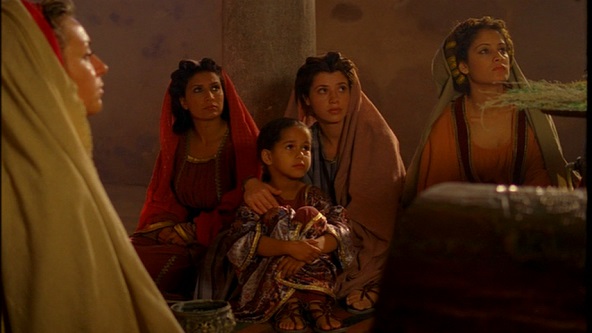
I tend to just roll my eyes at movie Jesuses now. They all look the same and I doubt they’re even that accurate. Even the idea that Jesus had a beard is debatable, as it was actually quite a late addition to his iconography (in the earliest depictions he was a beardless youth). But where I really had to laugh watching The Gospel of Judas was when I saw the women. Here are some early Christians listening to a reading of the gospels.

Come on. These ladies are beautiful. I don’t think many working-class women in first-century Palestine looked like this. And here is the martyr Blandina about to die for the faith in the arena at Lugdunum (modern Lyon).

A model martyr, if you will.

Again Mel Gibson’s movie can be taken as setting a high bar for this sort of thing, with Monica Bellucci playing Mary Magdalene. I guess it makes sense that a pretty Jesus should be surrounded by Biblical babes but this can be taken too far, even by Hollywood.

Maigret: Maigret’s Failure

I haven’t said anything yet about the covers of these Penguin translations of the Maigret series. The photos are credited to Harry Gruyaert. I think they work really well, though I don’t like the lettering they used for Simenon’s name. In any event, most of the time they aptly capture the post-War Parisian scene, though not as much in the earlier books, which are set in the 1930s. I also wonder why they had a horse on the cover of Inspector Cadaver.

The cover for Maigret’s Failure presents us with the imposing façade of what looks to be a very swank address. I think it nicely captures the messaging of Ferdinand Fumal’s fancy digs on Boulevard de Courcelles: the stolid architecture, complete with closed shutters, reflects an abiding concern in the series with what lies behind respectable bourgeois appearances. Thirty years earlier a young Maigret and his wife had enjoyed walking past this same address, dreaming of moving on up.

“When I’m detective chief inspector . . . ,” he had joked.

And both of them had looked through the railings, with their gilded spikes glinting in the sun, at the opulent townhouses around the park, imagining the elegant, harmonious lives people must be living behind their windows.

If there was anyone in Paris who had gained first-hand experience of life’s brutal realities, who had learned, day after day, how to discover the truth of appearances, it was him, and yet he had never entirely grown out of certain fantasies from his childhood and adolescence.

Hadn’t he once said that he would have liked to be a “mender of destinies,” such was his desire to restore people to their rightful places, the places they would have occupied if the world were a naïve picture postcard version of itself?

Conflict rather than harmony probably reigned in eight out of ten of the still magnificent houses that surrounded the park. But he had rarely had the opportunity to breathe such a strained atmosphere as the one between these walls.

Or, as the cook later puts it when she’s being interviewed: “If you’d seen what I’ve seen in well-to-do houses!”

The actual mystery here will be a familiar one to genre fans, though I can’t remember Simenon using it before. It’s the murder victim who was such a loathsome individual that everyone wanted to kill him. Indeed this is something he was aware of, asking for Maigret’s protection. His murder thus constitutes Maigret’s initial failure, the first of several.

There are a plethora of suspects, all with motive, means, and opportunity. So does it even matter who’s guilty? Not much. The solution comes to Maigret in a dream and the killer’s apprehension, years later, is only worth a shrug.

One of Maigret’s oddities is that he can’t drive (in Maigret in Court we’ll be told that he never wanted to learn how to). He gets police cars to carry him about Paris most of the time, though in a pinch Madame Maigret can get behind the wheel. The fact that his wife drives and he can’t struck me as signaling that his inability to drive was something exceptional. And yet here the super-rich Monsieur Fumal can’t drive either. Nor can his manservant. All three of these fellows hail from the country, so maybe that was typical of Frenchmen of peasant stock at the time. But it’s also probably wrong to think of an ability to drive as being universal. I remember hearing that when filming Get Carter (1971) they had to work around the fact that Michael Caine, in his mid-30s then, didn’t know how to drive. Bringing the story up to date, apparently many young people today are choosing to go car-less, mainly for economic reasons, which, along with the advent of self-driving cars, means that the ability to drive may be about to go into steep decline. Now we just need better public transit and more walkable cities.

Maigret index

Boyhood crush revealed!

The wreck of the Endurance has been discovered 3000 meters beneath the Weddell Sea.

The story of the doomed Endurance expedition, headed by Sir Ernest Shackleton, is considered (at least by Wikipedia) “to be the last major expedition of the Heroic Age of Antarctic Exploration.” As it turned out, Shackleton never even set foot on the continent. The Endurance got stuck in and then crushed by ice, leading to heroic efforts made by the crew to survive.

Arctic and Antarctic exploration has always fascinated me. I remember reading every book there was about these expeditions when I was a kid. It was big news for me when the wrecks of the Erebus and Terror were found in 2014 and 2016 respectively. Because of where they sank, these wrecks are in remarkably good condition today. The pictures are amazing and only add to the romance.

So much for responding to climate change

From Boon (1915) by H. G. Wells:

If a thing is sufficiently strange and great no one will perceive it. Men will go on in their own ways though one rose from the dead to tell them that the Kingdom of Heaven was at hand, though the Kingdom itself and all its glory became visible, blinding their eyes. They and their ways are one. Men will go on in their ways as rabbits will go on feeding in their hutches within a hundred yards of a battery of artillery. For rabbits are rabbits, and made to eat and breed, and men are human beings and creatures of habit and custom and prejudice; and what has made them, what will judge them, what will destroy them – they may turn their eyes to it at times as the rabbits will glance at the concussion of the guns, but it will never draw them away from eating their lettuce and sniffing after their does . . .

Maigret: Maigret Sets a Trap

In my write-up on Maigret’s Mistake I referred to Dr. Gouin as being “another of Simenon’s spoiled man-babies, waited upon by codependent women.” What it put me in mind of was the similar case of “morbid codependency” I noted in The Flemish House. In both books a man becomes the ironic prize of women competing to show how much they will sacrifice to make him happy. In Dr. Gouin’s case it’s his wife and his personal assistant. In The Flemish House it’s the suspect’s sisters and mother. In this case the killer’s mother and wife have a duel over who will possess him most completely. In order for evil to triumph in the world it’s not only necessary that good men do nothing, but evil must be actively enabled.

Marcel Monsin is a rarity in these books in being a serial killer, and I thought Simenon did a reasonable job trying to explain what drives him. But despite his capture becoming, once again, a “personal challenge” to Maigret, Monsin isn’t the key to the story. That role belongs to the women, who are set up like hot and cold running furies. “In my entire career no case has disturbed me so much,” Maigret sadly concludes. And while there are good reasons for this, I wonder if one that’s not expressed is how much he can relate to these man-baby figures. Isn’t the Detective Chief Inspector a bit of one himself? Childless, and mothered by Madame Maigret at every turn? In my notes on Maigret and the Tall Woman I observed his “instinctive loathing of men who are excessively mothered” and wondered “if there was some psychological projection going on here, as Maigret himself is waited on hand foot by his wife.” (As a quick addendum, at the beginning of Maigret Enjoys Himself Maigret is even conscious of how much Madame Maigret resembles his mother as she goes about her daily routines.)

This may also shed some light on a minor moment that caught my attention here. Is Maigret surprised at the Monsins having separate bedrooms? Madame Monsin can’t understand why, because isn’t this “like many married couples?” Mentally, Maigret concedes the point: “It was after all almost standard, in a certain social milieu. It didn’t necessarily mean anything.” Not necessarily anything, but perhaps something.

Maigret index

Blowing bubbles

(Getty Images – Anatolii Stepanov)

On February 24 Russia launched an unprovoked invasion of Ukraine. This was a mistake, but an even greater crime. According to the judgment of the International Military Tribunal at Nuremberg: “To initiate a war of aggression, therefore, is not only an international crime; it is the supreme international crime differing only from other war crimes in that it contains within itself the accumulated evil of the whole.” Few events in recent times have had such moral clarity, and the invasion has been met with near-universal condemnation.

Intelligence leading up the outbreak of war was good and (a bit surprisingly) much of it was made public. Still, when the invasion came it took many people by surprise. I think mainly because it seemed to make no sense. It was often repeated by the talking heads and experts featured in various media that the only person who knew what was going on was Russian president Vladimir Putin, who seemed to be behaving erratically as of late.

This isn’t hard to understand. With all our talk of privilege — white, male, or whatever — the master privilege of those who are wealthy and powerful has always been the ability to create and live within their own alternate realities. These bubbles are never impermeable. Illness, in particular, has a way of breaking in, like the Red Death crashing Prince Prospero’s party. But while they last, bubbles can be both a nice place to visit and to live in.

A bubble’s biggest weakness, however, is the denial of reality that is their whole reason for being. Within the court of Prince Prospero, nary will be heard a discouraging word. The wealthy and powerful, surrounded by courtiers, yes-men, flunkies, and flatterers, come to believe not only that all their jokes are funny but that they have an invincible destiny.

I wrote about the effect this can have in my review of Hillary Clinton’s campaign memoir What Happened. Clinton should not have run for president in 2016 but by that point ClintonWorld, as it had come to be known, was a bubble swollen to bursting. Critics and detractors had been weeded out of an inner circle where, in her words, loyalty was “prized most among human traits.” Trump, in turn, was no different, prizing loyalty just as highly and making sure that everyone around him was an obsequious toady. And while today his bubble has shrunk to Mar-a-Lago and fringe news outlets, it is still being maintained.

Another example of the bubble phenomenon, bearing perhaps even more directly on the Ukraine invasion, was Hitler’s Operation Barbarossa. The German high command wanted nothing to do with the folly of launching a war against Russia, but by that point Hitler was in such control and had been proven right so often that no one dared speak out against his decision.

It’s quite natural to want to shape reality to one’s own desires and push contradiction (or “negativity”) to the side. Natural, but dangerous. Of course, you may still get away with it. It’s been often remarked, for example, how J. K. Rowling badly needed an editor on the final Harry Potter books, someone to tell her that things were going wrong, but who would have done that? And why? By that point nothing was going to hurt her sales anyway.

I’ve heard it said that Warren Buffett has an advisor on the payroll whose only job is to argue against every decision he makes. He has to do this because he knows that otherwise nobody would speak out against him. I think this shows how smart a guy Buffett is.

My own hunch is that Putin fell into this same trap. Russia has no opposition party or critical press. Putin enjoys unchallenged political power and enormous wealth. Watching his televised meeting with his security council in his throne room I was reminded of when Trump made everyone in his cabinet humiliate themselves by going around the table and forcing them to debase themselves before their Dear Leader. The difference being that Putin has even more control over his bubble, and his flunkies were almost fainting in terror. Trump was only ever a wannabe dictator, not on that level at all.

A piece in Slate by Ben Judah fleshed out some of my thoughts on how this works, describing Russia today in political-science terms as a “personalist dictatorship, where the whims of one man, and one man only, determine policy”:

Americans tend to see the world in much the same way as President Joe Biden frames it in his speeches, divided neatly between “democracies” and “autocracies.” But the reality is that authoritarian states exist on a political spectrum depending on how much power is exercised by a single individual—and where states land on this spectrum has a big impact on matters of war and peace. At one end, you have civilian-run regimes, like Hu Jintao’s China or Leonid Brezhnev’s Soviet Union, where political power is checked and shared within a ruling party. At the other, you have personalist dictatorships like that of, say, Saddam Hussein, where rivals are purged, loyalists are rewarded, cults of personality flourish, and all authority runs through the glorious leader.

As Judah goes on to observe, “A key reason that many wise foreign policy hands thought Russia was bluffing about an invasion was that they assumed Putin wasn’t making his decisions alone. . . . But the world is now realizing that the Putin regime is really just Vladimir Putin. And he is apparently no longer worried about what war will mean for Russia’s rich, much less its masses.”

I don’t think this is all that’s going on, but I do think that a big part of why Putin invaded Ukraine is that there was nobody left within his bubble to tell him that it was a stupid idea. There’s a line about celebrities going bad when they start believing their own press. For politicians it’s changed to believing their own propaganda. It comes to the same thing. Living in a bubble must be great most of the time, but you have to be conscious of the fact that none of it is real. If you imagine that it is then you may be heading for a fall.
Double feature

Richard and Clint, plotting their next move.

A book-movie double bill today, with notes on Where Eagles Dare up at Alex on Film and a brief review of Geoff Dyer’s commentary on it, “Broadsword Calling Danny Boy,” at Goodreports. Both well worth checking out. They made me wonder though how much of the interest in Where Eagles Dare today is driven by nostalgia. Not for the Second World War, but its place in the cultural imagination, particularly of boys in the 1960s and ’70s. And whether that’s a kind of popularity likely to last. If so, I think it will have to change into something else.

Maigret: Maigret and the Headless Corpse

Right near the start of Maigret and the Headless Corpse a canal-side scene is drawn wherein “everything seemed as bright and clear as a painting by Utrillo.” I’m not the best-informed fellow when it comes to art history and pulled a blank on this name. I looked it up and Utrillo is Maurice Utrillo, who actually died in 1955, the year this book was first published. I don’t know if Simenon slipped his name in as an homage. I looked at some of Utrillo’s paintings online and while there were a number of cityscapes the sky always seemed slightly overcast.

I wonder how many people reading this book at the time it came out would have known what sort of an image was being drawn. Were readers of Maigret novels the same people as would be familiar with Utrillo paintings? I don’t know. Is it a connection Maigret himself would have been likely to make? Probably not. This is part of what made me think it could have been meant as an homage.

The whole first chapter here is brilliant, taking us through the discovery of the headless corpse in a manner that underlines the automatic nature of the process, with the one out-of-the-ordinary fact of the case (it’s a man’s arm) being flagged by everyone along the way. Simenon’s usual economy is perfectly employed. I was smiling with the turn of every page.

The rest of the book is almost as good. After the clutter of Maigret and the Minister Simenon seems to have wanted to pare everything down to the bare essentials this time. Just a corpse (they never do find the head) and a few suspects. One of these is the bistro owner Aline Calas, who is Maigret’s chief antagonist. “They were evenly matched,” we are told at one point, and soon it becomes clear that this is “less a police investigation to discover a culprit than a personal matter between Maigret and this woman.” It’s on!

Even though there’s not much detective work, and Maigret, as so often, just has to wait to have the solution provided to him, I still thought this one of the best I’ve read in the series for a while. Once again there’s the slow revelation of a perverse character type, which also allows for observations such as this:

Maigret had often tried to get other people, including men of experience, to admit that those who fall, especially those who have a morbid determination to descend ever lower and take pleasure in disgracing themselves, are almost always idealists.

Self-destructiveness is fueled, in other words, by a profound disappointment or even disgust with the world. I’d never thought of it quite that way, but I think the Detective Chief Inspector has a point.

Maigret index

End of the road?

(Bloomberg – David Kawai)

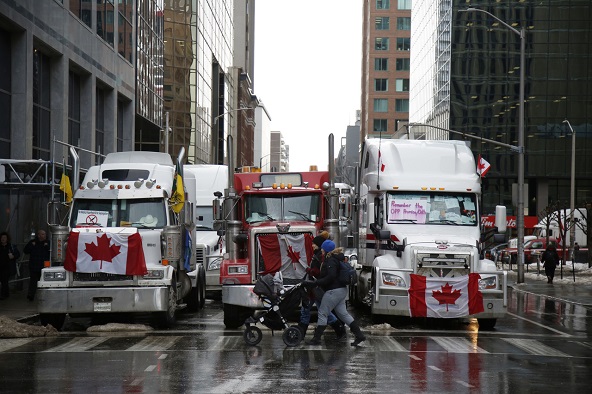
Well, it looks like the Freedom Convoy is over now. They’re just clearing the last of it away. What, if anything, did it all mean?

(1) It was great political theatre. This was a story that got major media play not just in Canada but in the U.S. and Europe too. I can’t think of the last time that happened with a Canadian news story.

(2) It didn’t make a lot of sense. Indeed, I said when it started that it was born of a certain lack of seriousness. The ostensible point was to protest vaccine mandates which required Canadian truckers to show proof of vaccination to enter back into Canada from the U.S. Without such proof they were required to quarantine for two weeks. Since they already had to show proof of vaccination to enter the U.S. from Canada this seemed like reciprocity. Also, apparently 85% of truckers were vaccinated. But then they were against all vaccine mandates (passports) and perhaps even more against Justin Trudeau. And it’s still an open question as to how many of the protesters were even truckers.

(3) If they’d stuck to just having a quick demonstration I think they could have called it a huge success. But they kept hanging around in Ottawa and Windsor, with no clear idea what for, and that started to irritate people. Rule for protests: Don’t be too annoying! Though given how Ottawa is a Liberal stronghold they probably figured they had nothing to lose there.

(4) As it is, the whole thing might still be considered a success by those involved in that it provoked the government into an overreaction with their invoking the Emergencies Act to clamp down. I don’t think this was necessary, and the business of going after funding, most of which was domestic, strikes me as particularly problematic. This was not “Canada’s January 6,” or anything even close, though both sides were certainly channeling the energy and iconography from that event.

(5) That said, it might also have been successful in firing up an American-style culture war, one that had both sides calling the other Nazis. (An aside: Will we ever be free of this tired and misleading rhetoric? The threat of authoritarianism in our time isn’t Nazism, or Communism, but something new.) Who gains the most from this polarization? The results will probably take a while to tally, but I’m inclined to think Trudeau was one of the losers, as he came across as both weak and sanctimonious, qualities that have become his most readily distinguishable and least admirable trademarks. On the other hand, the convoy was pushing the Conservatives further than I think many of them wanted to go. What began as farce might still end as tragedy.

Maigret: Maigret and the Minister

Maigret and the Minister is a bit of a change-up, being more of a political novel than the other books in the series. Maigret doesn’t care much for politics, or politicians, so when he gets called in by a government minister to investigate the theft of a politically explosive document he doesn’t relish the assignment one bit. He’d rather be dealing with the usual criminal types, feeling at one point “almost fond of the petty thieves maniacs, swindlers, and offenders of all kinds that he usually had to deal with.”

Making matters worse is the role of a press baron in all of this. Because if there’s one group of people that, then as now, people tend to like even less than politicians it’s the media. Who will win this race to the bottom?

Fitting the broader, more public scope of the proceedings there’s also a larger cast, with lots of incidental characters. This is compounded by what Maigret sees as the almost comic competition between Maigret’s team – the Police Judiciaire, headquartered at Quai des Orfèvres – and the Sûreté on Rue des Saussaies. I’m afraid I’m not clear on the distinction between these two organizations. I think Maigret is in a division of the Paris police and the other investigators are federal, but that might be the wrong way around.

Once everything gets unwrapped, however, things settle down into the usual round of Maigret and his deputies wearing out some shoe leather following people about and interviewing suspects until the solution just sort of comes to the Chief Inspector. It’s one of those things where he only needs to be reminded of something that’s been sitting at the back of his mind all along.

Also as usual, the chief villain will have to wait to get their full comeuppance. As for Maigret, he’s happy to wash the stink of politics off his hands and get back to his liars, murderers, and thieves.

Maigret index