Maigret: Maigret in Vichy

I don’t know if it’s because Simenon liked writing about them or because I like reading about them more, but his Maigret novels with wicked women as the villains are my favourites. It works (for me) again here as Maigret and his wife are on vacation taking the waters at Vichy, which is where a mysterious woman he had noticed as always dressed in lilac is found strangled one morning.

The heavies are the dangerously independent, and “self-satisfied,” Lange sisters. What a pair of schemers they are! We feel it’s only right that the elder Lange is killed, and Maigret even hopes the guy who did her in is acquitted. I can hear him muttering “What a bitch!” as he did at the end of Signed, Picpus.

It’s not much of a mystery, as there’s only one suspect and Maigret is led to him quickly through some rather random deductions. For example, that the phone caller needs time to arrange a meet-up is attributed immediately to the fact that he “must be married,” which isn’t an obvious connection to make. The back story is interesting though, playing like Who’s Afraid of Virginia Woolf? for grifters, and it moves along in a tight, suspenseful manner. On the copyright page it says it was first published serially (in Le Figaro), which I don’t think was usual up to this point. At least I didn’t see any notes to that effect in the other books I checked. Given that there were two or three Maigret novels being published every year, serial publication wasn’t really necessary.

Perhaps a week at the spa was just what the doctor ordered in more ways than one, as this was the first really good Maigret story in a while, and I think stands as one of the better in the series. Bad women really brought out the best in our man.


Maigret index

Apathy in the U.K.

Meet the new boss.

The two signal political events of 2016, at least in the English-speaking world, were the often-paired British vote for Brexit and the election of Donald Trump in the U.S. With six years’ worth of hindsight, I think it’s pretty clear that both votes were disasters. Ever since, much ink has been spilled trying to understand why and how they happened.

I’ve read more books on Trump than I can count, and I think I can say I have a general understanding of the Trump phenomenon. A bunch of different factors, including some long-term and others more immediate, played into his election, and continue to keep his name in the news. America is in a bad place, with political polarization leading to a dangerous level of extremism, including violence and the more-or-less open disavowal of democracy and the rule of law by one of the country’s two main parties.

I haven’t read as much about what’s been going on in the U.K., which is probably why I’m having trouble understanding what’s happening over there. In many if not most ways Britain is in even worse shape than the U.S. Economically I think this is certainly the case, and it may be politically as well. In a recent piece in The Atlantic, “Britain’s Guilty Men and Women,” Tom McTague points a finger at the country’s leadership and its ruling party: “For the past 12 years, Britain has been led by a succession of Conservative prime ministers — each, like Russian dolls, somehow smaller than the last — who have contrived to leave the country in a worse state than it was when they took over.”

To this list has now been added one Rishi Sunak, a very rich guy who used to work for Goldman Sachs and who voters apparently trust to be able to manage the economy. Because that’s something rich people just understand.

Given how bad things have gone in the U.K. over the course of the last six years, what I can’t figure out is why the Tories haven’t sunk to basement-level polling numbers. On some level I “get” the Trump voter, but the Tory voter is a beast I know nothing about. In my review of The Lost Decade 2010-2020 by Polly Toynbee and David Walker (one of the few books I’ve read on the subject) what stood out for me was the level of voter apathy and the effect of a generational split. And I suppose the forces that are driving anger in America — social inequality and the rage machine of social media — are also at play. I’ve heard the British news ecosystem is bad, but as bad as it is in the U.S.? This I don’t know.

I just find it remarkable that after over a decade of misgovernance, incompetence, and outright failure the Conservative Party has any defenders left at all. The shock of 2016 was one thing, but at least in 2020 the U.S. tried to correct course (for how long we still don’t know). Why are the Brits still digging?

My chess is improving

My long, slow climb to becoming a chess Grandmaster continues. A couple of years ago I posted a screenshot of one of my games that showed just how bad I am (and how unserious I am about chess). But today I played what I think may be my best game yet, delivering checkmate in only 9 moves and without losing a piece. According to the computer analysis I did make a mistake, but pfft.

No escape for my opponent!

If the glove fits

I went to the Dollarama yesterday to pick up a pair of oven mitts for my mother’s kitchen. Nothing complicated about that. Or so I thought.

There were, I discovered, no “pairs” of oven mitts. What they had for sale instead were two-packs of oven mitts. That’s not two pairs, but two mitts sold together. Which sounded odd to me, since that’s how you usually buy gloves. You want two of them because you have two hands. But these weren’t pairs of oven mitts, but two mitts for the same hand.

Now, for a lot of oven mitts there is no righty and lefty because both sides are the same. But these mitts were cloth on one side and a silicone surface on the other (the side you grip with). So I couldn’t buy a “pair” of gloves — that is, a right and a left-handed glove — but only a two-pack of right-handed gloves.

Am I missing something? What sense does this make? If you’re going to make oven mitts that like this and package them together, shouldn’t there be a right and left-handed glove in each package? And what if you’re left-handed? Some things I just can’t figure out.

Many books in tiny rooms

As I’ve mentioned before (see my write-ups for 2016 and 2019) I’m a big fan of the annual book sale — formerly known as the Giant Used Book Sale — put on by the Friends of the Guelph Public Library. Because of the COVID-19 lockdown this event was cancelled the last two years, but this past week it was back on, and I was waiting in line to enter on opening night.

I knew going in that I was going to be disappointed, which helped. In the past the sale took over a small warehouse, but this year they were in the same building but had been shunted aside into some office space adjoining the warehouse proper. The result being that the floor space was reduced from 30 000 to 8 000 square feet. That was too tight, and there simply wasn’t enough space for all the books, or all the people. They had a limit of 375 people they could let in at one time, and there were that many waiting in line when the doors opened on the first night (which was also the only day there was an admission fee). Then there were so many people packed together when I got inside that I had to give up on the fiction room entirely as I literally couldn’t move through it.

As an aside, I came away from the experience figuring that, having escaped getting COVID thus far, if I missed getting it this week I could feel confident I had achieved some kind of immunity. So far, all clear! I remain a NOVID, or COVID virgin.

Not having enough room for all the books wasn’t quite as bad as the restricted mobility, since it meant the tables had to keep getting replenished with books from the storage area as the sale went on. So it made sense to keep going back. I attended on three separate days and found a big difference in the selection each day.

All-in-all it was a pleasant enough experience, though when I filled out the feedback form online I told them they needed to find a bigger venue (something I’m sure they already knew). The volunteers were great, and all the people were friendly despite the crowding, semi-competitive atmosphere, and lingering COVID anxieties. I figure around 20% of the people attending were wearing masks. But nobody was yelling at anyone, which was nice.

I was lucky in not wanting to shop for fiction. As it is, I’m always impressed at the kinds of books that people seem to flock to the most. The people who buy bales of books were mainly buying genre fiction: thrillers, mysteries, romance, SF/Fantasy, and YA. You can say what you want about those kinds of books, but the people who read them read a lot. Meanwhile, the rooms I was interested in — history, biography, criticism — were only lightly attended, and the books weren’t moving quickly. Which was nice for me, anyway.

All politics is . . .

Municipal elections are coming up in Ontario. These are not well attended by the voting public. According to the stats I found online, in my current hometown’s last municipal election in 2018 the voter turnout was around 33-36%, which I think is about average for the province.

Commentators in the U.S. have been remarking on how, in recent years, the old adage that “all politics is local” has been turned on its head, and that all politics is now national. I find something similar happening in Canada, where people tend to get excited about the big issues and personalities that play out in parliament, while not caring much about how their cities are run. The fact that Toronto tends to get a higher voter turnout than the rest of the province is part of the same dynamic. Add to this the disappearance of local media (my hometown newspaper shut down a few years ago after a run of over a century) and municipal politics outside of Toronto has become a kind of vacuum. Who’s covering City Hall? In many municipalities, no one.

I think this is dangerous, as a lot of the things that will affect people the most directly are precisely the local issues that people don’t seem interested in. Where I live, I suspect the current mayor will be re-elected. Before I sat down to write this post, I didn’t know the name of anyone running against the incumbent. I certainly haven’t seen signs for anyone else (though one mayoral candidate has made the principled decision not to have any, and even argues that the “environmentally destructive eye-sores” should be banned).

That said, when I checked I was surprised to find that there are actually six people running for mayor! And a couple of them had really slick web-pages, so maybe that counts for something.

I confess I don’t know what the driving issues are. Affordable housing seems to be the hottest button, but that’s a provincial and national issue as well that’s getting a lot of attention. Otherwise, the candidates seem to want to boil everything down to a few key words. One mayoral candidate’s web-page lists “Accountability, Transparency, Participation, and Inclusion.” Sounds good. Among the signs for candidates running for Council I saw one in my neighbourhood that said “Innovation and Diversity.” Another said “People Planet Prosperity.” This may mean something more than “Elect Jane Doe,” but I’m not sure. In any event, I can’t say they’re words that excite me, or that make me want to get out and vote.

Maigret: Maigret Hesitates

It was in my review of Maigret Sets a Trap that I first remarked on how much significance Maigret puts on married couples sleeping in separate bedrooms. It’s something that the detective chief inspector often finds himself taking note of in these books, and when we find out here that Émile Parendon and his wife aren’t sleeping together we can only take it as a red flag. It’s the flip side of how much time Simenon spends describing Maigret and Madame Maigret together in bed, which is obviously something he holds up as a kind of domestic ideal.

I liked reading Maigret Hesitates, though it’s representative of most of the later books in this series in that the ending was a lot less interesting than the build-up. The premise here had a lot of potential, with Maigret receiving an anonymous note in which a murder is announced. He investigates the grand old house from which the letter came and finds the usual family of rich eccentrics. It all seems building up to something neat, but then the murder itself is more of an accident and all the preliminaries, like the emphasis on Article 64 of the Penal Code, are made irrelevant. At least they seem irrelevant to me. Maigret apparently thinks Article 64 has some application to the murder, though I’m not sure what.

More than that though, Simenon just isn’t creating interesting psychological types anymore. Even a couple as weird as the Parendons are strange without being relatable or compelling. Nor is there anything interesting in the family relations. So what you get is an entertaining read, but the odd elements (like the letters and the Article 64 obsession) don’t add up and there’s no big payoff.

Maigret index

Crummikub II

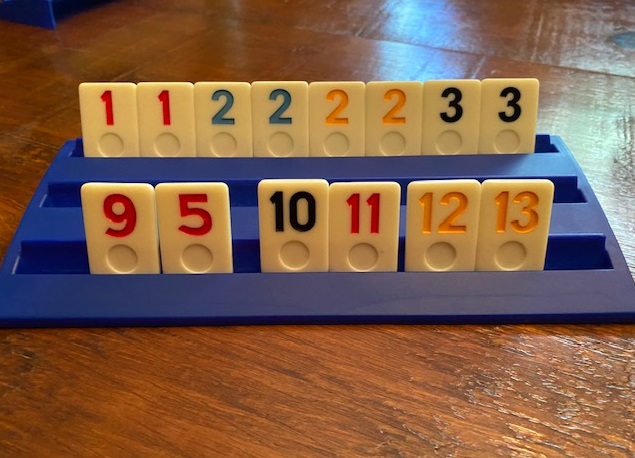
Decisions, decisions.

I posted a really bad selection of Rummikub tiles a couple of years ago and thought I’d add another from last night. If you play Rummikub you know that the numbers 1-3 and 11-13 are a sort of dead zone because they’re harder to play. And having doubles is another hurdle. Put them together and you get a case of what I call “doubles in the dead zone.” This selection is about as bad as it gets, and it was my initial draw of 14 tiles! Ugh!

But there’s a happy ending to my tale of woe. I actually ended up winning this game!

Maigret: Maigret’s Pickpocket

Thank goodness! I don’t consider Maigret’s Pickpocket to be one of the best Maigret books, but considering how dull and contrived the series had been getting, it was nice to have one that I enjoyed. There were lots of questions to ponder, not just whodunit, but whether Ricain had talent or was just a poseur, and how loyal his wife actually was. That these ancillary questions are never answered didn’t bother me a bit. In fact, they made me like the book even more.

François Ricain is the pickpocket, a young man of modest means trying to make it in the film business in Paris. The odds of him getting a break seem long indeed, and he’s settled down into a shabby Bohemian existence, living with his wife in an oddly-appointed apartment and scrounging among friends to make enough money to pay his rent. One day he steals Maigret’s wallet but returns it the next day. This is because his wife has been shot and he needs Maigret’s help.

(As a quick aside, Maigret has his wallet stolen because he keeps it in his back pocket. Madame Maigret has told him not to do this but he doesn’t listen. For the life of me I don’t know why anyone keeps their wallet in their back pocket. I have never in my life kept my wallet in my back pocket. That’s just stupid.)

As you’d probably guess by this point, Maigret doesn’t like this particular crowd. Nor do any of the other upstanding citizens of Paris. After making inquiries, the words that come up most often to describe them are: “savages, badly brought-up people, no morals.” And it’s not just the young people. The older producer who takes advantage of the system crosses a line with Maigret:

“Tell me, Monsieur Carus. I imagine that you have a procession of pretty girls coming into your office every day. And most of them would do anything to get a part in a film.”

“Very true.”

“And I’m guessing that you may sometimes take advantage of your visitor.”

“I don’t hide it.”

“Even from Nora?”

“Let me explain. If now and then I take advantage, as you put it, of a pretty girl, Nora doesn’t worry too much, as long as it doesn’t last. It comes with the job. All men do the same thing, though they don’t all have the same opportunity. Yourself, chief inspector . . .”

Maigret looked at him forbiddingly, without smiling.

“Oh please forgive me if I shocked you. Where was I? . . .”

The killer is the sort of loser that Simenon seems to have had a special dislike for: intelligent but bitter about going nowhere and carrying about a sense of grievance and humiliation. The thing that’s new here is that this is a description not only of the killer but of most of his friends as well. Which makes you think that a larger breakdown was occurring in Paris in . . . 1967. The shit was about to hit the fan.

Maigret index

Celebrity bios, the early days

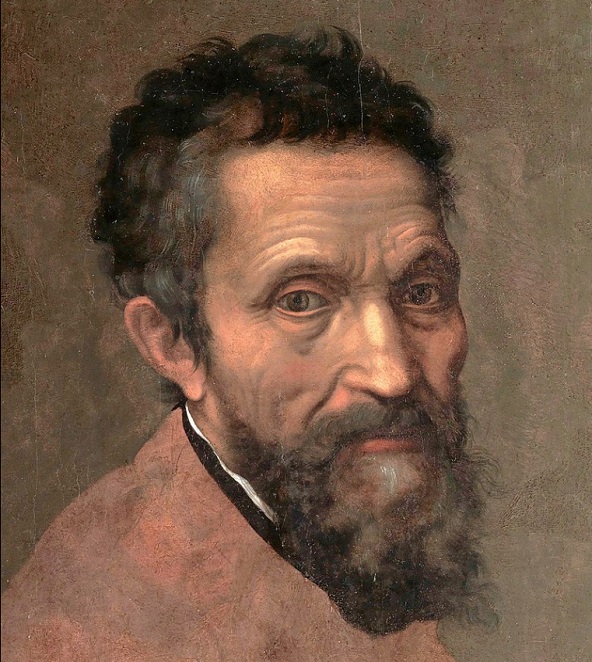
Michelangelo (or is it?) by Daniele da Volterra, c. 1545.

Regular readers of this irregular blog will know that I have a passing interest in the way celebrities or people in positions of power seek to manage and control their image or “narrative,” both in their dealings with the media and with biographers. For earlier takes, see here and here. It really is a fascinating subject.

Giorgio Vasari may have invented the biography of the artist with the publication in 1550 of The Lives of the Most Excellent Painters, Sculptors, and Architects, English translations of which are still in print. This is a collection of biographies or biographical sketches of famous artists of the Italian Renaissance, many of whom Vasari knew. Vasari thought of the arts as progressing, mainly through the technical achievements, and as the culminating figure of the story of Renaissance art he placed Michelangelo, someone who he considered to be sent by God, if not divine himself.

That wasn’t good enough. It never is.

I was reading The Lost Battles by Jonathan Jones recently and had to smile at this:

Michelangelo read this [Vasari’s book] and was ambivalent. Having sent Vasari a poem praising him for bringing so many dead artists back to life, he got his own pupil Ascanio Condivi to take a break from making paintings based on Michelangelo’s drawings in order to write an official life of his master.

Condivi’s Life of Michelangelo, published in 1553, set out to correct errors in Vasari – and to overturn facts Michelangelo didn’t like, such as Vasari’s entirely accurate claim that he had been Ghirlandaio’s apprentice.

I love it! Imagine being so upset at a hagiographical life that you assign a subordinate to “correct” it by falsifying the record.

As I’ve said before, if you’re reading the bio of a living celeb (meaning one who still has the ability to have any influence over what someone is writing about them) you have to assume that it’s going to be, at best, only the loosest facsimile of the truth. It has always been thus.

Update, October 19 2023:

This is a subject that just keeps giving and giving.