TCF: She Wanted It All

She Wanted It All: A True Story of Sex, Murder, and a Texas Millionaire
By Kathryn Casey

The crime:

In the early morning hours of October 3 1999 retired Texas businessman Steven Beard was shot by Tracey Tarlton with a shotgun while he was sleeping. He would die of complications related to the injury several months later. Tarlton had acted at the behest and with the assistance of Beard’s wife (and Tarlton’s sometime lover) Celeste. For cooperating with the D.A. in prosecuting Celeste, Tarlton received a reduced sentence of ten years. Celeste was convicted of capital murder in 2003, receiving a life sentence.
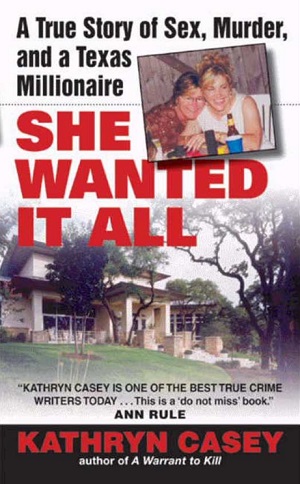
The book:

This was Kathryn Casey’s second book and I think it’s still her best known. She clearly put a lot of work into it and it shows. I particularly liked how it told the story in-depth chronologically and still avoided the transcript trap so many true crime books fall into, with a final act in the courtroom just giving us play-by-play of the trial.

It reads well because it’s a classic soap opera, and Casey even describes it at the end as being like the plot of a Coen brothers movie. Celeste is the heartless gold-digger marrying a millionaire who was in poor health and nearly forty years her senior (they met when she was a waitress at his country club). Steven Beard had plenty of evidence supporting the conclusion that Celeste was only after him for his money, and indeed seemed at times to be well aware of what she was after (if not how ruthless she could be), but . . . men are fools when it comes to pretty young women. For her part, Celeste only had to wait to get everything, but she was impatient to go into full shopaholic mode and started trying to kill Steve off in various ways almost as soon as they were married.

While it’s an old story, there were some strange elements and weird moments. The relationship between Celeste and her teenaged twin daughters, for example, was something I couldn’t understand even at the end. I guess they were both just afraid of her. Steve’s 9-1-1 call for help after he was shot (in the gut, because Celeste didn’t want a lot of blood spatter) was stunning too. One can’t imagine waking up to something like that, but his confusion about what had just happened was luckily matched by incredible presence of mind. He immediately gave his address to the operator before calmly trying to explain how “My guts just jumped out of my stomach.”

The biggest mystery to me had to do with Celeste’s sexuality. On the one hand she was voracious, behaving like a horny party girl on boozy road trips, sleeping around while married, and even marrying for a fifth time just before going to trial. But at the same time several partners complained of her not enjoying sex, and she seems not to have felt a great attraction to any of the men in her life, from husbands to pick-ups. The relationship with Tracey Tarlton was typical of this ambiguity. Until the hatching of the murder plot she really had no use for Tarlton, and it doesn’t seem as though she felt any attraction to her, much less sexual desire. Lesbian love was just another sexual flavour that she took up in a compulsive but disinterested way.

The only person I could relate this to in my own life was a hypersexual, early middle-aged woman who was living with a friend of mine years ago. She’d been married several times, had several children, and would end up dumping my friend as well in due course. Given how she carried on you would think she had a tremendous sex drive, but she actually didn’t like sex and hated men. I don’t know what the current scholarly literature on hypersexuality (formerly known as nymphomania) is, but I’ve always suspected this is how most such people are wired. They have a lot of sex, but they don’t really enjoy it.

A couple of other points stood out. For example, cramming didn’t help Celeste very much in planning the perfect murder. She was a voracious reader, going through three to four books a week, most of which were true crime. She was also a big fan of Court TV and homicide investigations on A&E and printed out grisly crime scene photographs as study material. When trying to convince Tarlton to kill her husband she explained how “I’ve read so many books on things like this, watched so many movies. I know what I’m doing.” And yet, she seems to have learned nothing from all this research.

Some people shouldn’t be parents. When Casey describes Celeste as “a mother who’d never known how to love” her children, I thought that was putting it mildly. Not surprisingly, Celeste’s own upbringing had been chaotic and dysfunctional (though her claims of abuse were unproven). She’d been adopted, along with a couple of other children, by a couple who both had mental problems. The thing about bad parenting is it just keeps getting passed down the line.

Finally, we are reminded yet again of how important it is to always, always, claim victim status. I know this could be taken as a mantra for our age, but it’s something that stands out clearly in a lot of true-crime stories. When charged with serious crimes the best defence is a good offence, so accused killers and cheats always seek to shift the blame on to others. Celeste did this as a matter of course, claiming to have been abused as a child and telling Tarlton that Steven was going to kill her if she didn’t kill him first.

Noted in passing:

When you’re rich you can waste your money in all kinds of stupid ways. Since shopping was, like sex, a compulsion for Celeste, and she had no concept of the value of money, she was an easy mark for high-end stores and services. Particularly eye-opening was her spending $3,000 to decorate her Christmas tree one year, and $950 for an antique pickle jar. Unleashed, in the seven months after Steven died she burned through half a million dollars. This made me reflect on the lottery fantasy of what I’d actually do, or even what I could do, if I won $50 million in a lottery. I don’t think I could spend money like Celeste, and even if I did I still wouldn’t have enough time left to spend half of my winnings. Which makes playing the lottery seem all the more pointless.

Takeaways:

I mentioned how obvious it was – even to Steven, I believe – that Celeste was a gold-digger as well as a nut-job. But even the people around him, including close friends and family, realized it was useless saying anything to him about it. There’s no warning men (or women) in such situations. All you can do is hope for the best and prepare for the worst.


True Crime Files

Crazy chess

This was the endgame!

Had one of my crazier chess games recently. 32 moves total, and I got to checkmate without losing a piece and only taking a couple of black’s pawns. So things were still really crowded at the end! But a victory is twice itself when the achiever brings home full numbers . . .

But just to make it clear: I really am a terrible chess player. Not just against Mittens either. Most of the time I play against the 1000 ELO avatar, and here’s a snap of a breakdown from one of my recent efforts. Note that basically a blunder is worse than a mistake. If you make a blunder you should lose the game. I actually won this game, but only because I used all three of my “friendly” take-backs.

Re-reading Shakespeare: The Taming of the Shrew

(1) The standard line on The Taming of the Shrew is that it’s a play that needs to be seen in performance. It’s a lot of fun when you see it live, but a chore to read. This is borne out by the evidence of its consistent popularity on stage over the centuries while not being studied much.

Then there’s the fact that the text as we have it is a mess. It may be that we were supposed to get more Christopher Sly interspersed throughout the play and at the end. Also, the already more-than-confusing-enough mash of secondary characters who adopt new identities is made worse by the way a couple of the roles (Hortensio and Tranio) seem to have bled into each other at some point. All of this is easier to follow on stage than it is on the page, especially when some streamlining helps sort things out.

That said, I remember an acquaintance of mine going to see it at Stratford years ago and saying that she hadn’t understood much of it and didn’t think any of it was funny. This is one of Shakespeare’s most accessible works (again, on stage) and I figured if that production wasn’t working then there must have been a problem. But I can also understand her feeling that way regardless. Biondello’s description of Petruchio’s horse, for example, is one of the highlights, but it’s impossible for any modern audience to understand. It might as well have been written in Old Church Slavonic.

(2) Petruchio’s ambition “to wive it wealthily in Padua” is a great line (and song too), but just why is he so fixated on the bottom line? He’s after the money and he doesn’t care who knows that “wealth is burden of my wooing dance.” The fact that marriages at the time were primarily economic arrangements has been said to justify his mercenary motives on the grounds of realism, and to be sure Bianca is basically auctioned off. But Petruchio seems, at least to me, to go over a line, especially since he’s already a man of independent means. “My father dead, my fortune lives for me,” he tells us. He has been “Left solely heir to all his lands and goods, / Which I have bettered rather than decreased.” In the 2005 BBC modernization they rationalize his character by having him inherit nothing from his father but a dilapidated mansion and an ancient title. He reallly needs the money. But that’s not in Shakespeare’s play.

So why then such an insistence on a rich bride? I think he’s just that kind of guy. He’s not romantic, but a climber who knows his worth and is looking to increase it through marriage, which is just another deal to be won, to come out bettered rather than decreased. Is this something Katherina sees in him, and respects and approves of? The end of the play is usually read as Petruchio and Katherina recognizing each other as soul mates, and that may be true in a not very nice way.

(3) A lot of one’s response to the play depends on how you read Katharina’s final speech on the necessity of a wife’s submission to her husband. Are we to take it straight, or as her being ironic? And if the latter, how ironic?

Tony Tanner is one critic who says the speech “cannot be heard as irony,” but it still seems to me that she’s putting it on. Such a reading is prepared for by the Induction, when the page boy Bartholomew is instructed in how to play a dutiful lady. Then Petruchio’s tyrannical “taming” or training exercises (gaslighting well avant la lettre) have made the point that life, at least public life, is all a show anyway. That seems to always come up in Shakespeare, and the fact that this is such an early play means it’s presented in starker terms than it usually is.

The thing is, we tend not to like people who are looking to reshape our reality like this. We see them, justifiably, as both cynical and up to something. On the other hand, their cynicism is often justified. All the world’s a stage and they’re the playwrights, directors, and theatre-owners who get to make all the rules. At least until they bomb, or the stage burns down.

Maigret: Maigret and the Loner

A homeless man is found shot dead in an abandoned building. The word most often used to describe such people in these books is “tramp,” and I thought for a moment that Maigret and the Tramp would have been a better title for this one but then remembered that it had already been used.

As with the previous tramp, the victim here just walked out of his marriage and his old life, only to end up as a Parisian crime statistic some twenty years later. The mystery unravels in the usual perfunctory manner of the later Maigret novels. As a reader, Simenon doesn’t even let you play along because he just skims over any necessary information. Indeed, at one point I was surprised to find Maigret looking for a suspect who he described as very tall and thin with a long face and blue eyes. When I went back I couldn’t find where Maigret had got this description from, as the suspect had only been described as looking “very upright” by the first witness. A second witness, at least in his initial interview, doesn’t mention seeing anyone with the victim at all, but Maigret later calls him back in to identify the suspect. I feel like I missed something here, and probably did.

In any event, it doesn’t matter because a clue like that – a tall, thin man with blue eyes – doesn’t mean anything to a reader until you come to a later description of a character as a tall, thin man with blue eyes. At which point you know that’s the guy. Throw in the fact that this suspect and his wife sleep in separate bedrooms (always a bad sign in Maigret’s world) and the detective chief inspector has got his man. It’s all automatic and not very interesting, which by this point shouldn’t come as any surprise.

Maigret index

DNF files: Murder Book

Murder Book: A Graphic Memoir of a True Crime Obsession

By Hilary Fitzgerald Campbell

Page I bailed on: 165

Verdict: Wasn’t my thing. Every artist has their own style, and since Campbell has risen to what I reckon is the top of her profession – a cartoonist for The New Yorker – then it’s pretty clear hers is working for her. But for me the slapdash drawing, which extends to lettering that in places is so sloppy I had trouble reading it because the letters were so poorly formed or spaced, didn’t seem expressive of much. It fits with all of the verbal tics and mannerisms of a generational voice, but that’s the best I can say for it. And that voice, while I could understand it, was something I didn’t relate to. The ironic self-awareness that comes with mocking millennials and their narcissism, while very much indulging the same, gets on my nerves. The whole genre of true-crime memoir does that too.

I want to emphasize though that in saying it’s not my thing I’m not saying it’s bad. I just didn’t feel like I was the target audience here. This feeling began on the first page, where Campbell welcomes us to her Murder Book by saying that you (the reader) must have bought it because you love murder, are a murderer, or are “trying to understand why your wife/girlfriend/daughter/niece/aunt/partner loves murder.” She says this because the audience for true crime is “mostly female.” Which is kind of off-putting, if you’re a man.

After a while, the whole “Fuck the patriarchy!” bit (yes, she says that, or yells it in bold caps) became tiresome and then started to grate. When Campbell mentions how Ted Bundy approached his victims and introduced himself using his real first name it’s presented as evidence of “how confident men are.” Huh? That’s a man thing? And why was Bundy successful at picking up women? Not because he was good-looking and intelligent but because he played to their sympathy and “Women, partly because most of us are decent human beings and partly because we’re socialized to be helpful, want to help those in need.” Campbell gives this another wink by saying it’s a “blanket statement, I know,” but it’s something you still hear a lot and I don’t really get it. Men aren’t socialized to be helpful or to want to help those in need? When Bundy presents himself as a security officer to another victim she goes along with him because “Women are taught to trust authority, not to question it.” It was just after this that I gave up and didn’t even bother skimming the rest. Women still hold views like this in the 2020s? Campbell’s obsession with the 1970s may go a lot deeper than she thinks.

The DNF files

The bad beginnings

Stellan Skarsgård working overtime.

Over at Alex on Film I’ve been looking at the two attempts made at an Exorcist prequel: Paul Schrader’s Dominion: Prequel to the Exorcist and Renny Harlin’s Exorcist: The Beginning. What a two-car pile-up. Schrader was first man up, but the studio hated what he did and told Harlin to fix it. He ended up making an entirely new movie, which the studio didn’t like any better so they got Schrader to rejig his version.

It’s interesting to look at the two movies side by side just to see what two very different directors did with the same basic material. Both movies are terrible, but I can’t think of any other examples of something like this happening.

Re-reading Shakespeare: King Lear

(1) Yes, Lear is more sinned against than sinning. But only just. Throughout the twentieth century critics started judging him more harshly, and that’s a turn we may not have seen the back of.

He really doesn’t start off well. We begin with an exercise in flattery, the pre-eminent sin of court life back then (whenever then was) as it is now. Today I think we may be less likely to feel sympathy for the old guy. Lear is a familiar type: enjoying living in a bubble of privilege maintained by his wealth, power, and celebrity. In olden days this was an exalted condition pretty much exclusive to royalty. The monarch or lord of the manor could surround himself with people who would only tell him what he wanted to hear. When, late in the play, Lear complains that “they told me I was everything: ‘tis a lie, I am not ague-proof,” he seems doubly shocked in a way that’s startling. Is he put out because his courtiers lied to him, or to find that he is not ague-proof? Either way, he must have been pretty far gone to have put any stock in such flattery. Admittedly he’s quite old, and has probably lived in this bubble his entire life, but still. I think today the lesson would be the familiar one (to us) that you’re in trouble when you start believing in your own publicity.

Then again, why not? If you have enough money you can afford to buy your own version of reality. Lear’s house, Lear’s rules. It’s wrong to think of Lear as being entirely foolish here. He has a plan for the succession, it’s just that he’s not used to being crossed. Then the problems start when the plan comes apart in a way he hadn’t anticipated. The illusion machine stops being greased and the posse of riotous retainers instantly disappears. This is the madness that Lear fears: not that the world will stop making sense but that his world will stop making sense, will indeed fall to pieces.

This strikes me as being a message that’s still very much relevant to our own time, and one that’s just as disturbing today to think about. Put simply: wouldn’t it be better to maintain the illusion, even knowing it to be all a lie, and self-awareness be damned? This is the lesson of Plato’s parable of the cave. We all live in a world of make-believe, after all. Cordelia is just ruining it for everyone, and upsetting Lear’s actually rather careful plans for the succession, by not playing along.

This gets to the question of how much Lear actually believes in all of this court bullshit. “Thy truth then be thy dower,” is how he condemns Cordelia. I wonder if “thy truth” is related to what we mean today when we say people speak “their truth.” In any event, he’s saying that if that’s the way she wants to play it then she doesn’t get a cookie. So much for the truth. Cornwall is even more cynical when faced with Kent’s plain speaking:

This is some fellow
Who, having been praised for bluntness, doth affect
A saucy roughness, and constrains the garb
Quite from his nature. He cannot flatter, he:
An honest mind and plain, he must speak truth!
And they will take it, so: if not, he’s plain.
These kind of knaves I know, which in this plainness
Harbour more craft and more corrupter ends
Than twenty silly ducking observants
That stretch their duties nicely.

This actually echoes something Lear says in the first scene where he refers to Cordelia’s “pride, which she calls plainness,” but takes it even further. I wonder what’s worse: to not believe that people can speak truth, or to rage against it when they do? Cornwall’s way of thinking is more dangerous to the social order because nobody can be trusted (except to lie out of self-interest), while Lear’s is more dangerous to himself because it leaves him exposed when reality comes knocking. Either way, I think Lear comes off looking worse. He’s a spoiled old fool in the first act, and even out on the heath seems a bit too much like a child having a tantrum. Someone who rides on a tiger can never dismount, and if you live in a bubble you can never leave.

(2) Why so much interest in sexual matters, expressed in such lurid terms? This doesn’t seem to me to be a play about sexual passion at all. The only lusty ones on stage are the “murderous lechers” Goneril and Regan, and their feelings toward Edmund are not reciprocated as he’s indifferent to which of them he’ll end up with. But then there’s Edgar. As Poor Tom he implies, I think, that he’s lost his mind to syphilis, his downfall the result of having lived a life of dissolution (one who “slept in the contriving of lust, and waked to do it”). This is also connected indirectly to Gloucester. When Edgar reveals himself to Edmund at the end he says that “The dark and vicious place where thee he got [that is, where Gloucester begot Edmund, presumably in a brothel] / Cost him his eyes.” This may be another indirect nod to syphilis but it’s also just Edgar being moralistic again and looking to find some way to interpret what happened to Gloucester as effect following cause. I don’t think we need to follow his lead and draw the conclusion that some critics do: that Gloucester’s blindness is the wages of sin (in his case the physical sin of lechery). But aside from Edmund having been begotten between unlawful sheets some twenty or more years earlier where else is Gloucester’s lechery in evidence? This isn’t Ibsen’s Ghosts. (Marjorie Garber is one critic who has it in for Gloucester, saying that he has “been established in the play as the ‘old lecher’.” But the words “old lecher” are only a bit of figurative language used by the Fool and are not necessarily directed at Gloucester.)

Lear is more direct and forceful in his language, raging right up to the end about animal lechery. Below the waistline there’s only hell: “there’s darkness, there is the sulphurous burning, scalding, stench, consumption. Fie, fie, fie! Pah, pah!” This reminds me of Hamlet always being distracted by thoughts of his mother and Claudius romping in incestuous sheets (he even repeats the “Fie on’t! O fie!”). Hamlet’s father has to warn him about tainting his mind in this way. But to return to what bugs me: we expect this kind of language from Othello given the kind of things Iago is whispering in his ear, and even to some extent Hamlet, but why does Lear go down this road?

Such imaginings are the ravings of an unbalanced mind. Hamlet and Lear are getting carried away and finding in the language of runaway lust a sort of mental release valve. Claudius, Goneril, and Regan are villains who need to get their comeuppance, but their greatest sins aren’t lechery (and there’s no indication Lear is aware of his daughters’ chasing after Edmund anyway). Hamlet thinks Claudius a satyr but there’s little to no evidence for that, and he even acknowledges that the heyday of his mother’s blood is tame and humble so that she isn’t being driven by her hormones. Hamlet’s the only one who sees things in these terms, just as Lear is. And in many ways I find Lear’s raging about sex even stranger. I saw an interview with Ian McKellen where he was talking about playing Lear and musing over the same thing. He likened it to his elderly mother-in-law’s fascination with sex just before she died, and found it to be true of other old people as well. Is there anything more to it than that? Anthony Burgess speculated that the screaming against lechery (“totally without pretext in the plot”) might have been connected to Shakespeare suffering from venereal disease. Perhaps. In any event, I don’t think Shakespeare wants us to believe that bad people are all bad in the same predictable, bestial ways.

(3) In a footnote in his book on Shakespearean Tragedy A. C. Bradley dips a toe into the matter of linking Shakespeare’s biography to the writing of King Lear and draws the following tentative conclusion: “Shakespeare during these years was probably not a happy man, and it is quite likely that he felt at times even an intense melancholy, bitterness, contempt, anger, possibly even loathing and despair.”

Shakespeare changed his sources to give the play its unhappy ending, one that mocks the idea of poetic justice. This was so shocking and ahead of its time that for a couple of hundred years it had to be cleaned up. But it was obviously quite deliberate because that notion of poetic or divine justice is directly invoked only to be slapped down again and again. This really was a point Shakespeare was insisting on.

I don’t think Shakespeare believed in poetic justice outside of what would play well. He seems to have had a cynical view of how justice works. It crops up here in several places. Lear himself talks about how if “change places, and handy-dandy, which is the justice, which is the thief?” Only “Place sins with gold / And the strong lance of justice hurtless breaks.” Goneril has learned well from her father, and when confronted by Albany with proof of her own evil she can be dismissive: “the laws are mine, not thine: Who can arraign me for’t.” That’s not a question.

Justice, like truth, is something everybody expects can be bought.

Words, words, words

Over the years I’ve been posting on words I’ve come across that I didn’t know but found kind of interesting. Here’s a list (not alphabetical, but in order of posting) that I’ll keep updating as I go along:

Catena and Pulvinate
Lethiferous
Equitation and Toxophilite
Oscitant
Azoic
Graticule
Dehiscence
Raddled
Pococurante
Gurning
Gulosity
Daven
Taradiddles
Virga
Shiver
Hassock
Infandous
Grawlix
Cataphonic
Lingamic

Raddle and hum

In Ben Macintyre’s A Spy Among Friends there’s the following description of the double agent Kim Philby gradually coming undone while stationed in Washington in the 1950s:

Philby was only thirty-eight but looked older. There was already something raddled in his handsome features. The eyes remained bright, but the bags beneath them were growing heavier, and the lunches at Harvey’s were taking a toll on his waistline.

At first blush I thought “raddled” must be a misprint for “rattled.” But somehow that seemed unlikely so I looked it up and found that there really is a word raddled that means old and worn-out or “confused . . . often associated with alcohol and drugs.” Since Philby was prematurely aged and drinking epic amounts at the time the word fit perfectly.

Nobody know where raddled comes from. Its first use in English may have come in a 1694 translation of Rabelais that described “a . . . fellow, continually raddled, and as drunk as a wheelbarrow.” Whatever that means. It may derive from “raddle,” which is a red ochre used for marking animals. From there, to be “raddled” came to refer to an overapplication of rouge. I don’t know how it then made the leap to meaning broken-down, confused and discomposed, but it blends in nicely with “addled” and “rattled.” Well played by Macintyre.

Words, words, words