
A real treat here. Darryl Berger is a Kingston artist who makes art out of old library cards (remember those?). They make perfect bookmarks!
Book: Dreyfus: Politics, Emotion, and the Scandal of the Century by Ruth Harris
A real treat here. Darryl Berger is a Kingston artist who makes art out of old library cards (remember those?). They make perfect bookmarks!
Book: Dreyfus: Politics, Emotion, and the Scandal of the Century by Ruth Harris

Thought it was time to update with a new avatar and give Shere Khan a break. The new pic was taken from the Art Gallery of Guelph’s sculpture garden and the bronze installation “Living Room Suite” (2001) by the artist Seth. I had to sweep a broken beer bottle off the couch to sit down.


The crime:
On the night of April 18, 2020, Gabriel Wortman got dressed up as an RCMP officer and into a car made to look like a police cruiser, then went around shooting up the community of Portapique, Nova Scotia. The next day his murder spree continued as he hit the road. By the time he was finally shot by police at a gas station he had killed 22 people. In the days that followed the RCMP would come in for a great deal of criticism over the way they handled the situation and many questions remain unanswered.
 The book:
As the subtitle indicates, this is not a narrative history of Wortman’s 13-hour rampage, setting out to provide a definitive account of what happened and why. That’s a story that may never be told, some of the reasons for which are gone into here. Instead, what we get is more of a reporter’s notebook on the tragic events and their fallout, with much to say about the RCMP’s response to it and its media coverage.
Though I’ve never been one to rush to the defense of the police, I initially resisted being taken where Paul Palango was clearly going, which is that the RCMP were involved in a cover-up of their actions (and possibly a cover-up of some deeper relationship they might have had with Wortman). This is the sort of thing that is usually sneered at as conspiracy thinking, with calls for tin-foil hats and the theme from The X-Files playing in the background. But that’s unfair, as conspiracies do exist and in fact can be perfectly mundane, which seems to have been the case here.
“The more research we did,” Palango writes, “the clearer it was becoming evident that this was no conspiracy theory, as my detractors would have it, but rather a bona fide conspiracy.” The thing is, conspiracies are often equated in the public’s mind with highly-involved and sinister machinations when in fact they are often just part of the normal operation of many large bureaucracies or big corporations (Adam Smith: “People of the same trade seldom meet together, even for merriment and diversion, but the conversation ends in a conspiracy against the public, or in some contrivance to raise prices”).
That seems to have been the case here, as the RCMP, an almost entirely unaccountable organization, has become the preserve of what Palango (borrowing language from The Wire) derides as “house cats”: public employees who have become comfortable in well-appointed sinecures. Within such a government bureaucracy, the code of silence and CYA (Cover Your Ass) are the only operational rules. One rises through the system not by being productive or particularly good at one’s job but by being well connected (family matters in the RCMP) and by steadily advancing to positions that come with higher pay and better benefits but that are really just empty titles without any duties or responsibilities. And all the time the force becomes more and more top-heavy, with proportionately fewer boots on the ground. And these house cats cost a lot of money. One of the numbers Palango throws out is that government employees who move for work (soldiers, civil servants, and Mounties) cost the public purse $500 million a year. Wow! $35,000 per homeowner! That’s a hell of a perk.
In short: welcome to the blighted and bloated world of middle management and office administration. A world that isn’t a conspiracy so much as just the kind of thing you get given the natural and universal habit of people in positions of power and privilege to use those positions to feather their nests. One needn’t attribute to malignancy what is simple laziness and self-interest.
Where conspiracy enters the picture is with the cover-up. Or, as Palango puts it, “a massive cover-up . . . one that tested the natural laws of conspiratorial physics.” Is this going too far? To be sure, police were put in a difficult situation, as Wortman was no ordinary mass killer. There was a lot of confusion on the ground. But right from the get-go the Mounties had trouble keeping their story straight and clearly misinformed the public on several occasions as to what they knew and when they knew it (Palango isn’t reluctant to call them out for “lying”). With the help of a deferential and even pliant media they sought to put forward their own narrative while attacking anyone who would question it.
The official story about Portapique was shaping up to be a perfect modern fairy tale – the Monster and the Maiden. It was a macabre morality play and just about everyone in the media was eager to put it to music. The RCMP’s excuses for its failures were treated with less than an ounce of skepticism. The belief that the media have a duty and responsibility to hold institutions accountable seemed to be overridden by the undeniable and unhealthy deference to authority that permeates much of the Canadian psyche.
So true. So very true. Sing it, Paul!
For example, that reference to the Monster and the Maiden is directed at something Palango spends a lot of time trying to understand: what was going on between Wortman and his wife just before he went on his homicidal bender. Unfortunately, he keeps coming up against the “feminist lens” that was being used to portray her as a victim of domestic abuse. Palango refers to this as “coddling,” but it worked, and it’s still unclear what happened to her on the night of April 18.
As we all know, there are powerful incentives for claiming victim status. Victim credentials absolve you of all responsibility for your actions and allow you to make calls upon public sympathy that can be further exploited. The most egregious example in this case was the number of Mounties who claimed stress leave immediately after Wortman’s rampage. Apparently there were seventy of them. Seventy! In order to deal with their trauma they took the summer off, which came with a bill to the province of Nova Scotia of $3.75 million for hiring replacement officers. Meanwhile, as Palango reports, “The ‘sick’ Mounties got full pay and lounged around their vacation properties, many posting photos on social media.” This shit has to stop. I’ve posted before about the abuse of diagnoses of PTSD and I’ll just repeat here that it’s a disgrace. But I digress.
Given the combination of silence and misinformation the public began to lose trust in the official line. And this is the really bothering point. We live in a post-truth age of alternative facts and false narratives, thinking that shadowy elites in the media and the deep state are lying to us about everything. So when we see a case where something is clearly wrong about the story government spokespeople and newspaper editorials put forth, it deeply damages the foundation of our social bonds. I mean – and I say it this time without irony – if you can’t trust public institutions like the CBC and the Mounties, and I don’t think we can, then who can we trust? Put another way, what if all the sketchy-sounding podcasters who inveigh against the mainstream media and who are always “just asking questions” turn out to be right? Or if not right, at least have a point? This is something Palango is very aware of, pointing out “repeatedly that this is the kind of situation that leads to the flourishing of so-called conspiracy theories.”
It’s not a good place to find ourselves in. There was, inevitably, a board of inquiry into Wortman’s rampage. The Report of the Mass Casualty Commission came out in March 2023 (after this book was published) and it was highly critical of the RCMP, but this is not accountability. At some point something has to be done to restore public trust in such basic institutions as the police and the media or we are in trouble. It’s interesting that just a year before 22 Murders came out there were a couple of other Canadian true crime books that also raised disturbing questions about police (mis)conduct: Justin Ling’s Missing from the Village, on the Bruce McCarthur case that shook the gay community in Toronto, and Silver Donald Cameron’s Blood in the Water, which focused on the ineffectiveness of the Nova Scotia RCMP in dealing with a Cape Breton ne’er-do-well who ended up being killed (I reviewed both books together). Something isn’t working here, and whether you agree or disagree with Palango’s approach you have to give him credit for addressing what has become a real and growing problem.
Noted in passing:
A couple of points came up while reading 22 Murders that I’ve addressed before, but they’re worth returning to for further context.
The first has to do with how swiftly some crimes, no matter how sensational at the time, disappear from our memory. Wortman’s murderous rampage was a huge story, especially in Canada where these kinds of mass killings aren’t everyday occurrences. That said, I have to admit that only a few years after these events I’d already confused them in my head with the 2014 shootings in Moncton, when Justin Bourke shot five RCMP officers, killing three.
Palango has his own experience of this on a visit to a local pharmacy a little over a year after Wortman’s spree.
The thirtyish pharmacy assistant knew a little about me from the pharmacists, who knew a lot about what I had been doing.
“I hear you’re writing a book,” she said. “What’s it about?”
“Gabriel Wortman,” I said.
“Who?” she asked, raising an eyebrow.
“The Nova Scotia massacres,” I responded. Noting that she was still drawing a blank, I added, “The shootings last year.”
“Someone got shot?” she asked with a look of both astonishment and concern.
It’s surprising the assistant hadn’t heard of the shootings, but maybe not so surprising that she didn’t twig to Wortman’s name. This brings me to the second point I wanted to bring up: the policy in many media outlets, in Canada and internationally, of not providing the names of mass shooters in news reports.
As I’ve said before, I understand where this is coming from, especially in cases where a killer is looking to gain notoriety for a repugnant cause, for which they’ve prepared a manifesto. Think cases like Anders Behring Breivik, Elliot Rodger, and Brenton Tarrant. It’s also true that, with celebrity, or attention, as the only coin of the realm, one doesn’t want to give such individuals anything that smacks of a posthumous victory, much less a platform. That said, deliberately setting out to turn mass killers into anonymous unpersons strikes me as too ideological, while taking the news media away from its core duty to report all of the facts. We don’t call Hitler “the German dictator” by convention. No, the “five Ws” of journalism begins with “Who?” and that’s the way it should be. Alas, in 2020 this was no longer true, or even considered best practices:
A month or so after the massacres, just about every major news outlet had taken the same “ethical” position that it was not going to name Gabriel Wortman. He would only be known by his initials or some euphemism – the shooter, the madman or the denturist. His was a name not to be spoken.
On the front page of the Halifax Chronicle Herald the official editorial policy was announced: “we will only publish the murderer’s name and photo responsibly, when it serves the public good.” This struck me as very dangerous. Who decides what serves the public good? I can get on board with not publishing photos of the crime scenes, but the name of the perpetrator? As Palango puts it, “The rationale for this proud self-censorship was that naming Wortman would only glorify his actions and provide a model for others like him.” How so? Wortman wasn’t looking to go out in a blaze of media glory. He didn’t leave any manifesto or suicide note that I’m aware of. What sort of a model for others would his name provide? His use of a car made up to look like an RCMP cruiser was widely reported, with pictures of it popping up everywhere, and that’s the only aspect of the case that I would have thought another mass shooter might want to imitate.
I’m just not buying it. In such cases the killer’s name is part of the story, and it belongs in the story and not hidden behind some virtue signaling by the press. As Palango demonstrates, there was already far too much ideological and political shaping of the narrative of these events going on in the press and in statements made by the authorities.
Takeaways:
Does it matter that the truth is out there if nobody cares?
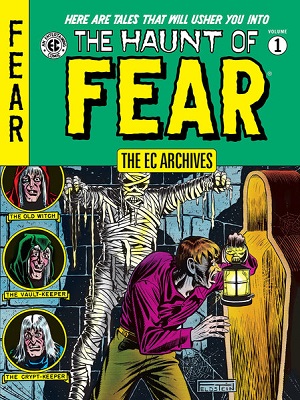 As the brief Introduction points out here, EC originally stood for Educational Comics, but they gave up on that pretty quickly in order to swap in “Entertaining.” In some of the ads included here demonstrate though, they were still selling their Picture Stories from the Bible series. I don’t know how popular those comics were, but I’m guessing somewhat less so than Tales from the Crypt.
This is the first EC Archives volume I’ll be looking at, but there will be many more. I love these stories, and the job Dark Horse has done in bringing them back in beautiful large-format packages. And now getting on with it, let’s dive in with The Haunt of Fear . . . #15?
The numbering had me confused, but gets explained in an instalment of “The Old Witch’s Niche.” Basically (if I have the story right) they started with #15 because there’d been a change of title from a previous magazine, The Gunfighter. Then, after issues #15-17 the U.S. Post Office (which ran these things) told them that their fourth issue (which would have been #18) had to be #4. So this collection includes issues #15-17 and then issues #4-6, in that order. Technically speaking, I guess The Haunt of Fear issues #1-3 don’t exist. Go figure.
There were three main EC horror imprints and they were entirely interchangeable as they used the same writers and artists and even crossed over a lot. At least I can’t tell any difference between them aside from their mascots: the Old Witch for The Haunt of Fear, the Vault-Keeper for The Vault of Horror, and the Crypt-Keeper for Tales from the Crypt. Even these three can be hard to distinguish, though the Old Witch, the last to be introduced, always looks sadder than the other two. But enough about our hosts.
Things begin with what would be an EC staple, which is ripping off classic horror tales. “The Wall: A Psychological Study” is a remix of Poe’s “The Tell-Tale Heart” and “The Black Cat,” with a hen-pecked husband walling a noisy cat up with his murdered wife. A later story, “Monster Maker,” revisits Frankenstein. Not the most original tales on offer then, but EC was pumping this stuff out on a deadline and they do at least attempt to add some new wrinkles. I’ll just comment now on a few of the stories that struck me as particularly noteworthy.
“Nightmare!”: a construction engineer keeps waking up from nightmares where he’s being buried alive. A “famous psychiatrist” named Dr. Froyd puts him on the couch and tells him these are manifestations of his feeling “buried under too much work.” Feeling cured, the engineer returns to his work site and is trapped in a frame when a bunch of cement gets poured onto him. Instead of fear he grins hysterically at what he is sure is just another dream. “Ha! Ha! Ha! Ha! C’mon! Bring on the cement!” He dies laughing.
“Television Terror!”: a reporter investigates a haunted house on a live TV broadcast, using a portable camera with a very long extension cord. Nearly the whole story (but for a bit of framing) plays out from the camera’s point of view, with things climaxing in a suitably mysterious disappearing act. October 1950, and the found-footage genre is born. The inspiration may have been a short story by H. Russell Wakefield called “Ghost Hunt,” but that was about a DJ broadcasting his night in a haunted mansion so this was the next step in the concept’s evolution.
“Horror Beneath the Streets!”: things get very meta as EC masthead figures “Al” (artist-writer Al Goldstein) and “Bill” (publisher William Gaines) are chased into the sewers by mysterious figures who turn out to be the Keepers of the Crypt and the Vault of Horror, looking for someone to publish their creepy stories.
“The Hunchback!”: he’s not really a hunchback, but a fellow who has been concealing a murderous Siamese twin. Shades of Basket Case and Malignant. Apparently the idea goes back to a Robert Bloch story from the 1930s though called “The Mannikin.”
So enjoy! Even if the lettering is crude, the stuttering and exclamation marks are overused, and the spelling has some surprising glitches. I mean, how could the writers of such material not know how to spell “cemetery”? It’s baffling. But there’s a lively spirit of gruesome fun at work throughout, with colours that really pop off the page and stories that never drag. Even the ads are worth a grin. You could subscribe to this mag for 75 cents, which got you six issues, including delivery! And who wouldn’t want to order a “Genuine Hollywood Wolf Ring” for $3.95: “Warns the girls (or boys) that you are OUT FOR NO GOOD, and they’ll LOVE YOU EVEN MORE FOR IT!” Ah-wooooo!


I just recently found this package of children’s bookmarks. I have no idea when or where I got them, but I think they were printed in Japan. They depict Mr. and Mrs. Noah and some of the animal pairs that were on the ark. I also included the package they came in, but I don’t know what the lettering on the side of the ark says. Any help? I also wonder why Noah and his wife are so cheery and who they might be waving at.
Book: The Harper Collins Study Bible

The one and only.
This is an index to my reviews of Charlie Chan films over at Alex on Film. When I review more I’ll update.
Behind That Curtain (1929)
The Black Camel (1931)
Charlie Chan in London (1934)
Charlie Chan in Paris (1935)
Charlie Chan in Egypt (1935)
Charlie Chan in Shanghai (1935)
Charlie Chan’s Secret (1936)
Charlie Chan at the Circus (1936)
Charlie Chan at the Race Track (1936)
Charlie Chan at the Opera (1936)
Charlie Chan at the Olympics (1937)
Charlie Chan on Broadway (1937)
Charlie Chan at Monte Carlo (1937)
Charlie Chan in Honolulu (1939)
Charlie Chan in Reno (1939)
Charlie Chan at Treasure Island (1939)
City in Darkness (1939)
Charlie Chan in Panama (1940)
Charlie Chan’s Murder Cruise (1940)
Charlie Chan at the Wax Museum (1940)
Murder Over New York (1940)
Dead Men Tell (1941)
Charlie Chan in Rio (1941)
Castle in the Desert (1942)
Charlie Chan in the Secret Service (1944)
Charlie Chan in the Chinese Cat (1944)
Black Magic (1944)
The Jade Mask (1945)
The Scarlet Clue (1945)
The Shanghai Cobra (1945)
The Red Dragon (1945)
Dangerous Money (1946)
Dark Alibi (1946)
The Trap (1946)
The Chinese Ring (1947)
From “A Free Man’s Worship” (1903) by Bertrand Russell:
That Man is the product of causes which had no prevision of the end they were achieving; that his origin, his growth, his hopes and fears, his loves and his beliefs, are but the outcome of accidental collocations of atoms; that no fire, no heroism, no intensity of thought and feeling, can preserve an individual life beyond the grave; that all the labours of the ages, all the devotion, all the inspiration, all the noonday brightness of human genius, are destined to extinction in the vast death of the solar system, and that the whole temple of Man’s achievement must inevitably be buried beneath the débris of a universe in ruins—all these things, if not quite beyond dispute, are yet so nearly certain, that no philosophy which rejects them can hope to stand. Only within the scaffolding of these truths, only on the firm foundation of unyielding despair, can the soul’s habitation henceforth be safely built.

Well, I don’t know if it’s a magic carpet. But it’s a Turkish carpet. Close enough!
Book: 1913: In Search of the World Before the Great War by Charles Emmerson

Whose bright idea was this? I can just kind of get behind those Terry’s chocolate oranges, but who thinks chocolate and carrots go together? I guess some people do, but to me they’re like ice cream and mayonnaise. Not that this chocolate has a carrot taste. At least I didn’t detect any.
What bugged me the most though was the way that the green plastic stem goes right down into the carrot, so you can’t bite through it but have to nibble around the edges. The whole thing seems like a swallowing hazard for small children, and was super annoying for me. Too clever by half!

Happy Easter!
 Alex Good