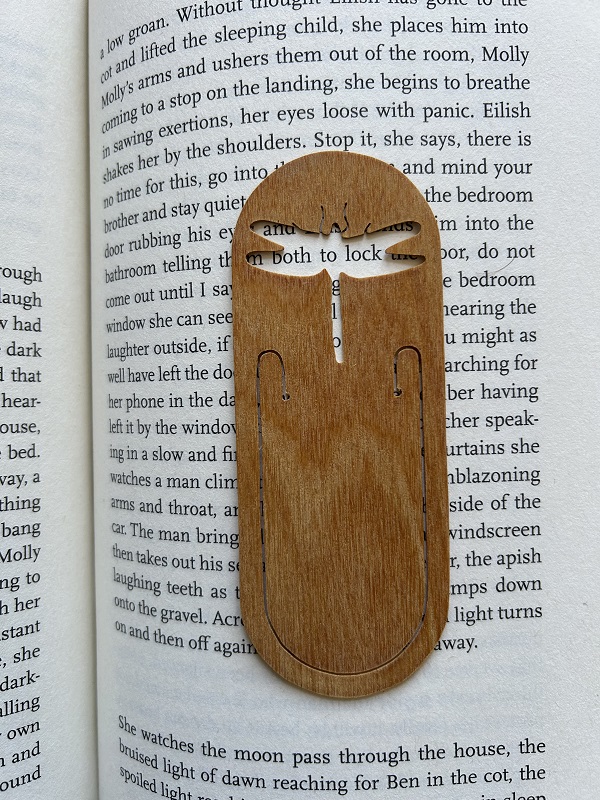
One of the nicer wood bookmarks I have. The art in these is keeping them thin enough to be functional.
Book: Prophet Song by Paul Lynch
One of the nicer wood bookmarks I have. The art in these is keeping them thin enough to be functional.
Book: Prophet Song by Paul Lynch
It’s the turn of Dr. Pender, “the elderly clergyman of the parish,” to tell a mystery story to the Tuesday Night Club, and he comes through with a preposterous tale about a house party that goes wrong when a guest, “one of the notorious beauties of the Season,” takes on the persona of the goddess Astarte and strikes the host dead.
There’s a video I remember watching a while ago that had the magician Penn Jillette explaining various magic tricks seen in movies, and when remarking on the transportation booth in The Prestige he says that it’s a bad trick if there’s only one way it could be done. Which is basically the same idea as Holmes’s famous dictum that “When you have eliminated all which is impossible, then whatever remains, however improbable, must be the truth.” Such an approach made solving the mystery here pretty straightforward, as the various attempts at an explanation put forward by the Club members (a javelin, “mass hypnotism,” etc.) are absurd. So pretty much what you think happened at first is in fact what happened. Miss Marple comes to the right conclusion precisely by not indulging her imagination, and cutting everyone else off short by saying “Of course there is only one way poor Sir Richard could have been stabbed.” I think in one of Christie’s novels she would have indulged something a little (or a lot) more improbable, but in a short story there’s no time for that so the obvious solution had to be the correct one as well.
The retired police commissioner also manages to identify the killer’s real identity despite Dr. Pender changing the names in his telling of the story. I thought this an odd note to end on, and it made me wonder if Christie might have had someone specific in mind.

Another pic from my garden. I don’t know the name of any of the stuff in my garden, as careful readers have pointed out on previous occasions. I’m just not a plant person. I don’t know what this purple ground cover is, but for a couple of weeks in the spring it looks nice.

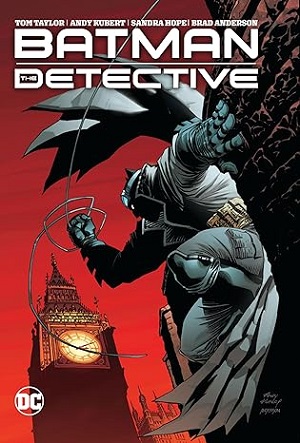 The biggest story in the development of movies in the twenty-first century, at least the first quarter of it, was the domination of comic-book action films. Not just the MCU, but almost any action movie started seeming more and more like a comic book through the heavy use of CGI and generic comic-book tropes.
It wouldn’t be unreasonable though to think that some influence went the other way. That’s certainly the feeling I had reading Batman: The Detective, which plays very much like the graphic-novel version of a Hollywood movie of the period, from the storyboard flavour of the action sequences to the iconic European locations.
Of course one of those comic-book tropes I mentioned as bleeding into film is that of the deathless hero. Despite all the scars on Batman’s tank-like frame (he’s huge in this comic), he just keeps going along. I mean, how does he crack a rib and dislocate his shoulder and keep on fighting when he crashes out of the hospital window and falls to the street? And even more to the point, how do the mooks he falls on keep going? And how does Beryl Hutchinson (Knight) survive falling from a plane and then being shot at point-blank range by Equilibrium? It’s not like Equilibrium wants to spare her, as Hutchinson must have been on the kill list and we know Equilibrium is a homicidal maniac. But the next time we see here she’s sitting up in a hospital bed, and by the time we get to the end of the series she’s ready for action again. I feel like I was missing something there.
Still, this is a really good comic that kept me interested all the way through. The action is great, and the writing moves us along quickly, even though I thought the plot was ridiculous. Equilibrium’s motivation seemed sketchy to me, but she was a strong villain, enforcing some kind of amoral order against Batman as agent of chaos. I thought of her as the anti-Joker in this regard.
I just don’t know why it was called The Detective since Batman doesn’t do much detecting here aside from plugging into his continental network (the European Alliance of the Bat) and getting status updates. I was also wondering when Batman started wearing goggles. I’m not enough of a Batman stan to know that bit of trivia.
One minor point: the use of @#$%$@# for cuss words seems out of place in a contemporary comic. Either don’t use bad language (there’s no need for it here) or spell it out. This isn’t Asterix.

Last year at this time I posted a pic of a neighbour’s back porch that a family of foxes had made their home. I haven’t seen the foxes this year, which means the same location has been taken over by other creatures that have just welcomed some new additions to their families. See if you can find the baby groundhogs and the baby rabbit in this pic! (You can make the picture bigger by clicking on it.)

The crime:
When Kari Baker was found dead by her husband Matt on April 7, 2006 it was judged to be a suicide by drug overdose, mainly because that is what Matt, a Baptist minister, told the authorities had happened. He also showed them a suicide note. Kari’s family, however, didn’t believe she would have killed herself and pursued a wrongful death civil case against Matt. After much prodding the police filed charges and, with Matt’s mistress testifying against him, he was found guilty of murder and sentenced to 65 years in prison.
 The book:
There’s a blurb of praise from Ann Rule on the cover of Deadly Little Secrets and I think that’s entirely apt as Kathryn Casey has always struck me as the Texas version of Ann Rule. What I mean is that while both authors cover a fair bit of ground, their real specialty is doing these deep dives into marriages and relationships that hit the rocks in a big, bad way. And I’m not knocking that, since I think there’s a real value in digging into such stories, precisely because they are so commonplace. If you’re going to be murdered, chances are pretty good it will be at the hands of a domestic partner. It’s certainly a lot more likely than being killed by a stranger. So it helps to be familiar with some of the warning signs.
Matt Baker’s murder of his wife Kari was a terrible tragedy but at the same time it was nothing much out of the ordinary. I was even a bit surprised that national news programs like 48 Hours and 20/20 ran segments on it, as I would have thought it was mainly a story of local interest. But I guess the “murdering minister” angle, which is all that sets it apart from countless similar stories of husbands killing their wives, played well in the media.
That a so-called “man of god” could go bad, or be bad in the first place, didn’t strike me as being news. I’m more concerned at how many people there still are who think individuals in positions of trust and authority are deserving of so much respect and deference. Cops, doctors, and clergy, to take just the most obvious examples, are no better or worse than anyone else out there. Given that, and the fact that at over 400 pages this is a book that goes into Matt and Kari’s break-up in granular detail, what lessons can we learn?
I think the red flags with Matt were all the obvious ones. He was overly possessive and controlling. He had no friends. He couldn’t stick with any one job for very long, usually being dismissed for some inappropriate conduct that wherever he was working wanted to keep hushed up. He was a sex addict. None of this meant he was bound to end up killing his wife, but they were bad signs. Only being a minister bought him a lot of trust, and Kari never wanted to believe the worst.
The other thing that stood out to me for it’s not being remarkable was the way the police investigation got off on the wrong foot and then only got worse because people in authority never want to admit making a mistake. By sheer coincidence I read David Wilson’s A Plot to Kill right after Deadly Little Secrets and both books deal with murders involving drug overdoses that were originally considered to be suicides or accidents so that the authorities didn’t have to perform an autopsy. When Wilson tried to get a copy of the coroner’s report on Peter Farquhar he was shut down in a way that he clearly felt miffed by. But I think he also understood why he was getting that treatment, and it’s not because he was a famous author. There are few rules more absolute when it comes to corporate culture than CYA (Cover Your Ass), and the police are nothing if not a corporate bureaucracy.
As with any bureaucracy, the failure of the police in this case wasn’t the result of corruption or incompetence but instead could mainly be put down to simple laziness. In my experience this is the Occam’s Razor of explaining how things go wrong in most organizations. It’s not the fault of bad people so much as people who can’t be bothered doing anything more than the bare minimum to keep their jobs. In this case, the police were offered an easy explanation for Kari’s death so they just took it at face value (a typewritten suicide note?) and called it a day. No need to bother with an investigation.
Because there was so little physical evidence collected the trial itself turned into a very near-run thing. Matt might have even been able to beat it if he’d known enough, or been better advised, to keep his mouth shut. You should always keep your mouth shut in such situations. This was the takeaway I offered in my review of The Count and the Confession: “Innocent or guilty, you have nothing to gain by talking to the police. It won’t do you any good and could get you in a lot trouble.” Talking to the police almost sent Beverly Monroe to prison for life, and she was innocent. It’s what nailed Matt, who otherwise had a good chance of walking out of court a free man.
Noted in passing:
Guy James Gray, Matt’s defense lawyer, got angry with Matt when he found out that Matt had been lying to him about not having an affair with the younger woman he hooked up with after Kari’s death. Indeed, Gray was so furious that he filed a motion to be taken off the case, citing a “serious breach of confidence.”
That didn’t sit well with Gray, who’d convinced himself early on that he had an innocent client. Suddenly Gray, like the prosecutors, had Baker pegged as a liar. “I think the judge should have let me leave,” he says, with a frown. “From that point on, I never talked to Baker unless I legally had to. I wanted nothing to do with him.”
This isn’t how it works. Or at least it’s not how it’s supposed to work. In the first place, Matt had only confessed at this point to lying about his affair, he hadn’t admitted to killing Kari so was still at least potentially an “innocent client.” But more than that, a defense attorney has a professional duty to present his or her client’s case as best they can, and the question of whether their client is actually guilty or innocent doesn’t come into it. For Gray to suggest he gave up on the case, a sort of “quiet quitting,” when he wasn’t allowed to resign (which would have been very difficult given how late in the day it was) is something I found really surprising.
Takeaways:
One can make any number of stupid mistakes in killing someone and still get away with it. Matt Baker was no criminal genius and should have been caught dead to rights but for the fact that he was a minister. What finally tripped him up though was the fact that his wife had a lot of close family members and friends who weren’t going to let the matter of her death slide and who had the resources to pursue Matt when the police and DA didn’t want to get involved.
There’s a reason so many serial killers manage to keep murdering for years without getting caught. They tend to prey on individuals who are socially isolated or who exist on the fringes of society. Runaways, homeless people, the down-and-out. Killing people with stronger connections to their community is a lot riskier.
 Disappointing.
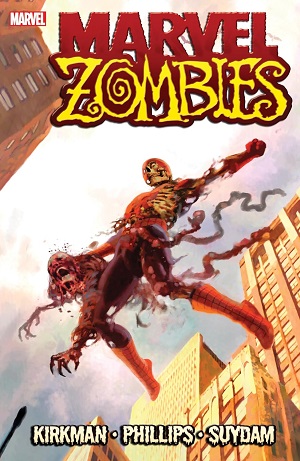
2005 was near the point of peak zombie, a genre fad that writer Robert (he’ll let you call him “the zombie guy”) Kirkman had ridden to huge success with his Walking Dead comics. I liked The Walking Dead, and indeed you could say I’m a big zombie fan, so I was definitely on board for seeing how zombification would go with the Marvel universe.
The answer? Meh.
The idea for Marvel Zombies took its start from a storyline in the Ultimate Fantastic Four, and as things kick off here the zombie apocalypse/virus has actually run its course. We’re in the ruins of a depopulated city with only superheroes left. Zombie superheroes, that is. I assume they’ve eaten everyone else.
These aren’t your usual zombies though, and not just because they still have their super powers. It’s not clear what the cause of the zombie outbreak was but the effect is somewhat similar to the classic Romero strain: those infected have a hunger for human flesh, and whoever they bite suffers the same fate (that is, if they aren’t fully consumed). What’s different is that though dead they have their minds entire. They know what’s happened to them, it’s just that they can’t control their appetite for flesh. After a good feast of flesh they’re able to function somewhat normally, but then the hunger begins to grow again . . .
They are, in other words, junkies.
I think more than anything else this is what gives Marvel Zombies its depressing air. To be sure, zombies have been used from the beginning as a kind of metaphor. They started life (after death) as slave labour in the cane fields of Haiti and went on to be identified with the lumpenproletariat, the underclass, or simply the masses. On a planet with too many mouths to feed and an economy without enough decent jobs for everyone, the zombie apocalypse was just what the name suggests: not a vision of the future but a revelation of our own class divisions and environmental crisis. Throw in the generic landscape of bombed-out, urban decay and everything about the premise here just feels grim. And then it gets grimmer.
I appreciated how Kirkman took things in a different direction here, and how dark it all was, but I can’t say I enjoyed it very much. It’s not that it’s too bleak or depressing, but more that the story, at least in the early going, doesn’t have much to do. What we get are fights between the zombies and the usual ascending order of level bad guys (who are now sort-of good guys). They kill Magneto and eat him. Then they kill the Silver Surfer and eat him. And finally they kill Galactus (!) and eat him. In this they are helped along by what I thought was a stupid plot device of having the heroes who eat the Silver Surfer absorbing some of his “cosmic powers” along with his flesh (or whatever it is the Surfer is made of). They need such an energy boost because their rotting bodies keep getting torn apart in their various battles. Captain America has the top of his skull sheared off. Spidey loses a leg. Iron Man loses his entire bottom half. Wolverine and Luke Cage both lose an arm. But they can keep going without losing a step because of the “cosmic powers” (or Power Cosmic) of the Surfer. I thought this was stupid. Given Kirkman had the whole Marvel line-up to play with I thought he should have had more of the heroes being destroyed completely.
The art by Sean Phillips is fine. The zombies are identified clearly by pupil-less eyes and the way lips and gums have disappeared from their mouths, which foregrounds shiny grills of teeth. For whatever reason the sun has gone missing so everything is equally dark, inside and out. Again: depressing. Arthur Suydam reimagines classic Marvel covers with zombie makeovers, even though these have nothing to do with the action inside.
The human story has it that Black Panther (who zombie Giant-Man had been keeping alive to munch on) has teamed up with Magneto’s Acolytes to maybe find some kind of cure. That part seemed kind of vague, but they manage to salvage the head of zombie Wasp so maybe they’ll be able to learn something from that. Meanwhile, the zombies who ate Galactus are hungry again and we’re left with them invading another planet. I can’t say this left me all that interested to see what was going to happen next, but maybe interested enough to carry on a bit more.
This story marks the first appearance of Miss (Jane) Marple. It came out in something called The Royal Magazine in 1927 and was followed up by a number of others that fell into two sequences, and which were later collected in the volume The Thirteen Problems. I think all of the stories were written before the first Miss Marple novel, The Murder at the Vicarage, which itself was an outlier in terms of its publication date (the next Miss Marple novel wouldn’t come out for another dozen years).
Christie’s inspiration was to make older spinsters more visible and give them a voice. That invisibility is very much pointed at here, as Miss Marple (you feel you have to always type that out with the “Miss”; she’s not like Holmes or Poirot or Wolfe) is one of a circle of friends who have gathered to discuss unsolved mysteries, but she’s mostly ignored as she knits in the corner listening to the others. Indeed at a couple of points in the story she is completely forgotten. And the group have assembled in her house!
Anyway, everyone decides that it would be fun to have the members of the newly formed Tuesday Night Club take turns telling mystery stories that they know the answer to and that the others will try to solve. Why? Because they all think they’re so smart. There’s a writer (Miss Marple’s nephew, Raymond West), an artist (the only other woman), a retired police commissioner, a clergyman, and a solicitor. They are all professionals, with the host being the one true “amateur.” But this will turn out to be her strength. She is a student of human nature, with fewer presuppositions based on a particular life history. Her method is to draw from her knowledge of other incidents in village life and find correspondences between them and the case in hand. And so in this story she is the one who is able to “hit upon the truth,” even as her correct conclusions are dismissed (twice, using the same language) in the final pages.
It’s quick and goes down easy. The solution, however, is probably well out of the grasp of twenty-first century North American readers. Indeed, I don’t think there are very many British readers who will still know the meaning of “banting” (dieting) or that “hundreds and thousands” are what we call sprinkles. And yet these are the two big clues used to unlock the mystery. While she may be a classic, Christie really wasn’t timeless. Which I guess is also a big part of her charm.
An index to my reviews of the Miss Marple stories and novels by Agatha Christie (and others).
The Tuesday Night Club
The Idol House of Astarte
Ingots of Gold
The Bloodstained Pavement
Motive v. Opportunity
The Thumb Mark of St. Peter
The Blue Geranium
The Companion
The Four Suspects
A Christmas Tragedy
The Herb of Death
The Affair at the Bungalow
The Murder at the Vicarage
Death by Drowning
Miss Marple Tells a Story
Strange Jest
The Body in the Library
The Case of the Perfect Maid
The Case of the Caretaker
Tape-Measure Murder
The Moving Finger
A Murder is Announced
They Do It with Mirrors
4.50 from Paddington
Greenshaw’s Folly
Sanctuary
Deuterocanonical Works
Evil in Small Places by Lucy Foley
Miss Marple’s Christmas by Ruth Ware
Miss Marple Takes Manhattan by Alyssa Cole
The Second Murder at the Vicarage by Val McDermid
The Unravelling by Natalie Haynes

Alice Munro died this week. I know I have some Munro bookmarks, but couldn’t locate them in storage. I’m still getting my collection organized. So this bookmark promoting Pedro Almodóvar’s Julieta, a 2016 adaptation of some of the stories in Runaway, will have to do.
Book: The Concise Oxford Companion to Canadian Literature ed. by William Toye
 Alex Good